 Skip to content
A parent dies. The family gathers in The Woodlands. Someone opens the will and reads terms that don't match years of conversations, prior planning, or basic common sense. A child who was always included is suddenly cut out. A new caregiver is getting most of the estate. A last-minute document appears, and nobody has seen it before.
That kind of meeting changes the tone of a family in minutes.
If you're in that position, you're probably asking two questions at once. Is this will valid? And just as important, what can I do in Montgomery County probate court? A will contest is the legal process for challenging a will when there is a real legal basis to do it. It isn't about hurt feelings alone. It exists to address fraud, manipulation, incapacity, and execution problems.
A concerned family usually doesn't need abstract Texas law. They need local, practical guidance. They need to know what the Montgomery County probate process looks like, what evidence matters, what deadlines control the case, and whether the likely result justifies the cost and stress.
When a Loved One's Will Feels Wrong
Families in Creekside, Sterling Ridge, Panther Creek, and Alden Bridge often come into probate disputes the same way. Nothing felt unusual until the will was read. Then the details didn't fit the person they knew.
Sometimes the issue is a dramatic change near the end of life. Sometimes it's a document signed during serious cognitive decline. Sometimes it's a relative who suddenly controlled transportation, medication, banking, and access to the parent. Those facts don't automatically make the will invalid, but they do justify a careful legal review.
What a will contest really is
A will contest asks the probate court to decide whether the will should be enforced. In Montgomery County, that means the court looks at whether the document was validly executed and whether the person who signed it had the legal ability and freedom to make those decisions.
This is serious litigation. It affects inheritances, executor authority, estate administration, and family relationships. But it is also a lawful remedy. If a will feels wrong because something improper happened, contesting it may be the only way to protect the estate and the people who should inherit from it.
Why local procedure matters
A generic Texas article won't tell you much about what happens when a dispute lands in Montgomery County. Local practice matters. Filing timing matters. The judge's expectations matter. How quickly you preserve medical records, financial records, and witness statements matters.
Practical rule: If you suspect a will problem, act before documents disappear, stories change, or probate moves too far forward.
People searching for a will contest lawyer the woodlands usually aren't looking for theory. They're looking for a calm answer to a hard situation. The right first move is not to confront every family member or send angry messages to the executor. The right first move is to get the will, the probate filings, and the surrounding facts reviewed by a probate litigator who handles contested matters in Montgomery County.
Valid Grounds for Contesting a Will in Texas
Not every unfair result creates a valid lawsuit. Texas probate courts don't set aside wills because one child feels disappointed or because the distribution seems morally wrong. A contest has to rest on a legal ground recognized under the Texas Estates Code rules for valid wills and probate proceedings.
Only about 1 in 10 wills are contested in probate court, and even then contests are more likely where the estate is valuable or family conflict is already high, as noted in this discussion of the likelihood of a will contest. That low baseline matters. Courts begin with the assumption that a signed will is valid unless someone proves otherwise.
The four grounds that matter most
Most Texas will contests are built around four core arguments.
| Grounds for Contest | What It Means | Example |
|---|---|---|
| Lack of testamentary capacity | The person signing the will did not understand they were making a will, what property they owned, or who their natural heirs were | A parent in Alden Bridge signs a new will during severe memory decline and cannot identify their children or major assets |
| Undue influence | Someone overpowered the will-maker's free choice through manipulation or pressure | A caregiver isolates a widower in Panther Creek, controls visitors, and drives a sudden estate change in the caregiver's favor |
| Fraud or forgery | The will was created, altered, or signed through deception or was not genuine | A family member presents a document that others believe was never actually signed by the decedent |
| Improper execution | The legal signing requirements were not followed | A typed will appears, but the circumstances of signing do not meet Texas formalities |
Lack of testamentary capacity
A person doesn't need perfect memory to sign a valid will. Age alone isn't enough. A diagnosis alone isn't enough either.
The legal question is narrower. Did the person understand, at the time of signing, that they were making a will, know the general nature of their property, and recognize the people who would ordinarily receive it? Capacity cases usually turn on timing. A person may have good and bad days, and the key issue is what their condition was when the will was executed.
Undue influence
This ground is common in emotionally charged cases, and it's often misunderstood. Influence by itself isn't illegal. Children give advice. Spouses make suggestions. Caregivers help with appointments. None of that alone invalidates a will.
Undue influence means the pressure became so strong that the will reflected someone else's intent instead of the decedent's own decision. Isolation, dependence, secrecy, and sudden changes to longstanding plans often become important facts.
A court wants proof of pressure tied to the will itself, not just proof that one relative was difficult or controlling in daily life.
Fraud or forgery
Fraud cases involve deception. That might mean someone lied to the will-maker to induce a change, concealed important facts, or misrepresented what document was being signed. Forgery cases focus on whether the signature or document is genuine.
These cases often require careful document review and witness testimony. A suspicious signature alone won't carry a case if nobody can connect it to admissible evidence.
Improper execution
Texas law imposes formal requirements on wills. The exact requirements depend on the type of will, but a typed will generally must be signed in compliance with the Estates Code formalities. If those formalities weren't met, the will can fail even if everyone agrees the decedent intended a certain result.
A practical screening question
Before filing anything, ask this: Can the problem be proved with records, witnesses, or other admissible evidence? If the answer is no, the case may feel compelling at the kitchen table but fall apart in probate court.
Navigating the Montgomery County Will Contest Process
The process starts earlier than many families expect. By the time emotions settle, deadlines may already be running, and the probate case may already be moving.
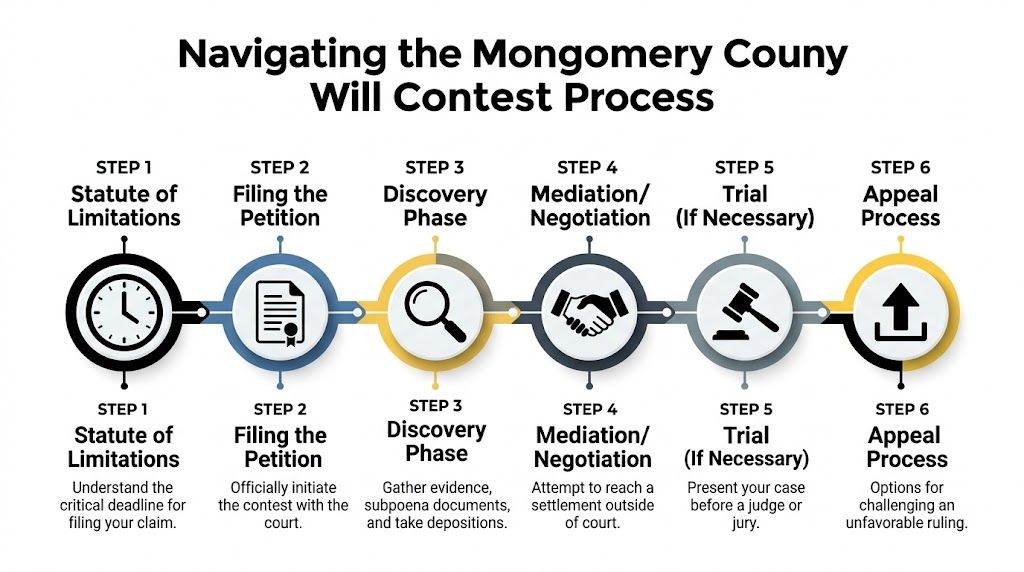
The filing window is not flexible
Under Texas Estates Code §256.204, a will contest generally must be filed within two years after the will is admitted to probate, and local Montgomery County reporting notes that only about 15 to 20% of filed contests succeed at trial because the proof burden is high, as summarized in this will contest overview discussing Texas Estates Code §256.204.
That doesn't mean you should wait anywhere near that long.
Early filing matters because records are easier to secure, witnesses remember more, and the estate may still be in a posture where practical relief is possible. Delay makes good cases harder. It also gives the opposing side time to shape the narrative.
How a case gets into court
A will contest begins with a petition filed in the proper probate court. That pleading identifies the parties, explains your standing, states the legal grounds, and asks for relief. If you're trying to understand what lawyers think about when drafting pleadings, a plain-language resource on how to draft a legal complaint can help you see why facts, claims, and requested relief must line up from the start.
You also have to establish that you have standing. In plain English, you must be legally affected by the will. Typical examples include an heir, a beneficiary under a prior will, or another interested person whose financial rights change depending on which document controls.
The executor and other required parties must then be formally served. Service is not just mailing someone a copy out of courtesy. It is the formal notice process that brings parties into the case and starts response deadlines.
For readers dealing with the broader probate side of the estate, this overview of how to probate a will in The Woodlands helps put the contest into the larger court process.
Discovery is where cases are won or lost
After the pleadings, the case moves into discovery. This is the evidence-gathering phase. Discovery isn't dramatic in the television sense. It's methodical.
A probate litigator may request:
- Medical records to show cognitive decline, dementia, delusion, medication effects, or timing problems around execution.
- Attorney files from the lawyer who prepared the will, including notes about meetings, instructions, and witnesses.
- Financial records to identify unusual transfers, joint account changes, beneficiary changes, or a sudden dependency relationship.
- Texts, emails, and letters that show pressure, isolation, or suspicious coordination around the new will.
- Depositions of witnesses, caregivers, relatives, doctors, and the drafting attorney.
Mediation is common for a reason
Most families assume the dispute is headed straight to trial. In reality, many probate contests resolve in mediation or negotiated settlement once both sides see the strengths and weaknesses of the evidence.
Mediation can work because probate cases often involve layered risks. One side may worry about proving undue influence. The other may worry about damaging testimony from a doctor, neighbor, or drafting witness. Settlement gives families more control than a trial does.
In Montgomery County probate litigation, the strongest leverage usually comes after enough discovery has exposed the facts, but before trial costs and family damage escalate further.
Trial is the fallback, not the goal
If the case doesn't settle, the court decides whether the evidence is enough to invalidate the will or uphold it. Trial requires disciplined proof. Speculation, suspicion, and broad accusations won't carry the day. The side bringing the contest needs admissible evidence tied tightly to the legal ground asserted.
An appeal may follow if the losing side believes the court made a reversible legal error. But appeals are not a do-over on facts. They are narrower, slower, and expensive.
Building Your Case Evidence and Proof
Most families ask the same question once the anger settles. What proof do we need?
The answer depends on the legal ground, but strong will contest cases almost always combine several kinds of evidence instead of relying on one dramatic fact.
Medical proof
Medical records often become the backbone of a capacity case. Hospital notes, neurology evaluations, memory testing, medication lists, and hospice records can help establish whether the decedent could understand the nature of the act at the time the will was signed.
This doesn't mean every diagnosis defeats a will. It means the timeline matters. If the chart shows severe confusion, delusions, or major cognitive impairment near the signing date, that can become important evidence.
Financial and communication evidence
Undue influence often leaves a paper trail even when nobody admits pressure happened. Bank statements may show unusual transfers. Changes to account access may show new control by a caregiver or relative. Emails and texts can reveal isolation, coaching, or efforts to keep certain family members away.
Sometimes the strongest evidence is ordinary. A calendar showing who drove the decedent to the lawyer's office. A message saying, "Don't tell your sister yet." A pattern of blocked contact in the final months. None of those facts alone decides the case, but together they can tell a coherent story.
For families handling the administration side while also investigating a dispute, this page on estate administration in The Woodlands, TX helps explain how records and inventories fit into the larger estate process.
Witnesses matter more than most people expect
A will contest isn't built only from documents. Witnesses often make the evidence understandable to the court.
Useful witnesses may include:
- Neighbors who saw isolation, confusion, or sudden control by a new person
- Friends from church or community groups who noticed personality shifts or unusual restrictions on access
- Healthcare providers who can explain observed mental condition close to signing
- The drafting attorney and signing witnesses who can describe what happened during execution
A witness doesn't have to be dramatic to be credible. In fact, neutral witnesses often carry more weight than angry relatives.
Later in the proof process, formal testimony becomes critical:
Experts turn suspicion into admissible opinion
According to this discussion of will contest preparation and settlement patterns, aggressive witness and expert opinion development matters because video-recorded depositions can capture non-verbal cues that juries find persuasive, medical capacity assessments can prove dementia at signing, and 90 to 97% of litigated cases settle before trial.
That figure doesn't mean settlement is automatic. It means preparation improves one's position.
Experts may include:
- Neurologists or psychiatrists who review records and explain whether the decedent likely had testamentary capacity
- Handwriting examiners in forgery disputes
- Forensic accountants who track suspicious transfers or dependence patterns
- Experienced probate litigators who know how to package those opinions into admissible, useful proof
Strong probate cases don't rely on one shocking accusation. They rely on records, witnesses, and expert opinions that point in the same direction.
What to Expect The Timeline and Costs
Families usually want a simple answer on timing. There isn't one.
Some will contests resolve relatively early because the evidence pushes both sides toward settlement. Others drag through months of record collection, depositions, motion practice, and mediation. A case that goes all the way to trial can take much longer than families expect, especially if the estate is large or the relationships are severely damaged.
A realistic Montgomery County scenario
A Panther Creek family learns that their uncle's final will leaves most of his estate to a person who had recently become heavily involved in his daily life. The family believes he was isolated and confused near the end. They don't file based on rumor alone. They gather prior estate documents, identify the probate case, preserve messages, and push quickly for records.
The case doesn't resolve immediately. The other side insists the uncle knew exactly what he was doing. Discovery reveals conflicting stories about who arranged the lawyer meeting and who was present around the signing. Medical records and witness testimony sharpen the dispute. The matter eventually settles in mediation rather than going through a full trial.
That is a common pattern. Not because every case settles, but because pressure changes once both sides see what the evidence can prove.
The money question
Texas probate litigation is expensive. Based on this Texas probate court contest outcomes overview, attorney retainers typically range from $15,000 to $25,000, hourly rates commonly range from $250 to $600, and expert witnesses often cost $2,000 to $5,000 per engagement.
Those aren't scare numbers. They're planning numbers.
On top of lawyer time, families may face filing fees, service costs, deposition expenses, medical record fees, mediation charges, and expert review costs. In a contested estate, legal spend can become a major strategic issue. Before filing, a good lawyer should help you compare likely cost against the value of the claim, the quality of the evidence, and the emotional cost of prolonged litigation.
Fee structures and trade-offs
Not every firm handles fees the same way. Here are the practical differences.
- Hourly billing works when the facts are disputed and the amount of work is unpredictable. It gives flexibility but can be hard for families to budget.
- Retainer plus hourly is common in probate litigation. The retainer funds the first phase of the work, and fees are billed against it.
- Contingency arrangements may be available in some disputed inheritance matters, but not in every case. Whether that structure is offered usually depends on the claim strength, recoverable assets, and collectability.
The cheapest option isn't always the least expensive in the long run. A lawyer who misses a record request, fails to secure a witness, or enters mediation without a proof strategy can waste far more than they save.
Time pressure isn't just emotional
Delay affects more than family stress. It can affect the evidence itself.
Witnesses move. Caregivers change jobs. Digital records vanish. Memory gets softer around details like dates, conversations, and who was in the room. In probate litigation, speed is not about panic. It's about preservation.
How to Choose the Right Will Contest Lawyer in The Woodlands
A will contest is not routine estate planning. It is litigation. That distinction matters when you're deciding who should represent you.
Some lawyers are excellent at drafting wills and managing uncontested probate but don't spend much time taking depositions, fighting over records, preparing witnesses, or trying disputed matters. If your case involves allegations like undue influence, fraud, or incapacity, you need someone who is comfortable building a record for court.
Local probate experience matters
Montgomery County probate practice has its own rhythm. A lawyer who regularly handles local cases is more likely to understand filing expectations, hearing practice, and what kind of evidence tends to move the case forward rather than sideways.
That doesn't mean local counsel can guarantee results. Nobody can. It means they are less likely to waste time learning the forum while your deadline runs.
If you're comparing options, one place to start is a lawyer who regularly handles contested probate matters in this area, such as a probate attorney in The Woodlands, Texas. The Law Office of Bryan Fagan is one local option for families dealing with probate disputes in Montgomery County.
Questions to ask in a consultation
Bring questions that test judgment, not just friendliness.
- How often do you handle contested probate matters? You want litigation experience, not general estate planning only.
- What would you need to see before recommending a contest? A thoughtful lawyer should talk about evidence, standing, timing, and cost.
- What is the likely first move in my case? The answer should sound specific, such as securing records, reviewing prior wills, or evaluating the probate file.
- How do you handle mediation? Since many disputes resolve short of trial, settlement strategy matters.
- How are fees structured? Ask for a clear explanation of retainer use, hourly rates, and expected outside costs.
- Who will do the work? Find out whether the lawyer you meet will personally handle the case or pass it down immediately.
Warning signs
A few responses should make you cautious.
If a lawyer promises a fast win before reviewing the will, the probate filings, and the evidence, that promise isn't worth much.
You should also be careful if a lawyer dismisses standing issues, talks only about your anger but not your proof, or can't explain how a Montgomery County contest usually unfolds in practice.
The right lawyer won't make the situation feel easy. They will make it feel organized.
Frequently Asked Questions About Will Contests
Can I challenge a will if it has a no-contest clause
Maybe. A no-contest clause, sometimes called an in terrorem clause, is designed to discourage beneficiaries from filing challenges by threatening forfeiture if they contest the will and lose.
Whether that clause applies depends on the language of the document and the facts of the case. Texas law can protect a person who acts in good faith and with probable cause, but that analysis is very case-specific. Before filing, your lawyer should review the clause itself, your status under the will, and whether your evidence is strong enough to justify the risk.
What happens if I contest the will and lose
The answer depends on the claims asserted, the fee arrangement, and what the court orders. At a minimum, you may still be responsible for your own legal fees and litigation expenses. In some situations, a failed contest can also worsen family relationships and delay estate administration without changing the result.
That doesn't mean a contest should be avoided whenever risk exists. It means the case should be screened candidly at the beginning. A hard conversation before filing is far cheaper than a hard lesson after trial.
My parent's will says nothing about crypto, online accounts, or other digital assets
This issue is getting more important in The Woodlands. Under Texas Estates Code §205, digital assets now have a defined legal framework, and this probate litigation discussion involving digital assets notes that 70% of contested wills overlook them and that Montgomery County probate cases involving digital assets have increased by 25%.
That matters because a will contest may involve more than a house, bank account, and brokerage statement. It may also involve cryptocurrency, cloud storage, email accounts, online business records, photo archives, and platform-based financial assets. If the estate plan didn't address access rights clearly, the executor may have to work through platform rules, fiduciary authority questions, and court procedures before those assets can be identified and transferred.
What should I do before I call a lawyer
Do three things first.
- Collect documents such as the will, prior wills, probate notices, letters from the court, and anything showing recent changes.
- Preserve communications including texts, emails, voicemails, and calendar entries.
- Write a timeline while your memory is fresh. Include names, dates, health changes, living arrangements, and who had access to your loved one.
If you're trying to evaluate how lawyers present themselves online while choosing counsel, even marketing-focused resources like strategies attorneys use to get clients can help you separate polished presentation from actual fit. In a will contest, substance matters more than slogans.
Is this article legal advice
No. This article is general information, not legal advice. Probate disputes turn on specific documents, facts, deadlines, and court filings. You should not rely on general online content as a substitute for getting advice about your own case from a Texas probate lawyer.
What to do next
- Get the probate file from Montgomery County if the case has already been opened.
- Identify your standing as an heir, beneficiary, or person affected by the disputed will.
- Preserve evidence early before records disappear or witnesses become harder to find.
- Ask for a candid case assessment focused on proof, timing, and cost.
- Avoid impulsive confrontation with the executor or other beneficiaries until your legal position is clear.
If you're dealing with a suspicious will, a sudden disinheritance, or questions about what happens next in Montgomery County probate court, a consultation can help you understand your options. The Law Office of Bryan Fagan works with families in The Woodlands and surrounding communities on probate and contested estate matters. Scheduling a consultation is a practical way to get clarity on deadlines, evidence, and the next step that makes sense for your situation.
