 Skip to content
A parent dies in The Woodlands. The funeral is over. Family has gone home. Then the practical questions start.
Who can deal with the house in Sterling Ridge? Who can access the bank account? What happens if there was no will?
That last fact changes everything. In Texas, when someone dies without a valid will, the estate is called intestate. The law doesn't let the family agree among themselves and move property around informally, especially when a home or land is involved. The court usually needs a legal way to identify the correct heirs.
For many local families, that legal tool is an heirship proceeding montgomery county case in probate court. It sounds technical, but the basic purpose is simple. The court builds an official family tree, confirms who inherits under Texas law, and signs an order that others can rely on.
Losing a Loved One in The Woodlands Without a Will
A common local situation looks like this. A mother living in Creekside passes away. She owned a home, had a checking account, and maybe a car in her name alone. Her children know who the family is, but the title company, the bank, and the county records office don't know that just because the family says so.

If she had left a valid will, the family might be looking at a different process, like the one described in this guide on how to probate a will in The Woodlands. But when there's no will, the question isn't “what did Mom want in writing?” It's “who does Texas law say inherits?”
Why families get stuck
People often assume the spouse automatically gets everything, or that children can sign a simple paper and transfer the house. Sometimes the law works close to that expectation. Sometimes it doesn't.
Texas inheritance rules depend on facts like:
- Marriage history: Was there a current spouse?
- Children: Were all children from that same marriage, or from different relationships?
- Property type: Was the property separate property or community property?
- Other relatives: If there is no spouse or child, the law may look to parents, siblings, or more distant family.
Texas Estates Code Chapter 201 governs intestate succession. In plain English, it provides the default inheritance rules when no valid will exists.
Losing someone is hard enough. Probate confusion usually starts when a family knows who their loved one was, but the legal system needs proof in a form the court can accept.
One short local example
A father in Alden Bridge dies without a will. He leaves a home and two adult children. One child lives nearby. The other lives out of state. Both agree on what should happen, but the house can't be sold cleanly until the legal heirs are formally identified.
That's where heirship enters the picture. It gives the family a court order they can use, instead of trying to piece together authority from conversations, text messages, or assumptions.
What an Heirship Proceeding Achieves in Montgomery County
Think of heirship as a court-supervised family tree investigation. The judge isn't deciding who seems most deserving. The court is deciding who legally inherits under Texas law because no valid will controls the estate.
In Montgomery County, an heirship case asks the court to identify the deceased person's heirs and their shares. The final product is usually a Judgment Declaring Heirship. That judgment becomes the legal roadmap for title companies, banks, and others handling estate property.
The main job of the case
An heirship proceeding montgomery county matter exists to answer a narrow but very important question: Who are the heirs under Texas law?
Once that question is answered by court order, the family has something official to rely on.
The goal is not to retell family history for its own sake. The goal is to legally identify the right heirs so property can be transferred correctly.
What the court is really checking
The court usually needs proof about the decedent's family relationships, including:
- Marital history: marriages, divorces, widowhood, or claimed informal marriage
- Children and descendants: biological children, adopted children, and whether any child died before the parent
- Parents and siblings: if there is no surviving spouse or descendant
- No will: evidence that the estate is intestate
Texas Estates Code § 202.001 addresses proceedings to declare heirship. Texas Estates Code Chapter 201 supplies the inheritance rules the judge applies once the family facts are proven.
How this differs from probating a will
People mix these two up all the time.
Probating a will means the court is asked to admit a written will and recognize the person named to act.
Heirship means there is no valid will controlling the estate, so the court must identify heirs through evidence of family lineage.
That difference matters because the evidence changes. In a will probate, the document does much of the work. In an heirship case, the family history does the work.
Why the judgment matters in real life
A Judgment Declaring Heirship can help clear the path for handling assets that were in the deceased person's sole name. That's especially important for a house in The Woodlands, Magnolia, or Conroe, where ownership records need to be clear.
A practical perspective:
- The death certificate shows the person died.
- The heirship judgment shows who legally steps into the picture as heirs.
- Other follow-up probate steps may still be needed, depending on the asset and the estate's circumstances.
Where people get confused
Many families hear the word “heirship” and think it means the court is distributing every asset right there in one sweep. Usually, it doesn't work that way. The heirship judgment identifies heirs. It may then support later acts involving title, administration, or transfer steps depending on the estate.
Practical rule: If there is no will and property is still in the deceased person's name, don't assume the family can sign around the problem. First determine whether a court order declaring heirship is needed.
Choosing the Right Path Heirship vs Other Options
A family in The Woodlands may know exactly who the children are and still choose the wrong probate tool. That happens because Texas offers several routes for an estate with no will, and each route solves a different problem. The key is matching the court process to the assets, the debts, and the family history.
In Montgomery County, that choice has a local angle. Probate matters are commonly handled through the county court system in Conroe, and the court's expectations often shape what is practical. General Texas articles can help, but families dealing with a house in The Woodlands or Magnolia usually need a plan that fits local practice and timing. A good starting point is this overview of the Montgomery County probate court process.
Probate Options in Montgomery County When There is No Will
| Method | When to Use | Key Limitation | Typical Complexity |
|---|---|---|---|
| Heirship proceeding | When the court must determine legal heirs in an intestate estate, especially if property title needs a clear court order | Requires proof of family history and court involvement | Moderate to high |
| Small Estate Affidavit | When the estate may qualify for a simplified Texas procedure for a smaller intestate estate | Not available for every estate, and title issues involving real property often limit usefulness | Lower, if it fits |
| Independent administration | When an administrator needs authority to handle the estate with less ongoing court supervision | Still requires appointment and proper legal basis | Moderate |
| Dependent administration | When greater court oversight is necessary, often because of complications or conflict | More court involvement in estate actions | High |
How to tell which option fits
A simple way to sort this out is to ask what problem needs solving.
If the main problem is, "Who legally inherited this property?", heirship is often the answer.
If the main problem is, "Who has authority to collect assets, pay debts, and sign documents for the estate?", some form of administration may be needed.
If the estate is small and the facts line up cleanly, a Small Estate Affidavit may be worth examining. But families often overestimate when that shortcut works. It can help in the right case, yet it does not fix every title problem involving real estate.
When heirship is usually the better path
Heirship often makes the most sense when the estate includes a house, land, mineral interests, or another asset that stays in the deceased person's sole name on paper. In that situation, the court is being asked to act like a family tree detective. The judge is not taking the family's word at face value. The court wants evidence that shows who the legal heirs are under Texas law.
This route is also common when the family history has bends in the road. Prior marriages, children from different relationships, a child who died before the parent, or uncertainty about relatives can all make informal solutions risky. Title companies and buyers tend to want a court order that clearly identifies the heirs.
When a Small Estate Affidavit may be considered
A Small Estate Affidavit can be useful in some intestate estates, especially when the estate is modest and the legal requirements are met. Families in Montgomery County often ask about it first because it sounds faster and less expensive.
The catch is practical, not just legal. A house in The Woodlands may be the family's biggest concern, and real property issues often make this option less helpful than people expect. Homestead status, liens, unpaid debts, and title questions can all change the analysis. A shortcut that works for a bank account may not work as cleanly for a home.
When administration should stay on the table
Some estates need more than a declaration of who the heirs are.
If bills need to be paid, claims need to be answered, property needs to be sold, or someone needs clear authority to act for the estate, administration may still be necessary. In a calmer case, independent administration is often the more workable route because it usually involves less court supervision after appointment. In a contested or debt-heavy case, dependent administration may be required, which usually means more court approval along the way.
That distinction matters in Montgomery County because additional court oversight often means more filings, more waiting, and more expense.
Four practical questions to ask before choosing
Is there real property still titled in the deceased person's name?
If yes, heirship becomes much more likely.Are there debts, lawsuits, or a need to sell property?
If yes, administration may need to be part of the plan.Is the family history simple and well documented?
If no, a formal heirship case is often safer than trying a shortcut.Does the estate appear small, with no major title complications?
If yes, a Small Estate Affidavit may be worth discussing with counsel.
A local way to think about it
For many Montgomery County families, the choice is less about speed and more about whether the result will hold up when it is time to deal with the house, the bank, or a future sale.
A Magnolia family with a straightforward family tree and one home may still need heirship because title clarity is the primary concern. A Conroe family dealing with debts and conflict may need heirship plus administration. Those are different problems, so they call for different tools.
The Montgomery County Heirship Process Step by Step
A common Montgomery County scenario goes like this. A parent in The Woodlands dies without a will, the house is still in that parent's name, and the family assumes they can just sign a few papers and move on. Then they learn the court needs a formal record of who the legal heirs are, and the process has its own local rhythm.
In Montgomery County, heirship matters are often handled in County Court at Law No. 2 in Conroe. That local practice matters more than many families expect. General Texas probate articles explain the rules, but they usually do not tell you how this court schedules heirship cases, when supporting paperwork needs to be ready, or why one missing family detail can delay a hearing.
For a local overview of filing flow and hearing expectations, many families start with this guide to the Montgomery County probate court process.
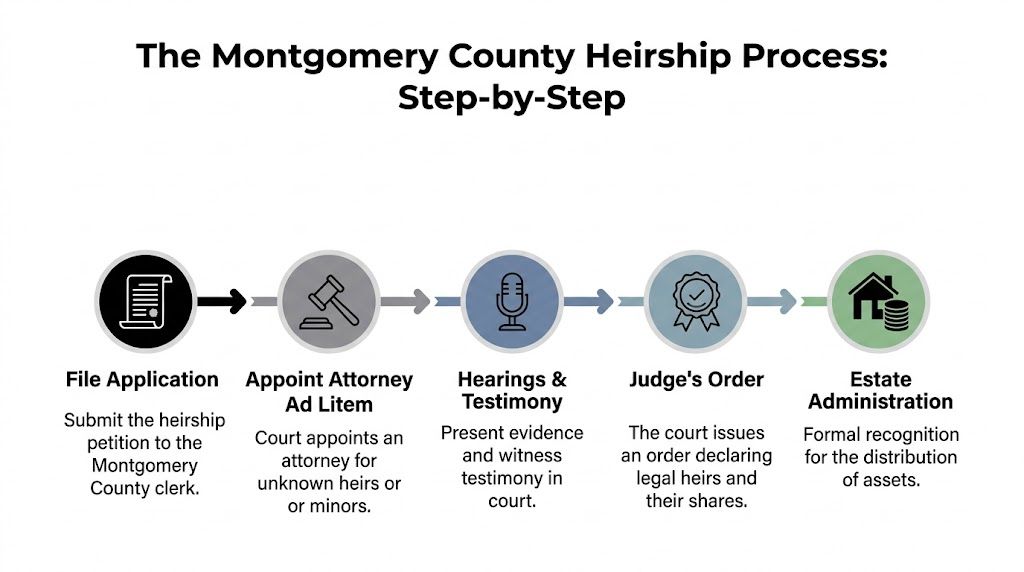
Step one, file the application
The case starts with an Application for Determination of Heirship. This asks the court to identify the legal heirs of a person who died without a valid will.
The application is more than a simple form. It is the roadmap for the case. It should lay out the decedent's family history clearly, including marriages, divorces, children, children from prior relationships, relatives who died earlier, and the basic estate facts. If the roadmap has missing roads, the court and the attorney ad litem will spend time trying to fill in the gaps later.
For Montgomery County families, that means it is often smarter to spend extra time getting the family history right before filing than to rush a half-complete application into court.
Step two, the court appoints an Attorney Ad Litem
This is the step that catches many families off guard.
In heirship proceedings, the court commonly appoints an Attorney Ad Litem. That lawyer does not represent the person who filed the case. The ad litem works for the court's process. The job is to investigate whether there could be unknown heirs, missing heirs, minors, or anyone else whose inheritance rights need protection.
A useful way to picture it is a family tree detective. Even if everyone in the family agrees about who belongs on the tree, the court still wants an independent person to test that story.
That extra layer is one reason a Montgomery County heirship case is more formal than families expect. The court is trying to produce a judgment that title companies, banks, and future buyers can rely on.
Step three, gather and present the proof
Texas Estates Code § 203.001 requires proof of heirship. In plain English, the judge needs reliable evidence showing how the family is connected and who survived the decedent.
That proof usually includes documents, sworn testimony, and information from people who know the family history. Common examples include:
- Death certificate
- Marriage and divorce records
- Birth and death information for children and other relatives
- Affidavits about family history
- Testimony from disinterested witnesses
The disinterested witness requirement causes confusion. A disinterested witness is someone who does not inherit from the estate but knows the family history well enough to testify about it. The court wants more than "the heirs say so." It wants neutral confirmation.
In practice, many delays originate at this stage. A missing divorce record, an uncertain common-law marriage claim, or an omitted child from a prior relationship can turn a simple case into a much slower one.
Step four, attend the hearing
Once the paperwork is filed and the required investigation is complete, the court sets the matter for hearing. In an uncontested case, the hearing is often focused and straightforward. The judge reviews the file, hears testimony, and checks whether the legal proof is in place.
County Court at Law No. 2 often handles heirship matters through an organized probate docket, which can help straightforward cases move efficiently when the file is complete. But "straightforward" has a very specific meaning in this setting. It usually means the family tree is clear, the witnesses are ready, the ad litem has finished the investigation, and no one has raised an objection.
For a family in The Woodlands, the practical lesson is simple. The hearing itself is usually not the hard part. Preparation is.
Step five, receive the Judgment Declaring Heirship
If the court is satisfied with the evidence, the judge signs a Judgment Declaring Heirship. This judgment identifies the heirs and states their shares under Texas intestacy law.
That order is the legal answer to the question, "Who inherited?" It does not always finish every estate task by itself, but it gives the family the court order they need to deal with title problems and related follow-up work. For example, if there is a house in The Woodlands still titled in the decedent's name, the judgment is often the foundation for the next step in clearing title.
What usually slows a Montgomery County heirship case
Three things tend to keep a case on track:
- A complete family history
- Prepared witnesses
- No dispute about relationships or heir status
Problems usually come from factual gaps, not courtroom drama.
Common examples include:
- Unknown or hard-to-locate heirs
- Prior marriages that were never fully documented
- Questions about divorce dates or whether a divorce was finalized
- Claims of common-law marriage
- Children from multiple relationships
- Property records that do not match the family's understanding
These issues matter in every Texas county, but they can feel especially frustrating in Montgomery County because families often expect an uncontested heirship case to move quickly. It often can, but only after the family tree and supporting proof are solid.
Good preparation gives the court a clean record to work from. That is what helps turn a confusing probate problem into a clear, usable judgment.
Required Evidence Documents and Costs
In Montgomery County heirship cases, the paperwork does two jobs at once. It tells the judge who belongs on the family tree, and it gives the court enough reliable detail to sign an order that other offices will respect later, especially when real property in The Woodlands is involved.
A useful way to approach this is to build the file like a family tree investigation. Start with the person who died, then trace outward by marriage, divorce, children, and any child who died earlier but left descendants. If one branch is missing, County Court at Law No. 2 may require more proof before the case can move to hearing.
The core document checklist
Start gathering records before anyone signs the application:
- Certified death certificate: The court and title companies usually want the official version, not a photocopy.
- Full names, addresses, and contact information for each heir: Include out-of-state relatives and anyone who may be difficult to reach.
- Marriage, divorce, and widowhood records: Dates matter. A missing divorce decree can create real confusion about who counts as a surviving spouse.
- Birth and death records for children and close relatives: These help prove each branch of the family line.
- Property records: Deeds, legal descriptions, tax statements, vehicle titles, and account statements help connect the heirship order to actual assets in Montgomery County.
- Older family records: Obituaries, funeral programs, family Bible entries, prior affidavits, and court papers can help fill gaps when formal records are incomplete.
What the court is really trying to verify
Texas Estates Code § 203.001 requires proof of heirship. In everyday terms, the court wants a clean, believable story about the family structure, supported by documents and witness testimony.
That usually means preparing a clear family tree exhibit that answers practical questions:
- Who was the decedent married to, and on what dates?
- Were there children from more than one relationship?
- Did any child die before the decedent?
- Did that child leave children of their own?
- If there was no spouse or child, which relatives come next under Texas intestacy law?
A strong file reads like an organized timeline. It should not feel like the family brought a box of unrelated papers to the courthouse.
The witness piece families often miss
Documents alone are often not enough. Heirship cases commonly require testimony or affidavits from two disinterested witnesses. These witnesses are not heirs. They are people who know the family history well enough to speak clearly about marriages, children, and other close relatives.
In Montgomery County, this point trips up families more often than they expect. A witness who only knows part of the story is like a neighbor who can describe one branch of the tree but not the trunk. Good options can include long-time family friends, clergy, former neighbors, or others who knew the decedent over time and can explain the family relationships with confidence.
Costs families should plan for
Costs vary, but families should usually expect several separate line items instead of one single probate bill.
Common expenses include:
- Court filing fees: These are set by the county and can change, so it is smart to confirm the current amount with the Montgomery County clerk before filing.
- Attorney ad litem fees: In heirship cases, the court appoints an attorney ad litem to investigate unknown heirs. That work is case-specific, so the cost depends on what the ad litem has to review or search for.
- Service, publication, or notice costs: These may apply if someone must be formally notified or if an unknown heir issue needs public notice.
- Your attorney's fees: These depend on the amount of family history work, document gathering, witness preparation, and whether any dispute develops.
- Certified copies and record retrieval costs: Usually smaller items, but they add up, especially if records must be ordered from multiple counties or states.
If the estate includes a house in The Woodlands, spending a little more time and money up front on correct names, dates, and property descriptions often saves far more later when the family tries to sell, refinance, or transfer title.
How preparation affects timing in Montgomery County
Local practice matters here. General Texas articles often make heirship sound like a standard form filing, but Montgomery County families usually see a faster path when the application is complete, the family tree is clear, and the disinterested witnesses are ready before the hearing is requested.
County Court at Law No. 2 can move an uncontested matter more efficiently than a case that starts with missing records and unanswered relationship questions. The delay usually comes from cleanup work. That may mean ordering an old divorce decree, locating a child from a prior relationship, or correcting property information so the final judgment can be utilized.
A careful filing is often the shorter route.
Getting help organizing the evidence
Many families benefit from having a probate lawyer sort the documents into a usable court file, identify gaps before filing, and prepare witnesses for the questions they are likely to hear in Montgomery County. If you want a local overview of that process, this Montgomery County probate lawyer resource explains probate help for families dealing with the county's procedures.
A Real World Scenario and Common Complications
A blended family often shows why heirship matters.
A man living near The Woodlands passes away without a will. He was married twice. He had one child from the first marriage, two children from the second, and he owned a home in his name. Everyone gets along well enough, but no one agrees on who legally owns what share of the house.

How heirship helps in that situation
An heirship case gives the court a chance to sort out the family structure under Texas intestacy rules. The question isn't who helped the most, or who lived closest, or who paid funeral expenses. The question is what the law says based on the decedent's spouse, children, and property character.
That can be especially important when separate property and community property issues overlap with children from different relationships. The judgment provides a formal answer everyone can work from.
The complication list families should expect
Some problems appear again and again in Montgomery County cases:
- An unknown heir appears: Someone mentions a child from an earlier relationship after filing.
- A marriage is disputed: The family disagrees about whether there was a valid marriage or divorce.
- Common-law marriage is claimed: That can require more proof than people expect.
- Witnesses are weak: The proposed witnesses don't really know the family history.
- Out-of-state relatives don't respond: Delay follows because paperwork and notice become harder.
- Title assumptions are wrong: The family thinks a house “just goes to the kids,” but title records and marital history tell a more complicated story.
The harder the family tree is to prove, the more valuable it becomes to slow down and verify every branch before the hearing.
A short video can also help make the process feel more concrete:
A practical warning
The biggest mistake I see neighbors make is acting before authority is clear. They clean out accounts, promise sale proceeds, or sign informal property agreements because everyone is trying to be reasonable.
That can create a much bigger mess later. If the court's heirship finding doesn't match the family's assumptions, undoing those early decisions becomes expensive and emotional.
Conclusion Your Next Steps in Montgomery County
If you're dealing with an heirship proceeding montgomery county issue, the process is formal but manageable when you break it into pieces. The court needs a reliable family history, proper filings, and credible proof. Families in The Woodlands usually do better when they gather facts first and make no moves with property until the legal path is clear.
What to do next
- Get the death certificate: You'll need it early.
- Build a draft family tree: Include every marriage, child, and predeceased relative you know about.
- Gather documents: Birth, death, marriage, divorce, deeds, and account records.
- Identify neutral witnesses: Look for two people who know the family history and are not heirs.
- Do not transfer property prematurely: Wait until the correct probate path is confirmed.
- Ask about related support needs: If an aging parent or caregiving situation is part of the picture, broader resources on senior citizen legal assistance may also be helpful.
This article is for general educational information only. It is not legal advice and does not create an attorney-client relationship. Probate facts vary from one family to another, especially with blended families, real property, and disputed relationships.
If you live in The Woodlands, Conroe, Magnolia, or another Montgomery County community, a local probate consultation can help you choose the right path before mistakes get expensive.
If you want guidance customized to your family, you can schedule a consultation with The Law Office of Bryan Fagan.
