 Skip to content
If you're searching for removing executor montgomery county texas, you're probably already past the point of mild concern. A parent died. An estate was opened. Someone was put in charge. And now the person who is supposed to protect the estate isn't answering questions, isn't sharing records, or isn't doing the basic work that probate requires.
That situation is common in The Woodlands and across Montgomery County. What starts as grief often turns into suspicion, then anger, then a practical problem. Bills go unpaid. Property sits unattended. Family members start accusing each other of hiding money or dragging their feet on purpose.
Sometimes the executor is overwhelmed. Sometimes the executor has a conflict that makes fair administration impossible. Sometimes the probate case becomes a second battlefield because the family already has divorce, custody, or property disputes in the background. If that sounds familiar, it helps to understand that Texas law gives beneficiaries and other interested parties a formal way to ask the court to step in. Probate is not supposed to run on trust alone.
When Trust Breaks Down in a Texas Probate
A beneficiary in The Woodlands might notice the trouble in small ways first. The executor stops returning calls. A house sits vacant and starts to deteriorate. Questions about bank accounts get brushed off. Nobody can explain why months have gone by with little visible progress.
Those details matter because probate puts real authority in the executor's hands. That person may control access to property, financial records, and communications with the court. If the executor is doing the job properly, that structure keeps the estate moving. If the executor isn't, the same structure can leave beneficiaries feeling stuck and shut out.
Montgomery County families often deal with this while other family tensions are already active. A second marriage, a recent divorce, adult children from different relationships, or an ex-spouse serving in a fiduciary role can turn an estate administration problem into a broader family dispute. In those cases, the probate file rarely tells the whole story.
For many families, the first practical question isn't whether the executor has become difficult. It's whether the problem is serious enough for court action. Removal is possible, but it isn't a tool for settling old family grievances. It is a legal remedy for a probate problem.
Practical rule: A judge won't remove an executor because the family relationship has broken down. The court wants proof that the executor's conduct threatens the estate, the beneficiaries, or the probate process.
That distinction is important. A beneficiary may feel disrespected, excluded, or manipulated and still not have a removal case. On the other hand, missed legal duties, poor recordkeeping, noncompliance with the Estates Code, and conflicts of interest can justify intervention.
Estate administration in this county also has local rhythms. The court expects organization, documentation, and credible evidence. A generalized complaint that "something feels wrong" usually doesn't move the case. A documented timeline does. If you're trying to understand what proper administration should look like, this overview of estate administration in The Woodlands is a useful baseline.
A common scenario looks like this. A father dies owning a home in The Woodlands, a checking account, and a brokerage account. He named one adult child as executor. The executor had a difficult history with a sibling and was also in a dispute with an ex-spouse over unrelated family matters. Months pass. The sibling asks for updates and gets silence. The home isn't maintained. No useful accounting is provided. What started as distrust becomes a probate issue because the estate is no longer being handled in a way that protects everyone involved.
Valid Legal Grounds for Removing an Executor
A judge in Montgomery County will remove an executor for legally recognized misconduct or inability, not because the family has reached a breaking point. The controlling standards come from the Texas Estates Code, including Sections 404.003 and 404.0035, and they are summarized in this Texas executor removal guide. In practice, the question is straightforward. Has this executor failed badly enough, or become conflicted enough, that the estate is no longer being protected?
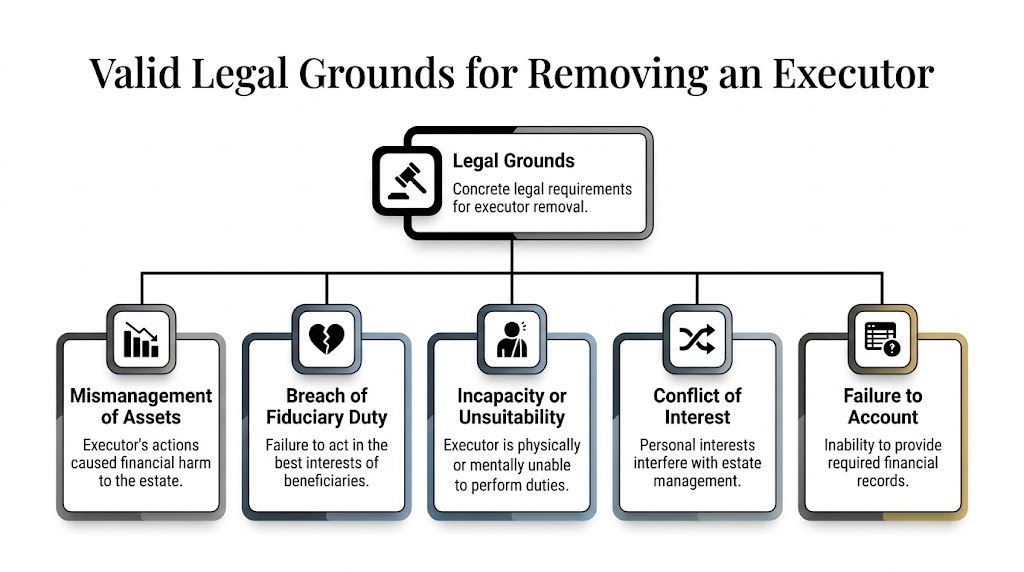
Mismanagement and gross misconduct
Mismanagement usually shows up in ordinary estate tasks that were handled carelessly or not handled at all. I often see this with real property. A house in The Woodlands sits vacant, insurance is not kept current, mail piles up, taxes are ignored, and the executor still insists everything is under control.
That kind of neglect can justify removal if the estate is exposed to loss.
Gross misconduct is more serious. It points to conduct that shows a clear breach of fiduciary duty, such as knowingly disregarding obligations, concealing important information, or allowing estate assets to deteriorate without a reasonable explanation. Judges understand that administration can be messy after a death. They pay close attention when the mess starts costing the estate money.
Embezzlement and self-dealing
Using estate money for personal purposes is a classic removal ground. So is steering estate property to yourself, your spouse, or an ally on terms that do not benefit the estate.
These cases are not always obvious at first. Sometimes the warning signs are smaller. Unexplained withdrawals. Missing deposit records. Reimbursement claims with no receipts. A vehicle sold to a relative for less than market value.
In blended-family cases, the explanation is often emotional rather than legal. One child says a parent promised the asset. An ex-spouse says everyone understood the arrangement. Probate court still expects records. If the executor cannot support the transaction, the problem quickly becomes larger than a family disagreement.
Failure to perform required duties
Some executors are removed because they do not do the job. The law expects action. That includes protecting assets, responding when an accounting is properly requested, dealing with creditors, and meeting filing requirements imposed by the court and the Estates Code.
One recurring issue is the inventory, appraisement, and list of claims. An independent executor generally must file it within 90 days after receiving letters testamentary unless the court grants relief or another procedure applies. Another common issue is failure to provide an accounting after a proper demand. If the executor ignores these duties long enough, the court may decide the administration cannot continue under that person's control.
Good records matter here. Beneficiaries who want to challenge delay should also understand how to properly manage evidence, because a removal request is only as strong as the documents behind it.
Material conflict of interest
This ground matters in The Woodlands more often than many articles admit. Probate fights here frequently overlap with divorce history, second marriages, reimbursement claims, adult-child disputes, and old property arguments that never really ended. That overlap can change how a judge sees the executor's judgment.
A conflict of interest becomes legally significant when the executor's personal position interferes with fair administration of the estate. For example, an executor who is also fighting a beneficiary over related property, support issues, or control of a family business may have trouble making neutral decisions about estate assets. The same concern can arise when an ex-spouse is serving in a fiduciary role while family court issues are still shaping the parties' incentives.
Family tension alone is not enough. The conflict must affect administration in a real way, such as delaying distributions, blocking access to information, influencing asset valuations, or favoring one side of a separate dispute.
Incapacity or unsuitability
Sometimes removal has nothing to do with dishonesty. The executor may be ill, overwhelmed, cognitively declining, or unable to keep up with basic estate responsibilities. In other cases, the problem is unsuitability. The person may be so disorganized, hostile, or unreliable that the estate cannot be managed safely.
These cases require judgment. Filing for removal against a grieving parent, sibling, or surviving spouse can intensify an already fragile family situation. Still, the court's obligation is to the estate. If the executor cannot carry out the role, keeping that person in place usually makes the damage harder and more expensive to fix later.
A common Montgomery County pattern
A familiar case starts with an executor who does just enough to open probate and then stalls. No useful accounting is produced. Estate property sits unattended. Beneficiaries hear excuses, but there is no paper trail showing real progress. In one family, the underlying pressure may come from a pending custody fight, a remarriage, or years of conflict after a divorce. Those family law dynamics do not replace probate proof, but they often explain why the executor stopped acting like a fiduciary and started acting like an adversary.
That is the point where removal becomes a practical remedy, not just a threat.
Gathering Evidence and Building Your Case
A probate judge in Montgomery County doesn't act on suspicion. The court acts on documents, timelines, and testimony that line up. If you're considering removing an executor, the work starts before any motion is filed.

Start with a timeline
Write down what happened and when. Keep it plain. Dates of death, probate filings, requests for information, unanswered emails, property issues, and unusual financial activity should all go on one timeline.
A good timeline does two things. It helps your lawyer see the case quickly, and it helps the judge understand whether the executor made an isolated mistake or allowed a serious pattern to develop.
If family law litigation is also happening, add those dates too. The overlap may matter if the executor's conduct in one case sheds light on motives or conflicts in the probate case.
Match the proof to the complaint
Not all concerns are proven the same way. If you're claiming financial mismanagement, gather financial records. If you're claiming failure to communicate, preserve written requests and responses. If you're claiming neglect of real property, photographs, repair invoices, insurance records, and tax notices may matter more than a stack of angry emails.
Here is a practical way of understanding it:
| Concern | Useful proof |
|---|---|
| Missing estate money | bank statements, withdrawal records, cancelled checks, transfer records |
| Failure to maintain property | photos, insurance notices, tax notices, repair estimates, HOA letters |
| Refusal to account | written requests, certified mail receipts, emails, text messages |
| Undisclosed transactions | deeds, sales documents, account statements, closing records |
| Conflict of interest | pleadings from related cases, sworn statements, contradictory positions |
Create a paper trail before emotions take over
Beneficiaries often call, text, and argue informally for months. That usually doesn't help. Once you suspect a genuine probate problem, move your requests into writing and keep copies.
Use concise requests. Ask for specific records. Ask for a response by a reasonable date. If the executor ignores the request, that silence becomes part of the record.
Keep this in mind: The strongest evidence packet usually looks boring. Organized dates, clean exhibits, and direct requests are more persuasive than emotional accusations.
The same principle appears in other compliance settings. This guide on how to properly manage evidence is not probate-specific, but its core lesson is useful: evidence carries more weight when it's preserved consistently, labeled clearly, and tied to a specific issue.
What helps and what doesn't
Some things make a case stronger fast. Others waste time.
Helpful items include:
- Court documents: copies of the probate docket, issued letters, filed inventories, or the absence of required filings.
- Financial records: statements that show unexplained movement of money or accounts left unmanaged.
- Neutral third-party records: tax notices, bank correspondence, title records, appraisals, insurance notices.
- Photographs with context: especially when estate property has deteriorated or been emptied.
- Written communications: emails and letters usually carry more weight than "he told me over the phone."
Less helpful items include:
- General family history: old resentment may explain the conflict, but it doesn't prove probate misconduct.
- Speculation: statements like "I know she's hiding something" rarely move a judge.
- Massive unorganized files: more paper doesn't mean better proof.
- Secret recordings or surveillance ideas: these can create separate legal problems and often distract from the cleanest evidence.
If the executor's role overlaps with a divorce, custody matter, or post-divorce property fight, don't assume the probate judge will automatically know what happened in the other court. Those records need to be obtained and used properly. Coordination matters.
The Removal Process in Montgomery County Probate Court
A common pattern in The Woodlands looks like this. A parent dies, one child is serving as executor, and an old divorce, remarriage, or post-divorce property dispute is still shaping who trusts whom. By the time the probate fight reaches Conroe, the legal issue is removal, but the pressure driving it often started in family court. That matters because Montgomery County probate judges focus on estate administration, not on sorting out every grievance from the marriage or custody history behind it.
Executor removal requests in Montgomery County are usually heard in Probate Court at Law No. 1 in Conroe. The person asking for relief must usually be an interested person and file a Verified Motion to Remove, which means the motion is sworn under oath. Filing fees, service costs, and timing can change, but one local overview describes an approximate $300 filing fee, about $100 for personal service, and a process that often takes 4 to 6 months in contested matters, as explained in this Montgomery County executor removal overview.
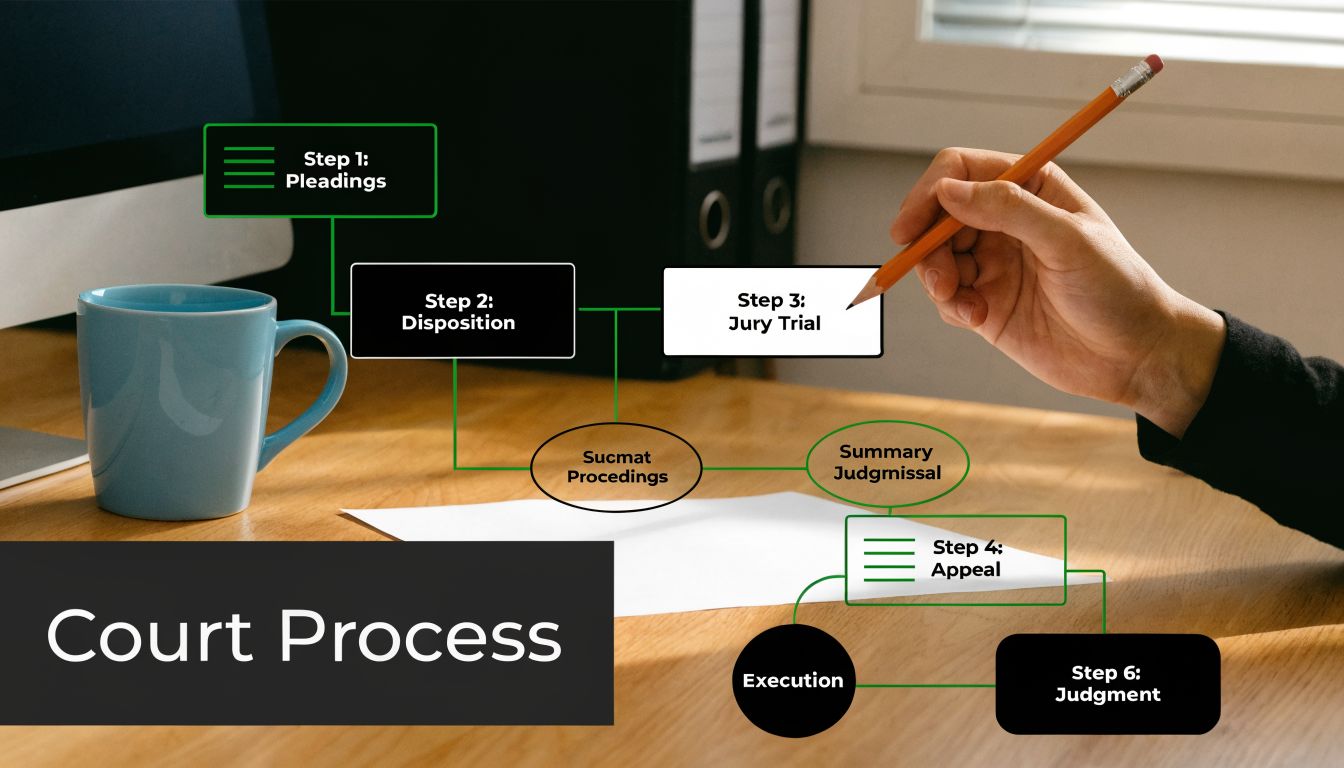
Step one is a sworn motion that stays tied to probate law
A verified motion is more than a complaint with attachments. It should tell the court who you are, why you have standing, what the executor did or failed to do, and which section of the Texas Estates Code supports removal.
That level of discipline matters in Montgomery County. Judges regularly see filings fueled by family mistrust, especially where a second marriage, stepchildren, a prior divorce decree, or disputed separate property is in the background. A motion gets more traction when it gives the court a probate problem it can solve, not a family history it cannot.
For a practical look at how filings, settings, and hearings generally move through Conroe, this guide to the Montgomery County probate court process is a useful starting point.
Step two is proper service and notice
After filing, the executor has to be served correctly unless the facts support emergency action without the usual timetable. Service is a due process issue. If notice is defective, the court may delay the hearing or require the process to start over.
I see this mistake often with self-represented beneficiaries. They assume filing puts the matter in front of the judge automatically. It does not. The court can only act cleanly when the procedural steps are done correctly.
Step three is a focused hearing
The hearing is usually less dramatic than families expect. In many cases, the judge is sorting through a short list of practical questions that determine whether removal is justified and whether the estate can keep functioning afterward.
Typical questions include:
- What legal ground for removal is being alleged
- What admissible proof supports that ground
- Whether the estate has been harmed, delayed, or exposed to real risk
- Whether removal is the right remedy under these facts
- Who should manage the estate if the current executor is removed
Good preparation shows up here. The stronger cases present a timeline, marked exhibits, and testimony that stays on point. They do not rely on speeches about who has been unfair for the last ten years.
Give the court an organized record. Dates, requests, responses, missing actions, and resulting harm should fit together without the judge having to guess.
Emergency relief exists, but judges expect specific proof
Some cases do justify quick action. Missing funds, threatened sales of estate property, destroyed records, or refusal to account for assets can create real urgency.
Even then, the court will want concrete facts. A judge is more likely to act quickly when the motion identifies a present risk to estate property and shows why ordinary notice or a later hearing will not protect the estate in time.
Local practical concerns in Montgomery County
Montgomery County courts usually care a great deal about keeping the estate functional while the dispute is pending. Removal can solve one problem and create another if nobody is ready to step in, records are incomplete, or estate property is tied up in related divorce or title issues.
That is why the best removal requests usually answer two questions at once. Why should this executor come out, and what workable plan replaces them? Sometimes the answer is a named successor. Sometimes it is a neutral administrator. In blended-family estates, that second option can calm the temperature when every proposed family member is viewed as partisan.
A contested removal also takes real effort. You may need bank records, title documents, prior court orders, testimony from third parties, and records from a divorce or SAPCR matter that the probate court has not seen. Families in The Woodlands are often surprised by this point. The probate case may look isolated on paper, but in practice, the family-law history often explains the incentives, the missing records, and the resistance to transparency. Handling that overlap well can change the outcome.
Defenses Alternatives and What Comes After
Not every bad probate situation ends with the executor being removed. Some executors defend themselves effectively. Some cases settle. Some judges decide that the problem is real but can be fixed without taking the executor out entirely.
Common defenses an executor may raise
Executors usually don't walk into court and admit failure. They explain. Sometimes those explanations are legitimate. Sometimes they are cover for disorganization.
A few defenses come up often:
- Delay caused by third parties: the executor may blame banks, appraisers, title problems, tax issues, or family members who refused access to property.
- Reasonable judgment call: the executor may argue that a challenged decision was a good-faith effort to protect value.
- No actual harm: even if the administration has been messy, the executor may claim the estate suffered no meaningful damage.
- Incomplete information from beneficiaries: in family fights, the executor may say the beneficiaries withheld records or created the conflict themselves.
Those defenses matter because removal is not automatic. If the executor can show that the estate is still being managed in a legally acceptable way, the judge may stop short of removal.
Alternatives to a full removal fight
Sometimes a focused pressure strategy works better than immediate litigation. That depends on the executor, the value of the estate, and how urgent the risk is.
Possible alternatives include:
Formal demand for information
A carefully drafted demand can force the issue and create a better record.Request for an accounting or other targeted relief
If the core problem is secrecy, this may be enough to expose whether the bigger concern is real.Negotiated resignation
Some executors know they are in over their heads and will step aside if the transition is handled respectfully.Bonding or other court oversight
When the court is not ready to remove the executor, it may still impose safeguards.
A strategic lawyer will usually assess whether the estate needs immediate surgery or whether a narrower order can protect the property without escalating the fight unnecessarily.
The best result is not always removal. The best result is the order that protects the estate fastest and with the least collateral damage.
What happens if the executor is removed
If the court grants removal, the administration does not disappear. Someone still has to gather assets, handle debts, communicate with beneficiaries, and finish the probate.
That next fiduciary may be a successor named under the will, a qualified person proposed by the parties, or a neutral administrator appointed by the court. The practical question becomes whether the estate can now be stabilized. Records have to be transferred. Authority has to be re-issued. In some cases, the successor must spend substantial time reconstructing what should have been done earlier.
This is one reason courts don't remove executors lightly. Removal solves one problem, but it also creates a transition that has to be managed carefully.
When to Hire a Montgomery County Probate Attorney
A beneficiary in The Woodlands often calls after months of trying to keep the peace. The executor has stopped answering questions, the house is sitting vacant, and a separate divorce or custody fight has already divided the family into camps. By that point, delay usually costs more than an early legal review.

Some probate problems can be fixed with a written request, better accounting, or a narrowly specific court order. Others need counsel from the start. If the executor is hostile, evasive, or entangled in related family litigation, handling it alone can box you into weak positions and make settlement harder later.
Red flags that usually call for counsel
You should seriously consider hiring a probate attorney if any of these facts are present:
- Money appears to be missing: unexplained withdrawals, shifting account balances, or transfers with no clear estate purpose.
- The executor refuses to produce records: repeated silence after reasonable written requests usually signals a bigger problem.
- Real property is at risk: a home, rental, or acreage in Montgomery County is being neglected, occupied without authority, or pushed toward a questionable sale.
- The estate includes a business, partnership interest, or other difficult asset: these cases require more than basic probate filing experience.
- Beneficiaries disagree about what happened: once the dispute turns into competing narratives, evidence and presentation matter.
- The executor is involved in another family dispute with someone connected to the estate: divorce, post-divorce enforcement, custody issues, or property division can affect both strategy and credibility.
The family law overlap that many articles miss
This issue comes up more often in The Woodlands than generic probate articles suggest. A former spouse may still be named in the will. An executor may also be litigating with a beneficiary over child support, possession, reimbursement, or enforcement of prior divorce orders. Facts from one case can spill into the other, and positions taken in one courtroom can damage the other.
That overlap matters because probate judges are not deciding these cases in a vacuum. If the executor claims one set of facts in family court and a different set in probate court, that inconsistency can affect credibility, settlement posture, and the court's view of conflict of interest. Standard probate guides often skip that point, even though executor removal can intersect with family litigation in exactly those ways, as discussed in this analysis of probate and family law overlap.
A coordinated strategy is usually better than two isolated fights. I have seen families spend money proving the right facts in the wrong court first.
Local representation changes the quality of the case
A removal case in Montgomery County is not won by citing the statute alone. It is won by presenting a clear record, a practical request, and evidence that stays focused on fiduciary conduct instead of old family grievances.
That distinction matters here. Judges in local probate matters see family tension all the time. What gets attention is organized proof: the missing records, the unanswered requests, the questionable transaction, the property condition, the conflict that affects administration. A lawyer who understands both probate and family law can often spot which facts belong in the removal case and which facts only create noise.
Some families start with a general civil lawyer. Others go straight to probate counsel. Others need a firm that can handle the probate dispute and the related family court issues at the same time. The Law Office of Bryan Fagan is one option for families dealing with contested probate matters in this area, especially when the dispute overlaps with divorce or other family court proceedings. If you are comparing local counsel, this page about a probate attorney in The Woodlands, Texas is a useful starting point.
What to do next
If you are worried about an executor, do these things now:
- Collect the court papers: get the will, letters testamentary, inventories, notices, and anything filed in the probate record.
- Build a working timeline: note missed deadlines, unanswered requests, property problems, and suspicious transactions.
- Put requests in writing: ask for records and updates clearly, then keep every response.
- Preserve related evidence: save photos, bank records, emails, texts, notices, and family court filings if the disputes overlap.
- Avoid emotional confrontations: they rarely improve access to information and often create new problems.
- Get legal advice before filing anything: a poorly drafted motion can limit your options and hand the executor easy defenses.
This article is not legal advice. Probate disputes depend on the will, the court record, the estate assets, and the conduct involved. Reading an article cannot replace a lawyer's review of the documents and the timeline.
If you are dealing with a probate dispute in The Woodlands or elsewhere in Montgomery County, The Law Office of Bryan Fagan can review the facts, assess whether removal is realistic, and help you choose the next step. A consultation may show that the right move is a demand for records, a request for limited court supervision, or a formal removal action.
