
You’re holding a will, fielding texts from family, and trying to figure out what “executor” means. That’s a hard place to be, especially when you’re also grieving.
For many families in The Woodlands, the first fear is that probate will turn into a legal maze. In reality, estate administration is a structured process. It has deadlines, paperwork, and court steps, but it also has a purpose. It gives someone legal authority to gather property, pay valid debts, and carry out a loved one’s wishes.
A common local example is a son or daughter in Alden Bridge or Creekside Park who finds out they’ve been named executor in a parent’s will. They may know where the house key is, but not where the deed, account statements, or beneficiary records are. They may worry that one wrong move could create personal liability. That concern is normal.
If that’s where you are, this guide is meant to slow the process down and make it understandable. It focuses on estate administration the woodlands tx, with practical context for Montgomery County families and the Texas probate system. If you need a broader starting point on local probate representation, you can review this page about a probate attorney in The Woodlands, Texas.
This article is for informational purposes only. It is not legal advice and does not create an attorney-client relationship. Probate outcomes depend on the will, the assets, the family situation, and the court involved.
A Guide for Families in The Woodlands After a Loss
The first days after a loss usually feel scattered. You may be planning a service, answering questions from relatives, and looking through drawers for documents all at once. Then someone asks, “Have you started probate yet?” That question often lands before a family is ready.
In Montgomery County, estate administration usually starts with a simple question. Did the person leave a valid will? If the answer is yes, the next question is whether that will names an executor and whether the executor is ready to serve. If the answer is no, the court process changes, and the estate may need an administrator instead.
What families usually misunderstand first
It's often assumed that being an executor means “I get control over everything immediately.” That’s not quite right. In Texas, your authority usually begins after the probate court admits the will and issues the proper letters, often Letters Testamentary.
Until then, your job is mostly protective, not distributive. You secure property, locate papers, identify urgent issues, and avoid actions that could create confusion.
Practical rule: Don’t start giving away property, closing accounts, or signing sale documents just because the will names you as executor.
That restraint matters in The Woodlands, where estates often include a home, investment accounts, business interests, or family property with emotional value. One sibling may assume the will settles everything immediately. Another may think probate can be skipped entirely. Often, neither is correct.
What estate administration is trying to accomplish
At its core, the process is meant to do three things:
- Identify property so the estate knows what exists
- Resolve obligations such as valid debts, taxes, and claims
- Transfer what remains to the right beneficiaries or heirs under Texas law
Texas law supplies the framework, mainly through the Texas Estates Code. In some cases, related family issues can also overlap with probate, such as guardianship concerns involving minor children or property questions affecting surviving spouses. When those issues touch family relationships, the Texas Family Code may also matter.
For now, the key point is simple. You do not have to solve everything at once. You need to take the next correct step.
What Estate Administration Really Means in Texas
Think of estate administration as the orderly closing of a person’s financial life. If someone owned a home, had bank accounts, paid bills, filed taxes, and signed contracts, those matters don’t disappear when they die. Someone has to step in, identify what exists, and bring order to it.
In Texas, that process is governed by the Texas Estates Code. The court’s role is to confirm who has authority, protect creditors and beneficiaries, and create a clean legal path for transferring property. That matters most when title to a house, access to funds, or responsibility for debts is unclear.

Why this matters more in The Woodlands
The local setting changes the practical stakes. In The Woodlands, there is $32.1 billion in total assessed property value, a 72.5% homeownership rate, and median property values of $511,700 in 2024, according to Data USA’s profile for The Woodlands. When estates include high-value homes and other significant assets, paperwork mistakes become more expensive and family disagreements become more likely.
That’s why probate in this area often feels less like “filing a few forms” and more like managing a small business shutdown. You may need to identify the homestead, separate probate and non-probate assets, preserve records, and make sure title transfers happen correctly.
If you want a plain-language overview before diving deeper, this explanation of What Is Probate And How Does It Work is a useful companion resource.
What the executor actually does
An executor’s responsibilities usually include tasks like these:
- Secure the home and records. Change locks if needed, preserve mail, and gather financial statements.
- Open an estate process with the court. That starts the formal probate case if probate is needed.
- Collect and value assets. Real estate, accounts, vehicles, business interests, and personal property all need to be identified.
- Handle debts and taxes. The executor deals with valid claims and tax filings before making distributions.
- Distribute property correctly. The will controls when valid, but some assets may pass outside the will.
Some assets never become part of the probate estate. A bank account with a payable-on-death beneficiary, a properly funded trust, or jointly owned property may transfer by operation of law. Other assets do require court-backed authority to move cleanly.
Probate isn’t about taking property away from families. It’s about giving the right person legal authority to handle property the right way.
Why the court is involved at all
Families often ask, “If everyone agrees, why do we need probate?” The answer is title and authority. A title company, bank, transfer agent, or buyer usually wants proof that the person signing has authority to act for the estate.
That’s especially true with real estate. A house in The Woodlands may be the largest asset in the estate. Without proper probate steps, selling it, refinancing it, or retitling it can become difficult.
So when people refer to estate administration the woodlands tx, they’re usually talking about more than filing a will. They mean the practical work of bringing legal, financial, and family issues into alignment under Texas law.
Independent vs Dependent Administration The Key Choice
For many Montgomery County estates, the biggest decision is not whether probate exists. It’s what type of probate administration applies.
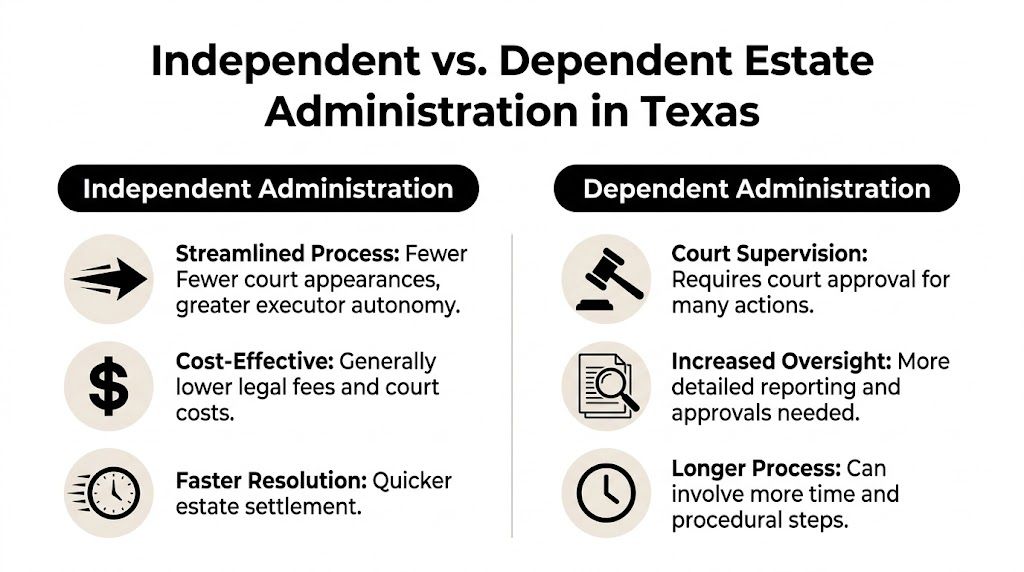
Texas offers two main paths. Independent administration is usually the smoother route. Dependent administration involves more court supervision and more procedural friction. The difference can affect cost, stress, and how long the estate stays open.
Why independent administration is usually preferred
Under the Texas Estates Code, independent administration lets the executor act with minimal court oversight. According to Texas Law Help’s estate administration overview, this path can close 40% to 60% faster than dependent administration. The same source notes that avoiding repeated court petitions for routine actions can help avoid cost increases of 20% to 50% in drawn-out cases.
In plain terms, that means an independent executor can usually handle tasks like paying debts, managing accounts, and selling property without asking the court for permission every step of the way.
That matters a lot in The Woodlands, where estates may involve a home, investment property, or business-related assets that need timely decisions. If the market is moving or the property needs maintenance, delay creates practical problems.
For a closer look at that role, this page on an independent executor in Montgomery County gives helpful local context.
When dependent administration shows up
Dependent administration is more common when there is conflict, uncertainty, or legal risk. For example:
- No valid independent language in the will and the heirs don’t all agree
- A contested family situation where the court wants tighter supervision
- Questions about debt, missing heirs, or asset handling that make oversight necessary
A dependent administrator often needs court approval before taking actions that would be routine in an independent case. That may include selling estate property, settling claims, or distributing assets. The administrator may also face bond requirements and more reporting obligations.
Bottom line: The less family agreement and planning there is, the more likely the court will require a slower, more supervised process.
Side by side comparison
| Feature | Independent Administration (Preferred) | Dependent Administration (Court-Supervised) |
|---|---|---|
| Court involvement | Limited after appointment | Ongoing oversight |
| Executor authority | Broader authority to act | Must seek approval for many actions |
| Speed | Often faster | Often slower |
| Cost pressure | Usually lower procedural cost | More hearings, filings, and approvals can increase cost |
| Best fit | Valid will with independent language, or agreement among heirs | Conflict, missing agreement, or closer judicial control needed |
A short local scenario
A family in Sterling Ridge loses a widowed parent who owned a home, several accounts, and personal property. In the first version, the will clearly names an independent executor. The children agree, the will is admitted, the executor gathers records, handles claims, and moves the estate forward with limited court involvement.
In the second version, the parent left a will that doesn’t clearly authorize independent administration, and one child challenges how property should be handled. The estate shifts into a more supervised process. Routine decisions take longer because approval is required more often, and family tension starts driving legal expense.
The assets may look similar on paper. The administration experience can look completely different.
What families should ask early
If you’ve just been named executor, these are the right early questions:
- Does the will authorize independent administration?
- If not, do all heirs agree to it?
- Is there any reason the court may require closer supervision?
- Are there unusual assets, creditor concerns, or family disputes?
Those questions often shape everything that follows. They also explain why probate planning matters before death, not just after it.
Navigating the Montgomery County Probate Process
Once you know probate is needed, the next challenge is sequence. Families often know what needs to happen in a general sense, but not in the right order. In Montgomery County, doing things in the right order matters.

Step one, file the probate application
The process usually begins by filing the appropriate application with the probate court in Montgomery County. The exact filing depends on the facts. It may be an application to probate a will and appoint an executor, or a different filing if there is no will.
You’ll usually need the original will, a death certificate, and basic information about the decedent and family. If the will is self-proved, that can simplify the initial proof process.
Local procedure matters here. If you want a county-specific overview of how the case moves through court, this guide to the Montgomery County probate court process is a useful starting point.
Step two, attend the hearing and receive authority
After filing, the court sets a hearing. If the judge admits the will to probate and appoints the executor, the clerk can issue Letters Testamentary. Those letters are often what banks, title companies, and others need before they’ll deal with you.
This is the point where many executors feel relief. Before the hearing, you may know what needs attention but lack legal authority to act. After appointment, you can begin taking formal estate steps.
A simple rule helps here. Don’t confuse being named in the will with being authorized by the court. In most probate matters, the court order and letters are what authorizes action.
Step three, prepare the inventory carefully
This step causes trouble more often than families expect. Texas law imposes a strict 90-day deadline for filing the Inventory, Appraisement, and List of Claims after appointment, as explained by Legist on Texas probate duties and deadlines. That same source notes that missing the deadline can lead to court sanctions and complicate the administration.
The inventory should identify estate assets and value them as required by law. In a straightforward estate, that may be manageable. In a higher-asset Woodlands estate with real property, investments, or hard-to-value items, this can take real work.
The inventory is not a rough guess. It’s one of the documents that shapes the estate’s credibility with the court and the beneficiaries.
For some estates, Texas law may allow an affidavit in lieu of inventory under the right conditions. Whether that applies depends on the facts and the debt picture.
Here’s a short explainer if you prefer video format before dealing with the paperwork:
Step four, deal with creditors and estate expenses
An executor has to distinguish between valid estate obligations and demands that aren’t collectible. That usually means reviewing bills, identifying secured versus unsecured debts, and giving required notices.
It also means keeping money separate. Estate funds should generally go into an estate account, not into the executor’s personal account. If there’s income coming in or bills still being paid, clean records matter.
Typical expenses may include funeral costs, property insurance, taxes, mortgage payments, utilities, and professional fees tied to administration. Timing matters because distributions to beneficiaries usually should not happen until the estate’s obligations are understood.
Step five, distribute and close
Once debts, expenses, taxes, and required notices are handled, the executor can distribute remaining estate property according to the will or Texas law. Some estates close formally with filed documents. Others conclude more informally after the required acts are complete.
Three practical points help at the end:
- Use receipts and releases when appropriate so distributions are documented.
- Confirm title work is complete if real estate is involved.
- Keep a full paper trail in case a beneficiary asks questions later.
For many families, this final stage is where grief catches up with the legal process. The paperwork slows down, and the finality of the loss becomes clearer. That’s normal too.
Common Probate Pitfalls in High-Asset Estates
The smooth version of probate looks orderly on paper. Real life is messier. In higher-asset estates around The Woodlands, the mistakes that create the most trouble are often ordinary ones made early.
Mixing estate money with personal money
An executor pays a utility bill from a personal checking account and plans to reimburse themselves later. Then another expense comes in. Then a refund check arrives in the executor’s name by mistake. Within weeks, the paper trail gets muddy.
That kind of co-mingling creates avoidable suspicion, even when the executor meant well. It can also make accountings harder and disputes easier.
Valuing property too casually
A parent’s home may feel easy to value because everyone has a number in mind. But family estimates are not the same as defensible valuation. If the home, business interest, or collection is undervalued or overstated, the inventory can trigger objections and delay.
In a place like Panther Creek or Sterling Ridge, real estate value is often central to the estate. Treat valuation as an evidence issue, not a guessing exercise.
Common mistake: Families assume fairness means equal division right away. Legally, the executor usually has to finish debt and administration work first.
Distributing too soon
This happens all the time. A beneficiary says, “Dad wanted me to have the truck,” and the executor turns over the keys before the estate’s debts are clear. Later, the estate needs liquidity to pay expenses or satisfy a valid claim.
When that happens, the executor may have to ask for the property back, offset another distribution, or explain why they acted prematurely. None of those outcomes is pleasant.
Ignoring creditor procedure
Some executors think old bills can just be set aside. Others overpay claims because they don’t want conflict. Both approaches can backfire.
Texas probate administration has procedures for notice and claim handling. A valid debt should be addressed correctly. An invalid or unsupported demand should not be paid just because it arrived on official-looking paper.
Forgetting that family dynamics matter
A will may be legally clear and still produce emotional conflict. Blended families, second marriages, and estranged siblings can turn a simple probate into a tense one if communication breaks down.
A practical approach helps:
- Keep written records of major decisions and dates
- Communicate consistently so one beneficiary doesn’t feel shut out
- Avoid side promises about who will receive what
- Pause before acting if someone raises a legal objection
In probate, the executor’s job is not to keep everyone happy. It’s to act lawfully, carefully, and with records that support each decision.
Your Executor Checklist and What to Do Next
The first month matters. You don’t need to finish the estate in that time, but you do need to protect it and organize it.
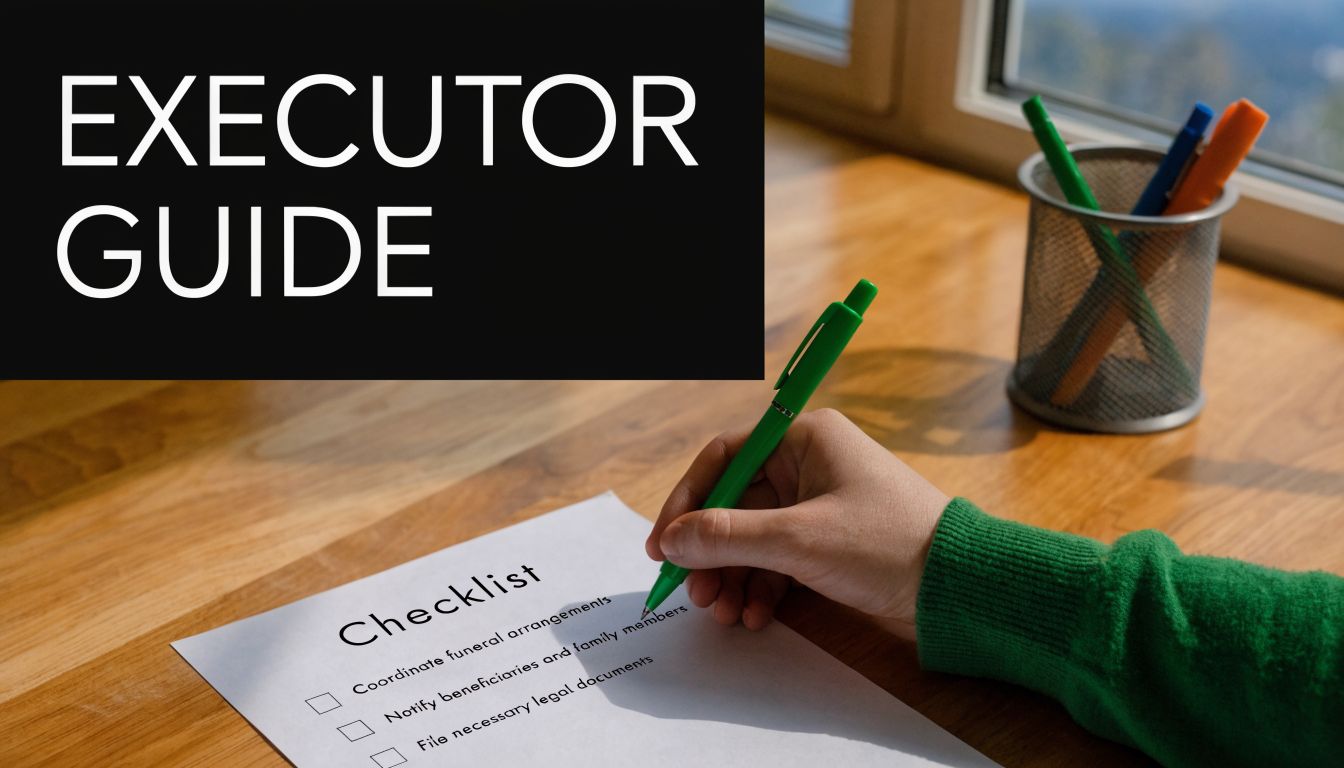
First 30 days checklist
- Locate the original will. Copies may help, but the court usually wants the original if one exists.
- Order death certificates. You’ll often need them for financial institutions and other transfers.
- Secure the residence. Check locks, vehicles, insurance, mail, and any vacant property concerns.
- Gather core documents. Deeds, tax returns, account statements, titles, loan information, and business records are all useful.
- Make a preliminary asset list. Don’t worry about perfection yet. Start with what you can identify.
- Avoid distributions. Even if the will seems clear, wait until authority and obligations are sorted out.
- Open a separate file system. Keep all estate receipts, statements, notes, and court papers together.
- Consult a probate attorney if the estate has real estate, disputes, debts, or unusual assets. Early advice often prevents later repair work.
If you want a general business-side summary of an executor of a will's responsibilities, that resource is a useful supplement to the Texas-specific points here.
What to do next
If you’ve been named executor in Montgomery County, focus on order, not speed. The right approach is usually:
- secure the property,
- confirm the will and asset picture,
- open the probate correctly,
- meet deadlines,
- document every important step.
If you’re unsure whether the estate qualifies for a simpler path, whether independent administration is available, or how to handle a family disagreement, get local guidance before making distributions or signing transfer documents.
One option families in this area use is The Law Office of Bryan Fagan, which handles probate matters in The Woodlands and Montgomery County. The value of local counsel is practical. It’s knowing the court process, the local filing habits, and the kinds of issues that come up with homes, blended families, and contested estates.
This is not legal advice. It’s a roadmap to help you ask the right questions and avoid the most common mistakes.
Frequently Asked Questions About The Woodlands Estates
What property skips probate
Not everything a person owned becomes part of the probate estate. Some assets pass outside probate by contract or title. Common examples include trust assets, some jointly owned accounts, and accounts with payable-on-death or transfer-on-death designations.
That’s why an executor should never assume “if it’s listed in the will, it goes through probate.” The actual title and beneficiary setup matter. A will doesn’t always override those arrangements.
How do digital assets work in Texas
Digital assets are one of the most overlooked parts of modern estate administration. Under Texas rules based on the Revised Uniform Fiduciary Access to Digital Assets Act, access to online accounts, cryptocurrency, and similar assets often requires specific authority in a will or a court order, as explained by White & Mejias on wills and probate administration. Without prior planning, that issue can add months to probate.
In practical terms, an executor may need to identify:
- Email and cloud accounts that hold billing or financial information
- Crypto wallets or exchange accounts
- Social media or business platform accounts
- Online-only financial records
If you suspect digital assets exist, preserve devices, passwords if lawfully available, and any written instructions left by the decedent. Don’t guess your way into access.
Is probate always necessary for a small estate
No. Some estates may qualify for alternatives depending on the facts, the type of property involved, and whether there is a will. In Texas, families sometimes ask about options like a small estate affidavit or other limited procedures.
The catch is that these simplified routes are fact-specific. A house, debt issues, or title complications can change the analysis quickly. That’s why “small” in everyday conversation doesn’t always mean “simple” in probate.
What if there is no will
If there’s no valid will, Texas intestacy rules control who inherits. The court may need to determine heirs before someone can administer the estate. In blended-family situations, that can get complicated fast because community property and separate property may pass differently.
The Texas Estates Code controls that framework. If surviving spouse rights or child-related issues overlap with other family-law questions, related statutes may also matter.
Can an executor sell a house in The Woodlands
Often yes, but the answer depends on the type of administration and the authority granted by the court and will. In an independent administration, the executor usually has more flexibility. In a dependent administration, court approval may be required more often.
Before listing a house, confirm title, authority, occupancy, insurance, and whether any homestead or spousal rights affect the timing.
If you’re facing probate after a loss and need practical guidance for Montgomery County cases, The Law Office of Bryan Fagan can discuss your situation, explain your options, and help you move forward with clarity. A consultation can help you understand whether probate is needed, what type of administration fits, and what steps to take next.