 Skip to content
A parent dies on a Tuesday. By Friday, the family is still answering text messages, planning a service, and trying to remember where the house deed, bank statements, and will might be. Someone says, “We need probate.” Someone else says, “Maybe we can avoid court.”
That moment is common in The Woodlands. Families in Creekside, Panther Creek, Alden Bridge, and Sterling Ridge often face probate while they’re still in shock. If that’s where you are, the first thing to know is simple. Probate is not a punishment, and it isn’t a sign that anything went wrong. It’s the legal process for transferring a person’s property after death.
In plain English, probate usually does three jobs. It confirms whether a will is valid. It gives someone legal authority to act for the estate. It creates a process for paying proper debts and transferring what remains to the right people.
The details matter because probate in The Woodlands means probate in Montgomery County, usually through the local court system in Conroe and under the Texas Estates Code. Local procedure matters. Timing matters. Paperwork matters. Family dynamics matter even more.
Navigating Loss and Legalities in The Woodlands
A family in Alden Bridge loses a widowed mother who owned a home, had a checking account, and named one daughter in a will as executor. The daughter assumes she can walk into the bank, show the death certificate, and access the account. The bank says no. The title company later says the house can’t be sold without probate paperwork. What felt like a private family matter suddenly becomes a court process.
That’s often the first real encounter people have with probate.

What probate means in everyday terms
Think of probate as a legal key. Until the court issues authority to the executor or administrator, many institutions won’t release assets, transfer title, or accept instructions from family members.
A probate attorney the woodlands texas families hire often starts by answering basic questions like these:
- Is there a will: If there’s an original signed will, that usually shapes the path forward.
- What did the person own: A house, bank account, vehicles, investment accounts, business interests, or personal property may all need different handling.
- Who has authority right now: Often, no one does until the court says so.
Practical rule: Don’t assume being a spouse, child, or named executor automatically gives you power to act before probate begins.
Why local experience matters
In The Woodlands, there are 139 probate attorneys available to serve local families, according to Avvo’s directory for probate lawyers in The Woodlands. That number reflects how often local families need probate help, especially in communities where estates may include real estate, retirement accounts, or blended-family issues.
The challenge isn’t just finding a lawyer. It’s finding someone who knows how Montgomery County probate works in practice.
One early step that helps many families is getting organized before anyone starts calling banks and insurance companies. A simple tool to utilize an estate inventory app can make it easier to build a working list of property, accounts, and documents while the family is still gathering information.
What confuses people most
The difference between these questions often causes confusion:
| Question | Why it matters |
|---|---|
| Is there a valid will | That affects who serves and how property passes |
| Does every asset need probate | Some assets transfer outside probate, others don’t |
| Is the estate simple or contested | Conflict changes timing, cost, and court involvement |
Probate can feel intimidating because families usually meet it at their worst moment. But once you break it into steps, it becomes much more manageable.
The Texas Probate Process A Montgomery County Focus
A Woodlands family often reaches this point the same way. Someone has died, the funeral has just happened, and a spouse or adult child is standing in a kitchen with a folder of papers, a house to secure, and no clear answer about what has to happen first in Montgomery County.
Probate gives the court a way to confirm who may act for the estate and what steps must follow. It is a legal process, but it also works like a checklist. One step clears the way for the next. If you want a broad overview before focusing on local procedure, this guide on Navigating the Probate Process in Texas helps explain the statewide framework.
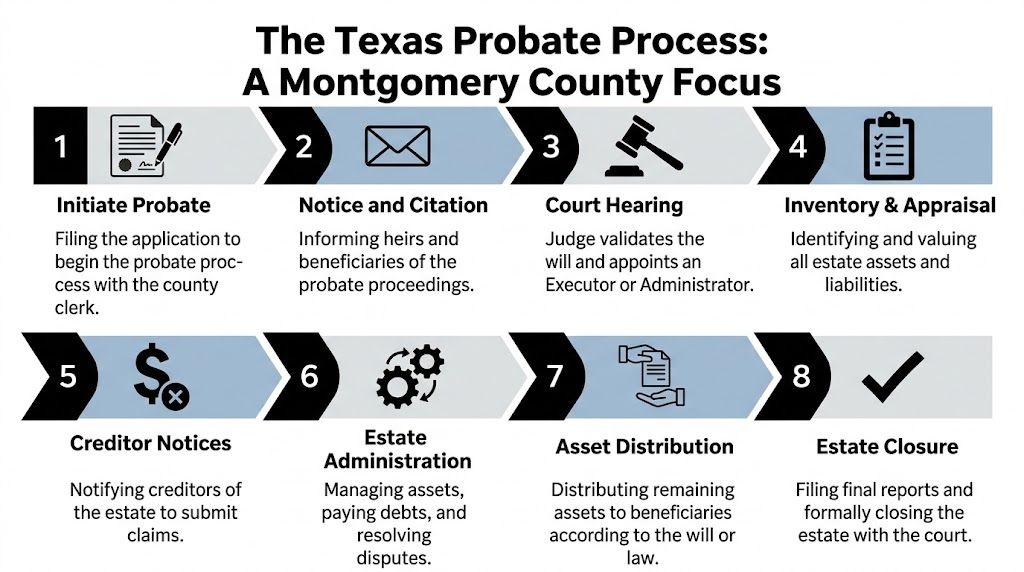
In Montgomery County, the first question is usually simple: are we probating a will, or are we asking the court to appoint someone because there is no will? That choice affects the paperwork, the hearing, and sometimes the timeline.
The first stage. Filing, posting, and the court hearing
Most cases begin with an application filed with the probate court. If there is a valid will, the filing usually asks the court to admit the will to probate and appoint the executor named in it. If there is no will, the family may need an application for administration, and in some situations a determination of heirship.
After filing, the clerk posts notice. That posted notice gives interested persons time to come forward if they object or believe a different person should serve.
Then comes the hearing. In many families, this is the first moment when the process starts to feel more concrete. The judge reviews the application, confirms the legal requirements have been met, and decides whether to appoint the executor or administrator.
That hearing answers the question banks, title companies, and other institutions care about. Who has authority to act for the estate?
After appointment, the real work begins
Letters Testamentary or Letters of Administration are often the documents people mean when they say, "Now I can start handling things." Those letters are like the court’s written confirmation that the representative has authority to deal with estate business.
From there, the personal representative usually needs to:
- locate and list estate property, such as bank accounts, a home, vehicles, business interests, and personal items
- identify the correct heirs or beneficiaries
- secure property and keep it from being lost, damaged, or taken
- review debts, bills, and possible claims
- prepare the inventory or other required filings
Families are often surprised by how practical this part is. Change the locks if needed. Forward the mail. Check insurance on the house. Find out how the deed is titled. Probate is not only court paperwork. It is also asset protection and careful recordkeeping.
Creditor notice deadlines under the Texas Estates Code can affect how claims are handled. Texas law also requires an estate inventory in many cases, though some estates may use an affidavit in place of a full inventory in the right circumstances. You can review a plain-language summary of local probate services in The Woodlands if you want to see how these tasks usually play out in practice.
Where Montgomery County cases often slow down
The opening hearing is only one part of the process. Delay usually shows up in the middle.
A family may discover an account no one knew existed. The deceased may have owned a home in The Woodlands but left no clear file showing the mortgage, insurance, or tax status. A child from a prior marriage may have different expectations than a surviving spouse. If there is no will, relatives may agree on very little except that someone needs to do something soon.
This is also where people get tripped up by timing. Court approval may come first, but collecting records, notifying creditors, valuing property, and preparing transfers often take longer than families expect. Probate moves through required notice periods, document requests, and court scheduling. Grief makes that waiting feel heavier.
Closing the estate takes more than admitting the will
The estate closes only after the representative has finished the administration work. That usually means paying valid debts, dealing with title issues, distributing property to the right people, and filing whatever closing documents are required for that type of estate.
For a Woodlands family, a home is often the biggest practical issue. Before anyone can sell it, transfer it, or refinance around it, the estate usually needs clear authority and clean title. The same is true for some investment accounts and closely held business interests.
A simple estate may move in a fairly steady line. An estate with missing records, family conflict, or intestate issues usually takes longer. That does not mean anyone has done something wrong. It often means the court is making sure the right person is acting, the right people are notified, and the right property ends up in the right hands.
Independent vs Dependent Administration Which Path is Right
Texas probate offers two primary tracks: independent administration and dependent administration. The core difference is the level of court supervision required after the personal representative is appointed.
That distinction is important in Montgomery County because families often expect probate to move in one straight line. It rarely does. The path depends on the will, the family dynamic, the estate’s debts, and whether the court believes closer oversight is needed.
Why independent administration is often preferred
In an independent administration, the executor or administrator can usually handle many estate tasks without returning to court for permission each time. That often means fewer hearings, fewer filings, and fewer pauses between one step and the next.
For a Woodlands family, that can make a real difference. If the estate includes a house, a few bank accounts, a vehicle, and cooperative beneficiaries, independent administration often gives the representative room to gather assets, deal with creditors, and prepare distributions with less court involvement.
Less supervision does not mean less responsibility.
The representative still has to follow Texas law, protect estate property, keep records, pay valid debts, and give required notices. A court may not be checking every small step, but the executor still owes legal duties to the estate and the people entitled to inherit. Families who are creating or updating wills and trusts for Texas families often plan for this in advance by using language that supports independent administration.
Why dependent administration still exists
Dependent administration places the estate under closer court control. The representative may need approval before taking actions that would be routine in an independent case, such as selling property or paying certain claims.
That extra structure can be helpful when the estate has problems that are hard to solve informally. Common examples include disputes over who should serve, arguments about whether a debt is valid, unclear records, suspected mishandling of property, or beneficiaries who do not trust one another.
Families sometimes hear the word “dependent” and assume the case is broken. A better way to read it is this: the court is acting like a careful supervisor because the estate needs more guardrails.
Independent vs Dependent Administration in Montgomery County
| Feature | Independent Administration | Dependent Administration |
|---|---|---|
| Court oversight | Limited after appointment | Ongoing supervision |
| Representative authority | Broader ability to act without repeated court approval | Court permission required more often |
| Paperwork | Usually lighter | Usually heavier |
| Good fit | Cooperative families, clear will, manageable assets and debts | Conflict, uncertainty, creditor pressure, contested issues |
| Timing | Often shorter because there are fewer approval steps | Often longer because actions may require court review |
| Cost pressure | Often lower due to fewer filings and hearings | Often higher due to more court involvement |
How to decide which path fits
Three practical questions usually point the family in the right direction.
Does the will allow independent administration
The wording of the will matters. If the will clearly authorizes independent administration, that often makes the process more efficient. If the language is missing or unclear, the court may need more information, and the family may have fewer options than expected.
Are the beneficiaries and heirs likely to cooperate
Probate is part legal process and part people process. A calm family meeting can save months of friction. A single unresolved dispute can push an estate toward more supervision, more filings, and more waiting.
Is the estate simple on paper and in real life
A home with clear title and no major debt is one kind of case. A blended family, a business interest, missing account statements, unpaid taxes, or questions about gifts made before death create a very different case.
A local example of how this choice affects the timeline
Suppose a Woodlands resident dies with a valid will, names an executor, and leaves a home in Montgomery County plus ordinary financial accounts. If the beneficiaries agree and the paperwork is in order, the court may allow an independent administration. The executor still has work to do, but the estate usually avoids repeated requests for permission.
Now change one fact. Two adult children disagree about the executor, a creditor is making aggressive demands, and no one can tell whether the home has title problems. The court may require a more supervised path because the risk of mistakes is higher.
That does not mean anyone has done anything wrong. It means the process is being matched to the problem.
Where families often get confused
Independent administration does not mean “no court.” The court still opens the estate, appoints the representative, and expects required steps to be completed.
Dependent administration does not mean failure, either. It means the estate needs closer review.
For grieving families in The Woodlands, this is often the moment when expectations need to be reset. You may walk into the process hoping for a quick transfer of property, then learn that the court needs more documentation or more oversight before anyone can act. Once families understand which track they are on, the timeline usually makes more sense, and the next step feels less overwhelming.
When There Is No Will Probate for Intestate Estates
When someone dies without a will, Texas calls that intestate. In that situation, the family doesn’t decide inheritance based on what seems fair or what the deceased “would have wanted.” The law steps in.
That’s one reason intestate probate is often more stressful than probate with a will.

What Texas law does when there is no will
The Texas Estates Code sets the order of inheritance. The outcome can depend on whether the deceased was married, had children, had children from another relationship, or left surviving parents or siblings.
That’s where many families get blindsided.
A surviving spouse may assume everything passes automatically to them. Sometimes that’s not how Texas intestate succession works. Adult children may assume they divide everything equally. Sometimes the character of the property changes the answer.
For local families, this often leads to a proceeding called an Application to Determine Heirship. As noted in this discussion of probate and heirship in The Woodlands, that process often involves an ad litem attorney, affidavits from two disinterested witnesses, and may take 6 to 18 months and cost $5,000 to $15,000 or more in complex cases.
A Sterling Ridge example
A man in Sterling Ridge dies owning a home and several accounts, but he never signed a will. He is survived by his second wife and two children from a prior marriage.
The family agrees that “everyone knows what he wanted.” The court still needs proof of legal heirship. That means formal filings, witness affidavits, and often an attorney ad litem to help protect the interests of unknown or unlocated heirs.
The family’s agreement may help emotionally. It doesn’t replace the legal process.
Why the court needs outside witnesses
People often ask why relatives can’t just tell the judge who the heirs are.
The answer is reliability. The court wants testimony from disinterested witnesses, meaning people who don’t benefit from the estate. Those witnesses may know the family history, marriage history, and whether the deceased had children or other heirs.
That requirement feels strange to grieving families. But it serves a purpose. It protects the estate from mistakes and protects absent heirs who may not be in the room.
If you’re dealing with a case like this, it can also help to review broader planning tools and estate documents through resources on wills and trusts in The Woodlands, because intestate problems often reveal what planning was missing.
The ad litem attorney’s role
An attorney ad litem doesn’t represent the family member who files the case. That lawyer is typically appointed to help the court investigate and protect the interests of heirs who are unknown, missing, or not before the court.
That can feel adversarial, but it isn’t necessarily. It’s part of the safeguard built into heirship proceedings.
Here’s a short explainer that helps many families understand the basics before they meet with counsel:
Why intestate probate feels heavier
Probate with a will asks, “Is this document valid, and who carries it out?”
Intestate probate asks a harder set of questions. Who are the legal heirs. Are there children from prior relationships. Is anyone missing. Is there enough evidence to establish the family tree. Those questions take time, and in Montgomery County they often require more proof than families expect.
When there’s no will, the court isn’t trying to be difficult. The court is trying to make sure property goes to the legally correct people.
Simplified Options and Common Probate Pitfalls
Many people assume probate always means a full court case, a long wait, and layers of administration. That isn’t always true.
Texas law offers simpler paths in some situations. The catch is that families have to qualify for them and use them correctly.

Small Estate Affidavit
For estates valued at $50,000 or less, excluding the homestead, Texas law may allow a Small Estate Affidavit instead of a full formal administration, as described by De Ford Law Firm’s discussion of Texas probate options.
That option can be a relief for families who qualify.
It isn’t available in every situation, and it doesn’t solve every title problem. But for the right estate, it can provide a much simpler path to transferring certain property.
Muniment of Title
Another option that some families ask about is Muniment of Title under the Texas Estates Code. In simple terms, this can allow a will to be admitted for the purpose of transferring title without a full administration in the right case.
This often comes up when the main issue is real estate transfer and there’s no need for broad estate administration.
The key point is this. Simple doesn’t mean automatic. The estate still has to fit the legal requirements.
Common mistakes that turn a manageable case into a hard one
Paying bills too early
A family member may start paying debts from personal funds or from estate funds before figuring out priority, validity, or whether the estate even owes the claim in the form presented.
That can create reimbursement problems and arguments later.
Letting property drift
A vacant house can become a problem fast. Insurance, maintenance, mail, utilities, and access all matter. So does keeping a written record of who removed what from the property.
Treating family agreement as legal authority
Families may agree on how to divide furniture, accounts, or sale proceeds. Without the proper legal authority, those decisions can still create title and liability issues.
The overlooked pitfall of guardianship
A particularly hard issue arises when an heir is a minor or an incapacitated adult.
According to Hannah Law’s discussion of probate and guardianship concerns in The Woodlands, 70% of probate inquiries involve such issues, and guardianship proceedings can cost upwards of $10,000 and take 6 to 12 months. The same source notes that lawyers may use tools such as Transfer on Death deeds or trusts in some situations to help avoid guardianship-related complications.
That matters because an estate that looks simple on paper can become much more complex if a child or incapacitated adult is set to receive property directly.
Why this catches families off guard
People often think, “The child is my child, so I can just manage the inheritance.” Probate law doesn’t work that way automatically.
The court may require a more formal protective structure before certain assets can be received or managed for that person. That’s one reason planning ahead matters so much.
A probate file can stay calm until one hidden issue appears. Minor heirs, title defects, and creditor mistakes are three of the most common triggers.
Your Next Steps and How a Local Attorney Helps
If you’ve made it this far, you probably need less theory and more direction.
The good news is that probate becomes easier once someone takes charge of the immediate tasks and stops the family from making avoidable mistakes. That’s where local guidance matters. A lawyer familiar with Montgomery County probate can help identify the right path, prepare filings, deal with the court, and reduce the risk of title problems and family disputes.
What to do next
Keep this checklist simple. You don’t need to solve everything today.
- Secure the home and valuables: Change access if needed, gather mail, and make sure important items don’t disappear.
- Locate the original will: Don’t rely on a copy if you can avoid it. Search home files, safes, and prior attorney records.
- Order death certificates: You’ll likely need multiple certified copies for banks, title work, and other institutions.
- Start a document folder: Include deeds, bank statements, insurance paperwork, tax returns, vehicle titles, and any trust or beneficiary documents.
- Make an asset list: Even a rough list is useful. Note what’s owned, what’s jointly held, and what may pass outside probate.
- Don’t distribute property early: Even if everyone agrees, wait until legal authority is clear.
- Be careful with debts: Don’t assume every bill must be paid immediately or from your own funds.
- Ask about minor or incapacitated heirs right away: These issues can change the entire probate strategy.
How a local probate attorney helps in practice
A probate attorney usually helps with more than filing paperwork.
That lawyer may:
- Evaluate the correct procedure: full probate, heirship, small estate affidavit, muniment of title, or another option
- Prepare court filings: so the case starts on the right footing
- Coordinate evidence and witnesses: especially in intestate estates
- Guide the executor or administrator: on duties under the Texas Estates Code
- Address property and family law overlap: which can matter in divorce-related estates, separate property disputes, or custody-connected family situations
For families comparing planning and probate together, estate planning guidance in The Woodlands can help clarify which problems can be prevented before a future loss occurs.
The Law Office of Bryan Fagan is one local option for families in The Woodlands and Montgomery County who need help with probate, estate administration, and related family law issues.
One last caution
As noted earlier in the article, guardianship concerns can change an otherwise manageable probate. If a minor or incapacitated adult may inherit, raise that issue early, not after the court case is already moving.
That early conversation can affect whether the family needs additional court involvement, whether another planning tool is available, and how the estate should be handled from the start.
This article is for general educational purposes only and is not legal advice. Probate outcomes depend on the specific facts, the documents involved, and local court procedure. If you’re handling a death in The Woodlands or Montgomery County, talk with a qualified Texas probate attorney about your specific situation.
Frequently Asked Questions about Probate in The Woodlands
How much does probate cost in Montgomery County
It depends on the type of case. A probate with a valid will and a cooperative family is usually more straightforward than an intestate heirship case or a contested administration. Court costs, attorney’s fees, appraisals, title issues, and dispute resolution can all affect the total. The best way to estimate cost is to identify the assets, confirm whether there is a will, and determine whether any heirs disagree.
How long does an executor have to distribute assets
There isn’t one universal calendar answer that fits every estate. The executor generally needs enough time to be appointed, gather assets, handle required notices, address debts and claims, and make sure distributions are legally safe. Distributing too early can create personal risk for the executor. In practice, distribution happens after the estate is in a position to close or partially distribute without creating avoidable problems.
What happens if an heir can’t be found
That issue can slow the case and may require additional court involvement. In heirship proceedings, the court may appoint an attorney ad litem to help identify and protect the interests of unknown or missing heirs. This is one reason good family-history information matters. Old marriage records, divorce records, birth records, and contact information can all become important.
Do all assets have to go through probate
No. Some assets may pass outside probate depending on how they’re titled or whether they have a beneficiary designation or survivorship feature. Other assets, especially property titled only in the deceased person’s name, may require probate authority to transfer. This is one of the first questions a lawyer reviews because it affects both strategy and cost.
Can I handle probate without a lawyer
Some people try, especially when the estate looks simple. But even a simple estate can become complicated if there are title issues, a missing original will, a blended family, debts, or minor heirs. Probate involves court procedure, statutory requirements, deadlines, and legal judgment calls. Many families decide they’d rather have help than learn those rules while grieving.
What should I bring to a probate consultation
Bring the original will if you have it, a death certificate if available, a basic list of assets and debts, any deeds or account statements you can find, and notes about family relationships. If there has already been conflict among heirs, bring that information too. A short written timeline is often more helpful than a stack of unsorted papers.
If you’re facing probate questions after the loss of a loved one in The Woodlands or Montgomery County, The Law Office of Bryan Fagan can help you understand the next step and evaluate your options in a consultation.
