 Skip to content
A parent dies in The Woodlands. You find the original will in a desk drawer, a stack of bank statements on the kitchen counter, and a house that still has bills coming in. Everyone in the family wants to know the same thing. What happens now?
That’s usually when probate stops feeling like a legal term and starts feeling personal.
If you’re trying to figure out how to probate a will in The Woodlands, the first thing to know is that the process is local. Texas law controls the rules, but the actual filing, hearing, and follow-through happen in Montgomery County, usually through the courthouse in Conroe. That local piece matters more than most online guides admit.
Losing a Loved One in The Woodlands What is Probate
Probate is the court process used to confirm that a will is valid, appoint the person authorized to act for the estate, and create a legal path for gathering property, paying debts, and distributing what’s left to the people named in the will.
For many families, the hardest part is that probate arrives when people are grieving, tired, and not always getting along. A son in Alden Bridge may have the original will. A daughter in Panther Creek may be paying utilities on the house. Someone else is asking whether they can sell a car or access an account. Probate answers who has authority to act.

What probate does in plain English
A valid will doesn’t automatically transfer everything on its own.
The probate court usually has to admit the will to probate and appoint the executor before banks, title companies, and other institutions will recognize that person’s authority. In Texas, the legal framework comes from the Texas Estates Code, including the rules on offering a will for probate and qualifying an executor.
That’s why families often need probate even when everyone agrees.
What probate does not do
Probate doesn’t control every asset a person owned.
Some assets pass outside probate, such as certain jointly held property or accounts with payable-on-death designations. That’s one reason the first review should always focus on what the decedent owned and how each asset was titled.
If you’re also reviewing the broader estate plan, it helps to understand how wills work alongside trusts and beneficiary designations. This overview of wills and trusts in Texas is a useful starting point.
Important disclaimer: This article provides general information about probate in Montgomery County and The Woodlands. It is not legal advice. Probate outcomes depend on the facts, the wording of the will, the estate’s assets and debts, and any disputes involved. Speak with a qualified Texas probate attorney for advice about your specific situation.
Why local procedure matters
A lot of probate content online stays at the Texas-wide level.
That isn’t enough for a family in The Woodlands. The practical issues usually involve local filing habits, hearing settings, document preparation, and what the Montgomery County court expects to see when a will is presented.
The good news is that many estates move in an orderly way when the will is clear, the original document is available, and the executor acts promptly.
Determining the Right Probate Path for Your Family
The first legal decision is usually not whether to probate the will. It is which probate procedure fits the estate.
In Montgomery County, that choice affects how much court involvement the family will face, how quickly the executor can act, and whether the estate spends money on steps that were never necessary. I often see families lose time by starting with a filing that does not match the assets, the debts, or the wording of the will.
General Texas guides rarely explain that practical difference well. Families in The Woodlands usually need to know what will work in Montgomery County Probate Court, not just what exists under the Estates Code. If you want a local overview of probate representation for Montgomery County estates, that can help frame the options before filing.
Independent administration is usually the preferred route
For a will-based estate, independent administration is often the most efficient path if the will authorizes it and the executor is qualified.
That matters because the executor can usually handle many estate tasks without asking the court for repeated permission. In a cooperative family, that often means fewer hearings, fewer attorney hours, and fewer delays tied to routine transactions.
A common example in The Woodlands is straightforward. The decedent owned a home, a checking account, and a vehicle, left an original will, and named an independent executor. No one expects a contest. In that situation, independent administration is often the right fit because the executor can gather assets, deal with creditors, and prepare for distribution without constant court supervision.
Dependent administration has a different purpose
Dependent administration involves closer court control from start to finish.
It is usually the better choice when the estate has serious conflict, concerns about how funds will be handled, or no workable basis for an independent administration. The extra oversight can protect beneficiaries and creditors. It also means more approvals, more paperwork, and slower decision-making.
That trade-off is real. If the family is fighting over the will, or if there are questions about missing property, court supervision may be worth the added cost and time.
Small Estate Affidavit and Muniment of Title can avoid full administration
Some estates do not need a full probate administration at all.
A Small Estate Affidavit may work if the estate qualifies under Texas law. The Texas Estates Code sets specific requirements, including a value cap and restrictions on what property can pass through that procedure. The statute is the best place to confirm eligibility because families often assume this option is available when the asset mix or debts make it unusable. See the Texas Legislature's Small Estate Affidavit provisions in the Estates Code.
A Muniment of Title is narrower. It is often used when there is a valid will, no need for full administration, and the main goal is transferring title to property, often real estate. In Montgomery County, this can be a practical solution when the estate is simple and there are no unresolved debt issues that call for an executor to manage claims.
If the estate is mostly real property and there is no reason for a full administration, the narrower procedure is often the better procedure.
Comparing Probate Options in Montgomery County
| Probate Type | Typical Timeline | Estimated Cost | Court Oversight | Best For |
|---|---|---|---|---|
| Independent Administration | Often faster than other full probate options when the will and paperwork are in order | Varies with estate complexity and whether problems arise | Lower after the executor qualifies | Estates with a valid will, a qualified executor, and limited conflict |
| Dependent Administration | Usually slower because multiple actions require court approval | Often higher because of added filings, hearings, and supervision | High | Disputed estates, management concerns, or cases that need tighter court control |
| Small Estate Affidavit | Can be simpler than full probate if the estate strictly qualifies | Usually lower than full administration | Limited | Smaller estates that meet Texas statutory requirements |
| Muniment of Title | Often narrower and more efficient than full administration in the right case | Usually lower than full administration | Limited and focused | Estates where transferring title under a valid will is the main issue |
Four questions usually decide the path
The right filing usually becomes clearer after a focused review of four points.
- Is there an original will? An original will is much easier to admit than a copy. A copy can create proof problems and extra delay.
- What assets require probate authority? A homestead, brokerage account, mineral interest, or closely held business interest can each point toward a different procedure.
- Are there debts that require active administration? Creditor issues often rule out shortcut options.
- Is the family in agreement? Even a well-drafted will can lead to a harder case if heirs do not trust the executor or disagree about property.
Choosing the right path early saves time. It also reduces the risk of filing one procedure, discovering a problem halfway through, and having to correct course in the Montgomery County court.
A Walkthrough of the Montgomery County Probate Court Process
Probate in The Woodlands usually starts with a drive to Conroe, not a website article.
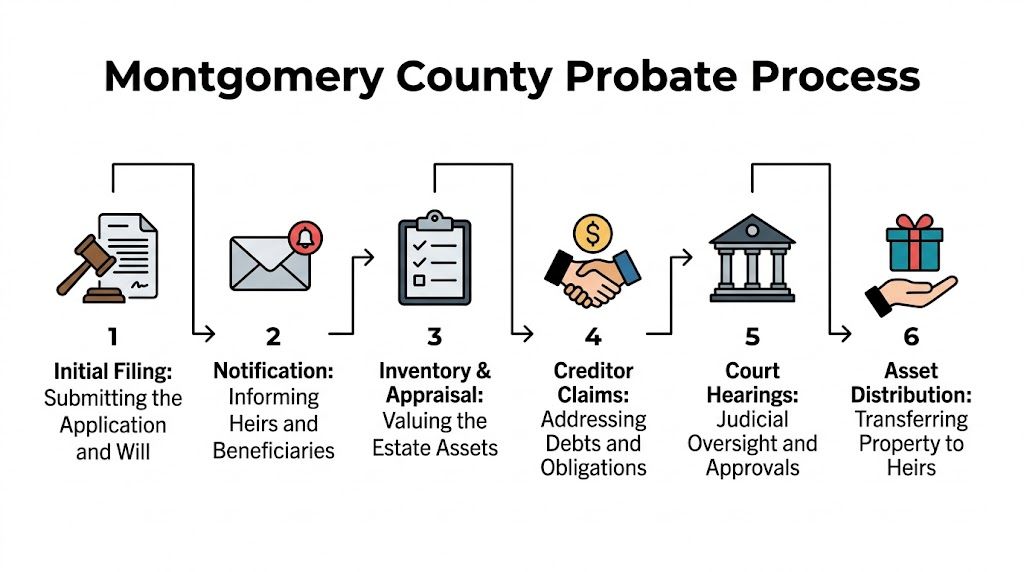
The court process is formal, but it isn’t mysterious once you know the sequence. Most families are dealing with the same chain of events: gathering the original will, preparing the application, waiting for the hearing, qualifying the executor, and then handling the notices and asset paperwork the court requires.
For a closer look at local representation in these matters, this page on probate services in The Woodlands gives additional context on the kind of cases that move through Montgomery County.
Filing the application in Conroe
The process usually begins when the named executor, or another qualified applicant, files an Application for Probate of Will and Issuance of Letters Testamentary with the county clerk.
The filing should be prepared carefully. It needs basic information about the decedent, the will, and the people connected to the estate. The executor also needs the original will and related supporting documents ready for submission.
Under one Texas probate practice guide, the executor submits the application to the county clerk, filing fees typically range from $200 to $400, and notices to heirs are sent by certified mail within 10 days. The same guide notes that the court generally schedules a hearing 10 to 30 days after filing, and the executor must later file a detailed inventory within 90 days of appointment, as described in this guide on probating a will in Texas without a lawyer.
The courthouse notice and the hearing
After filing, there is usually a waiting period before the hearing.
That time matters. The court expects proper notice procedures to be followed. Montgomery County families often underestimate this phase because it can feel administrative, but errors here can create delay.
At the hearing, the judge is looking for a valid will and a qualified executor. The court wants enough proof that the will was executed properly and that the person seeking appointment is eligible to serve.
A self-proved will usually makes this part easier than a will that requires witness testimony.
Practical rule: Bring order to the paperwork before you file. Probate hearings tend to go more smoothly when the original will, death certificate, and core family information are organized from the start.
Qualifying as executor
Once the court admits the will to probate, the executor doesn’t just walk out and start acting immediately in every case. There are qualification steps.
That often includes taking the oath and obtaining Letters Testamentary. Those letters are the document banks, brokerages, and title companies usually want to see before releasing information or honoring the executor’s authority.
This is the point where families often feel the first real sense of forward movement.
Notices after appointment
The court hearing is not the end of the work. It’s the beginning of administration.
The executor then has follow-up duties that need attention quickly. In Texas probate practice, those commonly include notifications to beneficiaries and creditor-related steps. Missing those obligations can create avoidable problems later, even in a cooperative estate.
The practical post-hearing tasks usually include:
- Beneficiary communication: Send the required notices and keep a record of what was sent.
- Creditor handling: Identify debts and address formal notice requirements.
- Asset control: Secure accounts, real property, mail, and records.
- Recordkeeping: Start a clean ledger for every receipt, bill, and disbursement.
The inventory and administration phase
One of the biggest early deadlines comes after appointment.
The executor must prepare the estate inventory, appraisement, and related information. In doing so, many first-time executors realize how much detail the job requires. You need to identify what the decedent owned, what it was worth, and what claims may exist against the estate.
That sounds straightforward until the estate includes mixed assets, missing statements, or a house in The Woodlands that needs upkeep while probate is pending.
Distribution comes last, not first
Families often want to distribute personal property quickly. That instinct is understandable, but it can create risk.
The executor should first make sure the estate administration supports distribution. Debts, claims, title issues, and required filings need attention before property is handed out. The order matters.
A safe sequence usually looks like this:
- Get legal authority from the court
- Identify and secure estate assets
- Address notices and claims
- Prepare the inventory
- Resolve administration issues
- Distribute property under the will
What works in Montgomery County is steady, documented administration. What doesn’t work is informal family agreement with no paper trail.
Understanding Probate Timelines Costs and Common Pitfalls
A common Montgomery County scenario looks like this. A family in The Woodlands has the original will, everyone agrees on who should serve as executor, and they expect the case to be quick. Then they learn the court still has its own filing requirements, hearing availability affects timing, and nothing about a house, bank account, or brokerage transfer moves until the probate authority is in place.
That is why timeline and cost questions matter so much at the start.

What timeline is realistic
In Montgomery County, a straightforward probate with a valid will often moves faster than a contested estate or an intestate case, but families should still expect probate to take months, not weeks.
The hearing to admit the will is only one step. After that, the executor still has to qualify, give required notice, gather asset information, deal with creditor issues if they exist, and complete the inventory or related filing. If the estate includes real property in The Woodlands, title questions, insurance issues, or an occupied home can slow progress even when nobody is fighting.
Court scheduling matters too. Local practice in Montgomery County can affect how quickly you get a hearing date, how complete the initial filing needs to be to avoid delay, and whether the clerk rejects documents that look minor to the family but matter to the court.
What costs tend to drive the total
Probate costs usually come from several smaller categories that add up.
Typical expenses may include filing fees, attorney fees, certified copies, appraisals, bond premiums if a bond is required, publication costs, accountant fees in tax-sensitive estates, and ongoing property expenses. In my experience, the estate becomes more expensive to administer when the records are disorganized, the original will is missing, or a house sits vacant while the family waits to decide what to do.
Real estate often creates the most friction. Utilities continue. Insurance may need review. Lawn care, repairs, HOA issues, and property taxes do not stop because the owner died.
The deadline families miss
Texas does impose one deadline that can change the whole case. Under Texas Estates Code § 256.003, the will generally must be filed for probate within 4 years after death. The Texas State Law Library explains that rule in its guide to probating a will in Texas.
If that deadline passes, the estate may no longer be handled as a standard probate of the will, and property may pass under rules that do not match the decedent's written wishes. For some families, that is the difference between a controlled transfer and a much harder fight over title and inheritance.
Common mistakes that create delay and extra cost
The mistakes I see most often in Montgomery County are practical mistakes with legal consequences:
- Waiting too long to file: Delay can create problems with the 4-year deadline and makes records harder to gather.
- Failing to locate the original will: A copy can be used in limited situations, but proving it up is harder.
- Treating estate property like family property: Vehicles, accounts, and personal items should not be divided before the executor has authority and the estate is ready.
- Ignoring local court expectations: Incomplete applications, missing notices, or incorrect supporting documents can delay a hearing.
- Overlooking real estate title issues: A home cannot usually be sold with clear title until the probate record supports the transfer.
If the estate includes a house, those issues tend to surface first. Families trying to list or transfer property often discover that buyers, title companies, and lenders want clean probate paperwork before closing. If you are also trying to understand the mechanics of selling a house in probate, that overview is based on another state, but it still gives useful context for why probate authority and title clearance come first.
A short explanation can also help if you want a plain-language overview of what probate involves:
What helps keep a Montgomery County probate on track
Start with the original will, a death certificate, a working asset list, and basic information about debts and real property. Keep every statement, invoice, and receipt in one place. If a hearing is needed, file a clean application the first time.
Families usually save time and money when they treat probate like a court process, not a family project. In Montgomery County, procedure matters. Good records and early action prevent many of the problems that make an estate drag on.
The Executor Role Your Duties and Responsibilities
Being named executor is an honor. It’s also work.
Under the Texas Estates Code, the executor acts in a fiduciary role. In plain English, that means the executor has to act in the best interests of the estate and the beneficiaries, not in personal self-interest.

What the executor actually does
The job is part paperwork, part communication, and part risk management.
An executor typically needs to:
- Secure estate property: Lock down the home, collect mail, preserve records, and protect valuables.
- Identify assets and debts: Bank accounts, vehicles, real estate, and outstanding obligations all need review.
- Manage estate funds carefully: Estate money should be handled separately and transparently.
- Communicate with beneficiaries: Silence creates suspicion fast.
- Make distributions only when appropriate: The will controls, but timing matters.
If the estate includes a home in Sterling Ridge, Alden Bridge, or Creekside, the executor may also be dealing with insurance, maintenance, property taxes, and access issues while probate remains open.
Where executors get into trouble
Most executor problems don’t start with bad intent. They start with shortcuts.
An executor can create personal risk by paying one beneficiary early, mixing estate funds with personal funds, failing to account for property, or handling family requests informally. Good records are often the difference between a smooth administration and a dispute.
Executor guidance: If a decision affects money, title, or one beneficiary differently from another, document it before you act.
A practical way to protect yourself
Executors should keep a running estate file from the first week forward.
That file should include the will, letters, court filings, notices, account statements, bills, receipts, and a written log of major actions taken. If questions come up later, memory won’t be enough. Documentation will.
In more involved estates, legal counsel can also help the executor stay inside the proper lane and avoid preventable mistakes.
When to Partner with a Woodlands Probate Attorney
A common Montgomery County probate problem starts like this. The family has a will, everyone assumes the case will be simple, and then the executor learns the court needs specific filings, sworn testimony, and clean paperwork before authority is issued. If the estate includes a house in The Woodlands, family tension, missing records, or questions about debt, delay follows quickly.
That is usually the point where legal help stops being optional in practice, even if the case looked manageable at first.
In Montgomery County, timing and procedure matter. The court will not overlook a missing original will, incomplete heir information, or a poorly prepared application just because the family agrees. I often tell executors the same thing. Probate gets harder and more expensive after preventable mistakes, not before.
Situations where counsel usually makes sense
A probate attorney is usually worth bringing in when the executor needs more than basic filing help, including cases such as:
- A will contest or family dispute: Objections, distrust, or pressure from one side of the family can change a routine probate into a contested matter.
- Real property in the estate: A home in The Woodlands often raises title questions, insurance issues, tax deadlines, and sale timing concerns.
- A missing original will or other gaps in the file: Copies, inconsistent asset information, or uncertainty about debts often require extra proof and a more careful court strategy.
- Questions about the right procedure: Some estates fit a simpler path. Others need full probate authority to transfer title or deal with creditors.
- An executor who feels exposed: That concern is usually tied to real risk. Personal liability often comes from acting too soon, paying the wrong expense, or handling property without clear authority.
For families weighing whether they need representation, this page on a probate attorney in The Woodlands gives a practical sense of the support people often seek once probate involves more than filing a will.
What legal help usually changes
Good probate counsel does more than prepare forms.
In Montgomery County Probate Court, a lawyer can help choose the correct probate path, prepare the application and supporting documents, get the executor ready for the prove-up hearing, and address title or creditor issues before they slow the estate down. That is especially helpful when the executor lives out of town, the estate holds real estate, or one mistake could create a dispute with beneficiaries.
The trade-off is straightforward. Paying for legal guidance increases upfront cost, but it can reduce delay, lower the chance of rejected filings, and protect the executor from informal decisions that create larger problems later.
What to do before you decide
Before you commit to handling the case alone, gather the key documents and test whether the estate is as simple as it looks:
- Locate the original will: The court will care whether the original exists and whether it appears altered.
- Collect certified death certificates: Financial institutions, title companies, and the court process may each require them.
- Identify the assets that need probate authority: Focus on real estate, bank accounts, vehicles, business interests, and anything titled only in the decedent’s name.
- List known debts and deadlines: Mortgage payments, property taxes, insurance, and final bills do not pause because the family is grieving.
- Confirm the family tree and beneficiary information: Full names, addresses, and relationships matter early in the filing process.
- Get a legal review if any fact feels uncertain: One short consultation can reveal whether the case is routine or headed toward a problem.
The Law Office of Bryan Fagan is one local option families use when they need help with probate filings, executor guidance, and Montgomery County court procedure.
This article is general information only and is not legal advice. If you are dealing with a probate matter in The Woodlands, Panther Creek, Alden Bridge, Sterling Ridge, Creekside, or elsewhere in Montgomery County, a consultation can help you choose the right next step with fewer surprises.
Frequently Asked Questions About Texas Probate
Do all wills have to go through probate in Texas
No. Some assets pass outside probate, and some estates may qualify for a narrower procedure. The answer depends on what the decedent owned, how the assets were titled, and whether formal authority is needed to transfer property.
What if I only have a copy of the will
That can complicate the case. Courts generally prefer the original will. A copy may require extra proof, and that often means more work, more delay, and more risk.
Can an executor sell a house during probate
Sometimes, but the executor should make sure the estate has proper authority and that title issues are addressed first. In practice, real estate sales often slow down when probate paperwork is incomplete.
What if the family agrees on everything
Agreement helps, but it doesn’t eliminate legal requirements. The court process still matters when a will needs to be admitted and the executor needs authority to act.
Can I probate a will without a lawyer
Some people try. Whether that’s realistic depends on the estate. A simple estate with clear paperwork is very different from an estate with real property, debt, or family tension.
What if the person died years ago and the will was never filed
That situation needs immediate review because filing deadlines are strict in Texas. Waiting longer usually makes the problem harder, not easier.
If you’re facing probate after the loss of a loved one, The Law Office of Bryan Fagan can help you evaluate the will, the estate, and the proper Montgomery County filing path. A consultation can give you a clearer plan for what to do next.
