
A late child support payment usually doesn't arrive with a warning. A parent in Creekside Park or Sterling Ridge checks the account, sees nothing posted, and starts doing math right away. Rent, groceries, school costs, and after-school pickup don't wait for the other parent to catch up.
That's why what happens if child support is not paid in The Woodlands matters so much. In Texas, unpaid child support is not treated like a casual debt between two adults. It sits under a court order, and once payments are missed, the case can move into a formal enforcement system that reaches employers, banks, licensing agencies, and the court.
Unpaid Child Support in The Woodlands An Overview

In The Woodlands, this often begins subtly. One payment comes in late. The next one is short. Then the paying parent says they'll make it up next month, and the receiving parent is left deciding whether to wait, press the issue, or call the state.
Texas gives that problem legal weight fast. A Texas child support arrears overview reports that the Texas legislature's April 2025 bill analysis estimated Texas parents owed about $19 billion in unpaid child support, while the federal Office of Child Support Services reported U.S. child support arrears exceeded $26.6 billion in Fiscal Year 2023. The same source reports that nationally, only 45.9% of parents received the full amount owed in 2017, and about 30% of noncustodial parents who did not pay in full paid nothing at all.
Those numbers explain why courts and the Texas Child Support Division treat missed support as a serious enforcement issue. The state sees child support as money meant for a child's daily needs, not as an optional payment parents can sort out privately whenever they have time.
Why local parents get caught off guard
Many parents in Montgomery County assume two things that aren't true.
First, they assume a missed payment can be fixed informally if the parents are still talking. Sometimes that works for a week or two in practice, but it doesn't erase what the order required.
Second, they assume enforcement only starts after a long delay. In reality, the legal risk begins as soon as support ordered by the court is not paid as ordered.
Practical rule: If there is a signed court order, the court expects compliance until another signed order changes it.
The issue is bigger than one missed transfer
A late payment can become a pattern. A pattern can become arrears. Arrears can trigger state action and a court hearing in Montgomery County.
For the parent who is owed support, delay usually makes the proof more important, not less. For the parent who fell behind, silence usually makes the case worse.
The First Steps When a Payment Is Missed
The first question is simple. Was there a court order, or was there only an informal agreement?
If there is no signed court order, there may be a support dispute, but not a standard enforcement case for nonpayment of ordered support. If there is a signed order, every missed payment can become part of an arrears balance. Under the Texas Family Code, child support is typically set under Chapter 154 using the paying parent's net resources.
How the amount is usually calculated
A Texas child support guideline summary notes that for one child, guideline support has commonly been described as 20% of net monthly resources. At the September 1, 2025 cap of $11,700 in monthly net resources, that produces a guideline amount of $2,340 per month for one child.
That doesn't mean every case in The Woodlands uses the exact same number. It does mean the order usually comes from a predictable legal formula, not a rough family estimate. Once the judge signs it, the obligation is enforceable.
Informal side deals usually don't protect either parent
Parents often make practical side agreements after a job change, medical problem, or scheduling issue. One parent says, “Pay half this month.” The other says, “I'll catch up when I can.”
That may lower conflict in the moment. It usually does not stop arrears from building under the existing order unless the court signs a modification.
What works:
- Getting the signed order and payment history together
- Checking whether payments were made through the state disbursement system or directly
- Acting early if the payment problem looks recurring
What doesn't work:
- Text-message deals that never become a court order
- Assuming the court will excuse missed payments because both parents talked about it
- Waiting months to fix an order that no longer fits real income
OAG case or private enforcement
In Montgomery County, most parents have two realistic enforcement paths.
One is to use the Texas Office of the Attorney General Child Support Division. The OAG can pursue collection and enforcement tools, and many families start there because it is the state system already built for support cases.
The other is to file a private enforcement lawsuit, usually through a Motion for Enforcement in the court that issued the order. That route can matter when the case is contested, the records are messy, or the parent owed support wants a more directed strategy.
Here is the practical difference:
| Path | Main feature | Trade-off |
|---|---|---|
| OAG enforcement | Uses the state child support system and common enforcement channels | Less individualized case strategy |
| Private enforcement | Lets your own lawyer focus on your records, relief requested, and hearing prep | Requires direct legal representation and litigation planning |
A lot of confusion in The Woodlands comes from this point. The OAG helps enforce support, but it does not act as either parent's personal attorney.
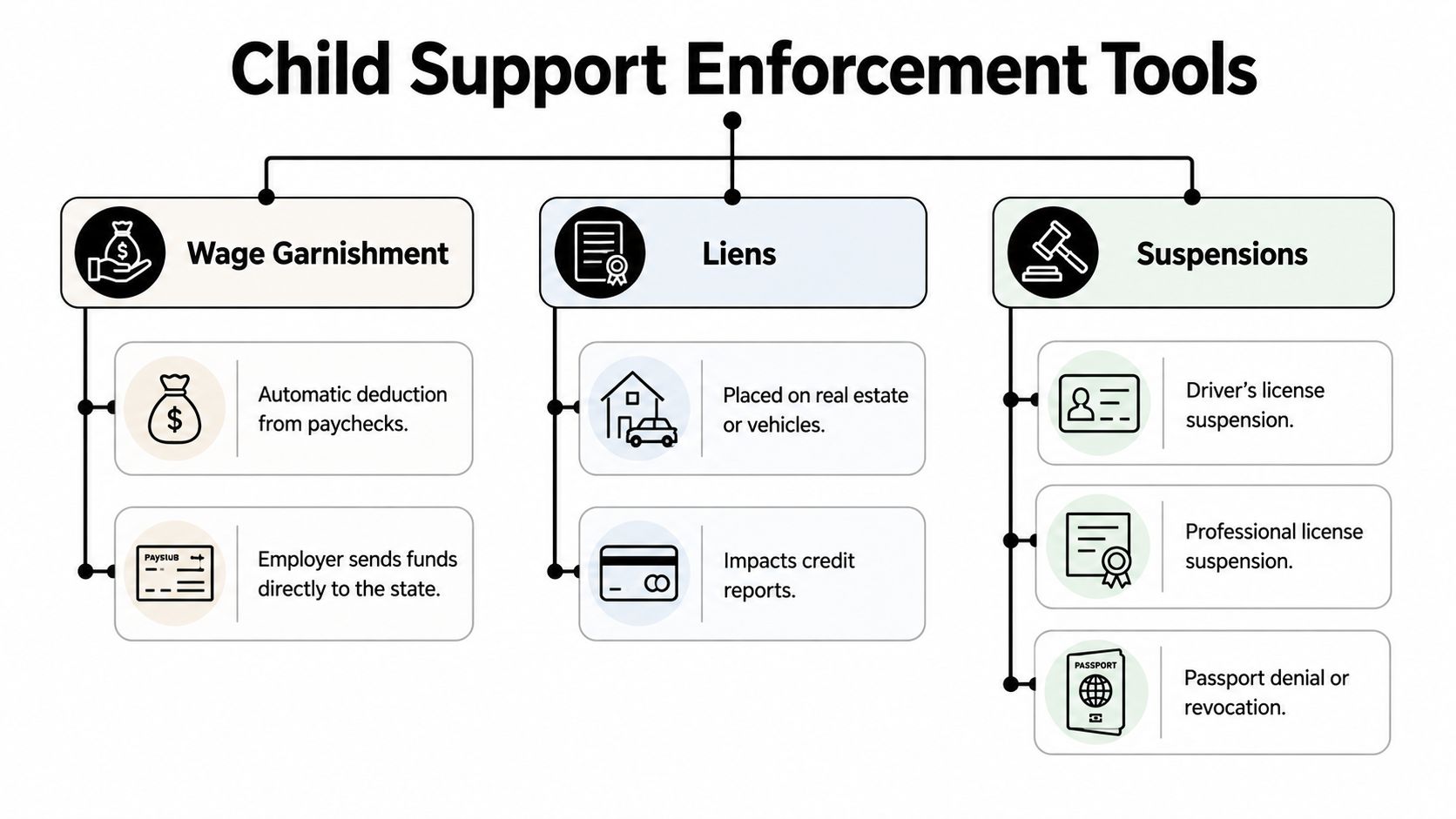
Primary Enforcement Tools Wage Garnishment Liens and Suspensions
When support goes unpaid, Texas uses a stack of civil enforcement tools that are meant to convert a missed monthly obligation into actual collection. The sequence can vary, but the practical pressure points are consistent.
Income withholding usually hits first
Under Texas Family Code Chapter 158, income withholding is one of the most common collection tools. That means support can be taken from wages, bonuses, or commissions before the employee receives the money.
For many parents, this is what people mean when they talk about garnishment. If you want a closer look at how that works locally, this guide on wage garnishment for child support in The Woodlands walks through the basics.
The practical impact is immediate. A parent who thought they could “catch up later” may find the employer already has an order directing where the money goes.
Liens can reach more than people expect
A Texas child support enforcement overview explains that the enforcement stack can include income withholding, tax-refund interception, liens on bank accounts or property, and license suspension. The same source notes that passport access can be blocked once arrears reach the federal threshold of $2,500.
Liens matter because they can reach assets, not just paychecks. In a Montgomery County case, that can affect bank accounts, real estate, and other property interests depending on the posture of the enforcement action.
Unpaid child support doesn't replace the original order. The debt keeps accumulating until a court signs a new order or the arrears are paid.
License problems create pressure fast
License suspension is one of the most disruptive enforcement tools because it spills into daily life and work. A parent may face problems with:
- Driver's license. Missing support can turn into transportation trouble very quickly.
- Professional or occupational license. This can matter for people whose income depends on keeping a credential active.
- Recreational licenses. These are less central to earning income, but they still show how broad the state's reach can be.
For some parents, this is the point where a manageable payment problem becomes a broader employment problem. That is one reason waiting rarely helps.
Texas Child Support Enforcement Mechanisms
| Enforcement Tool | What It Does | Common Trigger |
|---|---|---|
| Income withholding | Directs money from wages or other earnings toward support | Existing order and unpaid support |
| Tax-refund interception | Redirects qualifying refunds toward arrears | Certified overdue support |
| Liens | Attaches to property or accounts to secure payment | Accumulated arrears |
| License suspension | Suspends driver's, professional, occupational, or recreational licenses | Ongoing nonpayment |
| Passport denial | Blocks passport access at the federal threshold | Arrears of more than $2,500 |
What actually works
If you are owed support, complete records matter more than anger. Judges and agencies want dates, amounts due, amounts paid, and the exact order that controls.
If you are behind, the most useful step is not an argument about fairness. It is immediate action aimed at the order itself, especially if your income changed and the current amount is no longer realistic.
Understanding Contempt of Court and Potential Jail Time
Administrative tools are one thing. A court enforcement hearing is another.
When the problem reaches the courthouse, the case often proceeds through a Motion for Enforcement under the Texas Family Code. That filing asks the judge to review the order, identify the missed payments, decide whether the violation was willful, and impose remedies.
The key issue is ability to pay
A Texas contempt and child support discussion states that for willful nonpayment, Texas courts can impose jail time, fines, or probation, and that civil contempt requires proof that the parent had the ability to pay but chose not to. The same source notes courts may impose jail time of up to six months per violation.
That distinction matters in Montgomery County courtrooms. Judges usually focus less on excuses and more on evidence. If a parent experienced a loss of income, medical records, termination paperwork, unemployment records, and a documented job search can matter. If the parent instead prioritized other expenses, the case gets harder fast.
A short real-world scenario
A father in The Woodlands loses steady work and starts making irregular payments. He tells the other parent he'll catch up after the holidays, but he never files to modify support. Months later, he gets served with an enforcement action listing missed dates and amounts.
At the hearing, the judge is not deciding whether life was hard. The judge is deciding whether the order was violated and whether the parent had the ability to comply when each payment came due. If the paperwork shows he had income for part of that period and spent money elsewhere, contempt becomes a real risk.
Courtroom reality: “I meant to pay later” is not a defense to violating a signed order.
Parents also underestimate the consequences of skipping required court appearances. If you want a plain-English example of why failing to appear creates a separate problem, this overview of Colorado FTA consequences is useful as a general comparison. The legal systems are different, but the practical lesson is the same. Ignoring a court date rarely reduces exposure.
OAG hearing versus private enforcement hearing
An OAG-backed enforcement matter often follows the state's process and priorities. A private enforcement case may be more customized, especially when the moving party wants contempt findings, attorney's fees, or very specific relief based on a detailed payment ledger.
That difference can shape how the case is prepared. In a contested Montgomery County matter, pleadings have to be precise. The dates, amounts due, and requested remedies need to line up with the order and the payment record.
A fuller look at that process is available in this discussion of contempt of court in The Woodlands divorce and family cases.
This short video gives added context on how enforcement issues can escalate in real cases.
Can You Defend Against Enforcement or Change Your Obligation
Parents often ask the wrong question. They ask whether job loss, disability, or reduced hours automatically excuses child support. Usually, it doesn't.
The better question is whether you have a valid defense to the enforcement request, and whether you should be filing to modify the support order immediately. Under Texas Family Code § 156.401, a court may modify support when the legal standard is met, including a material and substantial change in circumstances.
Defenses are limited
In enforcement cases, the strongest defenses are usually factual and narrow.
Examples include:
- Proof of payment. If support was paid but not properly credited, records become critical.
- Proof the amount claimed is wrong. Accounting problems happen.
- Proof the order no longer applies in the way alleged. This depends on the actual text of the order and the child's status.
What usually fails is a broad fairness argument. Telling the court that you lost work but never sought a modification is far less effective than showing the court when income changed, what steps you took, and when you filed.
Modification is the proper fix for future payments
A child support order doesn't shrink on its own because income did. Until the judge signs a new order, the old one generally stays in effect.
That is why filing a Petition to Modify the Parent-Child Relationship is often the most important move a paying parent can make. If the parent waits, the arrears continue to grow under the existing order while the case drifts.
If your finances changed, the legal solution is to change the order. It is not to stop paying and hope the court understands later.
What helps your position
Judges respond to documents and timing. Helpful records often include:
- Termination or layoff documents
- Recent pay stubs or proof of reduced income
- Medical records if health affects ability to work
- Job search records
- Proof of partial payments made in good faith
One option for parents dealing with enforcement or modification issues in Montgomery County is to speak with private counsel, including firms such as The Law Office of Bryan Fagan, to review the order, payment history, and whether a modification or defense strategy fits the facts.
A Checklist for Custodial and Non-Custodial Parents
When support is late, individuals need a plan before they need a lecture. Start with records. Then decide whether the problem is temporary, repeated, or already in enforcement territory.
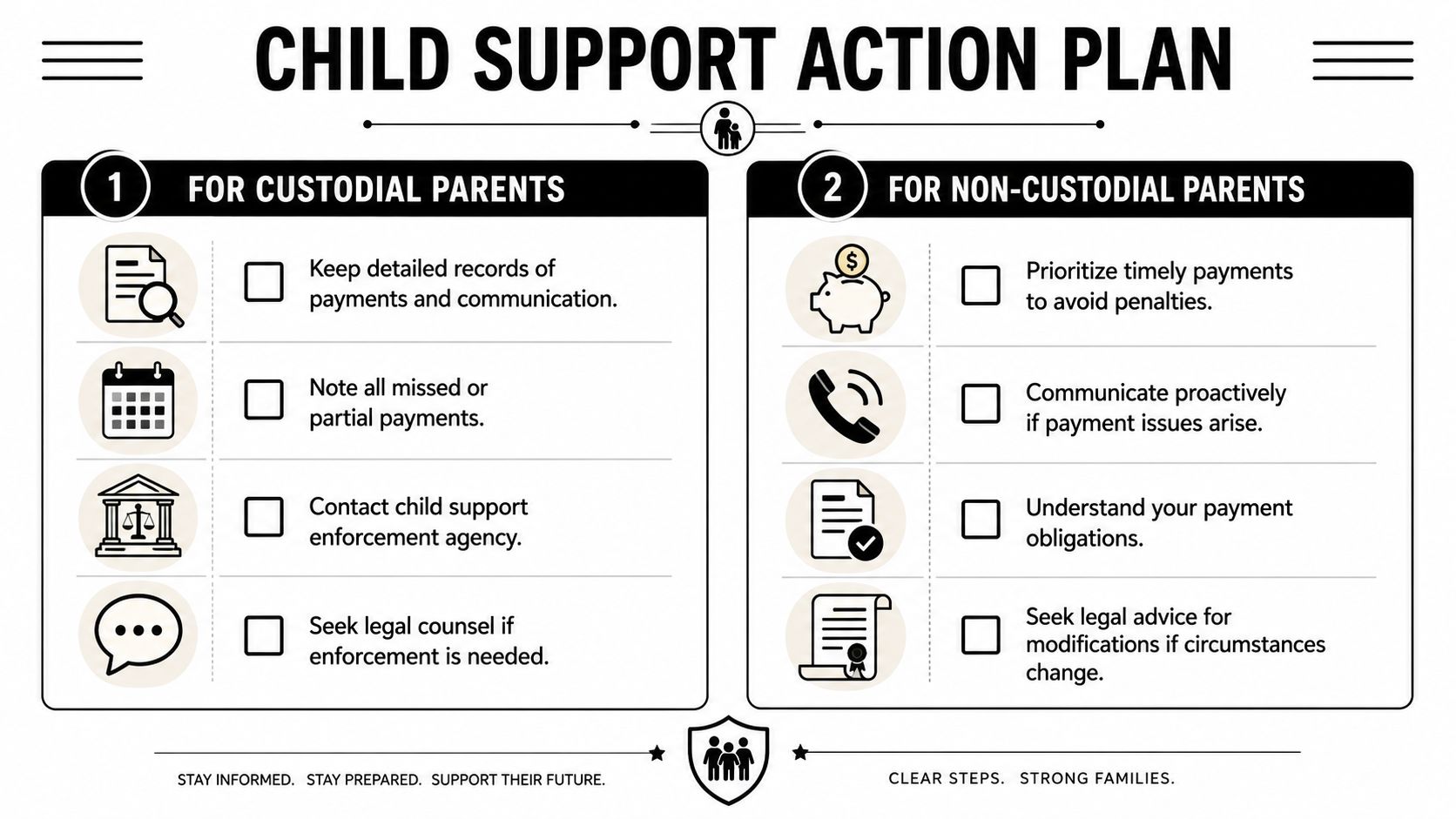
What to do next if you are owed support
- Collect the order first. Keep the signed child support order where you can access it quickly.
- Track every missed or partial payment. Write down dates, amounts due, amounts received, and how payment was made.
- Save communication carefully. Keep texts, emails, and app messages that discuss payment, but don't rely on them as a substitute for court action.
- Open or update the OAG file if needed. The Child Support Division is often the first stop for state enforcement.
- Consider private enforcement if the case is contested. That can make sense when there are repeated violations, disputed records, or a need for court-specific strategy.
What to do next if you are behind
- Don't ignore notices. Missed deadlines and missed hearings create bigger problems.
- Pay what you can. Partial payments usually don't erase the problem, but they may help show effort and reduce the running balance.
- Gather proof of your income change. Job loss, reduced hours, illness, or disability should be documented immediately.
- Review your spending thoroughly. A basic system for Household Budgeting can help you identify what can be redirected toward support while you address the legal side.
- Ask about modification now, not later. Waiting almost never improves your position.
One practical warning for both parents
If you and the other parent agree to change payments, get that agreement reviewed and turned into a court order if appropriate. A handshake may feel cooperative. In family court, it usually creates avoidable risk.
Navigating Child Support Enforcement in Montgomery County
Child support enforcement cases in Montgomery County are rarely just about one missed payment. They are about what happens after the first miss. Texas law gives the system tools to collect, pressure, and, in serious cases, punish noncompliance through the court.
For parents in The Woodlands, the most important practical point is this: the sequence matters. A missed payment can become arrears. Arrears can trigger income withholding, liens, intercepts, suspensions, and eventually a courtroom fight over contempt. Whether the case moves through the OAG or a private enforcement lawsuit changes how personalized the strategy is, but neither route should be taken lightly.
Local realities that matter
Montgomery County judges want clear records, organized pleadings, and evidence that fits the actual order. Parents who come to court with screenshots and frustration but no payment ledger are at a disadvantage. Parents who stop paying without filing for modification usually learn too late that the court separates hardship from legal compliance.
If your family is also dealing with overlapping long-term planning issues, topics like caregiving, capacity, and understanding senior legal issues can affect the broader household picture, even when the child support case itself stays in family court.
For a closer look at local process, this guide to enforcing child support in Montgomery County is a useful starting point.
Important disclaimer
This article is for informational purposes only. It is not legal advice and does not create an attorney-client relationship. Child support enforcement and modification depend on the exact wording of the order, the payment history, and the facts of your case.
If you're dealing with unpaid support in The Woodlands, Panther Creek, Alden Bridge, Sterling Ridge, Creekside, or nearby Montgomery County communities, it usually helps to get case-specific advice before the problem gets larger.
If you need help enforcing a child support order or responding to an enforcement action, you can schedule a consultation with The Law Office of Bryan Fagan to discuss your circumstances and the procedures that may apply in Montgomery County.