 Skip to content
The payment was supposed to hit on Friday. It did not.
By Saturday morning, you are moving money between accounts, delaying groceries, and wondering whether you can cover after-school care in The Woodlands or gas to get across Conroe this week. That is what unpaid child support looks like in real life. It is not an abstract legal problem. It lands in a parent’s checking account, calendar, and stress level all at once.
In Montgomery County, I see parents wait too long because they hope the missed payment is a one-time lapse. Sometimes it is. Often it is the start of a pattern. If you are dealing with that pattern now, enforcing child support montgomery county courts can give you real tools, but only if you use the right process and bring the right proof.
The Financial Strain of Unpaid Child Support in Our Community
A parent in The Woodlands misses one payment from the other parent. Then another. Soon the child’s routine changes. Summer camp may be off the table. A school fee gets pushed to next month. Credit cards start carrying basic household costs that support should have covered.
That spiral is common. It is also why enforcement exists.
This problem is bigger than one household
The national Child Support Enforcement program handled about 14.7 million families in FY2015 and covered about 60% of all cases, yet collection challenges remained significant, according to this Congressional Research Service review summarized by YoungWilliams. That should tell you two things.
First, if support has stopped coming in, you are not alone. Second, even a large enforcement system does not fix a case automatically. Parents still have to act, document the problem, and push the case forward.
What the missed payments usually affect first
In Montgomery County, the first impact is rarely luxury spending. It is the basics.
- Housing pressure: Rent or mortgage payments become tighter when support is inconsistent.
- Child-focused costs: School supplies, sports fees, childcare, and medical co-pays usually get squeezed first.
- Debt buildup: Parents often use cards or personal loans to bridge the gap. If that is happening, practical budgeting help on getting out of debt can help stabilize things while the legal process moves.
- Co-parenting conflict: Missed support often spills into pickup schedules, communication, and disputes about extras.
Practical takeaway: Do not wait for the arrears to become overwhelming before you act. Early enforcement is usually cleaner, cheaper, and easier to prove.
What local parents need most
Statewide articles often stay general. That is not enough when your case is in Montgomery County. The court process in Conroe rewards preparation. Judges want specifics. Clerks want complete filings. The other parent’s excuses get less traction when your records are clean.
That is the practical lens I use on these cases. Not just what Texas law allows, but what tends to work for parents in The Woodlands, Conroe, Magnolia, and nearby communities who need support enforced without wasting months on avoidable mistakes.
Understanding Your Enforcement Options Under Texas Law
Texas gives courts several ways to enforce support. The right tool depends on who you are dealing with. A W-2 employee who ignores an order is a different problem than a self-employed parent paid through an LLC, cash jobs, or irregular contracts.

Wage withholding is often the first and best tool
Under the Texas Family Code, wage withholding is usually the most efficient remedy when the paying parent has regular employment. Money is taken directly from earnings and sent through the proper payment channel.
In practice, this works well when the employer is known and the parent is not hopping between jobs. It works less well when the parent is self-employed, underreports income, or moves from one short-term position to another.
If you need a broader overview of support obligations and related strategy, a child support lawyer in The Woodlands can help evaluate whether withholding alone is enough or whether you need a more aggressive filing.
A motion for enforcement asks the court to act
A motion for enforcement is the formal request that tells the court what order was violated, when the violations happened, and what relief you want. Under the Texas Family Code, this is the backbone of many unpaid support cases.
The court can confirm arrears, enter judgment, order payment terms, and in the right case hold the non-paying parent in contempt.
Contempt is powerful, but judges use it carefully
Contempt matters because it gets a parent’s attention fast. It is also the remedy most likely to fail when the filing is sloppy.
If a non-custodial parent is shown to be in willful non-compliance, Texas courts can impose fines up to $500 per violation and jail time up to 180 days per violation, as described in this discussion of Montgomery County child support enforcement under Texas law.
That does not mean judges in Conroe rush to jail people. Most judges want compliance first. They want support paid. If they believe a parent can pay and is choosing not to, the risk of contempt becomes real.
Key point: Contempt is strongest when you can prove three things cleanly. A valid order existed, payment was due, and the parent had the ability to comply but did not.
Arrearage judgments turn missed support into an enforceable debt
Once arrears are confirmed, the court can reduce them to judgment. That matters because a judgment opens additional collection paths.
For some parents, this is the turning point. A parent who ignored reminders may take a judgment much more seriously because it follows them in a way informal demands do not.
License suspensions and related pressure points
Texas also allows pressure through license-related enforcement. Depending on the case posture and agency involvement, that can affect driving privileges and certain occupational licenses. These remedies are often effective with parents who can pay but need outside pressure to make support a priority.
They are less useful when the parent is already unstable, unemployed, or disconnected from formal systems. In those cases, a payment plan or order modification may be more productive than pure punishment.
Liens and asset-focused remedies
If the other parent owns property or holds valuable assets, enforcement may move beyond paychecks. Liens can become important in the right file. This is especially true in parts of The Woodlands where compensation may come through bonuses, business entities, or nontraditional income streams.
A simple rule helps here:
| Situation | Tool that often works |
|---|---|
| Regular payroll job | Wage withholding |
| Repeated nonpayment with clear ability to pay | Motion for enforcement and contempt |
| Business owner or self-employed parent | Discovery, records review, asset-focused strategy |
| Parent with property or significant accounts | Judgment and lien-based collection pressure |
What usually does not work
Parents often spend too much time on text-message arguments, side agreements, or threats that never become a court filing. Those rarely solve a serious arrears problem.
Also risky: accepting repeated promises without documenting them. If support is already ordered, the question is usually not whether the parent promised to pay. The question is whether they complied with the signed order.
Filing a Motion for Enforcement in Montgomery County
The courthouse process in Conroe is where many support cases either gain traction or stall out. A strong enforcement case is built before filing, not at the hearing.

Start with the order, not the argument
Before anything gets filed, get a complete copy of your current child support order. Not your memory of it. Not a screenshot. The signed order.
Under the Texas Family Code, enforcement depends on the wording of the order. The court needs to see the exact obligation, payment date, and terms that were violated.
Then build a payment history. I tell clients to create a clean ledger showing what was due, what was paid, when it was paid, and what remains unpaid. Bank records, state disbursement records, and payment app records can all matter.
Why the arrears calculation matters so much
In Montgomery County, details win these cases. If your numbers are vague, the other side gets room to argue.
A strong pre-filing arrears audit can matter a great deal. In fact, pre-filing arrears audits with precise calculations can improve the likelihood of successful enforcement by as much as 25%, according to the same Texas-focused enforcement discussion cited earlier. That is why I would rather spend more time preparing the numbers than spend a hearing correcting them.
Tip: If your spreadsheet has guesswork, fix it before filing. Judges do not like approximations in enforcement cases.
OAG or private attorney
Many parents ask whether to go through the Texas Office of the Attorney General or hire private counsel. The answer depends on the case.
The OAG route
The Office of the Attorney General can help with support enforcement. This path can make sense when:
- The facts are straightforward: One order, clear missed payments, known employer.
- You need a public enforcement channel: Some parents prefer to begin with the agency process.
- Cost sensitivity is the main concern: This is often the first reason parents explore the OAG option.
The trade-off is attention and speed. The OAG handles a large volume of matters. You may get process, but not the customized strategy a complex case needs.
The private attorney route
Private counsel is often the better fit when the case is high-conflict or fact-heavy. That includes:
- Self-employment or cash income
- A parent who changes jobs often
- Disputes over credits and offsets
- Interstate complications
- Asset-rich cases in The Woodlands
- Cases where contempt is seriously on the table
A private attorney can also align enforcement strategy with custody, modification, or divorce issues already pending in the same court. If your matter overlaps with a larger family case, this overview of navigating divorce court in Montgomery County, Texas gives useful context about local procedure and expectations.
What to gather before filing
Do not walk into this process with only frustration. Walk in with a file.
- Signed court orders
Get every order that affects support, withholding, and prior modifications. - Payment history
Pull records from the state disbursement unit, your bank, and any payment platforms used. - Your arrears worksheet
List each due date and each missed amount. Keep it simple and readable. - Communication records
Save texts and emails about payment promises, excuses, or admissions of nonpayment. - Employer and address information
Any current job details, business names, work addresses, or social media clues can help with service and follow-up. - Evidence of ability to pay
This can include public business activity, recent purchases, travel, or employment posts. Use good judgment and gather legally.
What the filing usually needs to allege
A proper motion for enforcement commonly identifies:
- The order being enforced
- The specific provisions violated
- The dates of noncompliance
- The amounts unpaid
- The relief requested
If contempt is sought, the pleading must be especially precise. Broad accusations are not enough. The court needs details.
Common filing mistakes in Conroe
Some mistakes show up again and again:
| Mistake | Why it hurts |
|---|---|
| Vague arrears total | The other side argues your numbers are unreliable |
| Missing signed orders | The court cannot enforce what is not properly before it |
| No proof of payment history | You turn a clear case into a factual dispute |
| Asking for too much without proof | Judges become more cautious when the request outruns the evidence |
One practical note about timing
Parents often ask how fast enforcement moves. The honest answer is that timing varies with the court’s docket, service issues, and whether the other parent contests the allegations.
What moves a case faster is not pressure from angry calls. It is complete paperwork, clean service, and evidence that does not need repair after filing.
Navigating the Court Hearing and Potential Outcomes
The hearing day in Conroe feels heavy for most parents. That is normal. The best way to lower that pressure is to know what the judge is looking for and what the other side is likely to say.

What the judge usually wants to see
Most enforcement hearings turn on a short list of issues:
- A valid order exists
- The payment obligation is clear
- The parent did not comply
- The arrears figure is supported
- The parent had the ability to comply, if contempt is requested
That last point is where many cases get contested. Nonpaying parents often say they were sick, out of work, or otherwise unable to pay.
A support agency page from Pennsylvania reflects a point Texas parents should understand too. Medical issues or unemployment are often raised as defenses, which is why a Texas enforcement case needs strong evidence showing nonpayment was a choice rather than a necessity, as discussed on Montgomery County Pennsylvania Support Enforcement.
A short local scenario
A mother from The Woodlands came into court with three things done right. She had the signed order. She had a clean payment chart matching the order’s due dates. And she had records showing the father was still working during the months he claimed he could not pay.
The father argued that work had been inconsistent and that he had fallen behind because life got hard. The judge listened. Then the judge focused on the records. Deposits were still coming in. The missed payments were not random. They lined up with discretionary spending shown elsewhere in the evidence.
The result was not dramatic courtroom theater. It was a practical ruling. The court confirmed arrears and set terms designed to force compliance.
That is how many good enforcement hearings go. Calm proof beats outrage.
Courtroom reality: Judges are far more interested in organized evidence than in who sounds more offended.
What outcomes are realistically on the table
An enforcement hearing can lead to several results, depending on the facts.
Confirmation of arrears
This is common. The court determines what is owed and makes that amount part of the enforceable record.
Payment plan orders
If the court believes the parent can pay over time, it may order a structured catch-up arrangement in addition to current support.
Income withholding and related enforcement
If payroll withholding is available and not already in place, the court may push the case toward automatic collection mechanisms.
Contempt findings
When the proof supports willful noncompliance, the court can impose sanctions. In some cases, that includes suspended commitment or jail consequences if compliance does not follow.
Defenses that show up often
Some defenses are legitimate. Some are tactical. Your job is not to guess which is which. Your job is to prepare for both.
A few examples:
- Job loss: This is stronger when backed by records and a prompt attempt to modify support.
- Medical inability to work: This needs real documentation.
- Payment disputes: The other parent may claim direct payments, credits, or informal agreements.
- Confusion about the order: This usually fails if the order is clear and service was proper.
What hurts the paying parent most is usually not hardship by itself. It is hardship with no records and no effort to seek modification when circumstances changed.
What tends to persuade Montgomery County judges
From a practical standpoint, judges tend to respond well to parties who:
- Bring exact numbers
- Stay focused on the order
- Avoid side arguments about unrelated parenting disputes
- Distinguish missed support from general co-parenting resentment
If your hearing becomes a forum for every complaint in the relationship, your strongest enforcement points can get buried.
Advanced Strategies for Difficult Collection Cases
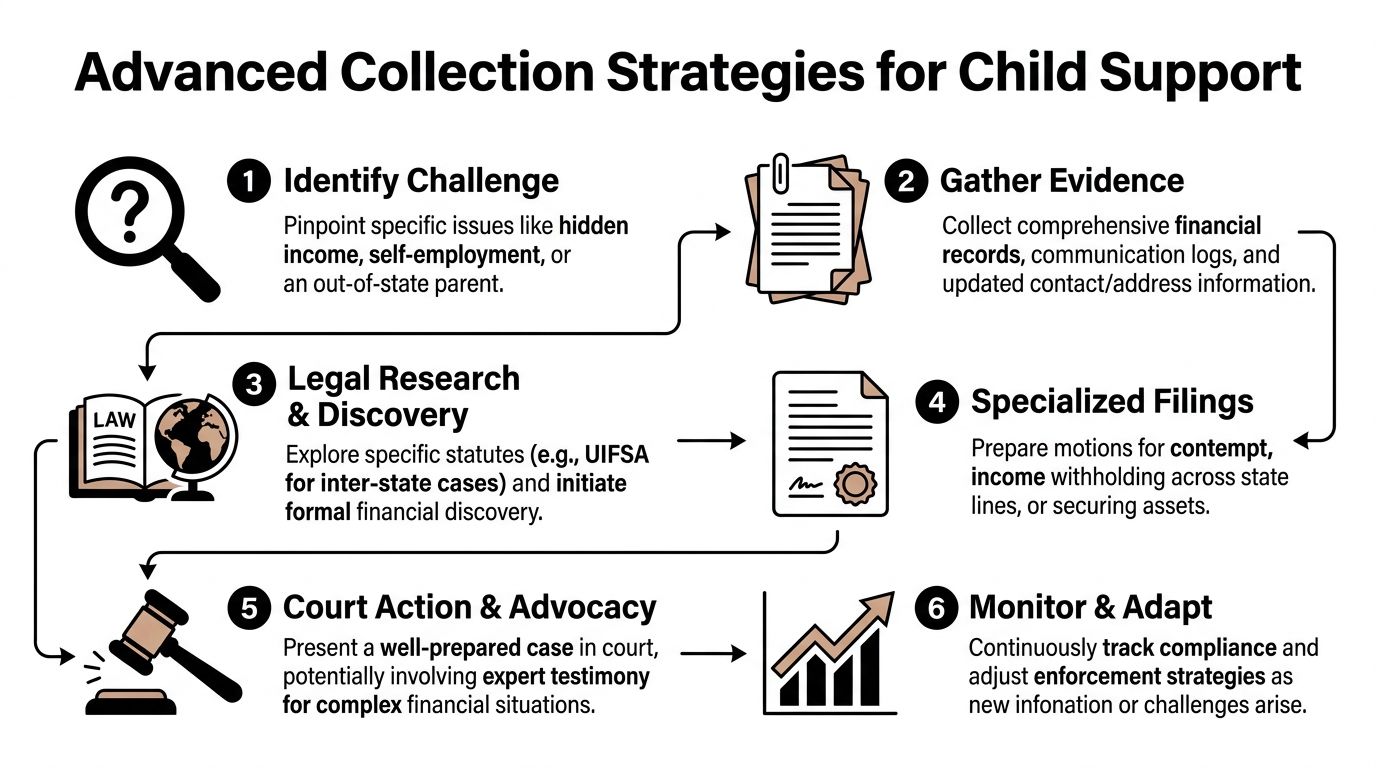
A Conroe parent finally gets a hearing date, only to learn the other parent is now working through an LLC, getting paid irregularly, and using someone else’s mailing address. That is the point where a standard enforcement approach starts to break down. Difficult cases require a tighter plan, better records, and a clear sense of what actions Montgomery County judges will prioritize for.
Hard cases are won or lost on proof
In straightforward payroll cases, payment records often tell the story. In difficult collection cases, they usually do not.
If the parent is self-employed, paid in cash, or mixing personal spending with business accounts, the court needs more than suspicion. Subpoenas, business records, bank statements, tax returns, payment apps, and testimony from third parties often make the difference. In Montgomery County, judges in Conroe usually want a clean trail from the missed obligation to the financial reality. If the evidence is scattered, the hearing loses force fast.
Locating a parent is often a records problem
Parents who want to avoid support rarely announce where they work or live. The practical answer is usually not guesswork. It is targeted information.
Employment records, business filings, appraisal district records, social media used alongside harder documentation, and prior court filings can help identify where the parent can be served or where assets may exist. In out-of-state cases, small errors in addresses, dates of birth, or employer details can stall enforcement for months. Accuracy matters more than volume.
Self-employment cases require a different approach in The Woodlands and Conroe
A parent may claim low income while paying for travel, vehicles, business overhead, or a higher standard of living than the numbers suggest. Courts can consider more than a claimed paycheck when the full financial picture points the other way.
Texas Family Code §154.123 can matter here, especially when the reported income does not match actual resources or earning ability. In some cases, enforcement should be reviewed alongside a support adjustment. A parent who has been underpaying because the order is outdated may raise issues better addressed through a child support modification in The Woodlands while enforcement continues on the amounts already due.
Lifestyle evidence can help, but it has to be tied to admissible proof. Photos of vacations or a new truck may support the story. Standing alone, they rarely carry the case.
Interstate cases move slower and punish sloppy paperwork
Texas can enforce support across state lines, but interstate files are more technical and less forgiving. UIFSA procedures, registration requirements, service issues, and state-to-state coordination create delay even when the claim is valid.
The practical problem for families in Montgomery County is timing. A case that would be routine in Conroe can slow down once another state’s agency or court gets involved. Current addresses, employer information, license details, and identifying information should be checked before filing, not after the file starts drifting.
A strategy that fits the facts
Different collection problems call for different pressure points.
| Problem | Better strategy |
|---|---|
| Parent is paid in cash or through a business | Financial discovery and document subpoenas |
| Parent moved out of Texas | Interstate enforcement with careful service and registration steps |
| Parent understates income | Income imputation analysis under Texas Family Code |
| Parent owns property but ignores support | Judgment-focused collection pressure and asset review |
What wastes time in these cases
Three mistakes show up often in hard files.
- Treating a business owner like a W-2 employee: Wage withholding may help, but it rarely answers where the money is really going.
- Building the case around social media posts: Those posts may support impeachment or credibility issues, but they do not replace financial records.
- Waiting too long to change course: If the original order no longer fits the parent’s real income, enforcement alone may not solve the larger problem.
In especially contested cases, local counsel can connect enforcement, discovery, modification questions, and pending family court issues in one strategy. That is the practical value of working with a Montgomery County family law office such as The Law Office of Bryan Fagan. The point is not branding. The point is having someone who knows how these issues are usually handled in Conroe and how to present a hard collection case without letting it sprawl into every grievance between the parents.
Your Action Plan and When to Seek Legal Help
At some point, every parent asks the same question. Can I handle this through the system myself, or do I need a lawyer now?
The answer depends less on how upset you are and more on how complicated the file has become.
What to do next
Use this checklist first.
- Get the signed order: Make sure you have the exact child support order and any modification orders.
- Build a payment ledger: Match each due date with what was paid and what was missed.
- Collect supporting records: Bank statements, state payment histories, texts, emails, and employer information all help.
- Decide on your path: Straightforward cases may begin with the OAG. Complex or contested cases often justify private counsel early.
- Think ahead about proof: If the other parent will claim job loss, illness, or confusion, gather the evidence that answers those points.
- Stay focused on support: Keep unrelated custody frustrations out of your enforcement presentation unless they directly matter to the issue before the court.
When legal help becomes important fast
Some cases should move to an attorney quickly:
- The other parent is self-employed
- You suspect hidden income or assets
- The parent lives out of state
- The case is high-conflict
- Your records are messy and need reconstruction
- You may need contempt relief
- The order itself may need enforcement and modification analysis at the same time
For complex files, especially in The Woodlands, proving actual earning ability can require more than pay stubs. Under Texas Family Code §154.123, income imputation using deviation factors, affidavits, and expert testimony can be effective. One verified benchmark notes this strategy is 70% successful when properly evidenced with affidavits and expert testimony, according to this discussion of advanced child support strategy.
One final caution
This article is for general educational information only. It is not legal advice. Child support enforcement turns on the exact language of your order, the facts of your case, and local court procedure in Montgomery County.
If support has stopped and the case is starting to get complicated, schedule a consultation before the arrears issue grows harder to fix.
If you need practical guidance on enforcing child support in Montgomery County, The Woodlands, or Conroe, consider scheduling a consultation with The Law Office of Bryan Fagan. A consultation can help you evaluate the order, the arrears proof, and whether your case calls for standard enforcement, contempt, modification, or a more targeted collection strategy.
