 Skip to content
Your ex was ordered to do something after the divorce, and they’re acting like the decree is optional.
Maybe child support hasn’t shown up for months. Maybe possession exchanges in Sterling Ridge keep getting blocked with last-minute excuses. Maybe the house in Panther Creek was supposed to be refinanced, but your name is still on the mortgage and your credit is taking the hit. In Montgomery County, those problems aren’t just frustrating. They can become enforcement and contempt issues.
When people search for contempt of court divorce The Woodlands, they’re usually already past the point of polite reminders. They’ve texted. They’ve emailed. They’ve tried to keep the peace for the kids. Nothing changed. At that stage, the practical question is simple. What will a judge in Montgomery County do, and how do you put the problem in front of the court the right way?
A divorce decree is a court order. It is not a suggestion, and it is not something either side gets to rewrite after the fact. If an ex-spouse is ignoring clear obligations, Texas law gives the court tools to enforce compliance. Used correctly, those tools can restore support, protect parenting time, and force action on property issues that have been dragging on far too long.
Your Divorce Decree is Being Ignored What Now
A common call starts like this. “We got divorced. The order is signed. I thought this part was over.”
Then reality hits. The parent in Creekside Park who was supposed to pay support misses one payment, then another. The parent with the child says exchanges can’t happen because of a “schedule change,” even though the possession order is clear. The spouse who was ordered to sign title paperwork never does, so the car and insurance stay tangled up long after the marriage ends.
That’s where many people in The Woodlands feel stuck. They know there’s a court order, but they don’t know whether the court will care about violations that happen after the divorce. The answer is yes. Courts care a great deal when a party ignores a signed order.
Why waiting usually makes the problem worse
Delay creates two kinds of trouble.
First, the facts get muddy. Dates blur together. Screenshots disappear. Bank records become harder to match to missed obligations. Second, the violating party gets comfortable. Once someone learns there’s no immediate consequence, the behavior often spreads from one missed duty to several.
Practical rule: The first time you see a pattern, start documenting it like a judge will read it later.
In family court, contempt is the mechanism the judge can use to address deliberate noncompliance. But it only works well when the underlying order is specific and the violations are tracked carefully. “He never helps” is not useful in court. “He missed support due on these dates” or “she denied pickup at this location under this paragraph of the decree” is useful.
The first question to ask
Before talking about punishment, ask this: What exactly does the order require?
Texas courts enforce clear obligations. If the decree says a party “should cooperate,” that language may be too vague for contempt. If it says a party must pay a defined amount, sign a deed, transfer title, or surrender the child at a stated time and place, that is much stronger enforcement language.
If your order is being ignored, the goal isn’t to escalate emotion. The goal is to restore compliance fast, with a record the court can act on.
Understanding Contempt of Court in a Texas Divorce
You have a signed decree. Pickup was supposed to happen at 6:00 p.m. in The Woodlands. The other parent does not show, then sends a text three hours later acting like the order was optional. In Montgomery County, that is the kind of problem that can turn into an enforcement case fast, but only if the order is specific enough and the violation can be proved cleanly.
A Texas divorce decree is a court order, not a suggestion. If a party disobeys a clear provision, the judge who signed that order has power to enforce it through a Motion for Enforcement and, in the right case, contempt.

What contempt means in real life
In practice, contempt usually turns on three questions.
Was the order clear enough that a person could read it and know exactly what to do? Did that person know about the order? Did the person choose not to comply, instead of being genuinely unable to comply?
That third issue is where many cases are won or lost. A judge in the 410th or 418th District Court is not looking to punish confusion created by sloppy wording in a decree. The judge is looking for a clear command, a clear violation, and proof that the violation was deliberate.
That is why wording matters so much. “The parties will cooperate” is weak contempt language. “Father shall surrender the child at 6:00 p.m. at the front entrance of the H-E-B on Research Forest” is much easier to enforce. The same goes for money and property terms. A defined amount due on a defined date is enforceable. A vague promise to “help with expenses” usually is not.
Civil contempt and criminal contempt serve different purposes
Texas courts can use civil contempt, criminal contempt, or both. The label matters because the court is trying to do one of two different jobs.
Civil contempt is meant to force compliance. If someone has not turned over documents, signed a deed, or paid an amount the court ordered, the judge can use civil contempt to pressure that person to do it.
Criminal contempt addresses past disobedience. It punishes a completed violation of the court’s order.
| Feature | Civil Contempt | Criminal Contempt |
|---|---|---|
| Main goal | Get compliance with the order | Punish a past violation |
| Typical use in divorce cases | Support arrears, signing transfer documents, delivering property, following possession terms | Repeated or serious disobedience after clear notice |
| Practical effect | Compliance can affect the outcome and sometimes the duration of sanctions | The punishment is based on what already happened |
In plain terms, civil contempt is about getting the order followed. Criminal contempt is about the court defending its authority.
How Montgomery County judges usually look at these cases
Local procedure matters. In Montgomery County, enforcement hearings are not won by broad complaints. They are won by careful pleading and specific proof tied to the exact paragraph of the decree or order.
That means each alleged violation should usually be broken out by date, duty, and paragraph number. If support was due on the first of each month and three payments were missed, that is not one general complaint. It is three separate alleged violations. If a parent denied possession on two weekends, each denial needs its own details.
Judges here expect precision. They also move busy dockets. A clear enforcement pleading, organized exhibits, and a realistic request for relief make a real difference.
What a court can do if contempt is proven
Contempt has teeth. A court can fine the violating party, order jail time in some cases, award attorney’s fees, and issue orders designed to secure future compliance. The court can also grant other enforcement remedies that do not depend on a contempt finding, which matters when part of the order is enforceable but another part is too vague for contempt.
That trade-off comes up often. A client may want punishment. The better strategy may be an order that gets the deed signed, the money paid, or the possession schedule followed without spending months fighting over a jail request the court may never grant.
What contempt does not fix
Contempt is not a cure for every post-divorce dispute.
It does not repair a badly drafted decree. It does not replace a modification when circumstances changed after the divorce. It also does not help much when the accusing party has a strong story but weak records.
The strongest enforcement cases in Montgomery County are disciplined. They match the decree language to a specific act, on a specific date, with proof attached. That is what gives the court something it can enforce.
Common Contempt Scenarios in The Woodlands Divorces
You pull into the school pickup line in The Woodlands on a Friday, decree in hand, and your child is not released. Or you check the bank account and the support payment due on the first still has not arrived. Or the house was awarded to you months ago, but the deed transfer never happened. Those are the disputes that bring people back to court in Montgomery County.
Most enforcement cases I see in local divorce courts fall into three categories. Support and money issues. Possession and access problems. Property transfer failures. The pattern matters because each type of violation usually calls for different proof, different relief, and a different level of urgency before a hearing in the 410th or 418th District Court. If you are still trying to figure out which court handled your divorce, this overview of the Montgomery County divorce court system can help you place the case.

Financial violations
Missed child support is the scenario clients ask about most often. Partial payments can also create enforcement problems if the order required a specific amount on a specific date. The same is true for unpaid medical reimbursements, ordered spousal maintenance, or a lapse in insurance coverage that the decree required one party to maintain.
Details decide these cases.
A judge in Conroe will want to see the exact payment duty in the decree, the due date, the amount due, the amount paid, and the running total of the shortage. A bank statement, Attorney General payment record, reimbursement request, or insurance cancellation notice usually carries more weight than a long explanation about why the other side has been difficult.
A practical checklist for money violations includes:
- The decree or support order with the payment language highlighted
- A payment ledger by date and amount
- Proof that reimbursement requests were sent
- Bills, receipts, and insurance records
- A clean summary showing the total still owed
If you are filing on your own, this guide on how to file court documents may help with the mechanics, but the harder part is organizing the evidence so the court can follow it quickly.
Parenting time violations
Possession disputes are usually more emotional and more fact-sensitive.
A parent in Sterling Ridge may arrive at the exchange location and wait with no response. A parent in Creekside may be told at the last minute that the child has a birthday party and will not be coming. Sometimes the interference is less obvious. Late drop-offs that happen every weekend, blocked phone calls during extended possession, or repeated demands that a parent "trade weekends" outside the written order can add up fast.
These cases often turn on discipline. Save the text thread. Note the time you arrived. Keep a possession calendar. If another adult saw the denial, write down that person's name while the details are fresh.
One mistake hurts a lot of otherwise good cases. A parent gets denied possession, then keeps the child the next time "to make it even." That usually gives the other side a complaint too, and it shifts attention away from the original violation.
Property division violations
Property contempt issues are common after final orders are signed, especially when the decree required follow-up paperwork. One spouse must sign a deed. One must transfer a vehicle title. One must turn over retirement forms, release personal property, or cooperate with listing and selling a home.
These disputes are common in The Woodlands because many divorces involve real estate, business interests, retirement accounts, and loans that require several post-decree steps. The divorce may be final, but the paperwork often is not.
A typical example looks like this. The decree awards the house to one spouse and orders the other to sign transfer and refinance documents by a stated deadline. Weeks pass. The title company sends requests. The lawyer sends reminders. Nothing gets signed. The spouse who was awarded the home remains tied to debt, cannot complete the refinance, and keeps paying for a problem the decree was supposed to resolve.
That kind of delay is often enforceable if the order was specific enough. The strongest property cases usually include the decree language, the actual documents sent for signature, email follow-up, and a timeline showing each missed deadline.
Here’s a short overview that many clients find helpful before a hearing:
What tends to help, and what usually hurts
The best contempt cases are organized around acts, not frustration. One missed payment date. One denied exchange. One unsigned deed packet. Judges can act on that.
Cases weaken when the proof depends on side agreements, memory, or broad claims that the other party has been unreasonable for months. Bring the order. Bring the dates. Bring the records. In Montgomery County, that practical approach usually does more for a client than anger ever will.
The Montgomery County Enforcement Process Step by Step
Your ex misses a court-ordered pickup on Friday, ignores the decree’s deadline to reimburse medical expenses on Monday, and by Wednesday you are asking the same question I hear in my office every week. What does Montgomery County make you do to enforce the order?
The answer is more procedural than many people expect. In The Woodlands and Conroe, enforcement cases usually rise or fall on whether the paperwork is precise, service is done correctly, and the hearing proof matches the motion. In courts such as the 410th and 418th District Courts, judges expect specificity.
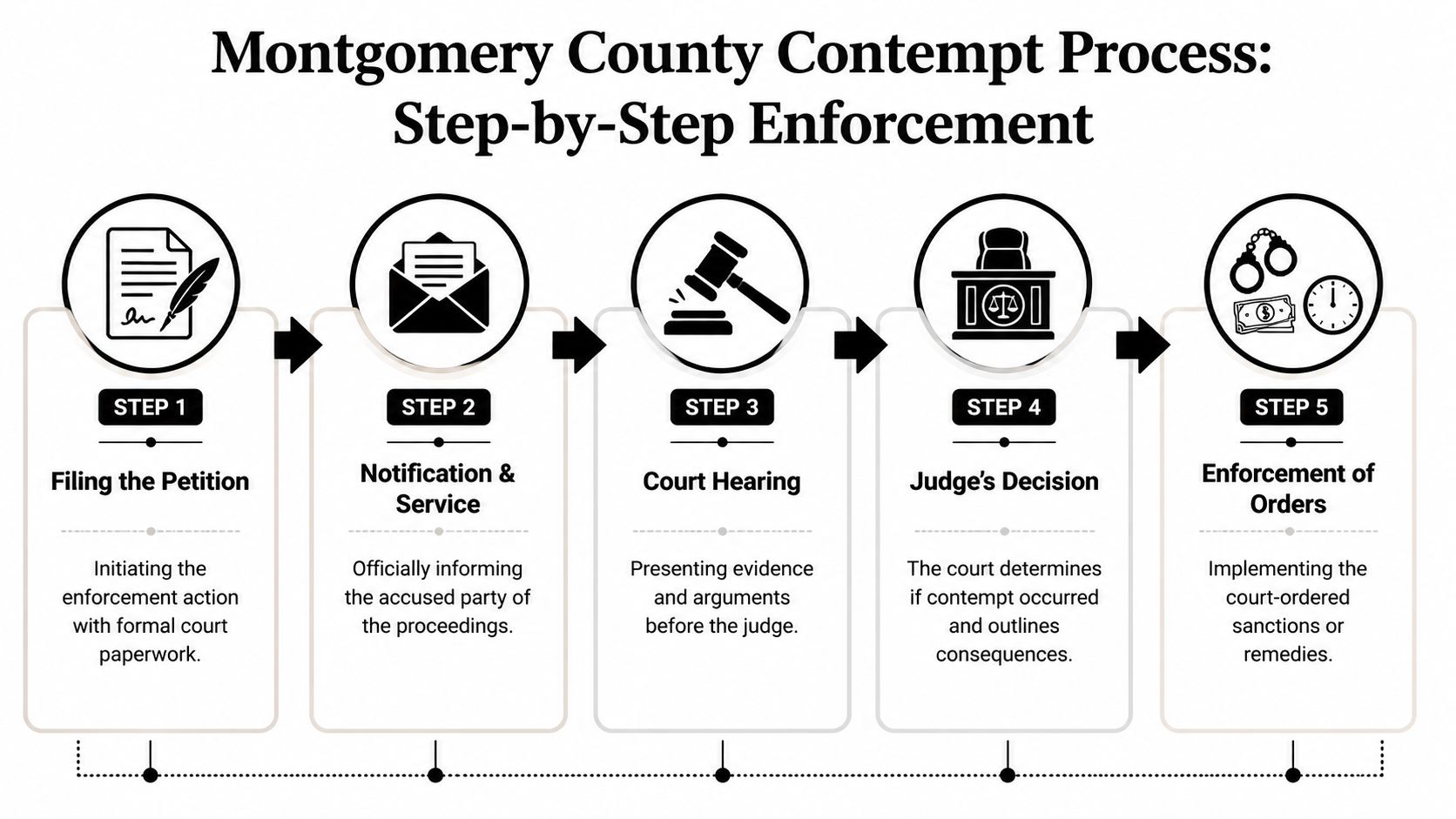
Step one, prepare the motion correctly
The usual starting point is a Motion for Enforcement under the Texas Family Code. In a contempt case, the motion has to do more than say the other party ignored the decree. It must identify each violation clearly enough that the court can enforce it and the other side has fair notice of what they must answer.
A workable motion usually includes:
- The exact order language that was violated
- The specific date or dates of each violation
- What the person failed to do, or did in violation of the order
- The relief requested, such as contempt, attorney’s fees, makeup time, turnover of property, or signing documents
A local enforcement overview notes that organized evidence improves the odds of success and that Montgomery County settings can move relatively quickly in some cases. It also discusses the practical difference good drafting makes in enforcement filings: Montgomery County enforcement discussion.
If you’re handling document assembly yourself, a general guide on how to file court documents can help with formatting and submission basics. It does not replace legal advice, but it can reduce avoidable filing mistakes.
Step two, get service done the right way
This step causes more delays than clients expect.
If you are asking the court to hold someone in contempt, notice has to be handled properly. A forwarded email, a text, or a casual agreement that the other side “knows about it” is often not enough. Formal service matters because contempt can lead to serious penalties, and judges are careful about due process.
In practice, a good case can stall for weeks if service is defective. I tell clients to treat service as part of the case, not a clerical afterthought.
Step three, get ready for the court setting
Once the case is filed and served, the court will set it for hearing. The timing depends on the court’s docket, the kind of relief requested, service issues, and whether the case needs more than a short setting. The same local source linked above discusses Montgomery County enforcement timing and common scheduling expectations.
By the time you reach the hearing date, the presentation should be tight. Judges in Conroe usually want the same core questions answered quickly. What did the order require? What happened instead? What proof shows the violation? What exact relief are you requesting today?
A practical hearing folder often includes:
- A file-stamped or certified copy of the order
- A short timeline of violations
- Payment records, ledgers, or bank proof
- Texts, emails, and screenshots in date order
- Any witness names and what each witness will prove
- A proposed enforcement order with the relief requested
For local court context, this overview of Montgomery County divorce court procedure helps explain where these hearings are typically handled.
Step four, prove the violation and address willfulness
At the hearing, the court is not deciding who has been more frustrated since the divorce. The court is deciding whether a clear order existed, whether the respondent violated it, and in a contempt request, whether that violation was willful.
That distinction matters. If the order required a parent to appear for an exchange at 6:00 p.m. at a named location, and your records show the parent refused, that is the kind of specific proof a judge can use. If the dispute is built around vague complaints, changing side agreements, or conversations no one documented, the case gets harder fast.
The responding party may raise defenses such as inability to comply, lack of clarity in the order, or lack of proper notice. Some defenses are real. Some are not. The court will look closely at whether the person could not comply, or chose not to.
Step five, get an enforceable result
If the court finds a violation, the remedy depends on the type of order, the proof, and the relief properly requested in the motion. The local enforcement source already cited notes that available remedies in these cases can include fines up to $500 per violation, attorney’s fees, and jail time in some contempt situations, along with orders compelling compliance.
The hearing order needs just as much attention as the original filing. If the judge orders missed support paid by a certain date, makeup possession on defined weekends, or signing of property documents by a specific deadline, those details matter. A vague win on paper is harder to enforce later. A precise order gives the court something it can act on if the problem continues.
In Montgomery County, the strongest enforcement cases are usually the ones built like a checklist. Clear order. Clear violation. Proper service. Focused proof. Specific relief.
Gathering Your Evidence for a Contempt Case
The strongest contempt cases are built before anyone walks into court.
If you’re dealing with an ex-spouse who ignores the decree, your first job is to stop arguing and start collecting. Judges decide these cases from documents, timelines, and credible testimony. Good evidence turns a stressful story into a clear legal claim.

For unpaid support or other financial violations
Start with the order itself. Then match each required payment to what was paid.
Useful evidence often includes:
- The signed decree or support order with the exact payment terms
- Bank records showing deposits or missing deposits
- Payment histories or ledgers organized by due date
- Messages about nonpayment if the other side admits delay or refusal
- Proof of related obligations such as insurance or reimbursement duties if the order is specific
The goal is simple. Make it easy for the judge to see the obligation and the missed performance side by side.
For denied visitation or possession interference
Custody enforcement cases are won with detail.
Keep a running log. Write down the date, time, pickup location, and what occurred. Save calm communications. If another adult witnessed the denial, note that person’s name and contact information.
A good possession log often includes:
| Item | Why it matters |
|---|---|
| Date and time of exchange | Shows exact violation point |
| Location | Matches the order language |
| Communication screenshots | Confirms refusal or interference |
| Witness information | Supports your version of events |
| Photos or call logs if relevant | Adds context when disputed |
If your issue centers on parenting-time enforcement, this page on enforcing a custody order in The Woodlands is a useful next read because custody violations often require a tighter factual timeline than clients expect.
For property division disputes
Property cases often turn on paperwork and follow-up.
If the decree required a deed, title transfer, refinance cooperation, or sale-related action, gather every draft, request, response, and deadline. Keep the communications in date order. If a title company, lender, or realtor sent written requests that were ignored, preserve those too.
When documents have changed over time, side-by-side review can help you spot what was altered or left unsigned. For that kind of document organization, CatchDiff's document comparison insights can be useful as a general workflow idea for comparing versions before you hand materials to your lawyer.
Save original files and screenshots. Don’t edit them, crop out dates, or forward them so many times that the metadata and sequence become confusing.
What not to do with evidence
Don’t manufacture a cleaner story than the facts support. Don’t delete messages that make you look upset. Don’t annotate screenshots with commentary that later becomes distracting.
A solid contempt file is usually boring. That’s a good thing. It reads like a business record, not a fight.
Potential Sanctions Remedies and Defenses
The question clients usually ask is direct. “What can the judge do?”
The answer depends on the violation, the wording of the decree, and the proof presented. In family court, the judge’s job is not only to punish. It is also to restore compliance and protect the children, money, or property interests affected by the violation.
Remedies the court may use
In the right case, the court can order contempt sanctions and practical remedies that fix the underlying problem.
Possible outcomes may include:
- Payment of arrears when support or maintenance wasn’t paid as ordered
- Attorney’s fees when the Family Code supports shifting fees to the noncompliant party
- Fines for proven violations within the court’s contempt power
- Jail consequences in serious cases involving willful disobedience
- Orders compelling action such as signing transfer documents or completing required steps
- Makeup possession or corrective parenting relief in access-related disputes
For parents focused on unpaid support, this resource on enforcing child support in Montgomery County gives a more issue-specific look at one of the most common enforcement categories.
Sanctions versus solutions
Not every client needs the harshest outcome. Sometimes the best result is quick compliance backed by a firm court order. In other cases, a pattern of excuses has gone on so long that stronger sanctions are the only thing that gets movement.
That trade-off matters. A contempt case should be built around the result that helps you and your children, not around anger.
For example, if the ex-spouse’s refusal to sign closing documents is a true financial emergency, then an order compelling execution may matter more than arguing over every ugly text message exchanged along the way.
Common defenses the other side may raise
The most common defense is some version of inability to comply.
Sometimes that defense is legitimate. Job loss, medical problems, or a real impossibility may change how the court sees the case. But the defense usually needs proof. Courts are skeptical when someone claims inability after ignoring the order and failing to seek modification or relief through proper channels.
Other common defenses include:
- The order was unclear
- I didn’t receive proper notice
- The violation was accidental
- We had a side agreement
- I substantially complied
Some of those arguments work better than others. Side agreements are especially risky in family cases. If the signed order says one thing and the parties informally did another, the judge may still enforce the written order.
The cleanest defense is usually a documented reason the person could not comply and a prompt effort to address the problem lawfully. Silence and delay rarely help.
What usually persuades the court
Judges tend to respond to credibility and structure.
A party who appears organized, measured, and focused on the written order usually has an advantage over a party who talks in circles, blames everyone else, or admits they decided the order was unfair and ignored it. In contempt proceedings, the court is deciding more than facts. It is deciding whether someone respected the authority of the order at all.
What to Do Next A Practical Checklist
If your ex-spouse is violating the decree, the best next move is a disciplined one.
You do not need to solve the whole case today. You do need to protect the record, avoid making things worse, and get clear about what the order says.
What to do next
- Pull the signed order first: Find your divorce decree, child support order, or modification order. Read the exact language that was violated.
- Mark every violation: Create a simple timeline with dates, missed payments, denied exchanges, or unsigned property documents.
- Save evidence in one place: Keep screenshots, bank records, emails, and calendars in folders by issue and date.
- Stop side negotiations that blur the record: If you keep changing terms informally, you may make enforcement harder.
- Don’t retaliate: Don’t withhold the child, stop complying on your side, or block communication because the other person broke the rules.
- Write down what outcome you need: Payment, makeup possession, signed title documents, or another concrete remedy.
- Review local court procedure: Montgomery County enforcement cases move better when the filing is specific and organized.
- Talk to a family lawyer promptly: A lawyer can tell you whether you have a contempt case, an enforcement issue without contempt, or a modification problem instead.
One more practical point
A lot of people confuse “unfair” with “enforceable.” Courts can enforce clear written duties. They are less helpful when the complaint is broad, emotional, or based on what one side thought the decree meant.
That’s why a calm paper trail beats a long argument almost every time.
If you’re still trying to get your footing emotionally while handling the legal side, a broader practical guide to divorce can help you think through day-to-day coping and communication outside the courtroom. It won’t replace legal strategy, but it can help you stay steady while the process moves forward.
This article is not legal advice. It is general information about Texas family law and Montgomery County divorce enforcement practice. Every case depends on the exact order language, the available evidence, and the facts in front of the court.
If you’re dealing with contempt of court divorce issues in The Woodlands, The Law Office of Bryan Fagan handles family law enforcement matters involving support, custody, and property orders in Montgomery County. If you want a clearer view of your options, scheduling a consultation is a practical next step.
