 Skip to content
A parent in The Woodlands gets a job offer in another state. The pay is better. Family support is there. Housing may be easier. Then the important question arises. Can a parent move away with a child in Texas?
The answer usually isn't yes or no. It depends on your court order, your current custody setup, and how the move affects the child's relationship with the other parent. In Montgomery County, parents often assume the issue is mileage. It usually isn't. The first thing I look for is whether the existing order restricts where the child can live.
That single point can decide whether a move is simple, negotiable, or headed straight into court.
A New Job Offer and a Difficult Choice in The Woodlands
A common local example looks like this. A parent in Alden Bridge or Conroe receives an offer to move to Oklahoma, Colorado, or Louisiana. The new job solves real problems. Better hours. Better support from grandparents. A safer landing after divorce or separation.
But there's another parent here in Montgomery County. That parent sees school pickups, midweek dinners, baseball practice, doctor visits, and ordinary time with the child slipping away. Both parents may have good reasons. That's what makes relocation cases hard.
The problem starts before the boxes are packed
Parents often ask the wrong first question. They ask, “How far can I move?” The better question is, “What does my order allow?”
In family law cases around The Woodlands, the practical issue is usually whether your current order limits the child's primary residence to Montgomery County or a group of nearby counties. If it does, moving outside that area without proper approval can create legal trouble quickly.
A relocation case is rarely about whether a move sounds reasonable to a parent. It's about whether the move fits the existing order and whether the child's life will remain stable.
There's also a life-planning side to this that families can't ignore. Housing, schools, transportation, and support systems all matter. If you're sorting through the practical side of a family relocation, MCHA's family moving advice gives a useful non-legal checklist to think through before you make commitments.
What worried parents usually need first
Most parents don't need a lecture. They need clarity on a few immediate points:
- Your current order. Is there a geographic restriction?
- The other parent's position. Are they open to an agreement?
- Your timing. Have you already accepted the job, signed a lease, or enrolled the child?
- Your proof. Can you show how the move benefits the child, not just you?
If you live in The Woodlands, Panther Creek, Sterling Ridge, Creekside, or nearby parts of Montgomery County, those questions should be answered before you announce a move as a done deal.
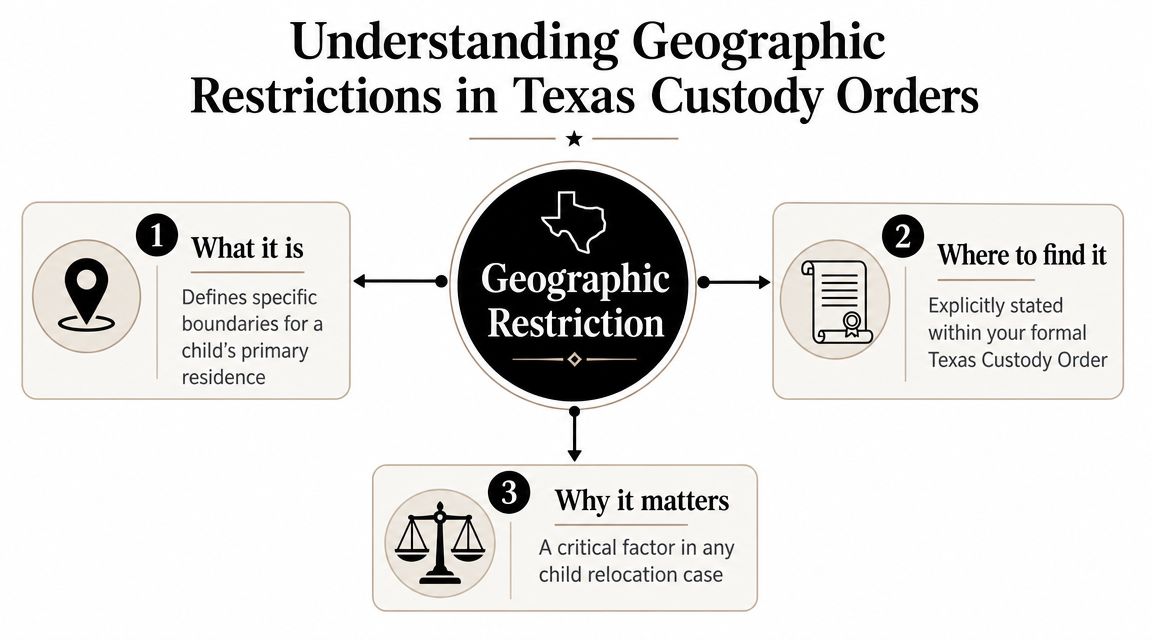
The Geographic Restriction in Your Texas Custody Order
In Montgomery County relocation cases, the answer usually starts with one document. The signed SAPCR order, divorce decree, or prior custody order controls who can choose the child's primary residence and where that residence can be located.
What the restriction does
A geographic restriction limits the area where the child's primary residence may be established. In many Montgomery County cases, that means Montgomery County alone or Montgomery County plus certain contiguous counties. Some orders use different wording, so the exact language matters.
The question is usually not how far the new home is from The Woodlands. The question is whether the move falls outside the area allowed by the order.
Practical rule: A parent may have the exclusive right to determine the child's primary residence and still be restricted to a defined area. If the new address is outside that area, the parent usually needs the other parent's written agreement in a form the court can enforce, or a modified court order. This discussion of Texas child custody laws on moving out of state gives a broader overview of how relocation disputes develop.
That point trips up parents in The Woodlands all the time. A new job in Dallas, family support in Austin, or a remarriage in another state may make perfect sense for the parent. The order may still block the move unless it is changed first.
Where to find it in your order
Start with the sections that define conservatorship rights and possession terms. Then read slowly for language about:
The exclusive right to designate the child's primary residence
One parent may hold that right, but the order may still limit the location.A geographic restriction
The order may name Montgomery County, nearby counties, or another specific area.Notice requirements
Some orders require advance notice of a change of address, even if the move stays within the allowed area.
For a closer local explanation, this guide on geographic restriction custody issues in Montgomery County is a useful starting point.
A short visual explanation can also help if you're reading your order for the first time:
What parents get wrong
The first mistake is assuming "primary custody" means unlimited freedom to relocate. It often does not. The right to choose the child's residence is only as broad as the order says it is.
The second mistake is treating informal approval like legal protection. A text message, a phone call, or a casual "that should be fine" can fall apart once school starts, travel costs rise, or the relationship between parents gets worse.
I also see parents miss a quieter problem. They read the restriction but ignore related parts of the order, such as exchange logistics, school provisions, or notice language. In Montgomery County, judges tend to look at the full order, not one isolated sentence.
A violation can lead to enforcement claims, contempt allegations, or a new fight over who should have the right to set the child's residence. Before you decide whether you can a parent move away with a child in Texas under your facts, read every line of the current order and have a lawyer review anything that is unclear.
Seeking Approval to Move With or Without Court
Once you know the order limits the child's residence, there are usually two legal paths. You either reach a formal agreement with the other parent, or you ask the court to modify the order.
The agreement route
If the other parent is willing to work with you, that's often the cleaner path. But “we talked and they said okay” isn't enough.
You need a written agreement that matches the move, the new possession schedule, transportation terms, and any related changes. In many situations, that agreement should be turned into a signed order.
What works:
- Specific written terms about where the child will live
- A revised possession schedule that fits school breaks, holidays, and travel realities
- Clear transportation rules so there's less room for conflict
What usually doesn't work:
- Loose verbal promises
- Undefined makeup time
- Waiting until after the move to document everything
The court route
If the other parent says no, or won't commit, the moving parent usually needs to file a modification case. Under the Texas Family Code provisions governing modification suits, a court can modify prior orders when the legal standard is met.
A modification case is not a request for permission based on convenience. You have to present a child-focused reason for changing the order and a practical plan that addresses the child's life after the move.
Here's the side-by-side comparison parents in Montgomery County usually need.
Comparing Relocation Paths Consent vs. Court Order
| Factor | Moving with Written Consent | Moving with a Court Order (Modification) |
|---|---|---|
| How it starts | Parents negotiate terms directly or through counsel | One parent files a modification case |
| Main requirement | A written, enforceable agreement | Evidence supporting a change to the current order |
| Control over outcome | Parents keep more control | Judge decides if no agreement is reached |
| Conflict level | Often lower if both parents are realistic | Often higher, especially if trust is already poor |
| Need for detail | High. Terms should be precise | Very high. The court will expect a full proposal |
| Timing risk | Lower if agreement is signed early | Higher if job deadlines or school enrollment are approaching |
| What fails most often | Informal side deals | Weak evidence or a plan centered on the parent instead of the child |
A practical decision point
If the other parent has a meaningful role in the child's daily routine, don't assume the court will fill in the blanks for you. Judges expect details. That means calendars, travel plans, communication plans, and school information.
In some cases, mediation helps. In others, parents are too far apart, and a hearing becomes necessary. The right strategy depends on the history between the parents and how quickly the move is happening.
How Montgomery County Courts Decide Relocation Cases
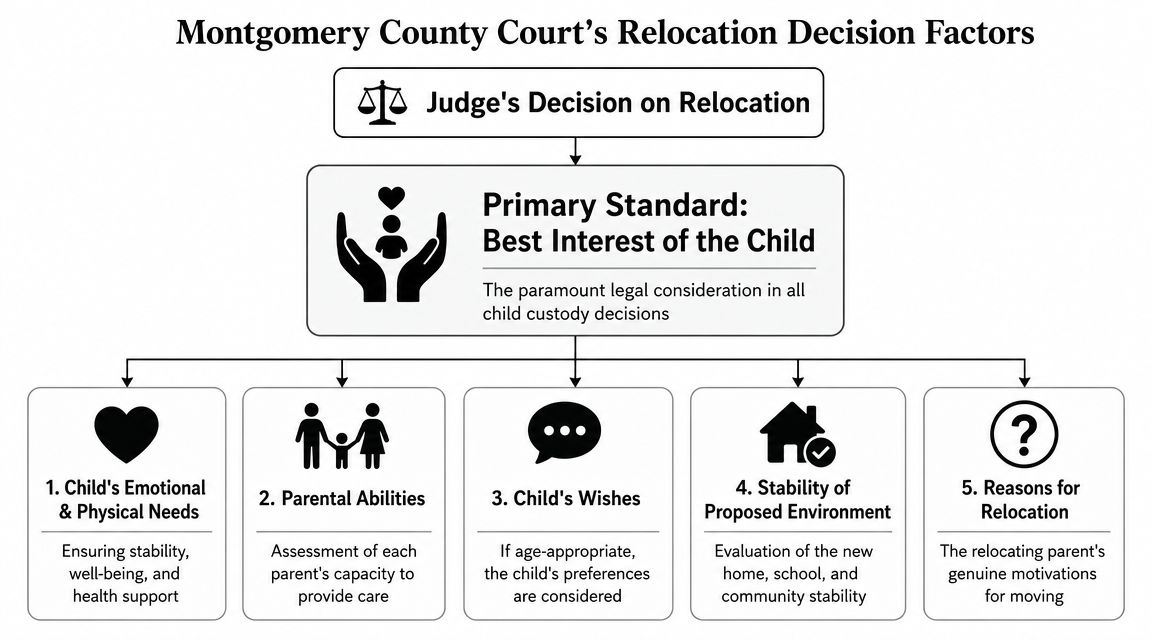
Montgomery County judges want specifics. In a relocation case, the parent asking to move needs to show how the child's day-to-day life will improve or remain stable, and how the child will keep a real relationship with the other parent.
What judges want to see
In this county, a judge is usually weighing two competing facts at the same time. One parent may have a legitimate reason to move, such as a better job, lower housing costs, or family support. The other parent may also have a legitimate complaint, especially if he or she has been part of school pickups, medical appointments, sports, homework, and the ordinary rhythm of the child's week.
That is why general statements rarely help. A parent who says, “This is a great opportunity for me,” has not answered the court's main question. The court wants to know what the move does for the child, what it takes away, and whether the loss of frequent in-person contact can be addressed in a realistic way.
Judges often focus on a few practical points:
The reason for the move
A confirmed job offer, family support, or a clear housing plan usually carries more weight than a vague desire to start over.The child's local ties
If the child is settled in The Woodlands or Conroe, the court will look at school performance, activities, extended family, counseling, and friendships.The other parent's actual involvement
Courts pay attention to what has really been happening, not just what the order says on paper.The quality of the proposed long-distance schedule
A serious proposal covers holiday periods, summer possession, transportation, costs, video calls, and how missed time will be handled.Each parent's judgment
Judges notice whether a parent gave fair notice, shared information, and approached the issue as a parenting problem rather than a fight to win.
For local context, this discussion of a relocation custody case in The Woodlands shows how these disputes are often framed in practice.
A short Montgomery County scenario
A parent in Sterling Ridge gets an out-of-state offer with better pay and more predictable hours. The child's other parent lives in Conroe and has been consistently involved for years. That case does not turn on whether the move sounds reasonable to friends or family. It turns on proof.
The parent requesting the move usually needs to bring documents and details, such as:
- the written job offer and start date,
- the proposed address and housing terms,
- the new school information,
- a possession calendar that works over distance,
- transportation arrangements,
- and a communication plan the child can realistically follow.
The parent opposing the move will often bring attendance records, activity schedules, photographs, messages, calendar entries, and testimony showing regular involvement in the child's life here in Montgomery County.
Judges compare both stories against the child's routine, not the parents' preferences.
What tends to help and what tends to hurt
A well-prepared parent usually does better than a parent who arrives with a conclusion and no plan. In my experience, Montgomery County courts respond better to a parent who has thought through school breaks, exchange logistics, airfare, make-up time, and how the child will stay connected to both homes.
Timing matters too. If a parent signs a lease, enrolls the child in a new school, or announces the move to the child before the issue is addressed with the other parent, the court may see that as poor judgment. That does not automatically end the case, but it can damage credibility.
The strongest relocation presentations are child-centered and concrete. The weaker ones sound rushed, parent-centered, or incomplete.
If a parent moves without authority and in violation of the current order, the court can respond harshly. Return orders, enforcement actions, contempt issues, and expensive emergency hearings become much more likely. In practice, those cases are harder to fix because the first question becomes why the parent acted first instead of asking the court for permission.
Relocating When No Custody Order Is in Place
Many people assume that if there's no custody order, they can move. That assumption creates risk.

Why the no-order situation is dangerous
Without a court order, both parents generally have equal rights to the child and there are no enforceable visitation rules. A parent who moves unilaterally risks a court issuing emergency orders for the child's return while custody proceedings begin, as explained by Texas Law Help on parents' rights when no custody orders exist.
That catches many parents off guard. They think no order means no restriction. In one sense, that's true. In another, it means no stability and no protection either.
The tradeoff most parents miss
If you move first without an order in place, the other parent may respond by filing quickly in Montgomery County and asking for emergency relief. The court may then have to sort out where the child should be, what the status quo really is, and whether the move was an attempt to gain an advantage.
That creates several problems at once:
- You may look reactive rather than child-focused.
- The child's routine may get disrupted twice, once by the move and again by emergency court action.
- You may spend the first stage of the case defending your decision, instead of presenting a thoughtful long-term plan.
No existing order doesn't mean no consequences. It often means the conflict starts faster.
The safer approach in many cases
If there's no prior order, filing a SAPCR before the move is often the steadier choice. It gives the court a chance to enter temporary orders, define rights, and reduce the chance of a sudden return fight after relocation.
That won't fit every case. Emergency safety issues can change the analysis. But in ordinary relocation disputes, moving first and litigating later often creates more instability than it solves.
For parents in The Woodlands and Montgomery County, this is one of the most overlooked parts of the question, can a parent move away with a child in Texas. Without orders in place, the legal situation can shift fast.
What to Do Next A Checklist for Parents in The Woodlands
Parents need action steps, not just legal concepts. If you're facing a move from The Woodlands, Conroe, Magnolia, or another part of Montgomery County, start with the basics.
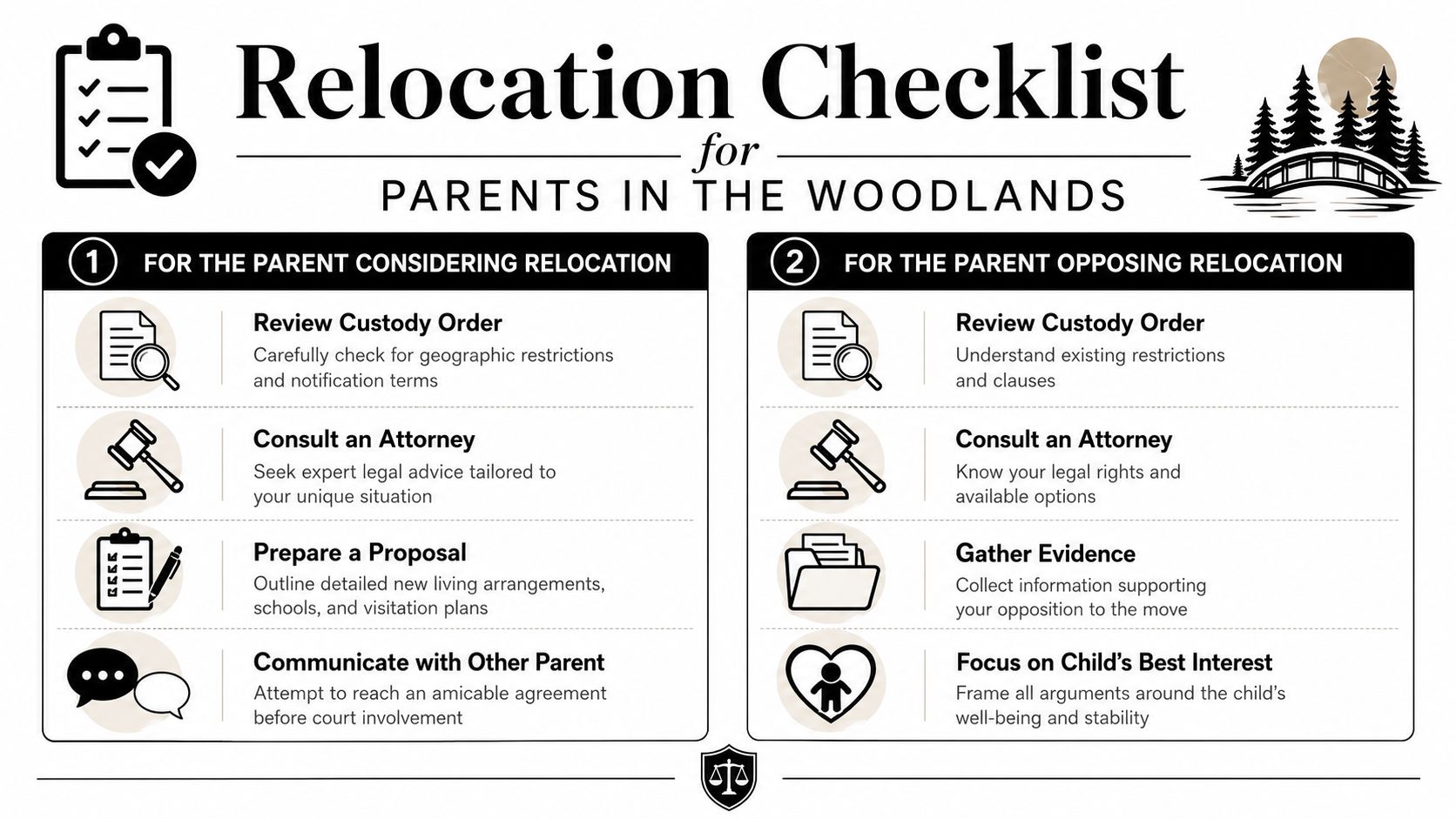
If you want to move with the child
- Review the current order. Check the residence language, conservatorship terms, and any notice requirements.
- Collect child-focused proof. Keep school information, housing details, support-network information, and anything else showing how the move helps the child.
- Draft a realistic possession plan. Include holidays, summers, communication, and travel logistics.
- Get legal guidance early. One option for local representation is speaking with a custody attorney in Montgomery County who handles modification and enforcement disputes.
- Handle the non-legal side carefully. If you're also organizing an interstate move, this checklist of essential legal steps for your move is a practical companion to the family-law side.
If you want to oppose the move
- Read the order line by line. Don't rely on memory.
- Document your involvement. Keep calendars, school contacts, activity records, and communication that show your role in the child's daily life.
- Respond quickly. Delay can make emergency hearings more likely and settlement harder.
- Stay child-centered. Courts usually respond better to evidence about stability and the parent-child relationship than anger about the other parent's choices.
One final caution
This article is for informational purposes only. It is not legal advice and does not create an attorney-client relationship. Relocation cases turn on the exact language of your order, the child's circumstances, and local court practice in Montgomery County.
If you're considering a move, or trying to stop one, get advice before the situation hardens into an emergency.
If you're dealing with a possible relocation in The Woodlands, Conroe, or anywhere in Montgomery County, a focused review of your order and your options can save time and avoid avoidable mistakes. The Law Office of Bryan Fagan works with parents on custody modifications, enforcement actions, and contested relocation issues. If you'd like to talk through your specific facts, schedule a consultation.
