 Skip to content
A lot of parents in The Woodlands first meet wage withholding in the worst possible way. A letter arrives at the house. HR sends an email. A payroll deduction appears before anyone has explained what it means.
If you're in Sterling Ridge, Alden Bridge, Panther Creek, Creekside, or anywhere else in Montgomery County, that moment can feel personal and punitive. It often isn't. In Texas child support cases, wage withholding is usually the standard collection method, not a sign that the court thinks you're a deadbeat parent.
What matters is figuring out three things fast. Is the amount correct. Did the order come from the right case. And if your income has changed, are you using the right legal tool to fix it.
This guide is written for people searching for wage garnishment child support the woodlands because they need practical answers, not courtroom jargon. The focus here is on what usually happens in Montgomery County, what your employer has to do, where mistakes show up, and what works if the withholding amount is wrong or no longer fits your financial reality.
A Notice in the Mail Understanding Your First Reaction
A parent in Alden Bridge opens the mail after work and sees an Order/Notice to Withhold Income for Child Support. The first reaction is usually one of three things. Panic. Anger. Confusion.
That reaction makes sense.
When individuals hear “wage garnishment,” they often think of old debts, aggressive collectors, and frozen finances. Child support withholding in Texas works differently. It comes through the family court system, and in many cases it starts because the order itself requires it, not because someone just accused you of refusing to pay.
What people usually worry about first
-
Will my employer think I did something wrong
Employers in Texas see withholding orders regularly. Payroll departments generally treat them as a legal processing issue, not a character judgment. -
Can they take my whole check
No. There are legal limits, and those limits depend on your disposable earnings and whether current support, arrears, or both are being withheld. -
Do I need to call my ex right away
Usually, no. Start with the paperwork. The order, the case number, and the support amount matter more than an emotional phone call.
What helps in the first 24 hours
Pull together the basic file before you do anything else:
- Your most recent child support order.
- The withholding notice.
- Your last few pay stubs.
- Any proof that your job, pay, or family situation has changed.
Don't assume the payroll deduction is wrong, and don't assume it's right. Verify it against the signed order.
In Montgomery County cases, the fastest way to calm the situation is to stop guessing. Read the exact wording of the order. Look at whether it covers current support, arrears, or medical support. Then decide whether this is a paperwork issue, an enforcement issue, or a modification issue.
What is an Order to Withhold Income in Texas
A parent in The Woodlands signs a final order expecting to make child support payments manually, then payroll sends notice that deductions will start next pay period. That usually means the case includes an Order/Notice to Withhold Income for Child Support under Texas Family Code §158.001. In practice, this is the document that tells an employer or other income source to deduct support and send it through the required payment channel.
What the order does
The order identifies the employee, the case, and the amounts to be withheld for current child support, medical support, cash medical support, or arrears if those are part of the signed order. Once the employer receives it, payroll is expected to treat it as a legal directive, not a suggestion.
Texas generally blocks wage garnishment for ordinary consumer debts under the state constitution. Child support is one of the recognized exceptions, which is why this process runs through family law orders and state collection procedures instead of standard debt collection channels.
For clients in Montgomery County, that distinction matters. If your employer is based in The Woodlands, Spring, Conroe, or Houston, the payroll department may casually call it a garnishment. The family court and the Office of the Attorney General usually call it income withholding. Using the right term helps when you are trying to fix a bad amount, match the withholding to the signed order, or explain the issue to payroll.
How it works in real life
Income withholding works like an automatic payment system tied to your wages. The money is usually sent through the Texas State Disbursement Unit so there is a record of what was paid and when it was received. That payment history often becomes the first thing reviewed if there is later a dispute about missed support or arrears.
Courts use withholding often because it reduces payment gaps and creates a cleaner paper trail. That helps the parent receiving support, but it also protects the parent paying support. In contested Montgomery County cases, a complete withholding record can resolve arguments that would otherwise turn into a hearing over who paid what and when.
Why this catches Woodlands parents off guard
High earners sometimes assume they can keep paying directly from a personal or business account and skip payroll withholding. Self-employed parents often assume no withholding order applies unless they fall behind. Neither assumption is safe. A withholding order can be signed even in agreed cases, and the practical question is not whether withholding feels fair. The question is whether the signed order requires an employer or income source to withhold.
The first review should be simple. Check whether the withholding amount matches the current order. Confirm whether it includes only current support or also medical support and arrears. If the numbers do not line up, treat it as a legal and payroll issue immediately, especially in Montgomery County where delay tends to create larger accounting problems than the original mistake.
Practical rule: If your Montgomery County support order mentions withholding, assume payroll will eventually receive paperwork and process it unless the order was later changed.
The Legal Limits on Child Support Withholding
A parent in The Woodlands may look at a pay stub, see a larger deduction than expected, and assume payroll made a mistake. Sometimes payroll did make a mistake. Just as often, the deduction reflects more than base child support.
The starting point is disposable earnings. That means pay left after legally required deductions, such as federal taxes, Social Security, and similar mandatory items. It does not mean gross salary, and it does not mean whatever remains after elective deductions like retirement contributions or insurance upgrades. That distinction matters because many withholding disputes begin with the wrong number.
Texas child support withholding is also subject to federal limits. In practice, the ceiling depends on whether the withholding covers current support only or current support plus arrears. If back child support is included, the allowable withholding can be higher. The cap is a ceiling, not the default amount in every case.
That is why the support amount in your decree and the amount coming out of your check may not match line for line.
A withholding order can include more than one item:
- Current child support
- Medical support
- Arrearage payments
- Fees specifically authorized in the order
In Montgomery County, I tell clients to read the signed order before they argue with payroll. Payroll departments in large Woodlands-area employers usually follow the withholding notice they receive. They do not recalculate support from scratch. If the order says current support, medical support, and arrears, payroll will usually process all three if the withholding stays within the legal limit tied to disposable earnings.
The guideline child support calculation and the withholding amount also serve different functions. The guideline calculation helps determine what support should be. The withholding order tells the employer what to deduct. In high-income cases common in The Woodlands, that difference matters. A parent may earn salary, bonus, restricted stock payouts, or commissions. If the order reaches those forms of compensation, withholding can rise and fall during the year even though the monthly base obligation in the decree looks stable.
Self-employed parents run into a different problem. They may focus on the withholding cap and miss the larger issue. If there is no traditional payroll stream, enforcement usually shifts to other collection methods. If that applies in your case, review your options for enforcing child support in Montgomery County because the legal limit on paycheck withholding does not answer the collection question by itself.
A quick review usually catches the issue:
- Pull the most recent signed support order and any later modification
- Identify each category ordered for payment
- Compare those categories to the labels on the pay stub
- Check the deduction against disposable earnings, not gross pay
- Look for arrears language, which often explains the gap
If the withholding leaves too little to manage ordinary expenses, that may point to an outdated support order, not an unlawful deduction. In Montgomery County, that is often the main dispute. The employer is following the notice. The parent needs to contest the amount, correct the accounting, or seek a modification through the court.
The Income Withholding Process in Montgomery County Step by Step
A parent in The Woodlands often learns about income withholding at the worst possible moment. The paycheck is lighter, HR says it had to follow the order, and nobody at payroll can explain what happened in plain English. The process makes more sense once you separate the legal order, the employer’s job, and the state payment system.
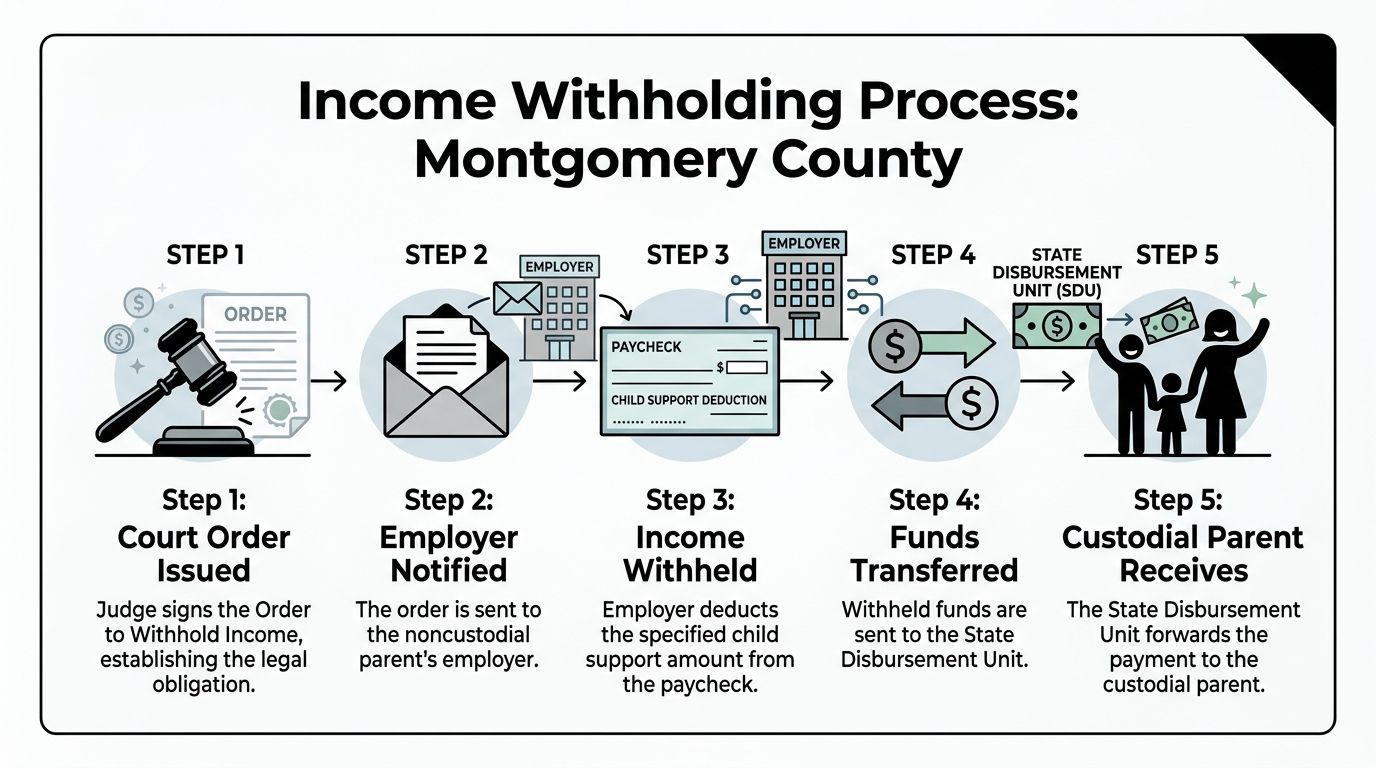
Step one starts with a signed order
In a Montgomery County family case, the withholding language is usually built into the final child support order or a later modification. The judge signs the support order, and the withholding paperwork follows from that order.
That point matters because payroll is not making an independent decision. Payroll is acting on a legal directive tied to your case.
If you are reviewing paperwork, start with the signed order, not the deduction line on the pay stub.
Step two is service on the employer
The withholding notice has to reach the employer or other income source. That may happen through the Office of the Attorney General, a private attorney, or paperwork filed through the court.
For larger employers around The Woodlands, this usually goes to a centralized payroll or compliance department, not your direct supervisor. For a smaller local business, the owner or office manager may be the first person who sees it. That difference affects how quickly errors get corrected.
Step three is payroll implementation
Once the employer receives a valid withholding notice, the company is expected to start withholding through payroll and send the funds to the Texas child support system. In practice, parents are often surprised by how fast this appears on a check.
I tell clients to do three things right away:
- Confirm the employer received the correct case number and employee information.
- Save the first two pay stubs that show the deduction.
- Compare the amount withheld to the signed order and any arrears language.
Those three documents usually tell you whether the problem is timing, math, or bad paperwork.
Step four runs through the state payment record
The money is generally sent through the Texas Child Support Disbursement Unit instead of being paid straight from one parent to the other. That record protects both sides. It shows what was withheld, when it was sent, and what was posted.
A short delay does happen. Payroll may deduct on Friday, transmit later, and the payment may post after that. A one-check lag is common enough that I do not assume employer noncompliance on day one.
If the issue grows beyond a timing delay and turns into missed payments, arrears, or collection trouble, review the local enforcement process for enforcing child support in Montgomery County.
Step five is posting, tracking, and correcting mistakes
After the state posts the payment, the receiving parent gets the funds through the state system. If the amount posted does not match what came out of the paycheck, pull records before making calls.
The useful set is usually small:
- the signed support order
- the withholding notice
- recent pay stubs
- any payment history from the state system
- written job or compensation records if your pay structure changed
In some correction disputes, written sworn statements become part of the file. If you are assembling supporting documents, it helps to understand how an affidavit as evidence in court may fit into a family-law filing.
Who does what in a Montgomery County case
Each part of the system has a narrow job.
- The court or issuing authority creates the support obligation and authorizes withholding.
- The employer deducts and remits based on the notice it received.
- The State Disbursement Unit records and forwards the payment.
- The paying parent checks pay stubs, job changes, and case information for accuracy.
- The receiving parent watches the posting history and compares it to the order.
Trouble starts when a parent expects one part of the system to fix a problem that belongs somewhere else. Payroll cannot rewrite a court order. The court does not process your paycheck. The state records what was sent to it.
Practical problems I see in The Woodlands
Local cases often involve compensation that is not a simple salary. Executives may receive bonus income. Sales professionals may be paid on commission. Business owners may draw irregular amounts. In those cases, withholding can look inconsistent from month to month even when the employer is following the order as written.
Job changes also create problems fast. A parent leaves an energy company in Spring or The Woodlands, starts with a new employer, and assumes the transfer will happen automatically. Sometimes it does not. Sometimes the old employer stops withholding before the new one starts. That gap can turn into an arrears dispute if nobody updates the file quickly.
The safest approach is plain and unglamorous. Keep the signed orders. Keep the notices. Keep every pay stub once withholding starts. In Montgomery County, that paper trail often decides whether a problem gets fixed in a week or turns into a hearing.
Your Options for Contesting or Modifying a Withholding Order
A withholding order is enforceable, but it is not untouchable. The key is knowing what kind of problem you have.
Some disputes are about accuracy. Others are about changed circumstances. Those are different legal paths.

If the withholding amount is wrong
Start with documents, not arguments.
Look at the signed order, the withholding notice, and your pay stub. If the employer is taking an amount that does not match the order, the issue may be clerical. If the notice itself is wrong, the problem may sit upstream with the issuing paperwork.
Useful proof often includes:
- The final order signed by the judge
- Recent payroll records showing the actual deduction
- Payment history from the state disbursement record
- Written job information if your employment changed
In some cases, sworn paperwork becomes part of the correction effort. If you're gathering written statements or supporting records, it helps to understand how an affidavit as evidence in court may fit into a larger family-law filing.
If your income changed and the order no longer fits
A lot of parents make the same mistake. They assume payroll should reduce the withholding amount because their pay dropped.
Payroll cannot rewrite a court order.
If you lost a job, had a major drop in income, or your compensation structure changed, the usual answer is a modification request under Texas Family Code §156.401. That statute governs modification of support orders when the legal standard is met.
A local resource on modifying child support in The Woodlands may help you spot whether your facts point toward a true modification case rather than a payroll mistake.
A short real-world scenario
A parent in Creekside worked on salary and bonus, then got laid off and took a lower-paying position. The old withholding amount kept hitting the paycheck because the prior order was still in effect.
The parent did one thing right and one thing wrong.
Right: they gathered termination paperwork, new pay information, and the current order immediately.
Wrong: they assumed calling payroll would solve it.
Payroll couldn't change anything without legal authority. The practical fix was filing for modification and creating a clear record of the income change. That did not erase the order overnight, but it put the case on the right track.
Limited grounds to contest the withholding itself
Texas law does allow narrow objections in some situations, including a possible good cause basis or an agreement for an alternative arrangement in certain settings, as noted in the verified data. But expectations need to stay realistic. Courts generally favor withholding because it creates traceable compliance.
What to do first if you're on the paying side
- Compare the notice to the signed order.
- Save every paycheck showing the deduction.
- Identify whether the issue is calculation, arrears, or changed income.
- File the correct motion instead of waiting for the problem to fix itself.
The hardest cases are the ones where a parent waits months, keeps getting deductions, and only then starts gathering records.
If you're trying to fix wage garnishment child support the woodlands issues, speed matters. So does using the right legal vehicle.
Complex Cases Self Employment and Multiple Garnishments
The hardest withholding cases in Montgomery County are not the straightforward W-2 jobs with stable pay. They are the cases involving self-employment, gig work, commissions, cash flow swings, and competing claims on income.
Self-employed parents face a different enforcement reality
Verified data on Texas enforcement notes a major gap. If the noncustodial parent is unemployed, self-employed, or works under the table, traditional wage withholding may be less effective, and the available search results do not provide clear procedural guidance for those cases. The same verified material notes that employer withholding makes up over 80% of collections in Texas, but that figure excludes self-employed obligors and leaves a meaningful coverage gap, as discussed in this summary of Texas child support enforcement when payments stop.
That tracks with what many families in The Woodlands already suspect. If there is no regular employer, there is no standard payroll channel to intercept.
What usually matters in self-employment disputes
The fight often shifts from payroll mechanics to proof.
Questions tend to include:
- What income is available from the business
- Whether personal expenses are running through the business
- How seasonal or variable revenue should be treated
- Whether other enforcement tools make more sense than waiting for wage withholding to work
In a high-earner or business-owner case, bank records, tax returns, profit-and-loss statements, and expense patterns often matter more than the label the parent uses for the business.
Multiple orders create calculation problems
Another difficult category is the parent facing more than one withholding-related demand at the same time.
The verified data states that calculating maximum withholding gets more complicated when the obligor is subject to multiple garnishment orders, but the available materials do not offer a full framework or clear examples for how Texas handles every competing claim. That means families often confront uncertainty at the moment they need a precise answer.
Practical guidance when more than one claim exists
What usually helps:
-
Get every order in one file
Do not review child support in isolation if another deduction is already hitting the check. -
Focus on disposable earnings
The legal cap applies to a defined earnings base, not to assumptions about take-home pay. -
Do not trust verbal payroll explanations alone
Payroll can explain what it did. Payroll usually cannot give legal advice on whether the stacking of orders is lawful. -
Watch for hardship arguments carefully
Some hardship claims are real. Others are incomplete because they ignore bonuses, side income, or business cash flow.
For business owners and self-employed parents in The Woodlands, these cases often become document-heavy quickly. The legal question is not just “Can wages be garnished?” It is often “What counts as income, what source can be reached, and what order takes priority in practice?”
Your Next Steps and Key Montgomery County Resources
Parents usually do better once they stop treating withholding as a mystery and start treating it as a record problem. The court order, payroll record, and payment history usually tell the story.

What to do next
-
Read the signed order first
Do not rely on what you remember from mediation or court. Use the filed order. -
Match the deduction to the paperwork
Compare your pay stub to the withholding language and look for arrears or medical support components. -
Keep a clean file
Save notices, pay stubs, state payment records, and any job-change documents. -
Talk to payroll about receipt, not legal strategy
Ask whether they received the order and when they processed it. Do not expect HR to interpret family law for you. -
Act quickly if your income dropped
If the order no longer fits your circumstances, address modification promptly instead of hoping the amount will correct itself.
Local places families often need
For Montgomery County filings and record questions, many parents need the Montgomery County District Clerk because that office handles court records in district court family cases. For enforcement matters involving the state system, families also commonly deal with the Texas Office of the Attorney General Child Support Division.
Before you make calls, gather:
- Cause number
- Signed order
- Employer name
- Recent pay stubs
- Any notice showing arrears or withholding details
Why local procedure matters
Verified data notes that calculating a maximum withholding can be more complicated if the obligor is subject to multiple garnishment orders, and the available materials do not supply a full Texas framework for those competing claims, as noted in this discussion of Texas child support garnishment order complications."
That is one reason local case review matters. Two parents can both say, “My paycheck is being hit too hard,” but one may have a payroll mistake while the other needs a modification action.
If you need a starting point for local representation, a child support lawyer in The Woodlands can review whether your issue is enforcement, correction, or modification.
One practical warning
Do not stop paying voluntarily because you believe the withholding amount is unfair. Unpaid support can trigger additional enforcement tools under the Family Code, including license-related consequences and other collection efforts.
Important disclaimer
This article is for general informational purposes only. It is not legal advice and does not create an attorney-client relationship. Child support withholding issues depend on the exact language of the order, the payment record, and the facts of your case.
If you're dealing with wage garnishment child support the woodlands issues and the paperwork isn't lining up, getting a focused case review early usually saves time, money, and avoidable conflict.
If you want help sorting out a withholding order, checking whether the amount matches your court papers, or deciding whether a modification makes sense, you can schedule a consultation with The Law Office of Bryan Fagan.
