 Skip to content
A process server shows up at your door in Alden Bridge, Panther Creek, or Creekside. You open the envelope and see a request to change custody, visitation, or both. Most parents have the same first reaction. Panic, anger, and a strong urge to call or text the other parent right away.
Pause.
If you're trying to figure out how to respond to custody modification Texas cases, the first thing to know is that this is a court matter now, not just a parenting disagreement. Your response needs to be calm, fast, and organized. In Montgomery County, the early decisions often shape the whole case.
This article gives general information for parents in The Woodlands and nearby Montgomery County communities. It is not legal advice, and it does not create an attorney-client relationship. Your facts matter, your current orders matter, and the wording in the petition matters. If you've been served, get case-specific legal advice before you make strategic decisions.
You've Been Served a Custody Modification Lawsuit What Now
A parent in The Woodlands often walks into my office with papers folded in half, a worried look, and one question: “Can they really do this?” The short answer is yes, they can file. That does not mean they automatically win.
In Texas, a custody modification is not supposed to be a redo of the old case because one parent is frustrated. Courts generally require more than a difference in parenting style. Under Texas Law Help's explanation of modification standards, the parent asking for a change generally must prove a material and substantial change and show that the requested change is in the child's best interest.
That matters because your job is not to match the other parent's emotion. Your job is to respond in a way that protects your position.
First practical point: being served is not the moment to negotiate by text, vent on Facebook, or assume the judge will “see through it” later.
A common local scenario looks like this. A father in Sterling Ridge gets served after an argument over school pickup and thinks, “This is ridiculous, I'll just explain it at court.” Then he learns the court expects a formal written response first. By the time he starts taking it seriously, he has already weakened his position.
If you were served recently and want a basic primer on the service process itself, this guide on what to do after being served divorce papers in The Woodlands helps explain the mindset you need. The same discipline applies here. Read carefully. Protect deadlines. Avoid impulsive mistakes.
What works right now is boring but effective. Put every page in order. Identify what changes are being requested. Keep your communication with the other parent brief and child-focused. Start thinking like someone preparing for court in Conroe, because that is where this can go.
Your Immediate Actions After Receiving Custody Papers
Your first job is triage. Not argument. Not revenge. Not a long reply to the petition.
Read the petition like a checklist
Start with the request itself. What is the other parent asking the court to change?
It might be primary custody, a pickup schedule, decision-making rights, child support, geographic restriction, or several issues packed into one pleading. Don't assume this is “just about visitation” unless the petition states that.
Look for the current court number, the county, and the court that entered the existing order. According to Texas Law Help's modification guide, the case is filed in the county where the current order was made, and the Return of Service must be on file with the court for at least 10 days before the case can be finalized. In Montgomery County, that means formal process matters from the start.
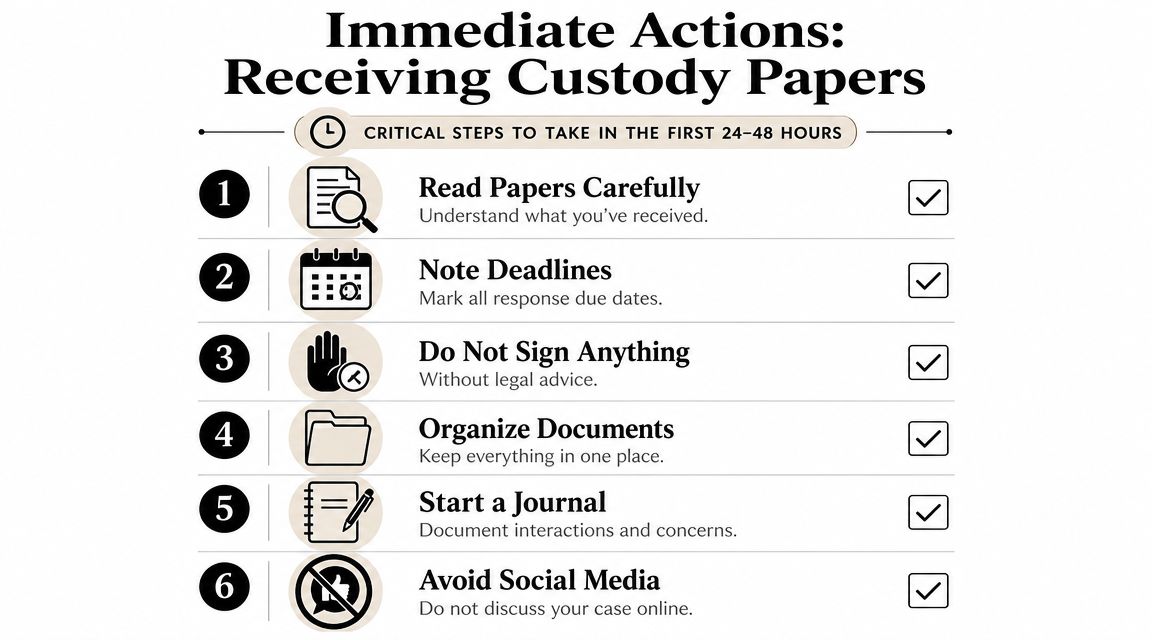
Get control of the first 48 hours
Here is the short version of what usually helps most:
- Calendar every deadline: Put the response deadline on your phone, your paper calendar, and wherever else you won't miss it.
- Gather existing orders: Find the divorce decree, SAPCR order, prior modification orders, and any temporary orders.
- Stop casual commentary: Don't post online. Don't send sarcastic texts. Don't ask your child to report back about the other home.
- Start one case folder: Keep pleadings, school records, communication logs, and notes in one place.
- Write down facts, not speeches: Note dates, exchanges, missed periods of possession, school issues, and anything directly tied to the allegations.
- Don't sign anything quickly: If you were handed an Answer or Waiver of Service, slow down before signing.
The parent who stays organized usually makes better decisions than the parent who reacts.
What not to do
Some mistakes create problems fast:
| Action | Why it hurts |
|---|---|
| Arguing by text | It creates exhibits for the other side |
| Ignoring the papers | It can lead to losing your chance to respond effectively |
| Relying on memory | Details blur quickly in contested parenting cases |
| Asking the child to choose sides | Judges don't like seeing children pulled into adult conflict |
If the filing mentions immediate safety issues or emergency relief, that's a different level of urgency. In that situation, review guidance on emergency custody orders in The Woodlands and get legal help right away.
How to File a Formal Response to the Court
You are standing at the kitchen counter in The Woodlands, reading a modification petition that asks for new pickup terms, different decision-making rights, or less time with your child. The next move is not a long text to the other parent. It is filing the right pleading, in the right court, by the deadline.

Answer versus Counter-Petition
An Answer tells the court you are appearing and contest the requested modification. It keeps the case from moving ahead without your participation.
A Counter-Petition asks the judge to grant relief you want, too. If you need the court to change possession terms, add restrictions, adjust exchange details, or revise another part of the order, that request usually needs to be in your own pleading.
The difference is practical, not technical. An Answer protects your seat in the case. A Counter-Petition protects your ability to ask for your own result.
As Texas Law Help's guide for responding to a modification case explains, the deadline to file an Answer is generally 10:00 a.m. on the first Monday after 20 days have passed from service. The same guide explains that if you want the court to make changes of its own, you need a Counter-Petition.
What that looks like in a Montgomery County case
Say the other parent wants to change the exchange location and add passport restrictions. You oppose both requests, but you also need a different summer schedule because the current order no longer fits camp and activity logistics in The Woodlands.
An Answer lets you contest their request. It does not automatically put your summer schedule change before the court. That request usually belongs in a Counter-Petition.
I see parents get tripped up here. They assume they can explain their own requested changes at a temporary-orders hearing or mediation and the judge will sort it out. Montgomery County courts expect the pleadings to frame the dispute clearly. If your request is not on file, you may lose time, bargaining power, or both.
File in the correct court, under the correct case
Most modification responses are filed in the same court that signed the current SAPCR order. In many local cases, that means returning to the Montgomery County court that already has the parent-child file, using the existing cause number.
That sounds simple. It is often where paperwork goes wrong.
A response filed late, filed under the wrong cause number, or drafted too narrowly can create problems before the judge ever reaches the facts. Local judges tend to focus on whether the file is in order before they spend time on a parent's broader story. Procedure does not win the case by itself, but poor procedure can put you behind fast.
For many parents, working with a child custody lawyer in The Woodlands becomes practical at this stage. The Law Office of Bryan Fagan is one local option that handles custody modification filings, responses, and contested hearings in Montgomery County.
Here is a short overview that may help you visualize the filing stage and early response issues:
What usually helps, and what creates avoidable problems
A few filing habits make a real difference:
- File on time and confirm the clerk has the pleading under the correct cause number.
- Read the petition line by line so you know whether the other parent is targeting conservatorship, possession, support, travel restrictions, or multiple issues at once.
- Match the pleading to your goal. If you want the court to make your own change, decide early whether a Counter-Petition is needed.
- Check local practice. Montgomery County courts can differ in how quickly they set temporary matters and how strictly they expect parties to clean up pleading issues before a hearing.
- Do not assume side agreements fix the lawsuit. Unless the filed case is addressed properly, the court file remains active.
Texas Family Code Chapter 156 sets the rules for modifying prior custody-related orders. You do not need to memorize the chapter. You do need to treat a modification case as a formal request for judicial relief, with deadlines, pleading requirements, and local court expectations that can affect the result.
Gathering Evidence to Defend Your Current Custody Order
Once your response is filed, the case turns to proof. Many parents then either settle from strength or lose ground because they brought feelings to an evidence fight.
Under this discussion of Texas custody modification standards, a parent seeking modification generally must prove a material and substantial change in circumstances and that the requested change is in the child's best interest. That is why evidence showing stability in the child's current environment can be a strong defense.
Match your proof to their claim
Don't collect documents randomly. Start with the petition and ask: what is the other parent alleging?
If they claim instability, gather records showing routine and consistency. If they claim missed parenting time, gather communication logs and calendars. If they claim the child is struggling, gather school and medical records that show the fuller picture.
A useful evidence map often looks like this:
| Allegation in petition | Evidence that may respond |
|---|---|
| Child is not doing well in current home | Report cards, attendance records, teacher communications |
| Parent is unreliable | Calendar entries, pickup logs, app messages, witnesses |
| Current schedule no longer works | Activity schedules, childcare records, work schedules |
| Change is better for the child | Evidence showing the child is currently stable and supported |
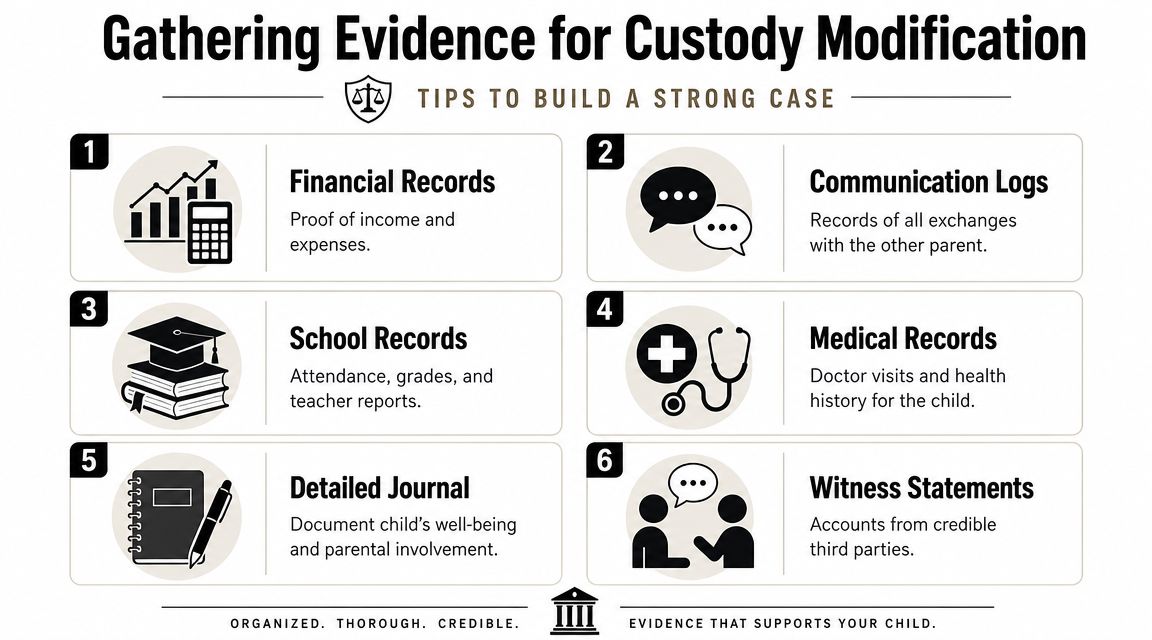
What to start preserving now
Good evidence is usually ordinary. It is rarely dramatic.
- Communication records: texts, emails, and messages from parenting apps such as OurFamilyWizard if your family uses one.
- School information: report cards, attendance notices, teacher emails, behavior notes, and school calendar records from Conroe ISD or private schools in the area.
- Medical information: appointment summaries, therapy attendance, prescription records, and provider recommendations when relevant.
- Activity records: sports schedules, dance attendance, church involvement, tutoring, and other routines that show consistency.
- A clean timeline: a simple dated log of events tied to the child, not editorial comments about the other parent.
- Witness list: coaches, teachers, relatives, counselors, or childcare providers who have direct knowledge.
Bring documents that answer the judge's question. Leave out materials that only show you're angry.
Stability is often persuasive
Many modification petitions sound bigger on paper than they look under scrutiny. A parent may describe conflict, but conflict alone is not the same as legal grounds to change custody. If your child is doing well in school, attending activities, receiving care, and following a reliable routine, those facts often matter more than broad accusations.
What does not help is overloading the case with irrelevant screenshots, old arguments, or dozens of photos that prove little. Judges and mediators respond better to organized, labeled evidence than to volume.
Texas Family Code Chapter 153 deals with conservatorship and best-interest issues. In practice, that means your evidence should keep circling back to one question: what arrangement best supports this child, in real life, right now?
The Montgomery County Court Process Mediation and Hearings
Most parents imagine that after filing papers, they go straight into a dramatic courtroom trial in Conroe. That usually isn't how it unfolds. Montgomery County family courts often move a contested modification through hearings, scheduling orders, and mediation before any final trial setting.
That local rhythm matters. A parent who prepares early usually has more options than a parent who waits for a hearing notice and starts scrambling then.

What mediation is really for
Mediation is a structured settlement process. You, the other parent, your lawyers if you have them, and a neutral mediator work through disputed issues and see whether an agreement is possible.
Mediation is not therapy. It is not a place to win an argument about who was more difficult during the relationship. It is where practical parents decide whether they can resolve enough issues to avoid a hearing or narrow what the judge must decide.
In Montgomery County, good mediation preparation usually includes:
- A written list of priorities: what must stay, what can move, and what trade-offs are acceptable.
- Organized exhibits: school records, calendars, and communication logs that support your position.
- A realistic tone: strong cases still settle better when the parent presents as child-focused and credible.
Mediation often turns on preparation, not personality.
A short scenario from Creekside Park
Sarah, a mother in Creekside Park, was served with a petition asking to change primary custody. She denied that any meaningful change had occurred and gathered records showing the children were thriving in their current school and activities.
At mediation, she did not spend the day rehashing every old fight. She focused on the child's routine, school stability, and what schedule adjustments might prove helpful. The case resolved with a narrower agreement on holiday possession while keeping the primary arrangement intact.
That kind of result is common because contested cases often soften when both sides are forced to compare allegations with evidence.
Temporary hearings and local expectations
Sometimes settlement doesn't happen early. Then the court may hear temporary issues while the case is pending. A temporary orders hearing can shape possession schedules, communication rules, and day-to-day expectations until final resolution.
Parents in Montgomery County often underestimate how much these early court appearances matter. The judge is watching for basic things:
| What the court tends to notice | What hurts your position |
|---|---|
| Prepared documents | Disorganized complaints |
| Child-focused testimony | Personal attacks unrelated to the child |
| Respect for the current order | Self-help changes without permission |
| Reasonable proposals | All-or-nothing demands |
A parent who arrives with a clear timeline, relevant records, and realistic requests usually presents better than a parent who talks in conclusions. “They're unstable” is a conclusion. “Here are the school attendance records, message history, and the parenting calendar” is evidence.
If your case remains contested, the path may continue through additional discovery, more negotiation, and eventually a final hearing or trial. That is why early organization pays off.
Common Defenses and Your What to Do Next Checklist
You are standing in your kitchen in The Woodlands with a modification petition in your hand, trying to figure out whether the other parent can really reopen custody. The short answer is no, not without meeting a legal standard and backing it up with facts the court can act on.
In Montgomery County, the defense usually starts in two places. Has there been a material and substantial change since the last order? If so, would the requested change serve the child's best interest? Judges here tend to focus less on broad accusations and more on whether the filing parent can show a real change in the child's circumstances, daily functioning, safety, schooling, or stability.
That gives you several practical defenses, depending on the facts in your case:
- No material and substantial change: the petition describes conflict, frustration, or ordinary parenting disagreements, not a legally meaningful change since the last order.
- No best-interest basis: the requested modification may benefit the other parent, but that is not the test. The question is whether it helps the child.
- The current order is working: the child is doing well in school, following a steady routine, and receiving consistent care under the present arrangement.
- The request may be barred by timing: some efforts to change primary custody face extra hurdles if filed too soon after the current order, unless a recognized exception applies.
That last point matters more than people realize. If the other side filed quickly after the prior order, timing can become part of your defense strategy, especially if the petition tries to re-argue old complaints instead of identifying new facts.
A generic denial has its place, but it is rarely enough by itself in a contested modification case. A stronger response ties your legal position to documents, dates, and a workable proposal. In Montgomery County courts, a parent who can say, "Here is what changed, here is what did not, and here is what serves the child right now," usually stands on firmer ground than a parent who says the other side is wrong.
What to do next
Use this checklist if you were served in Montgomery County:
- Confirm your answer deadline today: missing it can create problems that are expensive to fix.
- Read the requested relief line by line: many parents focus on custody labels and miss requested changes to possession, decision-making, geography, or child support.
- Compare the petition to your current order: mark what the other parent wants changed and what language remains in effect unless the judge signs something new.
- Decide whether to file only an Answer or also a Counter-Petition: if you want the court to grant you relief, raise that early instead of waiting to react later.
- Build a timeline: list major dates involving school, medical care, exchanges, police calls, counseling, relocations, or repeated schedule disputes.
- Gather proof that shows stability: attendance records, report cards, medical records, messages, calendars, and witness information usually matter more than general statements.
- Avoid self-help changes: do not withhold the child, rewrite the schedule on your own, or stop following the current order unless the court changes it.
- Prepare for mediation with specifics: know what you can agree to, what needs protection, and where a narrow compromise may solve the dispute.
- Get local legal advice before the first major setting: Montgomery County procedure, courtroom expectations, and judge-specific preferences can affect how you present the case.
If you have been served, treat the petition as a case that needs a response, not as a threat that will fade on its own. The early decisions matter. The record you build in the first few weeks often shapes settlement talks, temporary hearings, and the final outcome.
This article is general information only and is not legal advice. If you've been served with a modification suit, your next step should be a case-specific review of the petition, deadlines, and existing orders.
If you need help sorting out what the petition means, what to file, and how to prepare for Montgomery County court, you can schedule a consultation with The Law Office of Bryan Fagan. A focused review early in the case can help you protect deadlines, preserve defenses, and make informed decisions for your child.
