 Skip to content
A parent in Panther Creek loses her father. The funeral ends, casseroles stop coming, and then the paperwork starts. A bank asks for Letters Testamentary. A title company wants court documents before it will talk about the house. A brother from a prior marriage has questions about “what Dad intended,” and everyone is tired enough to make a bad decision just to get something done.
That’s the point when probate starts to feel bigger than grief itself.
For families in The Woodlands, Conroe, Magnolia, and nearby Montgomery County communities, the montgomery county probate court process is usually less mysterious once you see it in plain English. There are rules. There are deadlines. There are also practical choices that can save time, avoid conflict, and protect the person handling the estate from personal mistakes.
Probate is not just a paperwork exercise. It’s the legal process that gives someone authority to act for a deceased person’s estate under the Texas Estates Code. In some families, it’s straightforward. In others, it overlaps with divorce, custody issues, blended-family tensions, or guardianship concerns. Those crossover problems are where generic probate articles usually stop being helpful.
Losing a Loved One is Hard Enough Probate Does Not Have to Be
The first week after a loss is rarely organized. Someone is looking for the original will. Someone else is trying to access an account to pay immediate bills. A relative may already be asking when property will be divided. In neighborhoods like Sterling Ridge or Creekside, that often means a family home, retirement accounts, personal property, and emotions all tied together at once.

What those navigating this situation need at that moment isn’t a law school lecture. They need to know what the court cares about, what they should gather first, and what mistakes can create delays or family fights.
What local families usually run into first
The estate may include a house in The Woodlands, a vehicle, a checking account, and a will that names one child as executor. That sounds simple until practical questions start stacking up.
- Authority issues. Banks, title companies, and other institutions usually want formal proof that the executor or administrator has legal authority to act.
- Family tension. A surviving spouse, adult children from a prior marriage, or minors can all have different expectations about timing and control.
- Confusion about the right path. Not every estate needs the same kind of probate.
Practical rule: Don’t assume “having the will” means you automatically have authority to act. In probate, authority comes from the court.
Why plain English matters here
A lot of probate stress comes from terminology. “Independent administration,” “muniment of title,” “heirship,” “inventory,” and “letters” can all sound abstract when you’re trying to handle real property and real family issues.
The good news is that most estates fall into recognizable patterns. Once you identify which pattern fits your family, the process becomes more manageable. The harder cases usually aren’t hard because the forms are impossible. They’re hard because relationships, debt, property, and timing collide.
That’s especially true when probate overlaps with family law. A pending divorce, child support issue, or concern about a minor child’s inheritance can change the strategy fast.
Determining If Probate is Necessary in Montgomery County
A common Montgomery County call starts like this. A parent has died. There is a house in The Woodlands, a surviving spouse, two adult children from a first marriage, and a will someone found in a desk drawer. The first legal question is not how to file. It is whether the family needs probate at all, and if so, what kind.
Under the Texas Estates Code, the answer turns on four practical facts. What the decedent owned. How each asset was titled. Whether a valid will exists. Whether debts or family conflict require someone with formal court authority to act. That last point matters more than many families expect, especially where probate overlaps with divorce history, stepchildren, or a minor child's interest in the estate.
When full probate is usually the right call
Full probate often makes sense when assets are stuck without court authority. The usual examples are a house titled only in the decedent's name, bank accounts with no payable-on-death beneficiary, or investment accounts that will not release funds without letters testamentary or letters of administration.
It is also the safer route when family law issues are sitting in the background. I see that in estates involving a recent divorce, a second marriage, unpaid child support, a beneficiary designation that no longer matches the family structure, or disagreement over who should control property for a minor child. In those cases, the cheapest option on paper can become the most expensive option after a title dispute or heirship fight.
If you want a step-by-step explanation of the local filing path, this guide on how to probate a will in The Woodlands gives a useful overview.
When a simpler route may fit better
Some estates do not need full administration.
Muniment of Title can work where there is a valid will and the main job is clearing title, often to a home, and there are no unpaid debts other than debt secured by real estate. For a straightforward estate with a house, a clean will, and no unsecured creditor problems, that route can save time and reduce moving parts.
Small Estate Affidavit may be available when there is no will and the estate is modest enough to qualify under Texas law. It can be helpful, but families should be careful with it. It does not fix every title problem, and it is not a good substitute for full probate where the facts are messy or the heirs do not agree.
The trade-off is simple. A narrower tool works well only when the facts fit.
Probate Paths in Montgomery County Texas
| Feature | Independent Administration (Full Probate) | Muniment of Title | Small Estate Affidavit (SEA) |
|---|---|---|---|
| Best fit | A will exists or administration is needed to gather assets, handle debts, and distribute property | A valid will exists and the main goal is transferring title, often real estate | No will, limited estate, and statutory requirements are met |
| Court involvement | More front-end court involvement, less day-to-day supervision if independent | Limited court involvement after approval | Limited use if the estate qualifies |
| Use with debts | Better suited when debts or creditor issues need active administration | Usually not ideal if unsecured debts require administration | Depends on whether the estate qualifies under the statute |
| Authority granted | Executor or administrator receives formal authority to act for the estate | Focus is on recognizing the will as evidence of title | Affidavit-based process rather than full appointment |
| Common local use | Frequent for family homes, bank accounts, and estates needing active management | Often discussed for a debt-light property transfer | Often raised when there is no will and the estate is modest |
The family facts often decide the probate path
The same asset list can lead to very different legal advice depending on the family.
A widow with one adult child, a clear will, and a house with no unsecured debt may be a strong muniment candidate. Change one fact, and the answer changes. If the decedent had children from two relationships, an ex-spouse still tied to title, or a disabled adult child who may need a trust or guardianship planning, full probate becomes much more attractive because it creates a cleaner record and clearer authority.
That is why probate and family law often intersect in Montgomery County. The legal question is rarely just, "Is there a will?" The better question is, "Will this procedure hold up when the house is sold, the account is transferred, and every interested family member has had a chance to object?"
For families dealing with a home sale during the estate, timing matters too. Delays in authority and title cleanup can affect repairs, listing decisions, and closing schedules. This overview of navigating probate property sales is a helpful companion if real estate is part of the problem.
A few warning signs that call for closer review
Some situations deserve more caution at the start.
- A divorce was pending when the person died
- The decedent remarried and has children from a prior relationship
- A minor child may inherit property outright
- No one is sure which debts are legitimate
- The house title does not match the family story
- Someone is already living in or using estate property without agreement
Any one of those facts can shift the recommendation.
A lot of probate mistakes happen because a family chooses a shortcut based on one fact and ignores the rest. A will by itself does not answer the question. A small estate does not answer it either. The right path depends on title, debt, family structure, and whether the court needs to appoint someone with authority to act.
Navigating the Core Probate Process in Conroe
A common Montgomery County probate starts like this. A parent dies, one child has the original will, another child is still living in the house, and a former spouse or step-parent is asking what happens next. The family thinks the court process is just paperwork. In reality, the first few weeks often decide whether the estate stays orderly or turns into a fight over authority, possession, and money.
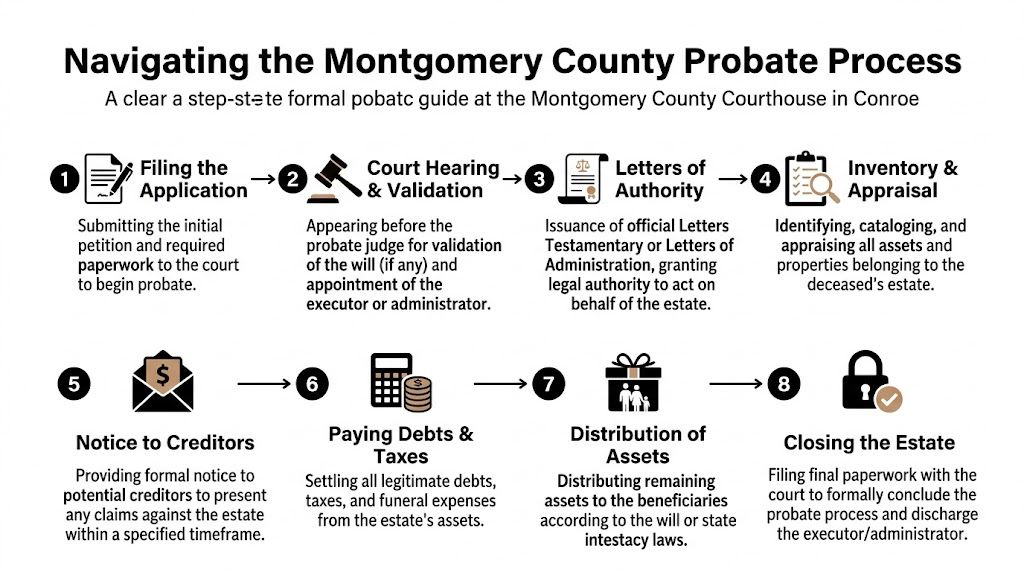
If full probate is needed, the case is usually opened in Conroe. In an uncontested estate, the court often allows an independent administration, which is the simpler path because it gives the personal representative room to do the work without repeated court approval. As noted earlier, Montgomery County also expects estates to be handled through counsel rather than self-representation.
Opening the estate
The case begins with an application to probate the will, or an application for administration if there is no will, plus the original will if one exists and the death certificate. The filing itself is straightforward. Getting the application right is what matters.
A weak filing causes problems fast. Names do not match prior divorce records. Children from a first marriage are left off the family history. A homestead is described loosely even though title is already a concern. Those are the kinds of details that slow down an otherwise routine estate in Montgomery County.
The hearing is brief, but it matters
After filing, the court sets a hearing to decide whether the will should be admitted to probate or whether an administration should be opened. The judge also looks at whether the proposed executor or administrator is legally qualified to serve.
In an uncontested case, the hearing is often short. It still carries real weight. Before the hearing, the family may agree that one person should take charge. After the hearing, the court has formally given that person authority to act for the estate.
That difference matters to banks, title companies, and family members who do not trust each other.
A local example
Take a familiar Conroe area problem. A father dies during a pending divorce. He has a will from years earlier naming his adult daughter as executor, but he also has a current spouse living in the house and a teenager from that marriage. The family wants to know who controls the property, whether the divorce changed the old will, and whether the minor child’s share needs protection.
That file is no longer a simple will admission. It touches probate, family law, and sometimes guardianship issues at the same time. The court process can still move forward, but only if the application and hearing presentation deal with those facts directly instead of pretending the family tree is simple.
What the appointment actually gives you
Once the judge signs the order, the clerk can issue Letters Testamentary if there is a will and a qualified executor, or Letters of Administration if there is no will or no named executor able to serve. Those letters are what third parties usually want to see before they will release information, transfer control, or allow a sale.
A will names the person. The court gives that person legal authority to act.
For families trying to understand the local will process in more detail, this guide on how to probate a will in The Woodlands connects the court procedure to the kinds of homes, titles, and family situations we see here every day.
The administration stage is where family tension shows up
After appointment, the representative has to locate assets, secure property, deal with creditors, and get the estate into a position for distribution. That is also the point where unresolved family issues start affecting probate.
In Montgomery County, I often see three pressure points:
- Blended families. One side of the family assumes the surviving spouse gets everything. The other side assumes the children from the first marriage do.
- Divorce overlap. A pending divorce, old divorce decree, or unpaid equalization payment can affect what belongs to the estate.
- Minor or incapacitated beneficiaries. A child may inherit property, but an adult cannot merely hold that property informally without considering guardianship or court supervision.
Real estate tends to bring those conflicts to the surface. If the estate includes a house that may need to be sold, timing and authority matter, especially when one heir wants cash, another wants to keep the home, and someone is already occupying it. Families dealing with those issues often benefit from practical guidance on navigating probate property sales.
What helps a Conroe probate go smoothly
Several habits reduce trouble early.
- Get the original will under control immediately. Waiting to search for it creates avoidable delay.
- Build the family history carefully. Prior marriages, adopted children, and children from different relationships need to be identified correctly.
- Treat the house as estate property. No one should assume they can move in, clean it out, or promise a sale before authority is in place.
- Use one consistent communication channel. Probate disputes often start because relatives hear different versions of the same plan.
The court process itself is usually manageable. The harder part is dealing with the full family facts at the start, especially in estates shaped by remarriage, divorce, and children who need added protection.
Your Duties as an Executor or Administrator
A lot of personal representatives in Montgomery County start the job at the worst possible time. A parent has died, a former spouse is calling about child support or the house, a new husband or wife is asking what happens next, and adult children want answers right away. The court appointment gives you authority, but it also puts you in a position of trust. You are expected to protect the estate, follow the court’s rules, and treat beneficiaries fairly, even when family relationships are already strained.
That duty shows up in ordinary decisions. Which bills get paid first. Who can enter the home. Whether a relative gets reimbursed. How you respond when one side of a blended family thinks the other side is getting special treatment.

Gather and protect the estate
Start with control of the assets. Secure the house, locate accounts, redirect mail, preserve business records, and identify anything that can disappear, be spent, or be transferred without much notice.
Probate and family law often collide in real life. A decedent may have been paying support under a divorce order. A surviving spouse may still be living in the home with children from a prior relationship. An ex-spouse may be holding records that matter to the estate. Those facts do not excuse informal handling. They are the reason careful handling matters.
Keep estate money separate. Keep a written ledger. Save receipts, bank statements, closing papers, and correspondence from day one.
Inventory is more than a form
The inventory sets the tone for the administration. If it is incomplete, every later step gets harder.
A proper inventory usually identifies:
- Real estate. Address, legal description, occupancy status, insurance status, and any title questions
- Bank and investment accounts. Including accounts that family members assume were joint but need confirmation
- Vehicles and personal property. Especially items likely to trigger disputes, such as jewelry, firearms, collections, or family heirlooms
- Business interests and records. Closely held companies, contractor payments, and bookkeeping access
- Debts and recurring expenses. Mortgage payments, taxes, utilities, medical bills, and funeral costs
In blended-family estates, inventory work often answers emotional questions before they turn into legal ones. If one child believes a truck was promised to him and the surviving spouse believes it belongs to the household, clear records matter more than family memory.
If you want a practical local reference on the day-to-day role, this overview of Texas executor duties in probate administration tracks many of the same issues that come up in Montgomery County estates.
Local insight: Executors get into trouble less from dramatic mistakes than from casual shortcuts. Letting a niece “borrow” the car, reimbursing yourself without backup, or handing out personal items before values are confirmed can create expensive disputes later.
Notice, claims, and keeping people informed
Part of the job is procedural. Required notices need to go out. Creditor issues need to be reviewed. Deadlines matter.
Part of the job is relational. Beneficiaries do better when they get consistent information in one place instead of rumors from three relatives. In high-conflict families, I often see the probate file become a substitute for old divorce grievances. A short written update every few weeks can lower suspicion and reduce unnecessary hearings.
You also have to evaluate claims with discipline. A relative may insist the decedent owed repayment for years of caregiving. An ex-spouse may assert reimbursement rights tied to prior property division. A surviving partner may say certain funds were never meant to pass through the estate. Those claims should be reviewed carefully before money goes out.
A short primer can help if you want to hear a plain-English explanation before diving into estate paperwork.
Managing property and money without creating new problems
Many executors feel pressure to keep everyone happy. That instinct causes trouble.
If the estate includes a home in Conroe or The Woodlands, decide who has access, document the condition of the property, and confirm insurance coverage. If someone is living there, get clear about whether they are there with legal authority, by family agreement, or because no one has confronted the issue yet. Those details matter if the house must be sold or if expenses are piling up.
The same caution applies to cash. Do not make early distributions because the family is impatient. Do not assume every bill should be paid immediately. Do not rely on text-message understandings about who gets what.
Compensation and reimbursement
Fees and reimbursements create tension when no one addresses them until the end. An executor may be entitled to compensation or repayment of proper estate expenses, but the right answer depends on the file, the work performed, and the court’s view of the records.
The practical rule is simple. If you spend estate money, reimburse yourself, advance funds, or claim compensation, document it well enough that a skeptical heir could follow it line by line.
Distribution usually happens later than families want
Beneficiaries usually want a timeline within the first week. Fair enough. They are grieving and trying to plan.
Still, distribution comes after the estate has a clear asset picture, debts and expenses have been addressed, and any family-law crossover issues have been sorted out. That may include questions about a former spouse, minor children, support obligations, or who has authority to receive property for someone who cannot manage it alone.
Careful administration feels slow. It also protects the person serving and reduces the odds that one probate case turns into two lawsuits.
Common Probate Hurdles and High-Conflict Scenarios
A common Montgomery County file starts like this. Dad dies. He remarried years ago. His adult children from the first marriage believe the house should stay in the bloodline. His current spouse still lives there and is paying some bills. One grandchild may need a guardian to receive funds. If there was a recent divorce, support dispute, or custody fight in the background, probate quickly stops being a paperwork exercise and becomes a family-law problem with a court file attached.
That is the part generic probate articles usually miss.

Blended families change the probate strategy
Second marriages and blended families create friction points that do not show up in a simple checklist. The surviving spouse may have a strong claim to remain in the home, while children from an earlier marriage focus on what they believe their parent intended. Sometimes they are relying on old conversations. Sometimes they are relying on an outdated will. Sometimes title to the house, beneficiary designations, and debt responsibility all point in different directions.
The practical answer is not to promise quick results. It is to slow down, confirm how property is titled, review prior divorce paperwork if there was one, and separate legal rights from family assumptions.
Divorce and probate often overlap
A pending divorce, a recent divorce decree, or unpaid support can change the probate analysis. I see families get tripped up here because they assume probate court will solve every issue inside the estate file. It will not. If an ex-spouse still appears on an account, if the house was never refinanced after divorce, or if retirement assets were supposed to be divided but never were, the estate may inherit a problem that started in family court.
That overlap matters in Conroe because delay in one case often increases pressure in the other. The spouse in possession of the home may want certainty. Adult children may want an accounting. A former spouse may still be part of the factual history even if no longer an heir.
Minor children and vulnerable heirs need a real plan
Families often say they will just hold the money for the child. That is how good intentions turn into accusations.
If a child is entitled to money, the adults need a lawful structure for who receives it, who can spend it, and who answers for those decisions later. The same concern comes up with young adults who cannot manage funds well, heirs with disabilities, and relatives already in a custody or guardianship dispute. Even basic intake documents matter here. Accurate information on a death certificate in Texas can affect how institutions process claims and how quickly the right people can start sorting out authority.
What helps in high-conflict estates
The cases that calm down fastest usually share a few habits.
- One channel for decisions. The executor or administrator works through counsel instead of negotiating by group text.
- Written records. Reimbursements, access to the house, claimed loans, and personal property disputes are documented while memories are still fresh.
- Early screening for family-law crossover. Questions about divorce orders, child support, guardianship, and prior court restrictions get reviewed before anyone acts on assumptions.
- Prompt attention to possession issues. Who has keys, who has the car, who is collecting rent, and who is using estate funds should be addressed early.
What usually makes things worse
Three patterns create avoidable damage.
- Treating a distrust problem like a forms problem. Filing the case is only one part of the job if the family already expects a fight.
- Letting one branch of the family control property by default. The person in possession gains practical advantage fast, especially with homes, vehicles, and sentimental items.
- Reading silence as agreement. After a death, relatives are often grieving, talking to their own lawyers, or waiting to see who makes the first mistake.
These files call for judgment, not just procedure. In Montgomery County, the hardest probate cases usually sit right at the intersection of inheritance, divorce history, parenting issues, and old family promises that were never put in writing.
Your Immediate What to Do Next Checklist
If you’re at the very beginning, keep it simple. Start with control, documentation, and restraint.
First moves that help
- Secure the original will. Put it somewhere safe and don’t write on it, staple new papers to it, or mark it up.
- Order certified death certificates. You’ll likely need multiple copies. If you want a plain-English overview of information on a death certificate in Texas, that can help you spot what institutions are looking at.
- Start a rough asset list. Include the house, vehicles, accounts, insurance, and obvious debts.
- Identify the family structure carefully. Make a list of spouse, children, stepchildren, former spouses with possible claims, and any minors.
- Protect the home and records. Secure keys, mail, financial papers, and digital account information if accessible lawfully.
- Hold off on distributions. Don’t give away personal property, transfer money, or promise anyone a timeline yet.
What to avoid this week
- Don’t rely on family memory alone. Memory gets worse when grief and old disputes are involved.
- Don’t let one relative empty the house. “Dad wanted me to have this” is not enough.
- Don’t pay every bill that arrives. Some obligations require review before payment.
- Don’t assume the easiest legal option is the correct one. The right path depends on title, debt, and family facts.
Start by preserving options. Once property is transferred or distributed, undoing it is much harder.
A consultation with a Montgomery County probate attorney is often the fastest way to sort out whether you need full probate, a narrower tool, or immediate planning around a family-law issue.
Your Path Forward Through the Probate Process
Most families in The Woodlands don’t need a dramatic solution. They need a clear one. The montgomery county probate court process is structured, and that helps. Once you know whether probate is necessary, what type fits the estate, and who will act as fiduciary, the next decisions become more manageable.
The practical sequence is usually straightforward. Figure out whether a full administration is needed. If it is, open the case correctly in Montgomery County. After appointment, handle the executor’s duties with discipline. If the family is dealing with divorce, custody, blended-family tension, or a minor heir’s interest, build those issues into the probate strategy from the start instead of trying to “fix them later.”
For a broader look at local estate administration services, this overview of probate representation in The Woodlands and Montgomery County can help you see where your matter fits.
One final point matters more in this county than in many others. Trying to force probate through by yourself is not just stressful. As noted earlier, local rules make self-represented probate filings a dead end in practice. Getting the procedure right at the beginning is usually cheaper and calmer than repairing a broken case later.
The information provided in this article is for informational purposes only and does not constitute legal advice. Every situation is unique, and you should consult with a qualified attorney for advice regarding your individual circumstances.
If you’re dealing with an estate in The Woodlands, Conroe, Magnolia, Montgomery, or another nearby community, a focused review of the facts can usually identify the right path quickly.
If you’d like to talk through your situation, The Law Office of Bryan Fagan offers consultations for families handling probate and probate-related family disputes in Montgomery County. A short meeting can clarify whether you need full probate, a simpler alternative, or a strategy for a high-conflict estate.
