 Skip to content

What if getting a lawyer appointed is only half the problem, and keeping that lawyer through every hearing is where parents lose ground? Many parents assume one request settles representation for the entire case. In Montgomery County, that assumption can leave you unprepared when paperwork is incomplete, income changes, or a routine setting turns out to be a hearing you could not miss.
Who Qualifies for Appointed Counsel in a Montgomery County CPS Case
You qualify for Montgomery County appointed counsel in a CPS case when the state files the case, you oppose its request, and the court finds you indigent.
That rule comes from Texas Family Code §107.013, which requires the court to appoint an attorney ad litem for an indigent parent who opposes termination of parental rights or appointment of a conservator. You must first claim indigence by filing an affidavit under Texas Rule of Civil Procedure 145(b). Being named in a CPS case in The Woodlands or Conroe does not guarantee counsel.
The Five Requirements in Plain Terms
| Requirement | What it means | Legal basis |
|---|---|---|
| Government-filed CPS case | The Department of Family and Protective Services asks the court to terminate rights or appoint a conservator | Texas Family Code 107.013 |
| Parent opposes the request | The parent responds in opposition rather than agreeing to the state's request | Texas Family Code 107.013 |
| Parent claims indigence | The parent tells the court they cannot afford a lawyer and asks for one | Texas Rule of Civil Procedure 145(b) |
| Affidavit of indigence filed | The parent submits financial information under oath before the court decides | Texas Rule of Civil Procedure 145(b) |
| Court finds the parent indigent | Appointment becomes mandatory and the finding is presumed to continue | Texas Family Code 107.013 |
If the court finds you indigent, appointment is mandatory, not a favor the judge can withhold. The statute also presumes you remain indigent during the case and any appeal unless your finances materially and substantially improve.
These rules apply across Texas. Montgomery County controls the local assignment, including which qualified lawyer is chosen from its appointment list and rotation.
Run a quick self-check today. Did the state file? Did you oppose? Did you ask for a lawyer? Have you filed the affidavit? A no on any item means you should act before the next hearing, not after it.
How the Court Decides Whether You Are Indigent
The court does not decide indigence from one sentence on a form. It looks at your whole household picture and asks whether hiring a lawyer for CPS litigation is realistic for you right now.
A parent in Magnolia might earn hourly wages that cover rent, gas, and groceries, but leave nothing for a retainer. Another parent might own a car, yet owe most of its value to a lender. Both examples show why the court reviews several factors together instead of using income alone.
Factors the Court May Review
| Factor | What it includes | Example |
|---|---|---|
| Income | Wages, self-employment earnings and regular support received | Hourly pay that covers rent but not legal fees |
| Assets | Bank accounts, savings and vehicles | A car with a remaining loan balance |
| Property ownership | Homes, land and other real property | A parent who owns a share of a family home |
| Public benefits | Assistance the household receives | Benefits that show the household's limited income |
| Debts | Credit cards, back rent and other obligations | Monthly payments that consume most of the income |
| Necessary expenses | Rent, utilities, child care and transportation to work | Child care costs needed to keep a job |
| Dependents | Number and ages of children in the household | Two young children who depend on one income |
Describe your finances as they are today. Do not describe last year's tax situation if you have since lost hours, changed jobs, or taken in another child. Accuracy protects you later, because understating income or hiding an asset can cause the court to revisit eligibility.
Report a material financial change promptly and in writing. Silence creates a credibility problem you do not need in a CPS case.
If you are unsure how to organize the numbers, review what's expected on a financial disclosure form before you complete the affidavit. Bring pay stubs, benefit letters, and expense records that support each entry. Once indigence is found, it is generally presumed to continue unless the court finds a material and substantial improvement in your circumstances.
How to Request Appointed Counsel Step by Step
The request is made in court, backed by a sworn affidavit, and the judge rules on eligibility at a hearing. That sequence matters because asking informally or telling a caseworker you need help is not the same as making a court record.
The visual below shows the core sequence from request to confirmation.
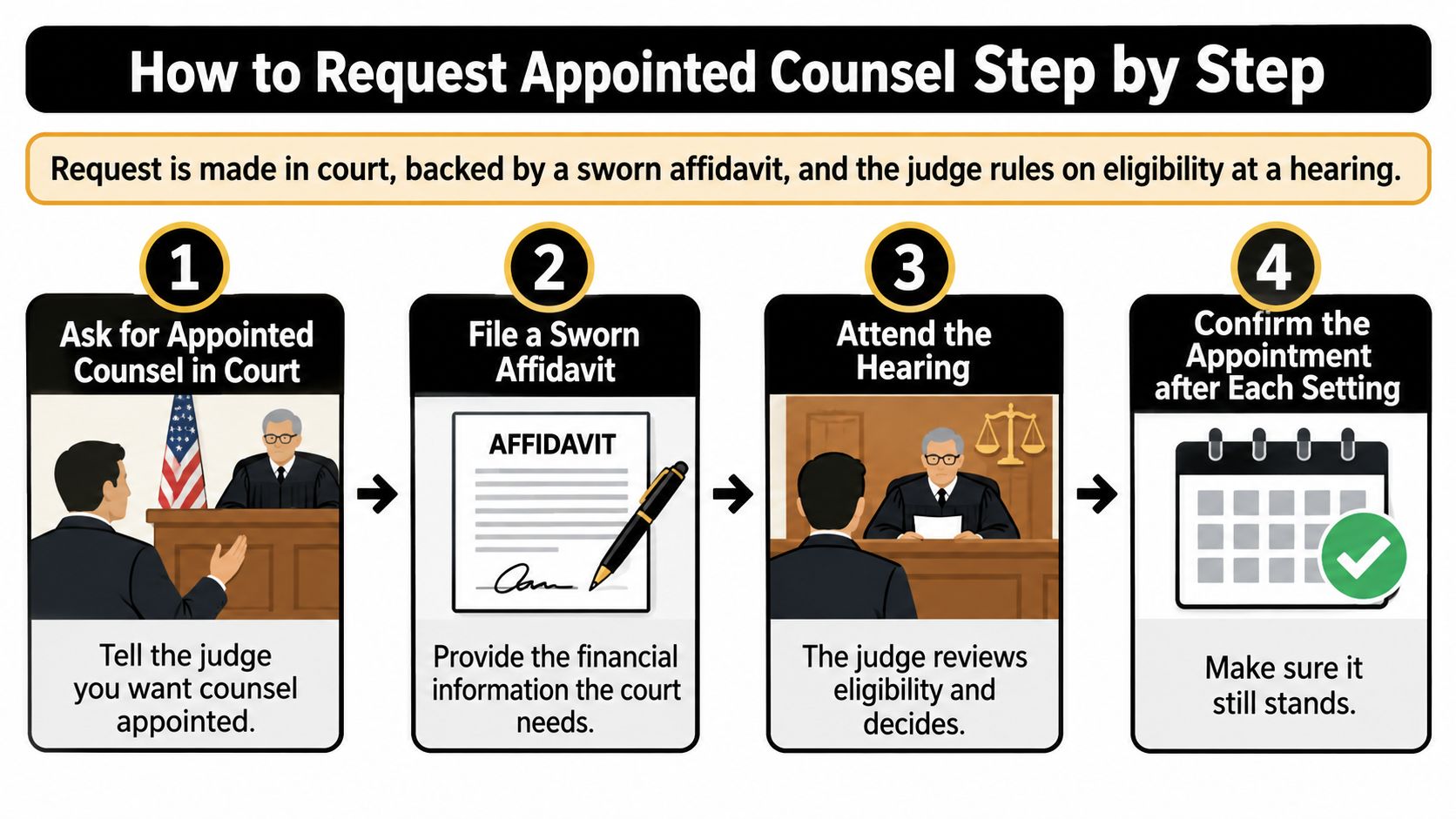
The Eight Steps That Build a Complete Request
- Ask at your first court appearance. Say clearly that you can't afford a lawyer and that you oppose the state's request. Waiting for a later setting leaves early decisions unchallenged.
- Get the affidavit from the clerk or court. Read every question before you answer. The common slip is rushing through sections about assets or benefits.
- Gather proof of income. Bring recent pay stubs, benefit letters, and bank statements. Documents make your affidavit easier for the judge to trust.
- List your obligations. Include debts, rent or mortgage payments, utilities, child care, transportation, and each dependent's name and age. Missing expenses can make you look more able to pay than you are.
- Sign only when every answer is accurate. You're swearing to this information. If a number changes before the hearing, tell the court instead of hoping no one notices.
- Attend the eligibility hearing. Bring copies of your documents and arrive early. Missing this hearing can delay appointment when you need guidance most.
- Get counsel's name and contact details in writing. Call before the next hearing, introduce yourself, and ask what documents your lawyer wants. Don't assume the lawyer received everything you gave the clerk.
- Keep a dated record. Track every hearing, filing, call, and income change in one notebook or phone file. That record helps when dates, instructions, or service requirements are disputed.
What a Finished Request Looks Like
At the end of the hearing, you should know whether counsel was appointed, who that lawyer is, and when you must return to court. Ask for a copy of the order before you leave.
Practical rule: If you can't name your lawyer, your next hearing date, and the papers you still owe, your request isn't finished yet.
Each Stage of a CPS Case and What Your Lawyer Does
Say a mother in Conroe loses part-time hours after her child is removed. She qualifies for appointed counsel at the first hearing, then misses a status hearing because she thinks it's optional. Her lawyer now has to repair the record instead of building her position, and the court may question her commitment to the service plan.
That scenario shows why Montgomery County appointed counsel in a CPS case must be protected stage by stage. The Texas Children's Commission benchbook material notes that some procedures provide only a temporary, ex parte appointment until the adversary hearing, and counsel may be discharged if the required financial affidavit is not submitted or the parent does not qualify.
The timeline below places each stage in order.
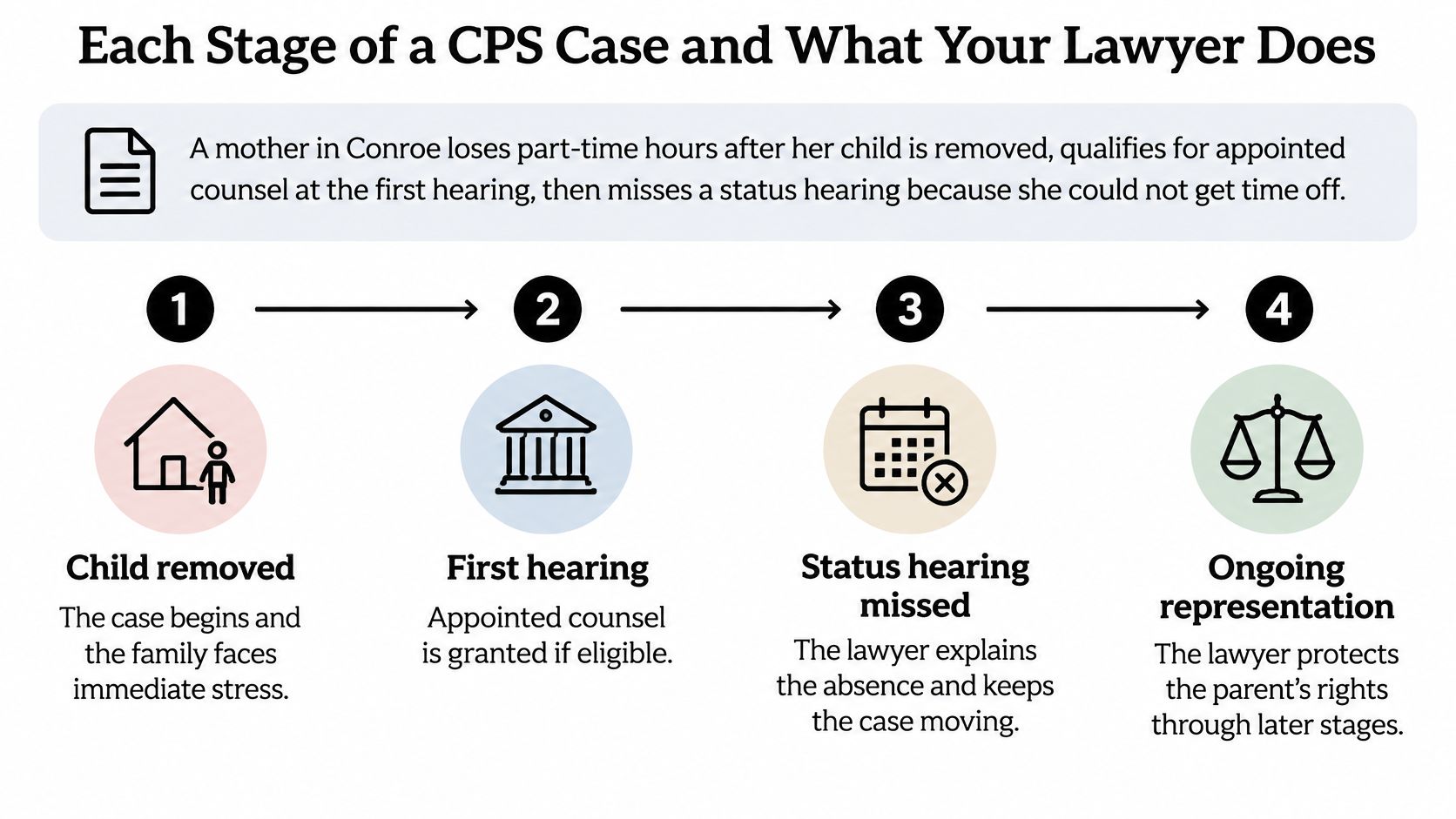
| Stage | When it happens | What counsel does | Continuity risk |
|---|---|---|---|
| Removal and first hearing | Early in the case | Reviews the petition and explains the case | Appointment may be temporary until the adversary hearing |
| Adversary hearing | After removal | Opposes or negotiates the state's requests | Missing financial paperwork can end the appointment |
| Status and permanency hearings | At scheduled intervals | Monitors the service plan and reports to the parent | A missed setting can harm the parent's position |
| Termination trial | If the state seeks termination | Presents evidence and cross-examines witnesses | Appointment generally continues unless the court orders otherwise |
| Appeal | After a final order | Handles the appeal | Indigence is presumed to continue unless finances materially improve |
Early settings move especially fast. Parents who want context on the Montgomery County child protection court removal hearing in the first 14 days should read their own orders for the exact date and time. Your order controls, even if another parent's case followed a different schedule.
Treat every setting as binding. After each hearing, confirm that your appointment still stands and write down what happens next.
Appointed Counsel Compared With Private Counsel and What It Covers
Who picks the lawyer, and who pays the bill? In a Montgomery County CPS case, those two answers separate appointed counsel from private counsel. When the court finds you indigent, the judge selects the lawyer and county funds pay. When you hire privately, you select the lawyer and you pay under your own agreement.
The scale of appointments shows why counties rely on lists and rotations. The Office of Court Administration report reported 55,382 court-appointed legal-representation appointments for children and parents in Texas during fiscal year 2021, with total reported spending of $66,238,774. A parent in The Woodlands, Conroe, or Magnolia sits inside that same county system. The court assigns from its list.
Side by Side Comparison
| Criterion | Appointed counsel | Private counsel |
|---|---|---|
| Who selects the lawyer | The court, through the county rotation or appointment list | The parent |
| Who pays | County general funds when the parent is found indigent | The parent, under a fee agreement |
| Scope of work | Set by the appointment order and local procedure | Set by the written engagement with the parent |
| Continuity | Generally continues through the case and any appeal while indigence is presumed | Continues as long as fees are paid and the relationship holds |
| Replacing counsel | Requested from the court for conflict or communication problems | The parent can hire a different lawyer at any time |
A rotation works like a duty schedule. The next lawyer on the list takes the case, so you may not receive the attorney you would have called yourself. That is the trade-off when county funds cover the fee. Private counsel gives you selection and direct control over the engagement when you can pay.
What the Appointment Usually Covers
Your appointed lawyer represents you, not your child and not the Department.
The appointment order works like a fence line around one yard. Hearings, discovery, mediation, service-plan disputes, termination litigation, and an appeal generally sit inside that line, as the order and local procedure define them. A custody fight in another proceeding needs its own analysis even when the facts overlap. Ask your lawyer to mark that boundary at the first meeting.
Ask three questions early. What does this appointment cover, how are fees handled if my income changes, and what should I do if I believe replacement counsel is needed?
Payment follows Texas Family Code §107.015, under which an appointed attorney is entitled to reasonable fees and expenses set by the court, generally paid from the county's general funds when indigency is established in a government-filed suit. The court may order a financially able party to pay fees or deposit money into the court registry before the final hearing. A raise, a new job, or an inheritance belongs in that conversation early. Keeping the same lawyer through later hearings and an appeal depends on the court still treating you as indigent, or on you paying if the court finds that you can.
Use this rule for your decision. If the court finds you indigent, request appointment without delay. If you can pay, compare two or three private lawyers on their CPS hearing experience in Montgomery County courts and on how clearly they explain fees, communication, and coverage.
Common Mistakes That Put Your Appointment at Risk
Having a right to counsel is not the same as keeping counsel for the whole case. That's the costliest misconception parents bring into Montgomery County CPS court.
- Waiting to ask. Fix it by requesting counsel at your first appearance and confirming the request in writing.
- Filing an incomplete affidavit. Fix it by updating income, assets, debts, and expenses whenever your finances change.
- Missing a routine looking hearing. Fix it by calendaring every setting and confirming attendance with counsel in advance.
- Hiding a job change. Fix it by telling counsel within days about a job loss, new income, or major expense.
- Assuming the appointment never changes. Fix it by asking counsel and the court to confirm after a financial change that the appointment still stands.
- Going silent after a disagreement. Fix it by raising the concern in writing and asking the court about replacement counsel for a conflict or serious communication problem.
The rules reflected in Texas Family Code provisions on indigent parents don't make every disagreement automatic grounds to remove counsel, and local appointment orders matter. A parent who is still in the investigation stage may also want guidance from a CPS investigation lawyer in The Woodlands about the difference between an investigation and a filed court case.
Apply one test before each hearing. Could the court's records show that you asked, filed, attended, and reported changes on time? If not, correct the gap now.
Frequently Asked Questions About Appointed Counsel in Montgomery County
Does Being Named in a CPS Case Automatically Get Me a Lawyer?
No. A CPS case alone does not automatically appoint a lawyer. You must oppose the government's request, claim indigence, ask for counsel, and submit the required affidavit. The court decides whether you qualify.
Does My Child's Lawyer Also Represent Me?
No. Your child has a separate attorney ad litem. That lawyer represents the child, while your appointed attorney represents your interests as a parent. Ask your own lawyer about your service plan, court orders, or testimony.
Can I Choose My Appointed Lawyer?
Usually, no. The court assigns an attorney, often from a county list or rotation. If a conflict or serious communication problem arises, tell the court and ask about replacement counsel. A preference for a different lawyer may not be enough.
What Should I Do if I Cannot Reach My Lawyer?
Keep a record of your attempts to contact counsel and state clearly what you need to discuss. If the problem continues, raise it with the court and explain how the communication issue affects your case. A disagreement by itself does not necessarily justify replacing appointed counsel.
Does the Appointment Cover an Appeal?
Review the appointment order and ask your lawyer whether it includes an appeal. The answer may depend on the order and the court's decisions. The earlier discussion of what appointed counsel covers explains the limits of representation.
Will I Have to Repay the Lawyer?
Payment depends on the court's determination and orders in your case. See the earlier discussion of fees and repayment for how those issues may be addressed.
Does the Appointment Cover a Custody Case in Another Court?
No. Montgomery County appointed counsel in a CPS case covers the CPS matter as stated in the appointment order. A separate custody, divorce, or enforcement case is a different matter, so ask whether you need separate representation.
Request Counsel Before Your Next Hearing
If your hearing date changes, write down the new date and ask your lawyer what the court expects you to address. A clear first conversation can help you focus on the issues that matter in your CPS case.

Questions for Your First Call
Use these prompts to make the conversation useful:
- What should I prepare for the next hearing? Ask which documents or updates relate to the issues the court will consider.
- What should I do if my income or household circumstances change? Clarify how to report a change that could affect your appointment or ability to pay.
- How can I reach you if I have a question before court? Confirm the best contact method and what to do if you cannot reach counsel.
Write down the answers and keep them with your case papers. Your lawyer can explain how the court's orders apply to your circumstances and what to expect at the next setting.
This article is general information, not legal advice. Your case depends on its facts, deadlines, and local court orders.
The Law Office of Bryan Fagan serves clients in The Woodlands and across Montgomery County and offers free consultations. Schedule one by calling (281) 819-1726 or using the firm's online contact form. For information about CPS defense in the area, see CPS Defense Attorney in The Woodlands.
If you are facing a CPS case in The Woodlands, Conroe, Magnolia, or elsewhere in Montgomery County, a free consultation can help you discuss your hearing dates and legal options. Visit The Law Office of Bryan Fagan to schedule.
