 Skip to content

You've got a hearing date on the calendar, a folder of paperwork on the kitchen counter, and one question that keeps coming back. What do I carry inside, and what stays in the car?
Most courthouse guides answer half of it. They list what can't go through the metal detector and stop there. For a Woodlands family with a custody, support, divorce, or probate matter on the docket, the part that goes wrong is usually the trip itself: the wrong building, a longer line than expected, a pocketknife nobody remembered was in the bag.
This is a packing and entry guide for Montgomery County courthouse security and what to bring. It covers the bring-and-leave list, the building and hours check, the screening line, dress, children, accessibility, and a night-before routine. It isn't about argument, evidence strategy, or what to say once you're in front of the judge.
A Hearing Day That Starts at the Wrong Door
A parent in Sterling Ridge leaves home at 8:15 a.m. for a 9:00 a.m. custody setting. She's doing the right thing, arriving early, papers in a folder on the passenger seat. The address in her head is the South County Annex on Lake Front Circle, a short drive from the house.
The notice folded in her bag says Conroe.
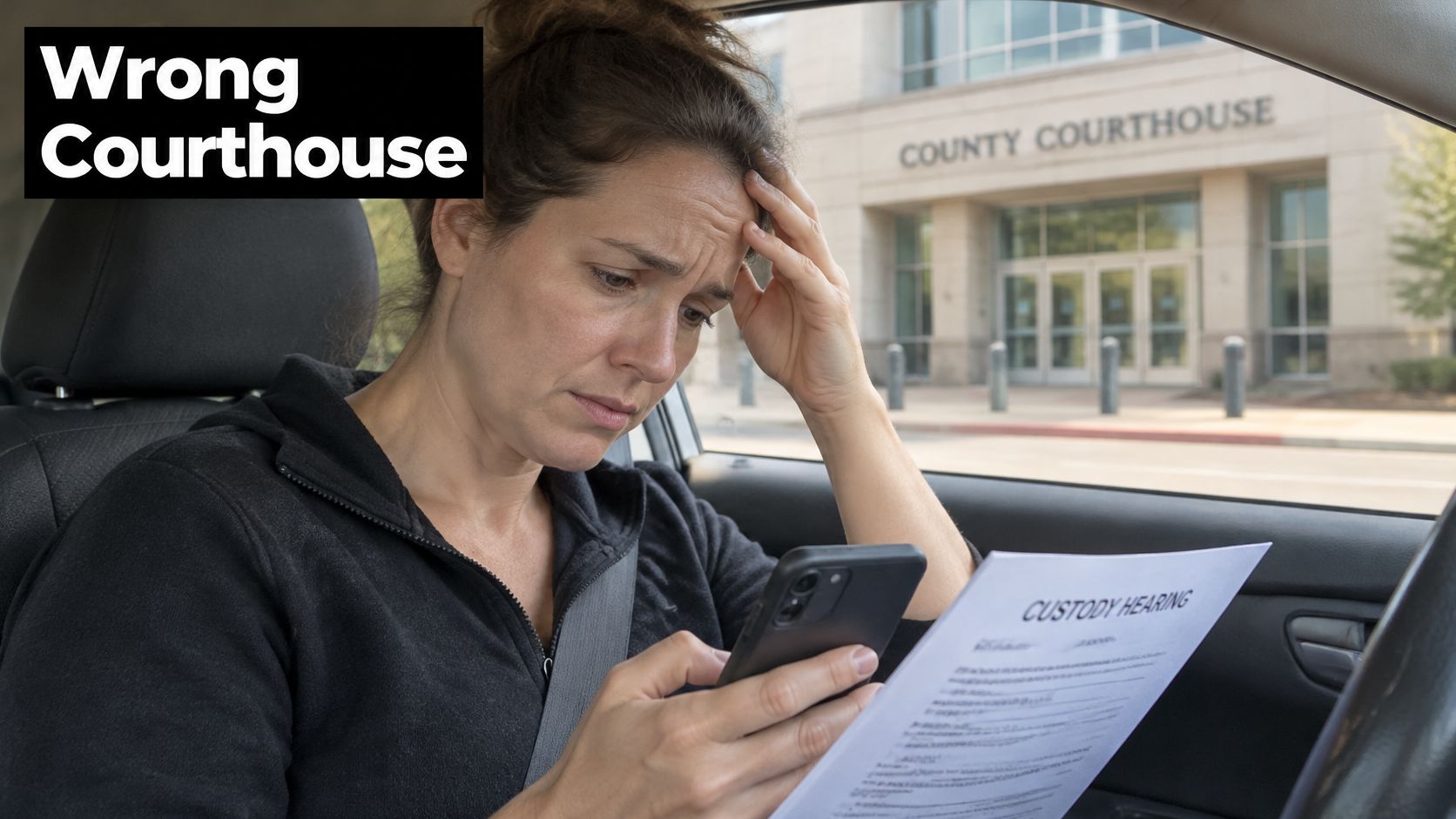
Then the second stop. A pocketknife from weekend yard work is still in the bottom of her work bag, so the metal detector turns a quick pass into a conversation at the screening table. Two small errors, and the docket call moves whether or not she's in the room.
That pairing, the wrong building plus time lost at the detector, is how people from Panther Creek, Alden Bridge, Creekside, Grogan's Mill, and the rest of the county miss the call of the case. A late appearance in a contested divorce, custody, support, or probate matter can let the docket proceed without the party.
The rule that outranks every map: the address and courtroom printed on your notice beat any saved screenshot, any remembered trip, and any annex that happens to be closer to home.
Courtroom rules also differ from one location to the next. The notice is the last word before you leave home, and this guide works backward from it.
What to Carry Through Montgomery County Security
Pack from this table the night before, not in the car. Every entry comes from what the county publishes about courthouse entry, and the practical limit is what keeps the line short.
| Item | Bring or leave | Why it matters | Practical limit |
|---|---|---|---|
| Government-issued photo ID | Bring | Security or the clerk may ask | Driver license or passport |
| Hearing notice or jury summons | Bring | Shows the courtroom and address | Jury summons is the county's clearest required example |
| Court papers in a simple folder | Bring | Pleadings, orders, and exhibits | Slim folder beats a bulky briefcase |
| Printed evidence and financial pages | Bring | Photos, messages, pay records | Do not rely on a phone display |
| Current orders or probate originals and copies | Bring | Custody, support, will, death certificate | Match the papers to the docket |
| Needed medication | Bring and declare | Personal medical need | Tell the screener before the bag is searched |
| Guns and ammunition | Leave home | Named prohibited items | No exceptions for a hearing day |
| Knives, multi-tools, and sharp objects | Leave home | Named prohibited items | Includes a pocketknife from work |
| Food and drinks | Finish before the courtroom | Not permitted in the courtroom | Eat or drink outside |
| Cell phone | Bring, silenced or off | Must not be used in proceedings | No calls in the courtroom |
| Recording devices | Leave out of the courtroom | Recording is prohibited | No audio or video |
What Belongs in the Folder
The county is direct about entry: visitors pass through metal detectors, may be searched, and purses, briefcases, and other containers may be inspected, as the jury information page from Montgomery County sets out. That one sentence reshapes the packing list. A slim folder you can hand over and close again moves faster than a briefcase with twelve compartments.
For a custody or support setting, carry the current order and any proposed paperwork you were told to bring, plus printed copies of the evidence you expect to reference. Messages, photographs, and pay records printed on paper matter more than usual here, because a phone screen is a poor substitute once devices must stay silent in the courtroom.
The Texas Family Code is what the judge applies to conservatorship, possession, and child support, so the orders and the dollar figures attached to them belong in the folder rather than in memory. The Texas Estates Code is why wills and probate applications travel through the county clerk, which is the reason the original will, certified death certificate copies, and any clerk receipt named on your notice go in with everything else.
What Stays Home
Guns and ammunition, illegal weapons, knives, and sharp objects are the prohibited items the county names, so leave the multi-tool, the box cutter, and the work pocketknife at home. Finish coffee and a snack before the courtroom door. Cell phones can come if they're silenced or off, but recording equipment stays out, and no one should plan to display evidence from a screen.
Pull the notice out of the folder now and read the address on it. The next section is about matching that address to a real building.
If you're unsure how the exhibits in your folder should be organized, this walkthrough on how to present evidence in court covers the order and format that courts in this county expect.
Match the Notice to the Right Building
You leave The Woodlands at 8:15 for a 9:00 hearing and pull into the South County Annex on Lake Front Circle. The notice on the passenger seat says 301 North Main Street in Conroe. That wrong door is the miss that costs a docket call. Whatever time is left still has to cover the screening line at the building that hears the case.
"Montgomery County courthouse" is a set of public counters and courtrooms spread across Conroe, New Caney, and The Woodlands. The county clerk's office location and hours page lists the main office at 210 West Davis in Conroe as open Monday through Friday from 8:00 a.m. to 5:00 p.m., and the East and South County Annexes as open Monday through Friday from 8:00 a.m. to 4:30 p.m. Those figures are the posted counter hours in the table below.
| Place | Address | Posted hours | Typical use |
|---|---|---|---|
| Main county office | 210 West Davis, Conroe | Monday-Friday 8:00 a.m.-5:00 p.m. | County clerk counters, including probate filings |
| East County Annex | 21130 Legion Road, New Caney | Monday-Friday 8:00 a.m.-4:30 p.m. | East county annex |
| South County Annex | 1520 Lake Front Circle, The Woodlands | Monday-Friday 8:00 a.m.-4:30 p.m. | Woodlands-area annex |
| Principal courthouse | 301 North Main Street, Conroe | Not separately posted, confirm with the court | District clerk and several district courts |
| Other courtrooms and offices | 207 West Phillips, Conroe | Not separately posted, confirm with the court | Other courtrooms and offices |
| County Court at Law No. 4 | 4210 West Davis Street | Not separately posted, confirm with the court | Separate court at law location |
| Jury Assembly Room | 301 North Thompson Street, Suite 202 | Per summons | Jurors only |
| Courthouse parking | Free public garage from Simonton Street | Two-hour limits around facilities | Arrive with time left on the meter |
Read the Courtroom Before the Street
The South County Annex is the short drive from Alden Bridge, Creekside, or Sterling Ridge. A notice that sets a 9:00 a.m. hearing in Conroe still sends you to the street printed on that paper. Match the courtroom on the notice to the building that hears it, not the nearest county office.
Counter hours and courtroom start times run on different clocks. A probate filing works like a library desk and a reading room: the clerk takes the papers at one counter, and the hearing can sit in another room on another schedule. Residents of The Woodlands must file probate at the Montgomery County Clerk's office in Conroe, at 210 W Davis St. Read the notice, circle the courtroom number, and match it to a street before you plan the drive.
When the Notice and the Map Disagree
Jurors follow their own instructions. The Jury Assembly Room sits at 301 North Thompson Street, Suite 202, and the summons is the document that gets them there. Family and probate notices can point to 301 North Main Street, 207 West Phillips, or 4210 West Davis Street. Each address has its own entrance and its own docket.
Write the matched address on the outside of the folder, and add a backup arrival thirty minutes earlier than your first estimate. The screening line at the correct door still uses the minutes you saved by skipping the wrong one. If any part of the notice is unclear, call the court that week rather than the morning of. Families sorting out which courthouse hears the case can use this plain comparison of Conroe versus The Woodlands family court.
How Screening, Parking and Accessible Entry Work
A family leaving The Woodlands at 8:15 for a 9:00 setting can still miss the call if the car stops at the wrong Conroe door and then waits in a screening line. The address on the notice gets you to a building. The open entrance, the garage, and the detector decide whether you are in the room when the docket starts.
The sequence below runs in travel order. Walk through it once at home and the morning has fewer surprises.
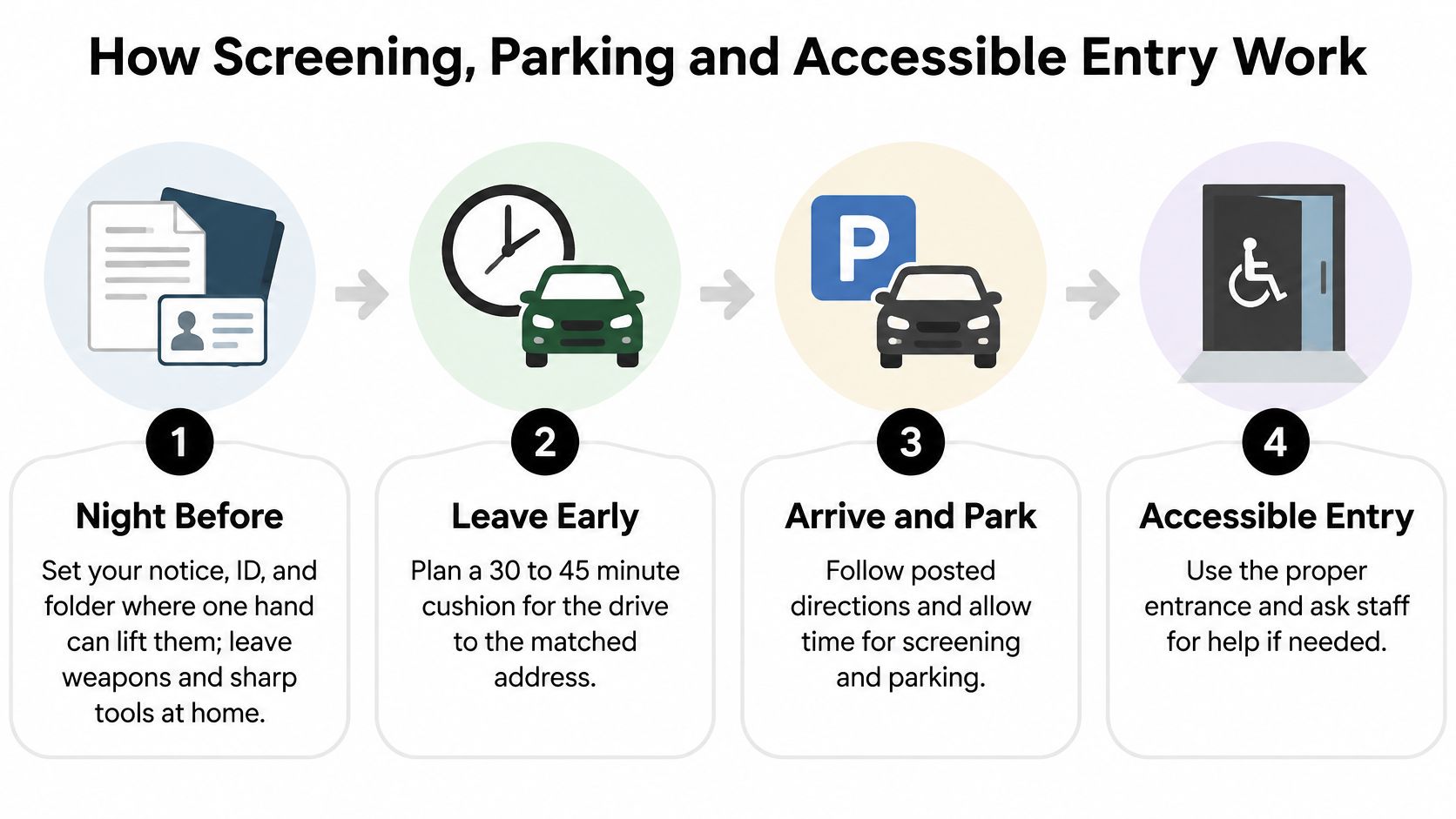
- The night before. Set the notice, your photo ID, and the folder in one place you can lift with one hand. What stays out of every bag is already on the packing table. Check that list instead of rebuilding it at the door.
- Leave early. Build a thirty to forty-five minute cushion for the drive to the matched address, parking, and the line. Screening works like a single-lane toll booth: one slow bag holds everyone behind it.
- Park legally and note the clock. Use the free public garage entered from Simonton Street or another legal space, and watch the two-hour limits posted around courthouse facilities. A legal spot that expires mid-hearing means a second trip, not a shortcut.
- At the door. Everyone passes a metal detector and may be searched. Purses, briefcases, and other containers may be opened for inspection, as the county's court website describes.
- Empty your pockets before you reach the table. Keys, coins, phone, and belt go in the tray. Declare medication or a medical device out loud, and keep the folder closed until someone asks for it.
- After the detector. Put the belt back on, pick up the folder, and read the courtroom number on the notice before you start down a hallway. A cleared bag does not tell you which room the setting is in.
- Find your courtroom and sit down. Match the number on the notice to the room, then take a seat and wait to be called. Quiet is the default once you are inside.
Practical rule: The delay that costs a docket call is discovering at the detector that something in your bag has to go back to the car.
The video below is a short companion to this same sequence.
Accessible Entry Takes One Phone Call
Entrances change. The county complex spans several Conroe addresses, and site work can open or close a different door without changing the street address printed on your notice.
If anyone in your group uses a wheelchair, a walker, a service animal, or medically necessary equipment, call the court listed on the notice that same week. Ask three things: which entrance is open now, how screening handles the device or service animal, and where a medical bag should be declared. Name the device before the bag is opened rather than after an officer has already started the search.
If two people are attending, have the second person carry the folder so one set of hands stays free at the detector.
Courtroom Clothes and Children in Tow
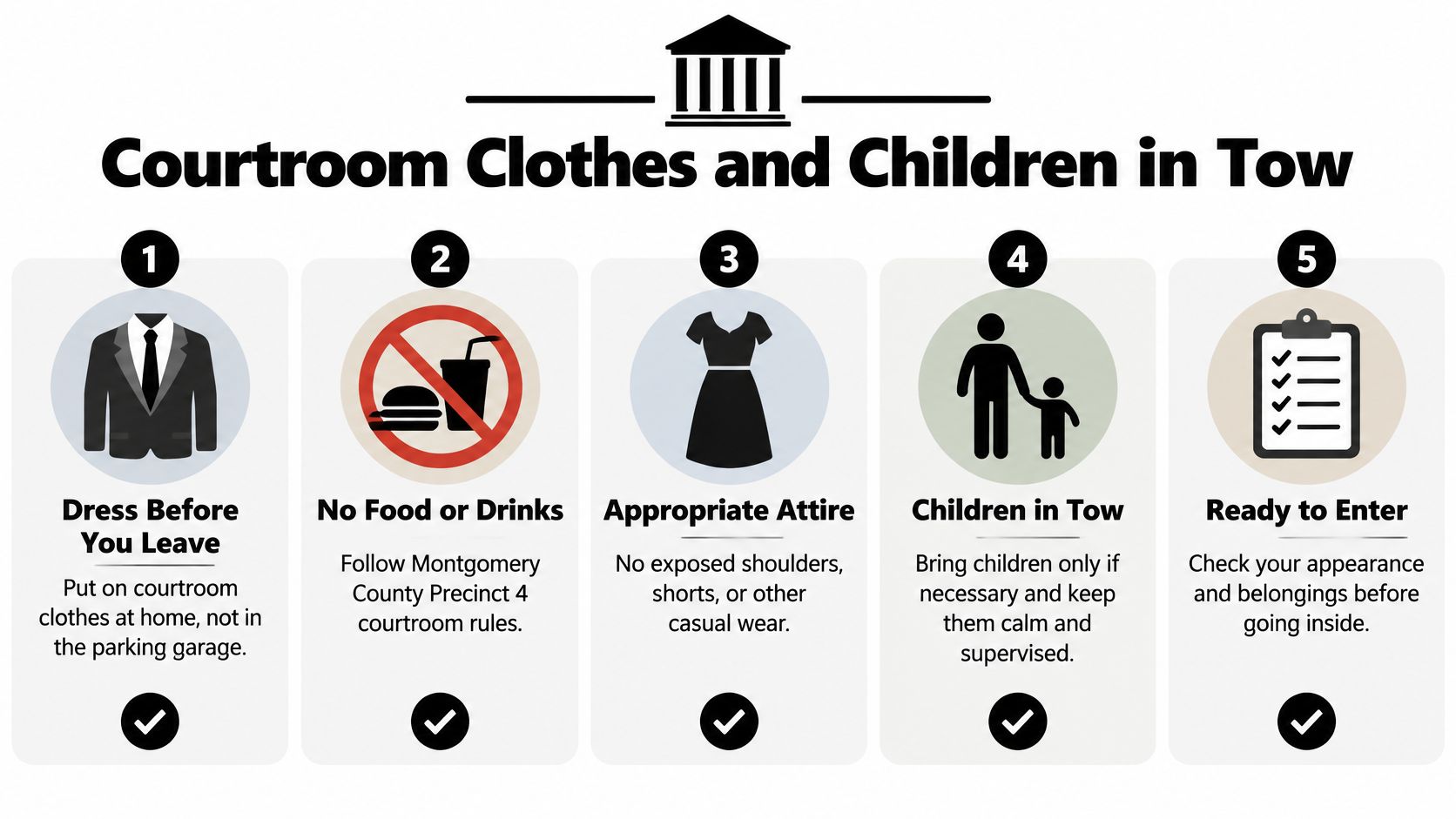
Dress at home, not in the parking garage. Montgomery County Precinct 4 publishes its courtroom rules, and they're a fair baseline for any hearing room in the county.
The Published Standard
The Precinct 4 courtroom rules and dress code prohibit food and drinks inside the courtroom and require appropriate attire. The listed restrictions cover exposed midriffs, tank tops and halter-style garments, excessively low-rise jeans, exposed undergarments, and clothing displaying offensive slogans or advertising alcohol or drugs. Hats and other headgear come off at the door.
Someone leaving work in Panther Creek or Alden Bridge at 8:00 a.m. for a 9:00 a.m. setting should choose the conservative option in the closet and finish the coffee outside. A work polo with a slogan on the back is a small risk that costs nothing to avoid. Closed-toe shoes and a belt that clears a detector without a second pass are the practical picks.
Children Are a Planning Question
A child at a hearing isn't a security exemption and isn't automatically welcome either. Read the notice, then ask the court whether the child's presence is required. If the answer is no, arrange a caregiver and keep the morning simple.
If a child has to come, pack only what a screener can inspect quickly. Leave toy weapons and sharp grooming tools at home, plan a quiet seat beside the adult who's supervising, and write a second adult's phone number on paper in case devices must stay off for an hour. Don't hand a child extra items to carry through the line, since a bag with two owners slows everyone down.
What happens once the doors open is a separate subject. This overview of what to expect in divorce court in The Woodlands covers the room itself, so the clothing and the folder aren't the only things you recognize on arrival.
Your Next Steps Before You Leave Home
The evening before is when a wrong door is still easy to fix. A Woodlands parent can have the morning organized and still miss a docket call by driving to the South County Annex when the notice lists a Conroe street. The detector line then uses the minutes that were meant for parking. The notice works like a boarding pass: the street address is the airport, the courtroom is the gate, and the start time is the boarding call.
Run this shorter list at the kitchen table. Ten minutes is enough.
- Circle three lines on the notice. Courtroom number, street address, and start time. The rest of the morning follows those three.
- Match the street to one building. Conroe, the New Caney annex, or the South County Annex in The Woodlands. If that address is not on the table in this guide, call the court before you drive.
- Confirm the notice again during the week before. Read the date, the room, and the street out loud. A changed setting is easier to catch on a weekday than in a parking lot.
- Call the court about entrance status. Ask which door is open that week and how screening is running. Write the answer beside the start time.
- Make the accessibility call if you need it. For a wheelchair, service animal, or medical device, confirm the open entrance and how that device goes through screening.
- Set the alarm for the earlier time. Plan the two-hour parking limit and the detector line into your start time.
Results in divorce, custody, support, and probate turn on the Texas Family Code or the Texas Estates Code and on the papers already filed. Those papers are what the judge works from once you are in the correct room. Montgomery County Family Courts: A Local Guide explains how family law cases proceed in the courts serving The Woodlands.
The Law Office of Bryan Fagan works with families in The Woodlands and across Montgomery County on divorce, custody, support, and probate. If the notice raises questions about the case itself, schedule a consultation through the website form or stop by the Woodlands office at 25211 Grogans Mills Rd, Suite 275, The Woodlands, TX 77380. Visit The Law Office of Bryan Fagan to use that form.
