 Skip to content
The first sign is usually small. A teacher leaves a voicemail. A neighbor says they saw a bruise. A nurse says the hospital had to make a report. Then your phone rings again, and now a DFPS caseworker wants to talk, wants to come by, wants answers right away.
That's the moment parents in The Woodlands and across Montgomery County usually feel the floor drop out. Don't treat it like a casual welfare check. Treat it like the start of a formal process with deadlines, interviews, records, and consequences that can move fast.
If you are already in that first day or two, the smartest move is to slow the situation down. Not emotionally, because that's hard. Procedurally. A cps investigation lawyer the Woodlands (if not already queued, verify) can help you decide what to answer, what to save, and what to refuse until you know whether CPS is asking for voluntary cooperation or building a case.
When a CPS Call Changes Everything in The Woodlands
A parent in Sterling Ridge gets a call from a school office after a child mentions something at recess. By the time that parent gets home, a DFPS worker has left a card and wants to set up a visit. A day later, the parent is staring at text messages, trying to remember who said what, and wondering whether the bruise the teacher mentioned even matters.
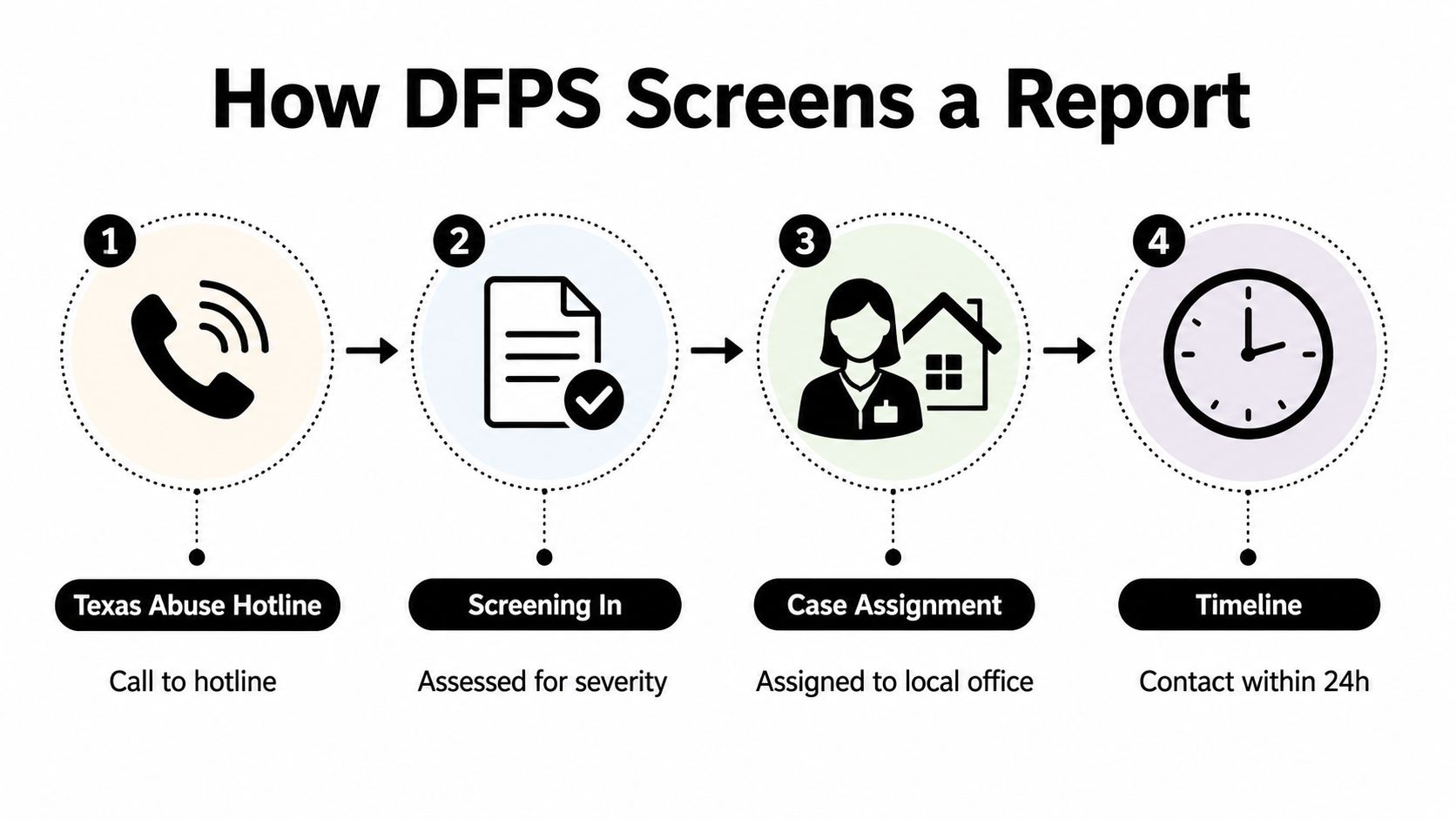
That panic is normal. The mistake is treating the call like an ordinary welfare check. DFPS says some reports are classified as Priority I when a child appears to face an immediate risk of abuse or neglect that could result in death or serious harm, and those investigations must begin within 24 hours of the report being received by DFPS. DFPS investigation guidance Once the report is in the system, the state can move from first contact to interviews and a home-safety review fast.
What parents usually miss in the first day
Many parents focus on whether they can “explain it” to the caseworker. That misses the core problem. The issue is whether they have already created a clean record, or a messy one, before anyone else starts writing the story.
Practical rule: the first 24 hours are about protecting the record, not proving your innocence in the driveway.
A report can come from a wide range of sources, including professionals such as doctors, nurses, and teachers, and DFPS also says reports can be made through the Texas Abuse Hotline at 1-800-252-5400 or online. In neighborhoods like Panther Creek, Alden Bridge, and Creekside, that can mean a parent goes from ordinary school pickup to a live CPS matter before dinner.
The key point is simple. CPS contact is not the same thing as a criminal accusation, and it is not the same thing as a court case either. But it is serious. The way you handle the first call, the first visit, and the first request for records often matters more than whatever happens later in a courtroom.
How DFPS Screens and Assigns a Case in Texas
A CPS matter does not begin in a courtroom. It begins at intake, where DFPS receives a report, screens it, and decides whether it is serious enough to open a case. The agency's process includes a preliminary assessment, assignment of a caseworker, contact and interviews, a home visit, information gathering, and a final assessment of safety and future risk.
What the labels mean in plain English
Once a report is screened in, a caseworker gets assigned and the file starts to move. If DFPS treats the matter as urgent, the response window can be very short, as with Priority I. Lower-priority reports still go through the same basic process, just without the same immediate deadline.
That difference matters for a parent in The Woodlands because the key question is not whether the case might become serious later. The question is how fast you need to respond today.
The investigation phase is a sequence, not a single conversation. DFPS can close it in several different ways, including Reason to Believe, Unable to Determine, Ruled Out, Unable to Complete, or Administrative Closure. TexasLawHelp CPS investigation phase
- Reason to Believe: DFPS concluded the report was supported.
- Unable to Determine: DFPS could not decide either way.
- Ruled Out: DFPS did not find support for the report.
- Unable to Complete: DFPS could not finish the investigation.
- Administrative Closure: DFPS closed the matter without the same kind of final finding you would see in a contested path.
Do not get lost in the labels. The file gets built piece by piece, and each interview, home visit, and records request shapes the outcome. If you are in Montgomery County, your texts, school emails, medical notes, and calendar entries are part of the case whether you treat them that way or not. When a parent needs an immediate response, an emergency CPS lawyer in The Woodlands can help make the first moves with a clear head.
Your First 72 Hours and What to Do Next
The first 72 hours are where parents make the kind of mistakes that are hard to undo. Don't argue with the caseworker by text. Don't delete anything. Don't assume your spouse, ex, or relative is helping by calling CPS to “clarify” things. Build your own record first.
Start preserving everything immediately
Save texts, emails, medical records, school messages, and business cards as soon as the call starts. Screenshot the thread. Back it up. Keep the caseworker's name, number, office, and the date of every contact. TexasLawHelp and DFPS both make clear that the investigation phase includes evidence gathering and interviews, so if you wait, you're already behind. TexasLawHelp parent attorney guidance
Then figure out what CPS is asking for. There's a big difference between a worker seeking voluntary cooperation and a situation that's moving toward court involvement. If the worker wants a recorded statement, slow down. If they mention a safety plan, read it like a contract, not a favor.
Plain advice: don't sign anything you haven't had reviewed, especially if the document changes where your child sleeps, who can see the child, or how often you can communicate.
A parent in Alden Bridge once told a caseworker at the front door, “I was just trying to keep everybody calm.” That line ended up being repeated back later as if it proved the parent was minimizing the issue. A different answer, tighter and shorter, would have helped: “I'm willing to cooperate, but I want counsel to review anything I sign or say first.” Same tone, better record.
Keep the home calm, not rehearsed
Prepare the home for a visit without staging a performance. The house does not need to look perfect. It needs to look safe, orderly, and normal. Tell the children not to answer questions they don't understand, but don't coach them on what to say.
Also pause case-related conversation with the other parent and with relatives. CPS files get built from fragments. A text sent in frustration tonight can show up tomorrow as the explanation for everything.
If you need a deeper local resource while you're sorting through the first call, review the firm's CPS Defense Attorney in The Woodlands page and the emergency resource at https://www.thewoodlandstxlawyers.com/emergency-cps-lawyer-the-woodlands/ as soon as you can. The goal is not to create drama. The goal is to keep a short window from turning into a long problem.
What to do next
- Preserve records immediately: Save messages, reports, voicemails, and business cards.
- Get the worker's goal in writing: Voluntary cooperation and court involvement are not the same.
- Hold off on recorded statements: Let counsel review first.
- Stop side conversations: Don't let relatives or the other parent improvise your defense.
- Prepare, don't coach: Make the home safe and the children comfortable, but keep it natural.
Parental Rights Under the Texas Family Code
Texas law gives parents rights, but those rights do not all show up at the same stage. During the investigation stage, you may hire a lawyer at any time, and you should. You are not entitled to a court-appointed lawyer during a CPS investigation. That is the practical reality for families in The Woodlands. The first lawyer in the room is usually privately retained, not appointed by the court, and that changes how quickly you can respond to what CPS asks for.
What changes if the case escalates
If the matter moves into court and you are found indigent, court appointment can become available later if the statutory requirements are met. If a child is removed, the court also appoints an attorney ad litem for the child. That lawyer represents the child's interests, not yours. For a clear explanation of the parent attorney issue during CPS contact, see Texas Law Help parent attorney guidance.
That distinction matters because parents often assume the child's lawyer is there to sort out family conflict fairly. That is not the role. The child's lawyer has a different job than your lawyer, and your interests are not automatically the same as the child's or the state's.
For a parent in an active CPS matter, the Texas Family Code matters because once the case enters court, orders can be sought, challenged, and reviewed. A safety plan that feels informal at the front door can become the starting point for later litigation if you sign it without review. A home visit that feels like a conversation can become evidence.
If you are deciding whether to consent to a visit, answer questions, or sign something, stop and ask one question first. Is this a voluntary step, or is it building the record for a later order? That is the legal issue that drives the next move.
A parent's biggest mistake is usually not defiance. It is agreement without understanding.
For families who need a court-stage reference point, the firm's CPS removal hearing the Woodlands page shows why removal is a different stage with different rules. You do not need to wait for that stage to get advice. Waiting usually weakens your position.
Voluntary Cooperation Versus Court Involvement
Parents often hear two things at once. “Just work with us,” and “If this escalates, we'll go to court.” Those are not the same path, even if they feel similar while the worker is standing in your kitchen. Voluntary cooperation gives CPS room to shape the file without a judge. Court involvement puts formal rules, filings, and hearings into the case.
| Factor | Voluntary Cooperation | Court Involvement |
|---|---|---|
| Record creation | The caseworker controls most of the paper trail. | The judge, filings, and hearings create a more formal record. |
| Counsel role | A lawyer can help before you sign or say too much. | Counsel can argue, object, and challenge orders. |
| Safety plan pressure | Parents often feel pressured to agree quickly. | Agreements can become part of a court-ordered path. |
| Custody overlap | Can affect an existing divorce or enforcement case quietly. | Can affect custody in a more public, traceable way. |
| Ability to challenge | Harder if you've already signed and cooperated loosely. | Better, because there's a formal forum to dispute facts. |
That trade-off matters in a divorce, custody dispute, or enforcement case in Montgomery County. A voluntary plan can look less confrontational today, but it can also narrow your options tomorrow. A court case is more stressful, but it gives your lawyer a defined place to push back.
If you need help thinking through that choice, one local resource is the firm's how to fight CPS in Montgomery County page. For families already juggling probate or future planning issues, an Estate Planning Attorney in The Woodlands may also matter if a family crisis is overlapping with wills or guardianship concerns.
The best rule is blunt. Refusal with counsel is not the same as refusal without a plan. Parents are often not choosing between cooperation and defiance. They're choosing between a guided response and an improvised one.
Why a CPS Investigation Lawyer in The Woodlands Matters Early
The best time to hire private counsel is before the file hardens. That's not a sales line. It's how these cases work. TexasLawHelp says you can hire a lawyer during the investigation stage, and that is exactly when a lawyer can still shape what gets preserved, what gets said, and what gets written down. Texas Law Help parent attorney guidance

A local lawyer also knows the practical pace of Region 6, the Montgomery County family court environment, and the way emergency matters get handled around the 410th and 418th district courts. That kind of familiarity matters when a worker wants an answer today and a parent needs time to think clearly.
The Law Office of Bryan Fagan handles family-law matters in The Woodlands and surrounding Montgomery County communities, and that includes emergency CPS issues when they intersect with custody and safety. The value is not hype. It's timing, judgment, and knowing how not to make a bad first day worse.
A poorly worded safety plan can do more damage than parents realize. So can an unnecessary removal. If a lawyer can help you avoid either one by reviewing the first contact before you talk yourself into a corner, that's the better trade.
Choosing Local Counsel and Booking a Consultation
Choose a lawyer who handles CPS defense, not someone who only handles family law and learns the process after your case has already started. Ask direct questions. How often do you deal with DFPS investigations? Have you handled cases in Montgomery County before? Do you know how emergency matters move when the caseworker is pushing for immediate cooperation?
That standard matters if you live in Panther Creek, Alden Bridge, Sterling Ridge, or Creekside. Local knowledge does not promise a favorable result, but it does lower the risk of paying for someone to learn the room while your case is already in motion.
Bring the right papers to the first meeting.
What to bring to the consultation
- Recent texts and voicemails: Bring the messages that show who contacted whom and when.
- The caseworker's card: The name and number matter more than people think.
- Any safety plan paperwork: Read it before the meeting, but do not try to fix it alone.
- School and medical records: These often become central once DFPS starts collecting documents.
- A short timeline: Write down the sequence while it is still fresh.
If you are calling around, ask the lawyer how they handle the first 24 to 72 hours, whether they review proposed statements before a parent gives them, and how they approach cases where CPS and custody are moving at the same time. You do not need a lecture. You need a plan.
This article is general information and not legal advice. Every CPS case turns on its own facts, and the DFPS clock often does not wait for you to feel ready. If you want a calm, local conversation about your options in The Woodlands or anywhere in Montgomery County, schedule a consultation before the file moves further.
The Law Office of Bryan Fagan helps parents in The Woodlands and Montgomery County handle CPS investigations, custody conflicts, and the first urgent decisions that shape the rest of the case. If you are dealing with DFPS contact right now, visit The Law Office of Bryan Fagan and set up a consultation so you can protect your rights before the record gets any harder to undo.
