 Skip to content

Getting your name on a county list is not the same thing as getting the next case. If you practice in The Woodlands, Conroe, or nearby Montgomery County, how attorneys get on the Montgomery County ad litem list is a registration problem first and a rotation problem second. The county does not appoint you because your office is close to the courthouse. You apply for a specific list, you qualify, and then you wait in line.
A custody lawyer and a probate lawyer are not filling out the same packet. Treating those dockets as one sign-up is the gap that stalls the file.
Which Montgomery County Ad Litem List Fits Your Practice
Montgomery County does not run one general ad litem sign-up. The county's Attorney Resources page publishes separate 2025–2026 applications for ad litem appointments in civil and probate cases and in family cases. You get on a list through that registration and application process, not through automatic appointment.
Texas Government Code Chapter 37 requires every Texas court to establish and maintain a list of qualified attorneys ad litem who are registered with the court. Courts may keep more than one list, sorted by case type and qualifications. Each court must post its lists annually at the county courthouse and on a court website. That split is why the county's forms don't collapse into a single download.
| List category | Application form | Case types | Application cycle |
|---|---|---|---|
| Family | Verified Ad Litem Application for Family Lists | Custody, divorce-related and other family cases | 2025-2026 |
| Civil and probate | Civil and probate ad litem application | Probate, heirship and related civil matters | 2025-2026 |
| Juvenile | Ask the clerk which form applies | Juvenile matters | Confirm before you file during 2025-2026 |
Match the form to the docket you want
Family matters use the Verified Ad Litem Application for Family Lists. That packet is for custody, divorce-related, and other family appointments. Civil and probate matters use the civil and probate ad litem application, which reaches probate, heirship, and related civil work.
The same county page identifies ad litem resources covering civil, family, probate, and juvenile matters. I would not assume a juvenile form sits in the same folder. Ask the clerk which form, if any, applies before you build that packet.
Practical rule: One family registration does not cover probate, and one probate registration does not cover custody.
A Woodlands family lawyer who also wants heirship work should file both applications. Submitting the right form is only the entry point. You still have to meet that court's qualifications, register for the right category, and stay eligible. If your work sits next to an amicus or guardian role, read how Montgomery County handles amicus attorney and guardian ad litem appointment cost so you don't mix those roles with the list you're joining.
Check for an updated form before each filing window. The 2025–2026 applications are the ones posted now. Last cycle's PDF is the wrong starting file.
How to Apply Step by Step
What keeps an application from reaching a judge? Start with the current county form and follow its instructions closely. The correct category is covered in the previous section; the steps below focus on preparing, submitting, and tracking your packet.
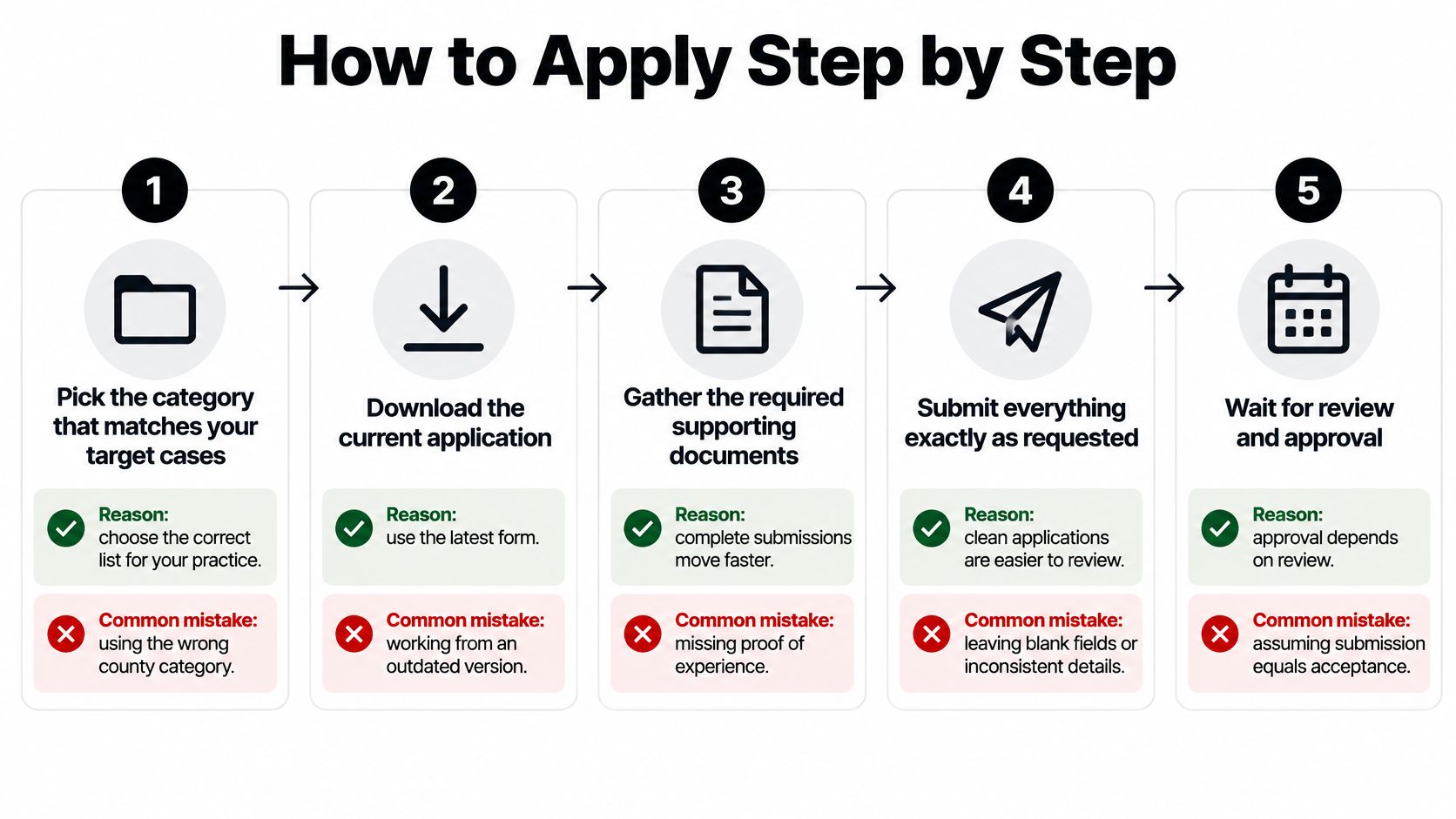
Montgomery County publishes a checklist for applicants, but does not publish an acceptance rate, average processing time, or guarantee of placement. A complete packet is necessary for review; it does not guarantee an appointment. Use the next section's table to check the attachments before submitting.
Five steps, and the mistake that slows each one
Download the current application. Confirm you have the version for the filing window you are applying to. Reusing an older form can leave you working from outdated instructions.
Complete every field. Give clear details about your experience and training. If the form asks about prior appointments, identify the court and case type rather than listing appointments without context.
Match each attachment to the form. Use the document table in the next section to check the packet. A generic litigation resume may not show the family, probate, juvenile, or guardianship experience relevant to the list.
Submit the packet as the form directs. Follow the stated submission method and include all required materials together. Do not assume you can send missing documents later.
Keep a dated copy and track the submission. Save the completed form and attachments, along with a record of when and how you submitted them. If a question arises during review, you can identify exactly what was sent.
Before submitting, confirm that the form is current, every field is complete, and each attachment is included. Note the county contact who confirmed the current application instructions.
Documents That Make an Application Complete
The most common packet gap is a resume that does not show relevant work. Reviewers need to see dated experience in the practice area for the list. A generic litigation summary can obscure family, probate, juvenile, or guardianship experience.
| Document | What to include | Common gap |
|---|---|---|
| Resume or work-experience summary | Family, probate, juvenile, or guardianship work with dates | Generic litigation resume with no family or probate detail |
| List of prior court appointments | Court, case type, and appointment dates | Appointments listed without court or case type |
| Guardianship certifications | Each certification that applies to the listed work | Certification mentioned but not attached |
| State Bar card | Copy of the current card | Expired, cropped, or unreadable copy |
| CLE-hour documentation | Certificates showing hours completed | Hours listed without certificates |
| Professional headshot | Current photo in the format the county requests | Old photo or a file the form does not ask for |
Three gaps that stall the packet
For each prior appointment, identify the court, case type, and date. “Appointed in several custody cases” leaves the reviewer without enough detail to assess the work.
Attach the supporting document for every certification listed. If your resume includes guardianship work, include the applicable certificate. A statement that you hold a certification does not replace the document.
Check the remaining files for readability and fit: the State Bar card should be current, CLE hours should be supported by certificates, and the headshot should follow the format requested on the form. Compare each attachment against the form's document list before filing.
Keep a running log of appointments with the court, case type, and date. It makes the next update more straightforward and reduces the chance of missing details.
Qualifications, Training and Staying Listed
A child-protection attorney-ad-litem listing requires ongoing compliance. Under Texas Family Code §107.004, an attorney on a court's list must complete at least 3 hours of relevant continuing legal education each year, before the anniversary of the listing, unless equivalent experience is found. Track that anniversary and keep the required records current.
| Requirement | Source | Timing |
|---|---|---|
| Child-protection CLE, at least 3 hours | Texas Family Code §107.004 | Each year before the listing anniversary |
| Trauma-informed care training documentation | Texas Family Code §107.104 | As required for the applicable list |
| Annual reporting in certain DFPS Title 5 cases | Texas Family Code §107.104 | Yearly, including share of professional time |
| Placement under court rotation | Texas Government Code Chapter 37 | While listed |
What sits beside the three hours
Texas Family Code §107.104 addresses trauma-informed care training documentation and annual reporting by attorneys appointed in certain DFPS Title 5 proceedings. The report includes the percentage of an attorney's professional time devoted to those appointments. Keep the training and reporting records with the listing file so they are available when needed.
Specialized education, certification, language proficiency, or subject-matter knowledge may affect how a court uses an attorney on its list. For attorneys seeking child-focused appointments, documenting relevant training helps show the qualifications they bring. A custody evaluation or social study in Montgomery County is a court-related process for assessing circumstances relevant to custody; it is distinct from the qualifications and compliance required to remain on an attorney-ad-litem list.
The section's cited rules do not establish a Montgomery County list-membership fee, minimum years in practice, or background-check requirement. Confirm those details with the court before filing, since local procedures can vary.
Put each listing anniversary on your calendar. Complete the required CLE before that date and retain the certificates with your records.
How Courts Choose From the Rotation
Say you're a family lawyer in The Woodlands. You're on the family list. A custody case comes in, and your name is fifth. The four lawyers ahead of you are still eligible. Whether you get that file depends on who is in front of you, and on whether the parties agree to someone else.
First on the list, unless an exception fits
After you qualify and register, Montgomery County appointments generally follow a rotation rather than unrestricted judicial selection. Under Texas Government Code Chapter 37, when a court uses a rotation, it ordinarily appoints the person whose name appears first on the applicable list. The statute allows a different qualified person when the parties agree and the court approves, or when a candidate has relevant specialized education, training, certification, skill, language proficiency, or subject-matter knowledge.
That framework creates two milestones. First, acceptance onto the right list. Second, your place in the rotation. Courts may keep separate lists by case type and qualifications, which is why a family listing does not put you in line for a probate appointment.
Probate is a different statute and a different office
Probate courts appoint an attorney ad litem under the Texas Estates Code, often for unknown heirs or an heir who can't appear. Confirm the local probate procedure with the clerk before you rely on a family-list approval. Residents of The Woodlands must file probate at the Montgomery County Clerk's office in Conroe, at 210 W Davis St. Docket habits in a family court, including the 410th District Court family docket procedures, don't set the probate court's deposit or billing practice.
Public county materials don't publish appointment volume, expected turnaround, or a standard fee deposit. An order on an attorney ad litem deposit can exist in one probate matter and look different in the next. Deposits and payment depend on the court and the case type.
Before you accept an appointment, ask about the deposit, how you bill, and how you withdraw if a conflict appears.
Listing means you may be considered. It does not mean the next file is yours, and it does not tell you what the work will pay after travel, record review, and hearings.
Confirm Your Listing Before the Next Application Window
How will you know your listing is current when the next application window opens? Keep a record of the applicable list, its cycle dates, and any ongoing requirements so you can update your materials without rebuilding the packet.

What to do next
- Confirm the list for each case type. Check the current form for family, civil and probate, or juvenile work. Approval for one list may not qualify you for another.
- Check the cycle dates. Review the current posting before filing so you do not rely on an outdated form.
- Calendar listing anniversaries. Track any required child-protection CLE deadlines and keep completion certificates with your records.
- Update your appointment log. Record the court, case type, and date after each appointment. A current log makes it easier to update an application accurately.
A current listing makes you eligible for consideration; it does not guarantee an appointment. Courts also make rotation decisions, so keep your application records current while treating each appointment as a separate possibility.
Attorneys and families in The Woodlands, Conroe, and surrounding Montgomery County communities can contact the Law Office of Bryan Fagan to discuss a legal matter. The firm offers a free consultation, where clients can discuss their circumstances confidentially and review their legal rights. Call (281) 819-1726 or use the firm's online contact form.
