
You're sitting at your kitchen table in The Woodlands with a stack of bank statements, tax records, retirement documents, and a request for a financial disclosure form. You may be wondering whether an old savings account, a cryptocurrency wallet, or an interest in a family business really matters. In Montgomery County family cases, those details can affect property division, child support, spousal maintenance, and the credibility of everything else you report.
A disclosure is more than a form to complete before a hearing. It creates the financial record that the court and the other party use to evaluate competing claims. The safest approach is accurate, complete, and organized disclosure, especially when personal and business finances overlap.
What a Financial Disclosure Form Does
A Montgomery County parent may receive a request for income records and financial information soon after a divorce or support case begins. The request can seem excessive, especially when both parties believe they already know what the family owns. The difficulty is that modern finances rarely fit neatly into a checking account and a pay stub. Cryptocurrency wallets, online payment accounts, restricted stock, side businesses, and digital sales income can affect the financial picture.
Texas courts need reliable information before deciding property, support, or financial claims. A financial disclosure form identifies income, assets, debts, expenses, and ongoing responsibilities. In a divorce, those details support analysis of community property and community debts. In a child support dispute or modification, they provide facts for arguments about current resources and recurring expenses. In a spousal maintenance dispute, they help the parties and the court examine income and reasonable needs.
The form also creates accountability. By signing, you generally represent that the information is complete and accurate to the best of your knowledge. Leaving out an account, business interest, or digital asset can create credibility problems even if the item seems minor. A missing asset may also prompt additional document requests or closer examination of the rest of the disclosure.
Practical rule: Treat every requested financial disclosure as a sworn financial record, not as an informal estimate.
Texas family procedure distinguishes between information exchanged by the parties and documents filed with the court. That distinction matters in Montgomery County. Some disclosures and supporting records are exchanged directly, while required notices, pleadings, certificates, and proofs of service may be filed with the clerk. The order in your case may set additional requirements, so confirm where each document belongs before submitting it.
The process can arise in several settings:
- Divorce and property division: The parties identify assets, liabilities, income, and expenses so property claims can be evaluated.
- Child support disputes: Current income and recurring expenses may affect the arguments presented to the court.
- Custody modifications: Financial information may matter when support, medical expenses, or another financial issue is part of the requested relief.
- Probate: An estate representative may have separate inventory and notice obligations under the Texas Estates Code.
A divorce discovery process in Texas can include document requests, written questions, and financial information beyond the initial form. Those requests often matter when records suggest an undisclosed account, mixed business and personal spending, or income held through a digital platform. The purpose is to prevent negotiations and court decisions from relying on an incomplete balance sheet.
In Panther Creek, Alden Bridge, Sterling Ridge, Creekside, and other Montgomery County communities, local filing practices still operate under Texas law and the specific orders in your case. Read the request carefully, preserve original records, and ask questions before guessing at an answer.
Required Sections and Supporting Documents
A useful way to complete a financial disclosure form is to build the financial picture before entering numbers. Gather records first, then compare those records against the form. That approach reduces omissions and makes inconsistent entries easier to catch.
Start with property and ownership
List real estate whether it's titled in your name alone, jointly owned, held through a business, or connected to a trust. For a Woodlands family, that may include a home in Sterling Ridge or Alden Bridge, a rental property, undeveloped land, or an interest in a property owned with relatives.
For each property, collect the deed or closing statement, current loan information, tax records, and any appraisal or valuation material you already have. Don't assume the county appraisal value answers every divorce valuation question. The relevant issue may involve equity, market value, reimbursement claims, or the characterization of the property as separate or community.
Texas community-property rules make tracing important. Property acquired during marriage may raise community-property questions, while property owned before marriage or received by gift or inheritance may involve separate-property claims. The form should identify the asset and provide enough information to explain the claimed character. Labeling an asset “separate” without records may not resolve the issue.
Include accounts, benefits, and vehicles
Gather statements for checking and savings accounts, certificates of deposit, brokerage accounts, retirement plans, pensions, education accounts, and employer benefits. Include vehicles, recreational equipment, valuable personal property, and insurance policies with cash value when the form or discovery requests call for them.
Recent pay stubs, tax returns, bank statements, credit-card statements, loan statements, and retirement statements usually help support the entries. Keep documents in folders by category and date. A clean index is often more useful than a random digital folder containing hundreds of pages.
Report business interests and expenses
A closely held company can be harder to disclose than a bank account. Gather business tax returns, profit-and-loss statements, balance sheets, general ledgers, ownership records, shareholder or operating agreements, and records of distributions or personal expenses paid by the company.
Monthly expenses deserve the same care. Separate housing, utilities, insurance, transportation, medical costs, debt payments, childcare, and recurring household expenses. Estimates are sometimes unavoidable, but unsupported guesses can weaken your presentation.
The Divorce Lawyer in The Woodlands, TX catalog description identifies representation for clients in The Woodlands and Montgomery County. Whether you use counsel, an accountant, or both, the professional should understand how the records connect to the legal issues rather than merely transcribe figures.
Before signing: Compare the form against your tax returns, account statements, business records, and credit reports. A mismatch doesn't automatically mean wrongdoing, but it does require an explanation.
Texas and Montgomery County Filing Deadlines
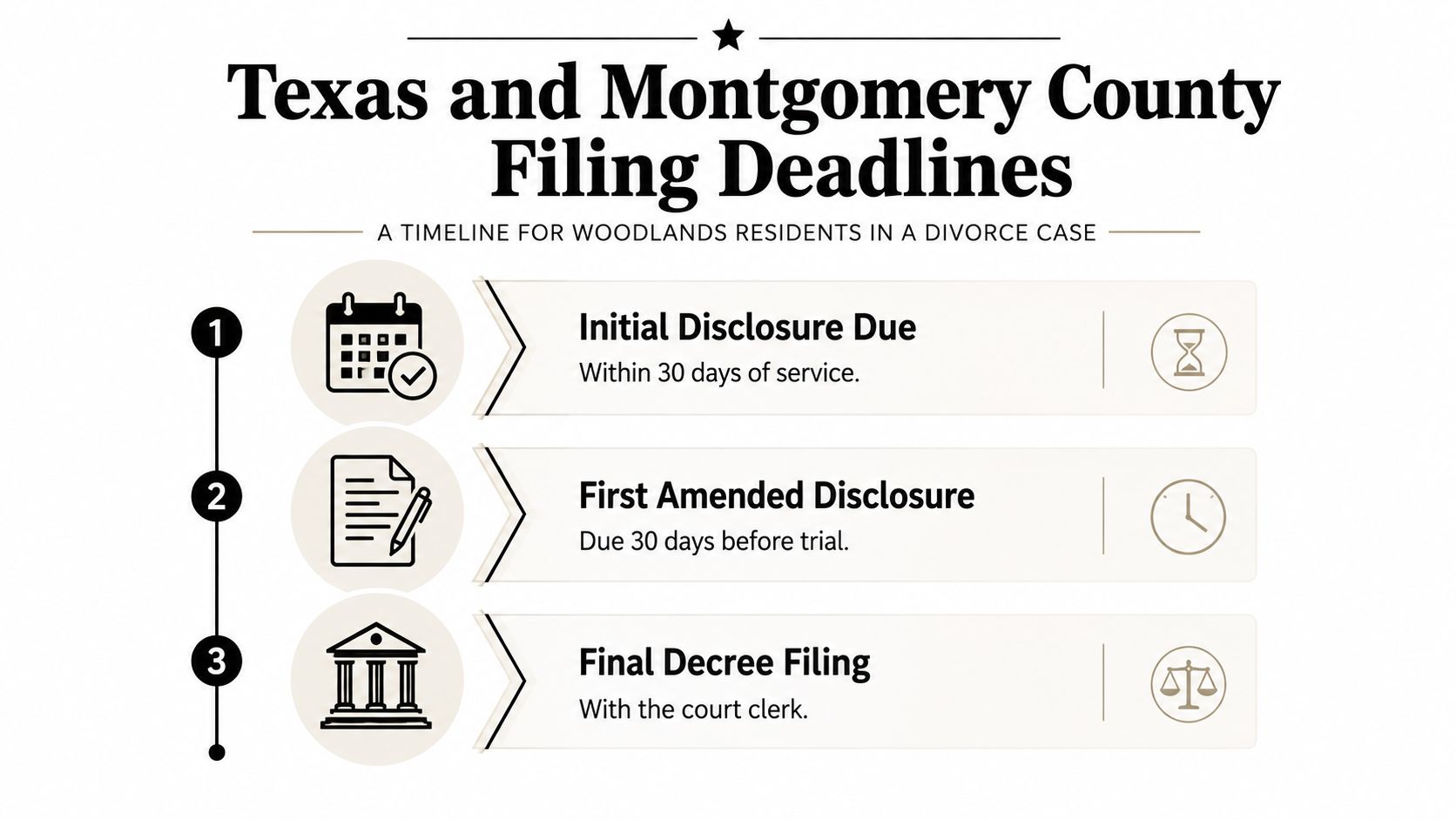
Deadlines depend on the type of case and the specific order or rule governing it. A Woodlands resident shouldn't assume that a deadline for exchanging divorce information is the same as a deadline for filing a probate document with the clerk.
In a Texas divorce case, initial disclosures are generally exchanged within the applicable period after service, and the parties may have continuing duties to supplement information. The timeline graphic above identifies common milestones, including an initial disclosure due within 30 days of service, a first amended disclosure due 30 days before trial, and final decree filing with the court clerk. Confirm the exact requirements in your case because scheduling orders, agreements, and court instructions can control the practical calendar.
The key distinction is exchange versus filing. A party may send financial records to the opposing side without filing every page with the clerk. Other documents, including pleadings, certificates, affidavits, or proof of service, may need to be filed. Sending a document does not always satisfy a filing requirement.
Probate uses a different framework. In Texas, a personal representative generally must file a verified, full, and detailed inventory with the court clerk before the 91st day after qualifying, unless the court grants more time. The inventory must show the fair market value of each item as of the date of death and identify whether each asset is separate or community property. See Texas Estates Code Section 309.051.
Certain independent executors may use an affidavit in lieu of the public inventory when the statutory conditions are met. That option is limited, and it doesn't erase the obligation to assemble accurate estate information. The same 90-day period applies unless the court extends it under the applicable law. Probate notice duties are separate. Under Texas Estates Code Section 308.004, the personal representative must file a sworn affidavit or attorney certificate identifying beneficiaries who received notice, those who didn't require notice, and anyone whose identity or address couldn't be found despite reasonable diligence, within the required period after the order admitting the will to probate.
Use a calendar with separate columns for service, exchange, amendment, filing, and hearing or trial. Save confirmation of delivery and filed-stamped copies. If a deadline is unclear, raise the issue before it passes.
Common Mistakes and Consequences of Noncompliance
The most damaging assumption is that an omitted item doesn't matter because it has little value. A court may view the omission less by its size than by what it suggests about the reliability of the entire disclosure. A missing account can lead to more questions, additional discovery, and less confidence in voluntary representations.
Undervaluation creates a different problem. A home, business interest, vehicle, or investment account may look simple on paper while requiring a careful valuation. Using an outdated statement, ignoring debt attached to an asset, or reporting a business only by its tax basis can produce a misleading result.
Errors that commonly create trouble
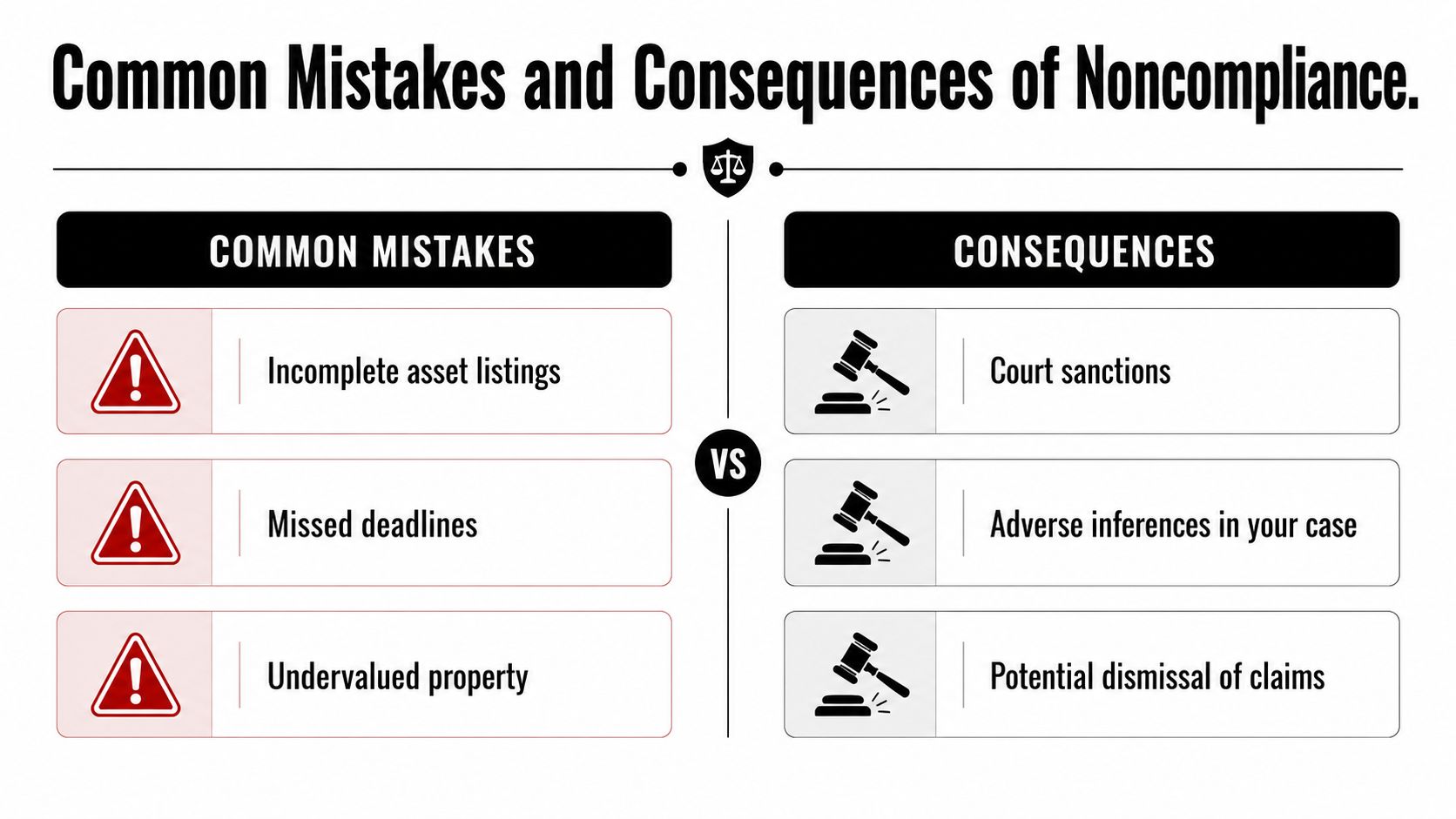
- Incomplete listings: Leaving out an online bank account, retirement plan, trust interest, or payment platform can prompt follow-up requests.
- Missed deadlines: Failing to exchange or file on time can affect hearings, settlement negotiations, and the court's willingness to grant relief.
- Unsupported values: A number without a statement, appraisal, ledger, or other explanation may be challenged.
- Mixed personal and business records: Personal expenses paid through a company can obscure both household income and business value.
- Unexplained changes: Large transfers, new debt, or account closures should have a clear paper trail.
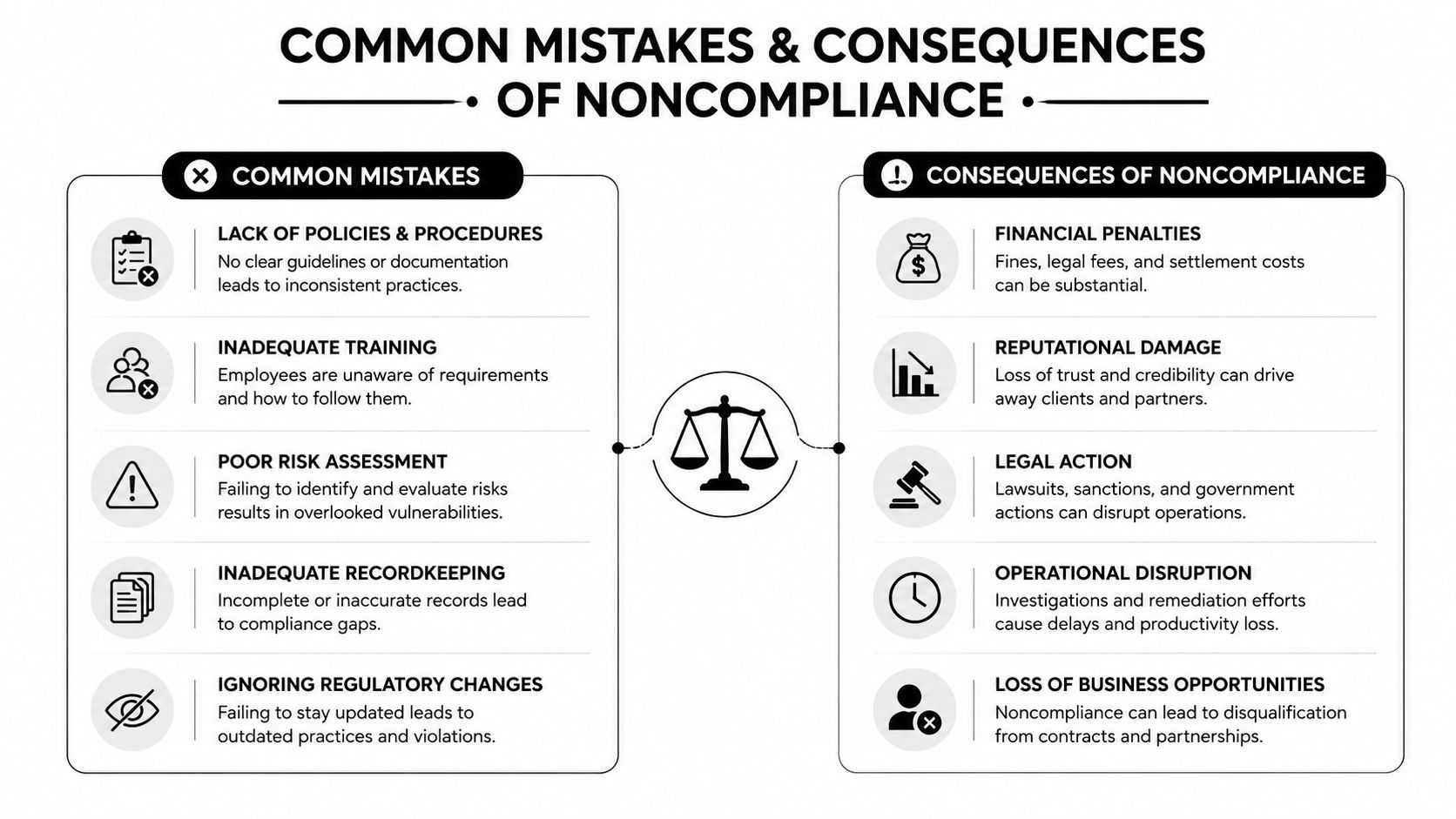
Texas family courts can address noncompliance through procedural remedies and sanctions. Depending on the circumstances, a court may limit evidence, require additional production, award fees, draw an adverse inference, or delay a ruling. A failure to complete required disclosure can also create obstacles to final judgment. The remedy depends on the facts, the order involved, the significance of the omission, and whether the party corrected it promptly.
A small omission can change the settlement
A Woodlands couple reaches a property settlement after exchanging ordinary bank and retirement records. Months later, the other spouse discovers a digital payment account used for side work. The account itself isn't the only concern. The discovery raises questions about whether related income, expenses, and transfers were also omitted.
That scenario can unravel confidence in the settlement process. It may lead to subpoenas, requests for amended disclosures, or litigation over whether the agreement was based on incomplete information. Correcting an honest mistake quickly is usually safer than defending a selective omission after the other side finds it.
A complete disclosure protects your credibility. Strategic withholding often creates a second dispute on top of the original case.
Hidden Assets and Modern Financial Complexity
A modern household's balance sheet rarely fits neatly into checking, savings, home, and car. Families in The Woodlands may use online-only banks, digital payment platforms, cryptocurrency exchanges, investment apps, business entities, trusts, and accounts outside the United States. A form can be completed neatly and still be incomplete if the search behind it was too narrow.
Start with transaction history rather than memory. Review bank statements for transfers to unfamiliar platforms, recurring electronic payments, exchange deposits, brokerage activity, and payments to or from a business. Search email and secure account records for account-opening confirmations, tax forms, wallet notices, and investment statements. Don't try to access an account you're not legally authorized to access, but preserve records you already possess.
Areas people often overlook
- Crypto assets: Check exchange statements, wallet records, transaction histories, and tax documents. A wallet may not resemble a traditional account statement.
- Online-only accounts: Identify accounts held through digital banks or financial applications, including accounts used only for savings or transfers.
- Payment platforms: Review business and personal activity on services used to receive payments, hold balances, or send money.
- Business interests: Look beyond ownership percentages. Distributions, shareholder loans, retained earnings, company-paid expenses, and intellectual property may matter.
- Trust interests: Determine whether you're a beneficiary, trustee, or recipient of distributions, and collect the governing documents and distribution records.
- Overseas holdings: Gather foreign account statements, investment records, ownership documents, and tax materials.
The practical problem is often identification, not handwriting or data entry. Recent family-law guidance flags online-only bank accounts, crypto assets, offshore investment accounts, and business records as items people commonly overlook. That concern is reflected in guidance on modern financial disclosure, although the governing requirements in your Texas case still depend on Texas law, the pleadings, discovery requests, and court orders.
For a high-asset divorce, create an asset map. List the account or entity, owner, custodian, approximate opening date, related tax records, transfers, and missing documents. Then give the map to your attorney and accountant together when business valuation, tracing, or tax consequences overlap.
If you're concerned about assets being concealed in a Montgomery County divorce, review the discussion of hidden assets in divorce and treat it as a prompt to investigate methodically, not as a reason to make unsupported accusations.
Your Disclosure Checklist and Local Next Steps
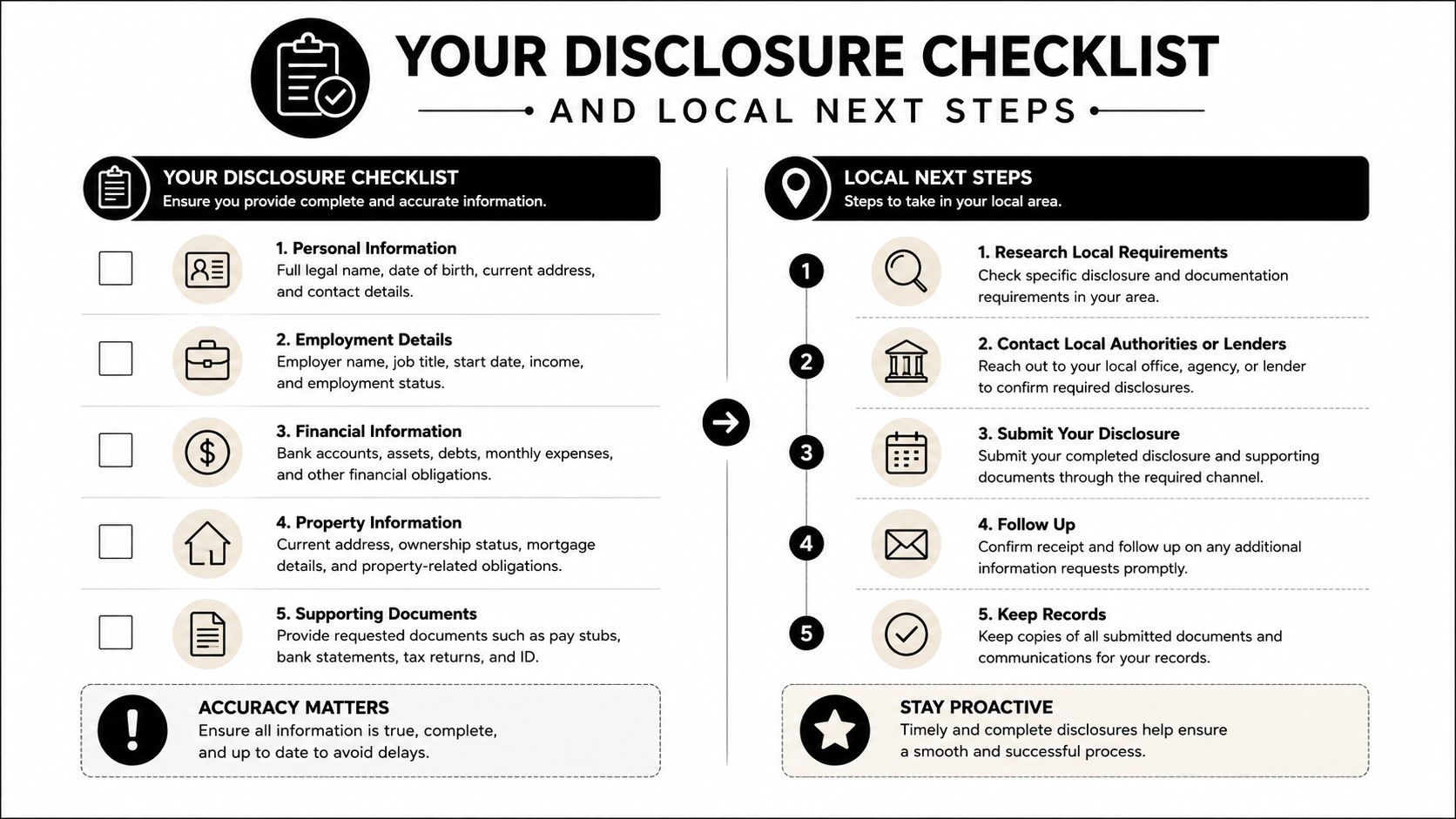
Use this checklist before completing or signing a financial disclosure form:
- Read the request closely: Identify the response date, required categories, service method, and whether the court entered a scheduling order.
- Build an account list: Include traditional banks, online-only accounts, investment platforms, retirement plans, digital payment services, and crypto exchanges.
- Gather ownership records: Collect deeds, titles, business agreements, trust documents, beneficiary records, and account statements.
- Trace income: Compare pay records, tax returns, business distributions, rental income, investment income, and recurring transfers.
- Separate property claims: Mark assets acquired before marriage or received by gift or inheritance, then gather tracing records.
- Document debts and expenses: Include loans, credit cards, taxes, insurance, medical expenses, childcare, and recurring household obligations.
- Check for gaps: Compare the form against tax returns, statements, email records, credit information, and business books.
- Preserve delivery proof: Keep copies of what you served, how you served it, and when it was received or filed.
- Update promptly: Tell your attorney when a new account, transfer, valuation, or document changes the picture.
For a Montgomery County consultation, bring the disclosure request, pleadings, court orders, recent financial records, property information, business documents, and a written list of questions. An accountant or financial advisor can help organize records and explain transactions, but legal counsel should determine what must be disclosed and how a disputed asset affects your case. This guide to preparing for a Texas divorce consultation can help you assemble the initial packet.
Probate clients should remember that using an affidavit in lieu of a public inventory doesn't eliminate the underlying inventory obligation. An independent executor still must prepare a verified, full, and detailed inventory and deliver it to each beneficiary, as described in Texas probate guidance on private inventories.
This article is for general educational information only and is not legal advice. Deadlines, disclosure duties, characterization issues, and available remedies depend on the facts of your case and the orders entered by the court.
The Law Office of Bryan Fagan serves families in The Woodlands and surrounding Montgomery County communities in divorce, custody, support, property division, and probate matters. If you're preparing a financial disclosure form or concerned about hidden assets, visit The Law Office of Bryan Fagan to schedule a consultation about your circumstances.