 Skip to content
If DFPS removed your child from your home in The Woodlands, you're probably dealing with unanswered calls, a sudden placement decision, and a hearing date that feels dangerously close. The first days aren't a waiting period. They're the time to secure counsel, identify safe relatives, preserve records, and prepare the judge with a practical alternative to continued removal.
This Montgomery County child protection court removal hearing first 14 days guide focuses on the gap between the emergency hearing and the full adversary hearing. That gap can determine where your child stays, what visitation looks like, and which temporary orders control the case before the court reaches the larger issues.
Understanding the Removal Hearing Process in Montgomery County
An emergency ex parte hearing is the court's early review of DFPS's emergency removal request. A full adversary hearing is the first hearing at which the parents and DFPS present their positions in a fuller contested setting. These hearings are related, but they aren't interchangeable.
Texas DFPS states that the emergency ex parte hearing must occur on or before the first business day after removal, or by the third business day at the latest if the court is unavailable. The full adversary hearing must occur no later than 14 calendar days after removal, unless the court grants an extension. See the Texas DFPS removal-hearing guidance.
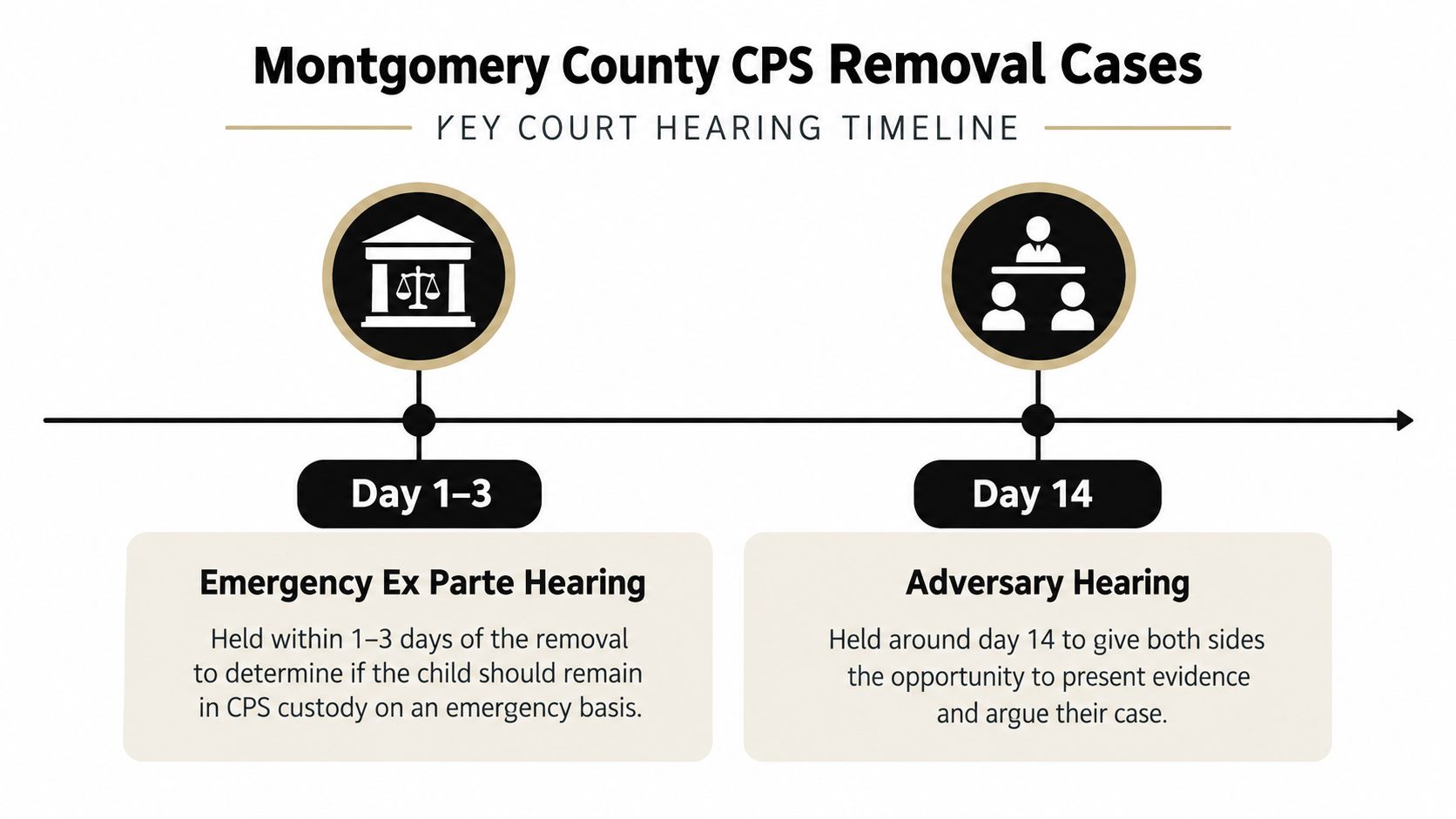
What each hearing decides
At the emergency hearing, the judge considers whether DFPS had a basis to remove the child and whether the child should remain outside the home while the case proceeds. The court may also enter temporary protective orders concerning placement, contact, or other safety conditions.
The adversary hearing is more consequential because the court must decide whether the emergency removal should continue and whether temporary orders are needed to protect the child. The possible direction is not limited to “CPS wins” or “the child goes home.” The judge may return the child, keep the child in state custody, or impose temporary conditions designed to address safety concerns.
Practical rule: Treat the emergency hearing as the start of the defense, not the end of it. The 14-day hearing is your first major opportunity to challenge continued removal with organized evidence and a workable safety proposal.
Track the removal date, the emergency hearing date, the adversary hearing date, every visit, each CPS contact, and every requested service. Don't rely on memory or informal assurances from a caseworker. If you need a broader explanation of the defense process, review how to fight CPS in Montgomery County.
Why the gap matters
The short period between hearings is where parents can locate relatives, arrange suitable housing, gather school and medical records, and obtain representation. It's also when statements, missed visits, incomplete paperwork, and unexplained delays can become part of the court's picture.
Extensions are limited. The deadline isn't something parents should assume can be moved because preparation is difficult. Your lawyer should confirm the hearing date directly and determine whether any legally recognized basis for additional time exists.
Securing Legal Representation and CASA in Montgomery County
Call a CPS attorney immediately after removal. Waiting until the hearing date is close leaves too little time to review the allegations, contact DFPS, investigate placement, and prepare a proposed order.
Parents in Montgomery County may seek private representation, ask the court about appointed counsel if they qualify, or contact organizations that provide legal assistance. The key is to make the request clearly and promptly. Tell each office that DFPS has removed your child, provide the removal date, identify the court and hearing date if known, and ask whether the attorney can represent you at the adversary hearing.
Texas law permits only limited extensions of the adversary-hearing deadline. DFPS guidance explains that the hearing may be postponed for up to seven days upon a finding of good cause. Texas law also provides a separate seven-day extension connected to representation issues when a parent hasn't obtained counsel, with written-agreement requirements in some circumstances. Review the DFPS attorney hearing guide with counsel rather than assuming an extension is automatic.
Choose counsel for the actual emergency
Ask direct questions:
- Court coverage: Can the lawyer appear at the adversary hearing in Montgomery County?
- CPS experience: Does the lawyer regularly handle removal, placement, visitation, and temporary-order disputes?
- Immediate strategy: What documents should you send today?
- Communication: Who receives urgent updates when the caseworker changes a visit or placement?
- Existing orders: How will the CPS case affect a custody, divorce, or support case already pending?
A CPS investigation lawyer in The Woodlands can help evaluate the allegations before you make statements or sign proposed arrangements. If your CPS matter overlaps with a pending separation or divorce, Divorce Lawyer in The Woodlands, TX representation is available for clients in The Woodlands and Montgomery County.
Ask about CASA involvement
A CASA volunteer is not your personal attorney and doesn't replace legal representation. CASA may provide the court with observations about the child's circumstances and needs, so cooperate respectfully, be truthful, and keep communications focused on the child's safety and stability.
Don't coach your child, attack the caseworker, or use a CASA volunteer as a messenger for legal arguments. Give your attorney the legal evidence. Give the child's appointed advocates accurate information about your progress and your proposed safe-care plan.
Gathering Evidence and Documentation After CPS Removal
A father in The Woodlands learns that DFPS is questioning whether his home is safe and whether he's consistently meeting his child's needs. He gathers school attendance records, a doctor's note, photographs showing the home's condition, and a written explanation of who can help with transportation. He doesn't send an angry packet full of accusations. He gives his lawyer a clean, indexed set of documents tied to the allegations.
That's the difference between collecting evidence and preparing evidence.

Build evidence around the allegations
Start with the allegations DFPS identified. Then collect material that answers them directly.
- Home conditions: Take current photographs of sleeping areas, food, utilities, medications, safety devices, and repairs. Don't alter the scene to create a misleading impression.
- Medical records: Obtain records that address treatment, appointments, diagnoses, or instructions relevant to the concern.
- School records: Attendance, enrollment, grades, counselor communications, and pickup information may help establish routine and involvement.
- Communication logs: Preserve texts, emails, voicemail notices, and messages concerning visits, placement, medical care, and requests for information.
- Witness information: Give your lawyer names and contact details for teachers, relatives, doctors, neighbors, counselors, or other people with firsthand knowledge.
Keep originals unchanged. Save copies in a secure folder, label each file with the date and a short description, and prepare a simple chronology. Don't delete embarrassing messages. Selective preservation can damage credibility when the complete conversation later appears.
Make the packet usable
Organize the material by issue, not by the order in which you found it. A short index should tell your lawyer what each document proves and whether someone can authenticate it. Avoid sending dozens of unmarked screenshots with no explanation.
Ask counsel which materials should be filed or offered in court. Filing requirements depend on the case, court, and type of document, and the county clerk's office isn't a substitute for legal advice about admissibility or service. For practical guidance on presenting materials, review how to present evidence in court.
Don't contact a child's teacher, doctor, or relative to pressure them into supporting you. Request records through proper channels and let your attorney decide how to use them. Your job is to preserve accurate information, not manufacture a favorable story.
Filing Emergency Motions and Temporary Orders
Some parents need court action before the adversary hearing. A parent may need a supervised visit scheduled, a relative placement reconsidered, or a temporary condition clarified. The correct filing depends on the order already entered and the specific safety issue. Don't download a generic emergency-custody form and file it without reviewing the existing case.

Match the motion to the problem
A lawyer may consider a request for temporary orders, a motion concerning visitation, a request for immediate return, or a request for a special setting. The title matters less than the facts and the relief requested. The filing should tell the judge what happened, what has changed, what order you want, and why the requested arrangement protects the child.
Under Texas Family Code § 262.201(c), the court at the adversary hearing must decide whether emergency removal should continue and whether temporary protective orders are needed. The statute also requires the court to tell each parent in open court that parental rights may be restricted or terminated unless the parent is willing and able to provide a safe environment. DFPS summarizes these requirements in its guidance on the adversary hearing.
File carefully and serve correctly
Your attorney should verify the assigned court, cause number, filing method, required notice, and any local procedures before submission. A clerk's acceptance of a document doesn't mean the judge will grant the relief or that service was completed correctly.
Attach only evidence that supports the specific request. Use a sworn affidavit when appropriate, state facts rather than conclusions, and identify firsthand knowledge. “DFPS is lying” is not useful. “The caseworker said the child had no bed, but the attached photograph taken that day shows the child's furnished bedroom” gives counsel something concrete to evaluate.
Provide copies to DFPS and other required parties through the proper method. Then confirm that the judge's coordinator or court staff received the request according to local procedure. Never assume that filing alone puts the matter before the judge immediately.
Navigating Visitation and Reunification in Montgomery County
Visitation is evidence of your ability to follow safety rules. Treat every visit as a court-related obligation, even if the arrangement began informally.
Read the temporary order and any written visitation plan carefully. Confirm the location, supervisor, start time, permitted participants, transportation rules, and cancellation procedure. A parent in The Woodlands who can't reach an approved visitation site should raise the transportation problem promptly with counsel and the case team. Missing a visit without documented communication can be portrayed as lack of commitment.
Use visits to show stability
Arrive prepared and calm. Bring only items allowed by the order or visitation provider. Follow the supervisor's instructions, keep adult disputes away from the child, and don't question the child about allegations or court testimony.
After each visit, create a brief private log:
- Date and location.
- Who attended.
- Start and end times.
- Activities and the child's condition.
- Any issue that affected the visit.
- Follow-up requested from DFPS or counsel.
Don't turn the log into a diary of insults. A useful record is factual, consistent, and easy for your attorney to verify.
Follow the reunification plan precisely
If DFPS proposes counseling, parenting education, substance-use evaluation, or another service, obtain the requirement in writing. Ask who approved the provider, what completion documentation is needed, and whether transportation or scheduling creates a conflict. Keep attendance records, certificates, receipts, provider contact information, and appointment confirmations.
Completion alone doesn't guarantee reunification. The court evaluates whether the parent can provide a safe environment and whether the proposed arrangement addresses the concerns before it. That's why your lawyer should present progress together with a concrete plan for housing, supervision, childcare, medical care, school routines, and support from safe relatives.
CASA or another child advocate may observe how the plan works in practice. Don't demand a particular recommendation. Demonstrate consistent conduct and let the record show what you've done.
Next Steps Checklist and Legal Disclaimer
The first 14 days require disciplined action, not panic. Put every deadline in writing and give your lawyer a complete, honest account, including facts you think hurt your case.
What to do next
- Mark the hearings: Record the removal date, emergency hearing, adversary hearing, visits, service appointments, and filing deadlines.
- Contact counsel: Call a Montgomery County CPS attorney and provide the case number, court information, DFPS contacts, and all paperwork.
- Protect communications: Save texts, emails, voicemails, notices, and written instructions. Don't argue with DFPS or post about the case online.
- Identify safe support: Give counsel the names of relatives or trusted adults who can provide placement, supervision, transportation, or practical help.
- Prepare evidence: Gather medical, school, housing, communication, and witness information in labeled folders.
- Follow orders: Attend every visit and appointment, arrive on time, and report obstacles before they become missed requirements.
- Evaluate motions: Ask whether a visitation request, placement challenge, return request, or other temporary motion is appropriate.
- Plan for court: Review testimony, documents, requested relief, and a realistic safety plan with your attorney.
This article is not legal advice and doesn't create an attorney-client relationship. Texas CPS cases turn on specific facts, pleadings, court orders, and deadlines. Talk with a qualified Texas family-law attorney before signing documents, making strategic statements, or filing a motion.
The Law Office of Bryan Fagan provides family-law representation involving CPS-related removal, custody, visitation, and temporary-order concerns in The Woodlands and Montgomery County. To discuss the first days of your case and schedule a consultation, visit The Law Office of Bryan Fagan.
