 Skip to content
The phone rings. A hospital social worker, a sibling, or a funeral home tells you something you weren’t ready to hear. Your spouse has died, and somewhere in the paperwork you’ve been named executor of the will.
If you live in The Woodlands, that moment often comes with two kinds of stress at once. First, the grief. Second, the sudden pressure to handle bank accounts, bills, insurance, the house, and a court process in Conroe that is often new to those involved.
That’s where many families get stuck. They search for “independent executor montgomery county,” find broad Texas articles, and still don’t know what to do on Monday morning. Local procedure matters. One probate guide aimed at Conroe notes that Montgomery County handled over 1,200 probate cases in 2025, yet many online resources still skip local expectations such as detailed inventories within 90 days for families in places like Panther Creek and Sterling Ridge, leaving a real knowledge gap for people trying to qualify and move forward in probate court (Conroe probate guidance discussing Montgomery County practice).
If that’s where you are right now, take a breath. An independent administration in Texas is meant to be more manageable than many people expect. But “more manageable” doesn’t mean effortless. The steps still matter, the deadlines still matter, and mistakes can become personal problems for the executor.
The Unexpected Role of an Executor in Montgomery County
Maria from Alden Bridge had just finished making funeral arrangements when her brother asked a simple question: “Did he leave a will?” She found it in a desk drawer, read a few paragraphs, and then saw the line naming her as executor.
She thought that meant she would just “handle things.” In reality, she had just taken on a legal job with deadlines, notice requirements, and fiduciary duties. That sounds intimidating, especially when you’re still dealing with loss, but it helps to know what Texas is trying to do with this role.

Why this role feels so heavy
Most newly named executors in Montgomery County worry about the same things:
- The court process: They don’t know what gets filed in Conroe or what happens at the hearing.
- Access to property: They’re unsure when they can talk to banks, title companies, or insurers.
- Family expectations: Relatives may assume assets can be handed out right away.
- Personal risk: They’ve heard the word “fiduciary” but don’t know what it means in plain English.
The plain-English version is this. The court may appoint you, but once you qualify, you’re expected to act for the estate carefully, fairly, and in the right order.
Practical rule: Being named in the will doesn’t automatically give you power to act. Your authority usually becomes usable after the court appointment and the issuance of Letters Testamentary.
Why local procedure matters in Montgomery County
A generic Texas article may tell you the law. It usually won’t tell you how the process feels on the ground in Montgomery County.
That local piece matters for people in The Woodlands, Creekside, Conroe, and nearby communities because probate isn’t just paperwork. It’s timing, court expectations, and getting your documents in shape before a judge signs off on your authority. Many delays happen because the family has the right idea, but the wrong sequence.
If you’re overwhelmed, that’s normal. You don’t need to know everything today. You do need a clear path.
What Is an Independent Executor in Texas
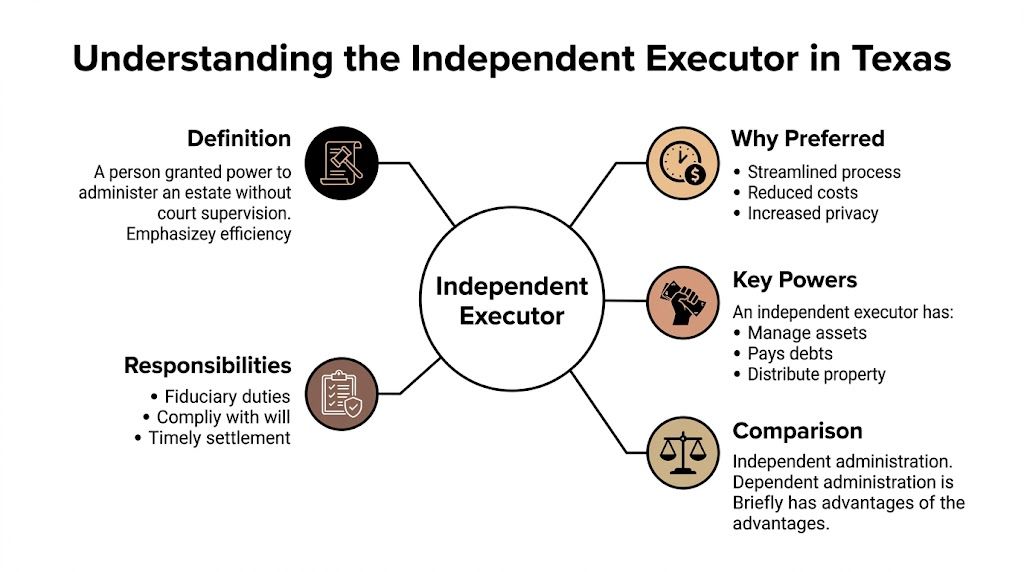
An independent executor is the person the court authorizes to settle a deceased person’s estate with relatively little ongoing court supervision. Under the Texas Estates Code, a will can name someone for that role, and Texas law generally allows estates to be handled through independent administration when the requirements are met.
The estate resembles a project with many moving parts. The court is not supposed to micromanage every task if the will and the law allow an independent administration. Instead, the executor acts more like a trusted project manager who can gather assets, pay proper debts, and distribute property without asking the judge for permission at every step.
Why families usually prefer independent administration
Independent administration is popular in Texas because it gives the executor room to do the work efficiently. That matters when there’s a home mortgage, vehicles, business interests, or multiple accounts that need attention quickly.
A dependent administration is more court-driven. It usually involves more requests for approval, more court interaction, and more friction. By contrast, an independent executor can often handle ordinary estate tasks with less interruption, as long as the executor follows the will and the Estates Code.
That doesn’t mean the executor can do whatever they want. It means the executor has authority, not freedom from responsibility.
What an independent executor actually does
The role usually includes tasks like these:
- Locate and protect assets: The home, vehicles, accounts, personal property, and important records need to be identified and secured.
- Deal with debts: Valid claims must be handled in the proper order under the Texas Estates Code.
- Communicate with beneficiaries: People named in the will need notice and, later, distributions when the estate is ready.
- Handle paperwork and tax matters: The estate may require filings, records, and tax-related decisions.
An independent executor has more operational freedom than many people expect, but every important action still has to serve the estate, not the executor personally.
What confuses people most
Many spouses in The Woodlands assume “independent” means “outside the court.” It doesn’t. You still start in probate court. You still need to qualify. You still need formal proof of authority.
The word really means the executor can administer the estate with minimal judicial oversight after appointment, rather than returning to court for routine permission over and over. That’s why this role can work well for families who need a practical path forward after a death.
Another point that causes confusion is title. If the will names you executor, that’s important, but it doesn’t replace the formal court process. Banks and title companies usually want Letters Testamentary, not just a copy of the will.
How to Qualify as an Independent Executor in Montgomery County
A lot of spouses in The Woodlands reach this point with the same question: “The will names me. Why can’t I just start handling things?” In Montgomery County, the court still has to confirm your authority before banks, title companies, and other institutions will deal with you as executor.

The process is easier to understand if you picture it as getting a key from the court. The will may nominate you, but the court is the one that hands you the legal key that lets you act.
Gather the papers before anyone files
Start by collecting the documents your lawyer and the Montgomery County probate court will expect to see:
- The original signed will
- A certified death certificate
- Basic identifying information for the person who died, the heirs, and the beneficiaries
- A preliminary list of assets, such as the home, bank accounts, vehicles, retirement funds, and any business interests
The original will matters more than many families expect. If all you have is a copy, pause there and get legal advice before filing. A copy does not get treated the same way, and that issue is better handled early than explained to a judge later.
File in the right county and ask for the right authority
If your loved one lived in Montgomery County, the probate case is usually opened there, often in Conroe. The filing typically asks the court to admit the will to probate and appoint the executor so the clerk can issue Letters Testamentary after qualification.
Local procedure matters here. Generic Texas probate advice often skips over county-level expectations about how the application is prepared, how the proposed order is presented, and what the court wants ready before the hearing. If you want a local overview, this Montgomery County probate lawyer resource explains how probate is handled in this county.
Once the application is filed, the clerk posts notice. That waiting period can feel slow when bills are arriving and accounts need attention, but it gives anyone with a legal objection time to speak up.
Prepare for a short hearing that still has to be done correctly
Many uncontested probate hearings in Conroe are brief. Brief does not mean informal.
Before the hearing, your file usually needs to be in proper order, with the will, application, and supporting paperwork ready for the judge to review. If the will waives bond, that should be clear from the documents. If there is a family complication, such as a prior marriage, estranged children, or questions about addresses and notice, it is better to clear that up before the hearing date.
Some families also find that paperwork logistics become surprisingly time-sensitive, especially when they need multiple certified sets and court-ready copies for banks or real estate matters. In those situations, legal printing services can help keep the documents organized and usable.
A short video can also help if you’re trying to visualize the process before stepping into court:
What the judge is deciding
At the hearing, the judge is usually deciding two basic questions. Is this will valid, and is the person named as executor qualified to serve?
That second question catches people off guard. Being named in the will is a strong start, but the court still has to confirm that you can legally serve. In a routine case, that may happen quickly. In a problem case, delays often occur.
Finish the qualification step
After the judge signs the order, you still have to complete the qualification requirements. That usually means taking the oath, and if the will does not waive bond or the court requires one, dealing with the bond before Letters Testamentary are issued.
This is the part many grieving spouses miss. They leave the hearing relieved, but the estate is not fully operational until that final step is completed and the clerk can issue the Letters Testamentary.
Those letters are the document financial institutions care about most. If you need to access an account, transfer title, or speak with a brokerage on behalf of the estate, this is usually the paper they will ask to see.
What Montgomery County families should expect after qualification
In Montgomery County, qualifying as independent executor is usually a clear, structured process, but the court expects follow-through. Families in The Woodlands and Conroe often assume the hard part is over once the hearing ends. The court sees it differently. Appointment gives you authority, and it also starts a series of legal duties that need to be handled on time and in the right order.
The Executor's Checklist Core Duties and Timelines
The day you receive Letters Testamentary, the job changes shape. Up to that point, you were trying to get authority. Now you have it, and Montgomery County expects you to use it carefully, keep records, and meet a short list of deadlines without drifting past them.
A good way to approach this is to treat the estate like a separate household with its own mailbox, bank account, bills, and file cabinet. If you keep that boundary clear from the start, the rest of the work becomes much easier.
Your first week: stabilize the estate
Start with protection and control.
That means making sure the home is secure, checking that insurance is active, locating mail, identifying bank and investment accounts, and gathering the documents tied to major assets. For families in The Woodlands and Conroe, the house often needs immediate attention. Utilities may still need to be paid, a vacant-home insurance issue may need to be addressed, and someone needs to know where the original will, deed, and account statements are.
At the same time, begin a clean paper trail. Open an estate account when appropriate. Keep estate funds out of your personal account. Save every statement, invoice, receipt, and letter. If a bank, title company, or court clerk asks for backup later, you want to be able to put your hand on it in minutes, not days.
Large estates can turn into a document-management project faster than people expect. Executors often need certified copies, organized notice packets, and hearing exhibits, so outside help such as legal printing services can be useful when the paperwork starts stacking up.
The deadlines that usually control the calendar
Montgomery County does not expect perfection, but it does expect follow-through. The main dates come quickly after appointment, and missing one can create delay, extra cost, or questions from the court.
Here is the practical timeline families should keep in mind:
| Task | General Deadline | Why it matters |
|---|---|---|
| Complete the oath and any remaining qualification steps | Shortly after appointment, under the court's deadline | Your authority is not fully usable until qualification is complete |
| Send notice to known secured creditors | Within the required post-appointment period | Protects the estate and puts lenders on formal notice |
| File the Inventory, Appraisement, and List of Claims, or an Affidavit in Lieu if allowed | Within the required inventory deadline | Gives the court a formal snapshot of estate assets |
| Keep administration moving | Ongoing | Long periods of inaction can create removal risk and beneficiary conflict |
As noted earlier, Texas law sets these deadlines. In real life, that means the clock starts almost immediately after appointment, not when life feels calmer.
What those duties look like in plain English
Oath and qualification: This is the last step that turns a signed order into real working authority. Many spouses feel relief after the hearing, then learn a bank still wants current Letters Testamentary before it will talk to them. That delay usually traces back to qualification not being fully finished.
Notice to secured creditors: Focus on creditors with collateral, such as a mortgage lender or vehicle lender. They are different from ordinary bills because their claim is tied to property.
Inventory or Affidavit in Lieu: This is the estate's opening snapshot. The court wants a reliable list of what the estate owns and enough detail to show the executor has identified the property. In Montgomery County, that usually means being organized, accurate, and realistic about values.
Some families can use an Affidavit in Lieu of Inventory instead of filing a full public inventory. That option can be helpful, but it is not automatic. Whether it fits depends on the estate's debts, beneficiaries, and administration details.
The work that fills the space between deadlines
Many executors underestimate the role. The calendar items are only part of the job. Between those dates, you are making a series of small decisions that either keep the estate orderly or slowly create problems.
Typical tasks include:
- opening and managing an estate account
- redirecting or monitoring mail
- confirming balances and beneficiary designations
- gathering deeds, titles, and tax records
- reviewing claims before paying them
- documenting every payment, reimbursement, and deposit
- getting date-of-death values where needed
- communicating with beneficiaries without promising early distributions
For Montgomery County families, local procedure matters here too. A broad Texas checklist is helpful, but the clerk, the court, and outside institutions still expect paperwork that is complete and easy to verify. If you want a practical local overview of how these steps fit together, this guide on how to probate a will in The Woodlands is a useful companion to your timeline.
A simple way to stay ahead
Use one folder for assets, one for debts, one for court documents, and one for communications.
Then keep a running log with four columns: date, action taken, amount involved, and why you did it. That simple habit helps more than people realize. Months later, if a beneficiary asks why a check cleared or why a property expense was paid, you will not be relying on memory during a stressful conversation.
The safest executors do not try to reconstruct the story later. They build the story as they go.
Common Pitfalls That Create Personal Liability
Sarah, a widow in Creekside, thought she was doing the right thing. She paid a few bills from her own checking account, reimbursed herself later, and let her son borrow money from an estate account because “it was his inheritance anyway.” None of this felt dishonest to her. It felt practical.
It was also the beginning of a problem. Executors don’t get judged only by intent. They get judged by whether they handled estate property correctly.

Mixing your money with estate money
This is one of the fastest ways to create trouble. If you deposit estate funds into your personal account or use your own account like a temporary holding place, you blur the line between you and the estate.
A Texas probate discussion of executor responsibilities warns that an independent executor’s fiduciary duties are absolute, and commingling estate funds with personal assets can void legal immunity and lead to surcharge claims. The same discussion notes that tax failures can reduce beneficiary shares by 5% to 10% or more, underscoring how expensive basic mistakes can become (Texas fiduciary duty discussion for independent executors).
Paying the wrong debts in the wrong order
Families often feel pressure from whoever calls first. A credit card company may sound urgent. A relative may insist a loan should be repaid immediately. That pressure doesn’t control the legal order of payment.
The Texas Estates Code sets out how debts are to be handled. Funeral expenses, administration costs, taxes, secured claims, and other obligations don’t all stand on equal footing. If you pay low-priority claims too early and the estate later lacks funds for higher-priority obligations, you may be the person beneficiaries look to for answers.
Don’t treat the mailbox like a to-do list. A bill arriving first doesn’t mean it gets paid first.
Distributing assets too soon
This mistake happens all the time in close families. The executor wants to help, wants to keep peace, and thinks, “Everyone agrees, so let’s just divide things now.”
That can backfire if a creditor claim appears later, if taxes are still unresolved, or if an asset was misunderstood. Once money or property leaves the estate, getting it back can be difficult and emotionally messy.
Common examples include:
- Transferring a vehicle too early
- Letting a beneficiary take valuable personal property before inventory
- Selling a house without clean records on debts, insurance, or title issues
Ignoring tax and property protection issues
A vacant home in Sterling Ridge or Panther Creek needs attention. Insurance coverage may need review. Utilities may need to stay on. Mail needs monitoring. Documents need safeguarding.
Taxes also keep moving even when a family is grieving. Depending on the estate, the executor may need to address the decedent’s final income tax return, the estate’s fiduciary income tax return on Form 1041, and in some cases estate tax issues such as Form 706. You don’t have to become a tax lawyer overnight, but you do have to know when professional help is needed.
The safest habit is simple. Slow down before moving money, property, or titles. Executors usually get into trouble by acting informally in a job that the law treats formally.
Understanding Executor Compensation and Estate Expenses
Many people are surprised to learn that serving as executor can involve compensation. They’re even more surprised by how often compensation becomes a family conflict because nobody explained it clearly at the start.
Under the Texas Estates Code, an executor may be entitled to compensation unless the will says otherwise or a legal exception applies. In plain terms, Texas law commonly uses a commission framework tied to money the executor receives or pays out in cash for the estate. The exact amount can depend on the facts, the will, and which receipts or disbursements count.
What compensation is supposed to cover
Executor compensation is meant to recognize work. This job can involve collecting records, dealing with financial institutions, preparing notices, coordinating valuations, handling real estate issues, and maintaining careful books.
It is not a blank check. You can’t label every inconvenience as “executor work” and pay yourself freely from estate funds.
What the estate can usually pay for
Legitimate estate expenses often include things such as:
- Court filing fees
- Attorney’s fees for estate administration
- Appraisal or valuation costs
- Postage, certified mail, and document handling tied to the estate
- Property protection costs, such as insurance or necessary maintenance
What usually should not be treated as an estate expense
Such situations often lead to disagreements with beneficiaries. Personal convenience costs are not automatically estate costs.
Examples that may raise questions include:
- Your personal travel that wasn’t necessary for administration
- Meals, errands, or time off work
- Unexplained reimbursements with no receipts
- Payments to family members without documentation
If you expect compensation, transparency helps. Keep a written record of what you did, when you did it, and what estate purpose it served. If the will says something specific about compensation, follow the will. If the will is silent, use caution and get advice before paying yourself.
Good records protect everyone. They protect the beneficiaries from hidden charges, and they protect the executor from accusations of self-dealing.
When You Need a Montgomery County Probate Attorney
An independent administration is simpler than a heavily supervised probate. It is not simple in the everyday sense of that word.
Ask yourself a few direct questions.
Are the beneficiaries getting along, or is one sibling already challenging every step? Is there a business, rental property, or property outside Texas? Was this a second marriage with children from a prior relationship? Are you trying to manage probate while also handling your own grief, work, and children in The Woodlands?
Situations that usually call for legal help
Some estates become risky faster than families expect. You should strongly consider probate counsel if any of these apply:
- Family conflict is already showing up: Arguments over the house, jewelry, or “what Mom wanted” tend to grow, not shrink.
- The estate includes complex assets: Businesses, multiple properties, and unusual investments create more room for valuation and distribution problems.
- You’re worried about doing something wrong: That instinct is often accurate. Executors are allowed to ask for help before a mistake happens.
- The paperwork already feels unmanageable: Missing one required step can create delays and expense that cost more than early guidance would have.
For local readers, this probate attorney resource for The Woodlands is one place to start if you need help matching Texas law to Montgomery County procedure.
What to do next
If you’ve just learned you may serve as executor, keep the next steps simple:
- Find the original will: Don’t mark on it, staple extra papers to it, or assume a copy will work the same way.
- Order certified death certificates: Banks, insurers, and the court may each require them.
- Make a first asset list: Include real estate, bank accounts, vehicles, life insurance, and any business interests.
- Secure property: Check the home, vehicles, mail, and insurance status.
- Do not distribute anything yet: Even if everyone agrees today, the estate needs the right process first.
- Get legal guidance early: Especially if there’s conflict, debt, blended family issues, or uncertainty about the court filing.
One important disclaimer
This article is for general educational information only. It is not legal advice and does not create an attorney-client relationship. Probate outcomes depend on the specific facts, the will, the estate’s assets and debts, and the practices of the Montgomery County court handling the matter.
If you’re carrying the weight of an executor role and you want clear next steps, a consultation can help you move from confusion to a workable plan.
If you need help with an independent executor montgomery county probate matter, The Law Office of Bryan Fagan works with families in The Woodlands and surrounding Montgomery County communities on probate and related family legal issues. A consultation can help you understand the filing process, deadlines, and what your role requires before small problems become expensive ones.
