 Skip to content
The phone rings, and a family member says, “You’re named as executor.” If you live in The Woodlands, Conroe, Magnolia, or another part of Montgomery County, that moment often lands in the middle of grief, paperwork, and a dozen unanswered questions.
Individuals often don’t feel ready. They wonder whether they can pay bills, talk to the bank, list the house, or even open the safe deposit box. They also run into a phrase that sounds formal and unfamiliar: letters testamentary.
That document is usually the key that lets you act for the estate. Without it, many institutions won’t deal with you, even if the will clearly names you.
Your Guide to Navigating Probate in The Woodlands
A neighbor in Alden Bridge might go through this exact sequence. A parent passes away. The family finds a will in a desk drawer. One child is named executor. Everyone assumes that means the child can “just handle things.”
Then the bank says no. The title company wants proof. The investment firm asks for court papers.
That’s where probate starts to feel less like family business and more like a court process. In Montgomery County, that process has local steps, local filing practices, and a local court that handles these matters. If you need a simple primer on the larger system first, Understanding What Is Probate gives helpful background before you dive into county-specific details.
Why local detail matters
Probate isn’t handled in the abstract. It happens in a real courthouse, with real clerks, deadlines, and hearing procedures. For Montgomery County residents, that means your path usually runs through the county’s probate process in Conroe, not through a generic Texas checklist pulled from somewhere else.
What tends to confuse executors
People usually get stuck on three things:
- Authority: Being named in the will doesn’t always mean you can act immediately.
- Timing: There’s often a waiting period before the court hearing and issuance of letters.
- Paperwork: The court and financial institutions want specific originals and certified copies.
Probate feels intimidating mostly because people are trying to learn legal procedure while they’re still mourning. Once you break it into steps, it becomes much more manageable.
If you’ve been searching for letters testamentary montgomery county texas, you’re probably looking for a practical answer, not legal jargon. That’s what this guide is for.
What Are Letters Testamentary and Why You Need Them
Think of letters testamentary as the official key to the estate. The will may nominate you as executor, but the court-issued letters are what prove to the outside world that you now have legal authority to act.
Under the Texas Estates Code Section 301.051, priority generally goes to the executor named in the will, assuming that person is qualified to serve. In plain English, the will points to you, and the court confirms you.
What the letters actually do
Once the court issues letters testamentary, you can usually take actions such as:
- Talk to institutions with authority: Banks, brokerages, title companies, and others are far more likely to work with you once you show certified letters.
- Handle estate property: That may include managing accounts, dealing with real property, and handling practical estate business.
- Pay proper debts and expenses: The executor’s role includes gathering assets, addressing valid obligations, and following the will.
A useful way to think about it is this. The will is the roadmap. The letters are the driver’s license.
Without the driver’s license, you may know where the road goes, but you still can’t lawfully take the wheel.
What you usually can’t do without them
Many families in The Woodlands often get tripped up here. They assume a death certificate and a copy of the will will be enough. Often, they aren’t.
Before letters testamentary are issued, you can run into problems with:
- Bank access
- Selling or transferring property
- Speaking for the estate with confidence
- Closing accounts held only in the decedent’s name
Practical rule: Don’t start acting like you already have executor authority until the court gives you the document that proves it.
What the letters do not cover
Letters testamentary don’t automatically pull every asset into probate. Some assets pass outside the probate estate. The verified local guidance notes that beneficiary-designated assets can bypass probate, and certain POD or TOD accounts may not require the letters in the same way. That’s why one account may freeze while another passes directly to a named beneficiary.
People often ask the same practical questions over and over, especially about timing, authority, and who needs notice. A basic roundup of common probate queries can help you compare your concerns with what other families commonly face.
Independent executor versus just being “the person in charge”
Texas often uses independent administration, which means the executor can often handle many tasks with less court supervision after appointment. If that term appears in the will or your attorney mentions it, this overview of an independent executor in Montgomery County gives added context about how the role works in practice.
The big takeaway is simple. The court’s letters are what transform your role from “named in a document” to “legally recognized by the world outside the family.”
The Montgomery County Probate Process Step by Step
If you live in The Woodlands or Conroe, the probate process usually feels confusing for one reason. The family is grieving, bills are still arriving, and the court has its own order for everything. In Montgomery County, that order matters. County Court at Law No. 2 expects the estate to move through a set sequence, and life gets easier once you know what happens first, what happens second, and what can wait.
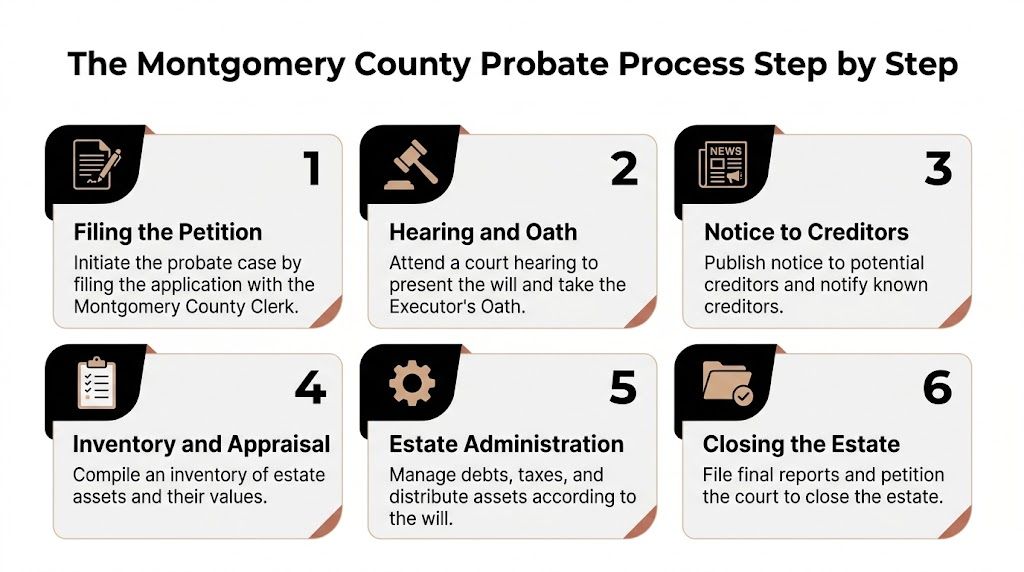
A good way to understand probate is to picture a checklist at the courthouse door. The judge does not start with family urgency. The judge starts with proof, notice, qualification, and only then authority.
Step one, file the probate application
The process starts when the proper probate application is filed with the Montgomery County Clerk for the estate. For a typical testate estate, that means asking the court to admit the will to probate and appoint the executor named in the will.
For local families, the practical point is simple. Filing opens the case. Until that happens, the court has nothing in front of it to act on.
Step two, allow the citation posting period
After filing, the clerk posts citation. Executors often worry during this stage because it can feel like the case is stalled.
It is not stalled. Public notice is part of the court process. The posting period gives the case a short waiting window before the hearing can go forward.
If you are used to banks and title companies acting fast, this part feels slow. Probate works more like a line at the deli counter. Your number has been taken, but the court still has to call it in order.
Step three, attend the probate hearing in County Court at Law No. 2
Once the notice period has run, the court sets the matter for hearing in Montgomery County’s probate court, usually County Court at Law No. 2 in Conroe. At that hearing, the judge reviews the will, confirms the applicant is qualified, and decides whether the estate should be opened as requested.
For uncontested estates, the hearing is often brief and focused. The court is checking that the legal basics are in place, not inviting a family debate unless someone has raised an actual dispute.
A plain-English overview of the Montgomery County probate court process can help if you want to see how this local court flow works from filing through appointment.
Step four, qualify as executor
Approval at the hearing is a major step, but it is not always the final step. The proposed executor still has to qualify.
That usually means taking the oath. If a bond is required, it must also be handled before the clerk issues the letters. Families often miss this detail and assume the executor can start signing documents right after court. In practice, the hearing opens the door, and qualification lets you walk through it.
Step five, receive the letters testamentary
After the executor qualifies, the clerk can issue letters testamentary. This is the document banks, brokerage firms, and title companies usually want to see before they will deal with you as executor.
That timing can test everyone’s patience. Relatives may want you to clean out a house, close accounts, or list property right away. Financial institutions usually want the letters first, because the letters are the court’s proof that you are the person authorized to act.
Step six, begin estate administration
Once you have the letters, the job shifts from court filing to estate work. You can start gathering estate assets, dealing with creditors, working with financial institutions, and handling the other duties that come with serving as executor.
In many Texas estates, administration proceeds with limited court involvement after appointment if the estate qualifies for independent administration. That is one reason some Montgomery County probate matters move more efficiently than families expect once the executor has been officially appointed.
Here is the sequence in plain terms:
- Locate the original will and the information needed to prepare the application.
- File the probate case with the Montgomery County Clerk.
- Wait through the citation posting period.
- Attend the hearing in County Court at Law No. 2.
- Take the oath and handle bond if the court requires it.
- Receive letters testamentary.
- Start administering the estate.
The process is much easier to handle when you stop viewing it as one big legal event and start viewing it as a series of gates. Clear one gate, then the next. That is how probate usually works in Montgomery County.
Gathering Your Documents for the Montgomery County Court
A lot of probate delays in Montgomery County start the same way. The family has a will, but it is a copy. Or the death certificate has not arrived yet. Or the original will is in a safe deposit box that no one can open without court authority.
That is why document gathering needs to happen before you focus on the hearing date in Conroe. County Court at Law No. 2 can only act on what is properly filed. If your paperwork is incomplete, the case can slow down for reasons that have nothing to do with family cooperation or the validity of the will.
For a typical application for letters testamentary in Montgomery County, you will usually need the original will, a death certificate, and the probate application prepared for filing with the Montgomery County Clerk. You will also want basic identifying information for the executor, beneficiaries, and close family members who may need notice. A probate file works like a toolbox. If one tool is missing, the job may pause until you find it.
Required Documents for Montgomery County Probate
| Document | Purpose | Where to Find It |
|---|---|---|
| Original will | Lets the court review the signed document that names the executor and states the decedent’s wishes | Home safe, firebox, file cabinet, estate planning binder, or the drafting lawyer’s office |
| Certified death certificate | Confirms the death for the court and is often requested later by banks, title companies, and insurance carriers | Funeral home, vital records office, or records already ordered by the family |
| Probate application | Requests that the will be admitted to probate and that the executor be appointed | Usually prepared for filing with the Montgomery County Clerk |
| Supporting identity and contact information | Helps the court papers correctly identify the executor and interested persons | Personal records, estate planning files, address books, and family notes |
| Funds for filing costs | Covers filing fees, issuance costs, and certified copies when needed | Estate funds if available, or a temporary advance if appropriate |
Why the original will gets so much attention
The original will matters because the court is being asked to rely on the decedent’s final signed instructions. A photocopy raises extra questions the court may need answered. If all you can find is a copy, do not panic. It does mean the case may require added proof and more careful preparation.
That issue comes up often in The Woodlands, especially when families know a parent signed a will years ago but are not sure where the original was stored. Start with the obvious places first. Check any home safe, locked desk, estate planning binder, and the office of the attorney who prepared the documents.
Certified copies of the letters
After appointment, many executors learn that one certified copy of the letters is not enough. Banks may want one for their file. A brokerage firm may ask for another. If there is real property to sell, a title company may need its own copy as well.
Ordering several certified copies at the start usually saves time and extra trips. For families driving from The Woodlands or Magnolia into Conroe, that small bit of planning can remove a lot of frustration later.
A practical way to organize everything
Use one main folder, one checklist, and one running call log. It sounds simple because it is simple, and simple systems work.
Keep the original will protected in its own sleeve or envelope. Store copies of death certificates separately so you are not handling the original estate papers every time someone asks for a document. Write down each bank, insurer, or utility company you contact, the date of the call, and what they asked you to send.
If you have ever packed for a trip and realized your driver’s license was in the wrong bag, you already understand probate organization. The court part is legal, but the day-to-day work is often administrative. Good organization helps your filing go more smoothly and makes it easier to answer questions from the clerk, your attorney, and the institutions holding estate assets.
A Real-World Scenario Navigating Probate in The Woodlands
Sarah lives in Alden Bridge and teaches at a local school. After her father dies, she learns that his will names her as executor. She knows what the word means in a general sense, but she doesn’t know what she’s allowed to do.
She finds the original will in a labeled estate folder at home. The funeral home helps the family with the death certificate process. A few days later, she starts calling banks, thinking she can begin consolidating accounts.
The answer is the same each time. They need court authority.

What Sarah does next
Sarah gets the probate filing prepared and the case is filed in Montgomery County. She learns that the process includes a court hearing in Conroe and that being named in the will isn’t the same as being authorized by the court.
That distinction calms her down. Instead of trying to force progress with institutions that can’t help yet, she shifts to gathering information. She makes a list of accounts, real property, insurance, recurring bills, and the people named in the will.
The hearing and the relief that follows
At the hearing, the court addresses the will and her appointment. The experience is more formal than a bank visit, but much less frightening than she imagined.
Once she qualifies and receives letters testamentary, her work changes from “waiting” to “doing.” She presents a certified copy to a bank that had previously refused to speak with her in any meaningful way. This time, the conversation is different. The bank recognizes that she is acting for the estate.
She can begin closing the decedent’s account and moving estate administration forward in an orderly way.
Why this story sounds familiar
Sarah’s experience is ordinary in the best sense. Most executors aren’t battling over dramatic courtroom issues. They’re trying to understand sequence, authority, and paperwork while juggling grief, work, and family expectations.
That’s why plain explanations matter. Once Sarah understood that letters testamentary were the court’s official proof of authority, the whole process made more sense.
Common Complications and How to Handle Them
Most estates don’t go perfectly from start to finish. The good news is that many probate problems are manageable if you identify them early and respond carefully.

A family member objects to the will
This is one of the hardest situations emotionally. The legal issue may involve capacity, undue influence, execution formalities, or a claim that a later will exists.
For the executor, the practical problem is that conflict slows everything down. Instead of moving directly into estate administration, attention shifts to proving what document controls and who should serve.
If you sense tension early, don’t make side promises to family members. Don’t “agree” to distributions before the court process settles the authority question.
The will names you, but the paperwork is missing or messy
Sometimes the original will can’t be located quickly. Sometimes names are misspelled, addresses are outdated, or the family has incomplete information about assets.
This doesn’t always stop probate, but it does raise the risk of delay. An executor should respond by building a clean file. That means gathering mail, account statements, deeds, tax records, and contact information before chasing institutions one by one.
Debts appear faster than assets
Executors often focus on who gets what. Early on, the sharper question is often what the estate owes and when those obligations must be addressed.
That doesn’t mean every claim gets paid automatically. It means the executor should avoid informal family distributions before the estate’s obligations are understood. Paying beneficiaries too soon can create problems if later claims surface.
A careful executor moves in order. First authority, then information, then administration, then distribution.
You discover assets that don’t pass through probate
Some families assume every asset goes through the estate because there is a will. Not necessarily. Some assets may transfer by beneficiary designation or other non-probate mechanism.
That can create confusion if one sibling thinks “the will controls everything.” It usually doesn’t. The executor has authority over probate assets, not over every item the family associates with the decedent.
Independent administration versus dependent administration
This distinction matters a great deal in Texas.
Independent administration usually gives the executor more room to act without repeated court approval. That can make estate administration more efficient, but it also means the executor must stay organized, keep clear records, and follow fiduciary duties carefully.
Dependent administration involves more court oversight. This is similar to driving with an instructor in the passenger seat. There’s less discretion, more approvals, and more procedure.
Here’s a simple comparison:
| Administration Type | What it feels like in practice |
|---|---|
| Independent | More freedom to handle ordinary tasks, with less routine court supervision |
| Dependent | More formal court involvement before certain actions can be taken |
Independent administration often works well where the will is clear and the family conflict is low. Dependent administration may become relevant when oversight is needed.
Heirs, blended families, and prior marriages
Montgomery County families are often blended families. A second marriage, adult children from a first marriage, and jointly used property can create confusion about what belongs to the estate and who expects to inherit.
People sometimes mention the wrong body of law. Probate authority and executor duties usually come from the Texas Estates Code, while certain family-status issues may touch the Texas Family Code. The point isn’t to memorize code books. It’s to recognize that family relationships and property rights can overlap in complicated ways.
When they do, caution matters. An executor should not guess.
When to Consult a Montgomery County Probate Attorney
Some estates are straightforward. Others only look straightforward for the first week.
If you’re handling an uncomplicated estate with a clear original will, cooperative beneficiaries, and ordinary assets, the process may stay relatively smooth. But there are several situations where legal help stops being a convenience and starts becoming risk management.
Red flags that call for legal guidance
You should strongly consider speaking with a probate lawyer if any of these are true:
- Family conflict is already visible: A sibling is questioning the will, accusing someone of pressure, or demanding immediate distributions.
- The original will is missing: A copy may exist, but missing originals can create procedural and evidentiary problems.
- The estate owns a business or unusual assets: Closely held companies, mineral interests, or layered investment structures usually need careful handling.
- Debt may exceed available liquid assets: The executor needs to understand order, notice, and payment decisions before distributing property.
- Property issues are complicated: Real estate may be in more than one name, may need to be sold, or may involve title issues.
- You’re worried about personal liability: That concern is healthy. Executors have fiduciary duties, and mistakes can be expensive.
Why local counsel matters
Probate is governed by Texas law, but local procedure still matters. Filing habits, hearing expectations, document preparation, and practical courthouse know-how all affect how smoothly a case moves.
If you want county-specific legal help, a probate attorney in The Woodlands, Texas can help evaluate whether the estate is simple, contested, or headed toward more court involvement.
Legal help isn’t a sign you failed
Many executors feel embarrassed about hiring counsel. They think they should be able to handle it alone because the will “isn’t that complicated.” That mindset causes more trouble than people realize.
An executor isn’t just helping family. The executor is serving in a legal role with duties to the estate, beneficiaries, and creditors. Getting guidance is often the most responsible thing you can do.
One option for local probate representation is The Law Office of Bryan Fagan, which handles probate matters for families in The Woodlands and surrounding Montgomery County communities. Whether you use that office or another attorney, what matters is getting advice that matches the estate’s actual level of complexity.
The right time to ask for legal help is before a preventable mistake turns into a dispute.
Your Next Steps Checklist and Getting Started
If you’ve made it this far, you already know more than most new executors knew on day one. The process still may not feel easy, but it should feel more understandable.
The core idea is simple. The will names the executor. The court confirms the executor. Letters testamentary montgomery county texas is the phrase people search when they need that confirmation and the practical authority that comes with it.
What to do next
Use this checklist as your immediate action plan:
- Locate the original will: Don’t rely on a copy if the original may still exist.
- Gather certified death certificates: You’ll likely need them for both court and financial institutions.
- Start a master estate file: Keep all mail, account notes, contacts, and documents in one place.
- List known assets and debts: Include bank accounts, real property, vehicles, recurring bills, and insurance information.
- Avoid acting too soon: Don’t try to sell property or move estate funds before the court gives proper authority.
- Prepare for the court process in Montgomery County: Filing, notice, hearing, oath, and issuance all have a sequence.
- Order multiple certified letters once issued: Different institutions may each want their own certified copy.
- Get legal advice if anything looks disputed or unclear: Especially if the family is tense, the will is questionable, or the assets are complicated.
Keep your role in perspective
An executor’s job isn’t to make everyone happy. It’s to carry out the estate process lawfully and carefully. Sometimes that means telling relatives, “I can’t do that yet.” Sometimes it means slowing down so you don’t create a bigger problem.
That’s not being difficult. That’s doing the job correctly.
Important disclaimer
This article is for general educational purposes only. It is not legal advice and does not create an attorney-client relationship. Probate facts matter, and small details can change the right legal approach. If you’re dealing with a Montgomery County estate, you should get advice based on your specific situation.
If you want help understanding your next step, scheduling a consultation can give you a clearer path and help you avoid missteps early in the process.
If you need practical guidance on probate in The Woodlands or Montgomery County, you can schedule a consultation with The Law Office of Bryan Fagan to discuss your specific situation, your role as executor, and the steps needed to move the estate forward.
