 Skip to content
If you're reading this, there's a good chance someone in your family just passed away, and now ordinary things suddenly feel complicated. The bank says it needs court papers. The title company won't move forward. Family members are asking what happens next, and you're trying to grieve while sorting through folders, keys, and unanswered questions.
That's where probate comes in.
For families in The Woodlands, Conroe, Magnolia, Montgomery, and nearby communities, probate often feels bigger than it should. Part of that is emotional. Part of it is procedural. And in Montgomery County, procedure matters a lot because local probate cases move through a very specific court structure. If you need a probate lawyer montgomery county tx, the right fit isn't just someone who knows probate law in general. It should be someone who understands how probate operates in this county.
Understanding Probate and Why It Matters in Montgomery County
A Conroe family loses a parent on Friday. By Monday, the questions start stacking up. The bank will not release funds. The title company wants court documents. A relative says, "We already have the will, so that should be enough."
Usually, it is not enough.
Probate is the court process that gives someone legal authority to gather assets, deal with debts, and transfer property after a death. In practical terms, it is the set of steps that turns a will, or the Texas inheritance rules when there is no will, into something banks, buyers, and county records offices will honor.
Texas probate law comes mainly from the Texas Estates Code. That law explains who can serve as executor or administrator, how a will is admitted to probate, what notices must go out, and what the estate representative must file with the court. If terms like letters testamentary, heirship, inventory, and administration sound unfamiliar, that is normal. They are labels for pieces of the process.
What probate actually answers
At its core, probate answers a few basic questions for everyone involved:
- Is there a valid will
- Who has authority to act for the estate
- What property, debts, and claims need attention
- Who inherits, and under what rules
That sounds formal, but the purpose is simple. Probate creates a reliable chain of authority. Without it, an executor named in a will often has no practical way to sell a house, access an account, or sign for the estate.
A will works like a set of instructions. Probate is the court's way of confirming who gets to carry them out.
Practical rule: In many estates, the will is only part of the story. The court order and the letters issued by the court are what third parties rely on.
Why Montgomery County procedure matters
Probate does not run the same way in every Texas county, even though the Estates Code applies statewide. Montgomery County handles probate matters through County Court at Law No. 2 in Conroe. That structure affects filing habits, hearing settings, and what local judges and clerks expect to see in probate pleadings.
A nearby county can look very different. Harris County, for example, has statutory probate courts devoted to probate matters. Montgomery County families do not file into that kind of court system. They file into a county court at law with its own procedures and rhythm. That difference is one reason local experience is required if your goal is to avoid preventable delays.
For families in The Woodlands, Magnolia, Montgomery, Willis, and Conroe, that court structure matters because estates here often involve a homestead, retirement accounts, mineral interests, or children from more than one marriage. None of those facts automatically create a dispute, but each one can change what paperwork is needed and how carefully the estate should be handled.
If you want a broad overview before sorting out county-specific details, this plain-language Probate Guide is a helpful starting point.
Some families also discover that probate problems begin years earlier, during estate planning. A will that was never updated after remarriage, a deed that does not match the plan, or missing beneficiary designations can all create extra work after death. If you want to see how those pieces fit together, this overview of estate planning services in The Woodlands gives useful background.
Probate is also day-to-day administration
Court filings are only one part of the job. The person serving for the estate may also need to:
- Collect and safeguard property
- Notify banks, beneficiaries, and creditors
- Handle mortgage, tax, and insurance issues
- Prepare required filings and accountings
- Transfer title to a home, vehicle, or other assets
That is why probate matters in Montgomery County. It is not just a legal label. It is the process that lets a family move from uncertainty to authority, and then from authority to actual transfer of property under the rules of the local court.
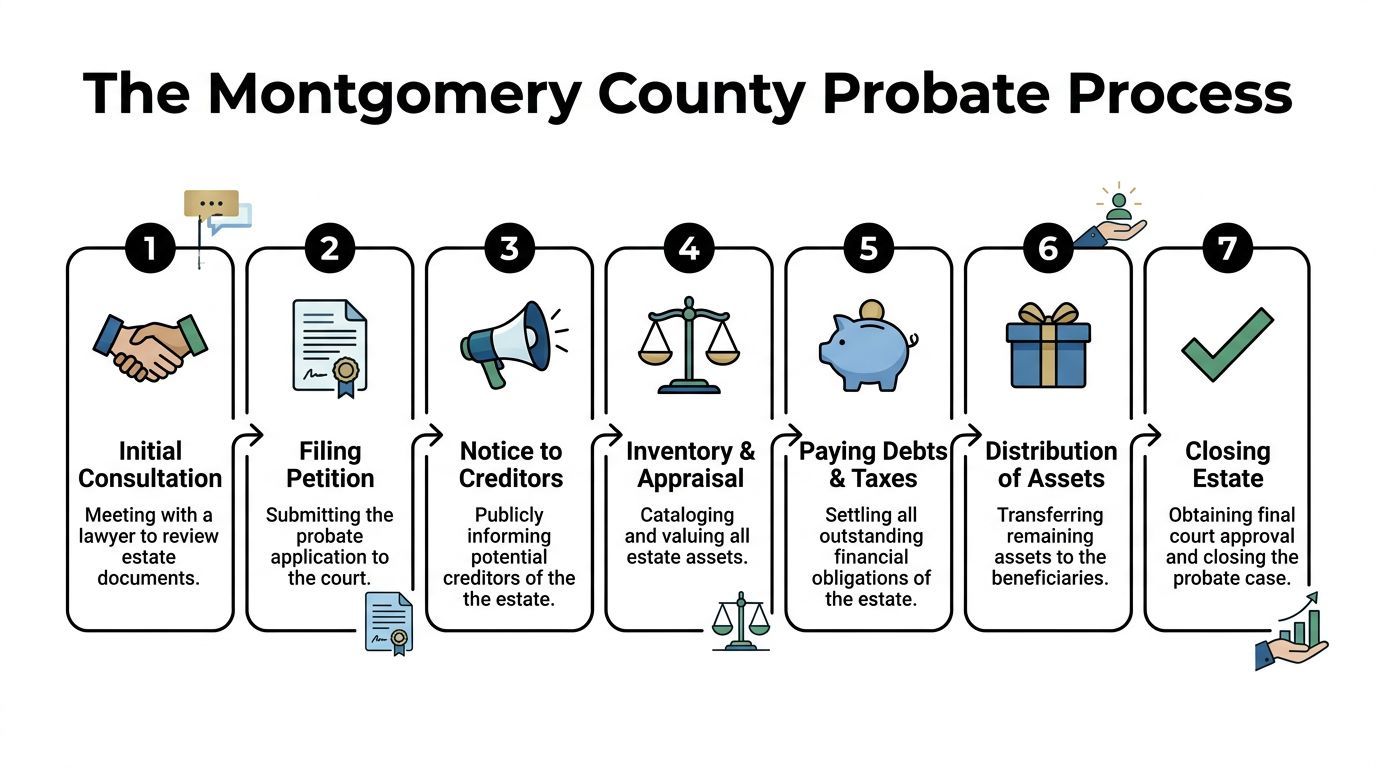
The Montgomery County Probate Process Step-by-Step
A family in The Woodlands often learns how probate really works on the day a bank says, "We need Letters Testamentary before we can talk to you." The will may be clear. The relatives may agree. Even so, the estate usually cannot move forward until County Court at Law No. 2 in Conroe signs off.
That court structure matters in Montgomery County. Some Texas counties use separate statutory probate courts. Montgomery County handles these matters through County Court at Law No. 2, and that affects filing practice, hearing settings, and the kind of preparation that keeps a case from stalling.
A Sterling Ridge example
Take a common Montgomery County situation. A daughter in Sterling Ridge loses her father. He left a will naming her executor. There is a home in The Woodlands, a frozen checking account, and a brother living in another state.
She may assume the will gives her immediate authority. In practice, the will is more like a key that still has to be cut by the court before it fits the lock. Until the court admits the will to probate and issues the right papers, her authority is limited.
How the process usually works here
Review the estate and the documents
The first job is to gather the original will, death certificate, and basic information about assets, debts, and family members. This helps identify whether the estate appears suited for independent administration, a muniment of title, or another probate path under Texas law.Prepare and file the application
The application filed with the court needs to match the facts. Names, dates, addresses, and family history all need to line up. If the will is being offered for probate, the original will is typically filed with the application. In Montgomery County, families also need to plan for a hearing in Conroe rather than assuming the paperwork alone will finish the job.Wait through the posting period
Texas probate is not same-day service. After filing, the clerk posts notice for the period required by law before the hearing can go forward. Families are often surprised by this pause, but it is a normal part of the process.Attend the probate hearing
At the hearing, the judge decides whether the will should be admitted to probate and whether the proposed executor is qualified to serve. Texas Estates Code Section 301.001 is one of the provisions that can matter because it addresses qualification to act as executor.Receive authority to act for the estate
Once the court signs the order and the executor qualifies, the clerk can issue Letters Testamentary or other appropriate letters. Those documents are what banks, title companies, and others usually want to see before recognizing the executor's authority.Administer the estate
This is the working phase. The executor gathers property, protects assets, gives required notices, deals with valid creditor claims, and begins the transfer process called for by the will or Texas law. A practical tool like this executor duties checklist helps many families keep track of the day-to-day tasks that pile up after the hearing.Complete the inventory and close out remaining duties
Texas law may require an inventory, appraisement, and list of claims, unless an affidavit in lieu of inventory is allowed in that estate. After the administration steps are completed, the estate can move toward closing, or in some independent administrations, toward a quieter finish without a formal closing hearing.
One mistake causes more delay than families expect. They treat probate like a stack of forms, when it is really a court process with local habits, deadlines, and expectations.
Why Montgomery County procedure deserves careful attention
Local experience matters here for a concrete reason. The court handling probate in Montgomery County is not set up exactly like counties with dedicated probate courts, so lawyers who regularly appear in this court tend to know how to present the file cleanly, set the hearing correctly, and avoid preventable resets.
That does not mean every estate is headed for conflict. It means efficiency often comes from knowing the court's rhythm. A missing original will, an incomplete application, or weak hearing preparation can slow down even a friendly family administration.
For a local example of what that representation can look like, this page about a probate attorney serving The Woodlands and Montgomery County families offers a useful starting point.
As noted earlier, a Montgomery County probate guide explains the county-specific court structure in plain language: https://txprobatelawyer.net/montgomery-county-probate-guide/
Typical Probate Timelines and Costs for Local Families
Most families ask two questions right away. How long will this take, and what will it cost?
The honest answer is that probate timing depends on the facts. A straightforward estate with a valid will, cooperative beneficiaries, and organized records moves differently from an estate with business interests, title issues, family disagreements, or missing information.
The filing cost is only the beginning
One number you can usually count on early is the court filing fee. In Montgomery County, the probate application filing fee typically falls in the $300 to $400 range. Beyond that, costs depend on what the estate needs.
Some estates need very little outside help. Others may need appraisals, deed work, tax coordination, or extra hearings.
| Expense Category | Estimated Cost Range |
|---|---|
| Court filing fees | $300 to $400 |
| Attorney fees | Varies by case and fee agreement |
| Notice and publication costs | Varies |
| Appraisal or valuation services | Varies |
| Certified copies and related filings | Varies |
Why some cases finish faster than others
Two case types often come up in Texas probate.
Independent administration usually involves less court oversight after appointment. That can make the process more efficient when the will supports it and the family situation is calm.
Dependent administration involves more direct court supervision. It can be necessary in harder cases, but it usually means more procedural steps and more waiting.
Local insight: The court process may look simple on paper, but the estate moves at the speed of its slowest problem. Missing records, old debts, title defects, and family mistrust can all slow things down.
The exact timeline in your case depends on things like:
- Whether there is a valid will
- Whether heirs agree
- How quickly asset information can be gathered
- Whether creditor issues need attention
- Whether the executor stays organized
A practical way to think about cost
Don't focus only on the filing fee. Focus on the total cost of delay.
If an executor distributes property too early, misses a deadline, or mishandles creditor notice, the estate can spend more time and money correcting avoidable mistakes. In probate, cheaper at the beginning isn't always cheaper at the end.
For families in The Woodlands, that's especially important when the estate includes a house, investment accounts, or a closely held business interest. The legal fee structure may be flat, hourly, or mixed, but the larger issue is whether the process is being handled cleanly.
Navigating Common Probate Hurdles in Texas
A common Montgomery County probate problem starts like this. One child has the will, another has the house keys, and nobody is sure what the court needs first. Before long, someone has changed a lock, forwarded the mail, or started promising family heirlooms to relatives. Those early moves can create avoidable trouble once the case reaches Montgomery County Court at Law No. 2.

Texas probate law sets the rules statewide, but local court structure changes how mistakes play out. In Montgomery County, probate matters are heard in County Court at Law No. 2, a court that handles a mixed docket rather than probate alone. That matters. A filing error or incomplete application can cost more time here because your case is competing for court attention with other county court matters, not moving through a probate-only pipeline.
Will contests and family conflict
Family disputes often begin long before anyone files a formal contest. A brother may believe the will was changed late in life under pressure. A daughter may question whether a parent understood what she signed. An executor may lose the family's trust by sharing information unevenly.
Once that tension reaches the courthouse, every step needs more care. Notice, pleadings, hearing settings, and document accuracy all matter more in a contested case. In Montgomery County Court at Law No. 2, that added pressure can slow the estate if the paperwork is sloppy or the legal theory is unclear from the start.
For many families, this is the point where local courtroom experience stops being a nice extra and becomes a practical advantage. A lawyer who regularly appears in this court understands how to prepare a matter cleanly, what issues tend to trigger delay, and how to avoid turning a disagreement into a procedural mess. You can learn more about that kind of county-specific probate experience on our Montgomery County probate law firm page.
Asset and debt problems usually surface late
Probate also gets complicated when the estate looks organized from the outside but is missing key pieces underneath.
A bank account may exist, but nobody knows where. A house in The Woodlands may need repairs before sale, or a title problem may appear when the executor tries to transfer it. A creditor may send a demand letter that sounds urgent even though the claim still needs legal review.
Those problems are manageable. They become expensive when the executor guesses.
Texas Estates Code rules on notice to creditors, claims, inventories, and estate administration are detailed for a reason. If an executor pays the wrong debt too soon, misses a deadline, or fails to document a decision, the estate may spend months fixing a mistake that took five minutes to make.
The DIY issue families underestimate
Many executors hear that probate is "independent" and assume that means informal. It does not.
Independent administration usually reduces ongoing court supervision after appointment, but the executor still has legal duties. Documents still have to be prepared correctly. Deadlines still matter. Notice still matters. Recordkeeping still matters.
Procedural errors are especially frustrating in Montgomery County because they can stall momentum in County Court at Law No. 2. A rejected filing, an incomplete application, or a missed requirement is not just a technical issue. It can push the case back on the calendar and extend the wait for a hearing or order.
That is why self-represented probate cases often run into trouble. The problem is rarely bad faith. The problem is that probate has hidden steps. Families see the front door, but not the wiring behind the walls.
Here is a short explainer that helps many families understand the stakes before they act:
Executor conflict is common, even in good families
Even a responsible executor can create conflict by staying too quiet.
If one beneficiary gets regular updates and another hears nothing, suspicion grows. If estate funds are mixed with personal money, even accidentally, the records become harder to defend. If the house sits untouched for months, relatives may assume someone is hiding something.
Three habits usually help keep the temperature down:
- Document decisions clearly
- Keep estate money separate
- Communicate in a steady, predictable way
That will not prevent every dispute. It does make ordinary probate less likely to turn into a fight, especially in a county where one court is managing these matters alongside many others. In Montgomery County, clear procedure and clear communication usually save the same thing. Time.
How to Choose the Right Probate Lawyer for Your Family
Your family may sit down with two probate lawyers who both say, "Yes, I handle estates." On paper, that sounds reassuring. In practice, Montgomery County probate runs through County Court at Law No. 2, and that local court setting shapes how smoothly a case tends to move.
So the better question is narrower. Does this lawyer regularly handle probate matters in this court, with this court's procedures, and with the kinds of issues local families face?
A probate case works a lot like a home repair. A general contractor may understand houses, but if your foundation is shifting, you want the person who has fixed that problem in your neighborhood before. Probate is similar. Broad estate planning experience helps, but courtroom familiarity in Montgomery County often matters more once an estate has to be opened, notices have to be handled correctly, and paperwork has to match what the court expects.
What to ask in a consultation
Keep your questions plain and direct. You are not testing legal vocabulary. You are trying to find out how this lawyer works.
Court experience in Montgomery County
Ask how often the lawyer appears in Montgomery County's County Court at Law No. 2 for probate matters.Type of probate cases handled
Ask whether the lawyer handles independent administrations, heirship cases, muniment of title matters, contested estates, or only straightforward cases.Day-to-day communication
Ask who will be returning your calls and emails. It may be the lawyer, a paralegal, or a team approach. You should know that upfront.Fees and billing
Ask whether the matter is billed hourly, on a flat fee, or with a mixed structure, and ask what work is included.Problem spotting
Ask what facts usually slow down a Montgomery County probate case. A lawyer with real local experience should be able to answer that clearly.
Why local knowledge matters here
Montgomery County is not just a dot on a Texas map. Families in The Woodlands, Conroe, Magnolia, Willis, and across the county bring different property, family, and title issues into the same court.
A house may have been refinanced more than once. A decedent may have remarried. Adult children may live out of state. A small business interest may be mixed in with personal assets. None of that makes a case impossible. It does mean the lawyer needs to recognize trouble early, before it becomes a delay.
That is especially true in a county where one court handles these probate matters. Local practice is not background noise. It is part of the job.
A practical standard: Hire the lawyer who can explain how your estate fits into Montgomery County's probate process, what the court is likely to require, and where delays usually come from.
If you want a local point of reference while comparing firms, the Montgomery County family and probate background of The Law Office of Bryan Fagan gives a basic picture of the kind of local practice experience families often look for.
Clear communication usually signals better representation
Good probate lawyers do more than file documents. They reduce confusion.
By the end of a consultation, you should understand what kind of probate may apply, which documents to gather, who may need to sign, what issues could slow the case down, and what the first concrete step will be this week.
If you leave the meeting with more fog than clarity, keep looking. In probate, clear explanations often reflect clear thinking.
Your Next Steps and Answers to Common Probate Questions
When a family member dies, people often feel pressure to act fast. Some action is good. Random action isn't.
Start with the basics.
What to do next
Find the original will
Look for the signed original, not just a copy, along with the death certificate and any trust or deed documents.Make a first-pass asset list
Include the home, bank accounts, vehicles, business interests, life insurance information, and known debts.Don't distribute property yet
Don't start handing out vehicles, jewelry, cash, or house keys just because everyone agrees verbally.Write down family questions
Bring your specific concerns to the consultation. Who lives in the house. Who has access to accounts. Whether there was a prior marriage. Those details matter.Schedule a probate consultation
A short meeting early can prevent a long cleanup later.
Common questions families ask
What if there is no will
Then the estate may pass under Texas intestacy rules in the Texas Estates Code. That means the law decides who inherits. In blended-family situations, that can produce results people didn't expect.
Does every estate have to go through probate
No. Some assets pass outside probate, depending on how they were owned or whether beneficiary designations control. The answer depends on the asset, not just on the family relationship.
What is a Muniment of Title
It's an efficient probate option used in certain situations, often when the main goal is transferring title and the estate meets the legal requirements. Whether it fits depends on the facts.
Can an executor act before the court hearing
Be careful. Limited practical steps may be possible, but full legal authority to act for the estate usually depends on court appointment and the proper probate documents.
What if probate overlaps with divorce or custody issues
That happens more often than people think. An inheritance, a homestead issue, or a deceased relative's property can affect ongoing family-law concerns. In those cases, coordinated legal advice matters.
This article is for general educational purposes only. It is not legal advice, does not create an attorney-client relationship, and may not fit your specific facts. Probate outcomes depend on the estate, the documents, and the people involved.
If you're in The Woodlands or elsewhere in Montgomery County and you're trying to figure out the next right step, a consultation can bring a lot of order to a stressful situation.
If you need practical guidance on probate in Montgomery County, The Law Office of Bryan Fagan works with families in The Woodlands and nearby communities on probate and related estate issues. If you'd like, you can schedule a consultation to talk through your situation, your documents, and the next steps.
