 Skip to content
When looking for how to win a custody modification case in Texas, you're probably already living the reason.
The schedule that made sense when your order was signed may now be creating conflict every week. A child in The Woodlands may have new school needs. A parent may have moved, changed jobs, remarried, or stopped following the order in a way that affects the child. In harder cases, the concern is more serious. Missed exchanges turn into instability. Drug use becomes an issue. A home that once seemed workable no longer feels safe.
That frustration is real. So is the legal standard.
In Montgomery County, judges don't change custody because a parent is tired of the current arrangement or feels the other parent is difficult. They change orders when the evidence shows a legally sufficient change and the requested fix serves the child, not the adults. That means strategy matters from day one. Timing matters. Documentation matters. The tone you bring into court matters.
A parent in Alden Bridge recently described the problem the way many people do. “Nothing dramatic happened all at once. It just kept getting worse.” That is often how modification cases start. Not with one event, but with a pattern that becomes impossible to ignore.
This article gives a practical roadmap for Montgomery County parents who need to evaluate whether they have a strong modification case and how to present it well. It provides general information only. It is not legal advice, and it doesn't replace getting advice about your specific facts from a Texas family law attorney.
Introduction When Your Custody Order No Longer Works
In Montgomery County, a custody order usually starts as a framework for stability. Over time, that same order can become the source of stress.
A child gets older and the routine no longer fits school, activities, or medical needs. One parent's work schedule changes. One household becomes more chaotic. In some families, the issue isn't convenience at all. It's the child's emotional health, physical safety, or basic consistency.
Most parents walk in with one question. “Can I fix this?” The better question is, “Can I prove this in a way a judge will act on?”
A modification case is rarely won by showing the old order is annoying. It's won by showing the current order no longer protects the child's best interests under present-day facts.
That difference is where many cases turn.
Montgomery County courts see a wide range of family situations from The Woodlands, Magnolia, Conroe, and Spring. The judges and associate judges are used to hearing strong emotions. What stands out is organized proof, credible testimony, and a parent who stays focused on the child instead of attacking the other side.
The practical goal isn't to tell the court everything that's gone wrong in your co-parenting relationship. The goal is to identify the changes that matter legally, collect the documents that support them, and ask for a remedy that a judge can realistically order.
Understanding the Two Legal Hurdles for Modification
Every custody modification case in Texas has two legal hurdles. Under the Texas Family Code, a parent seeking modification has to file in the same court that issued the original order and prove both a material and substantial change in circumstances and that the requested change is in the best interest of the child, with agreement or default being the only uncontested paths, as summarized by TexasLawHelp's modification guide.
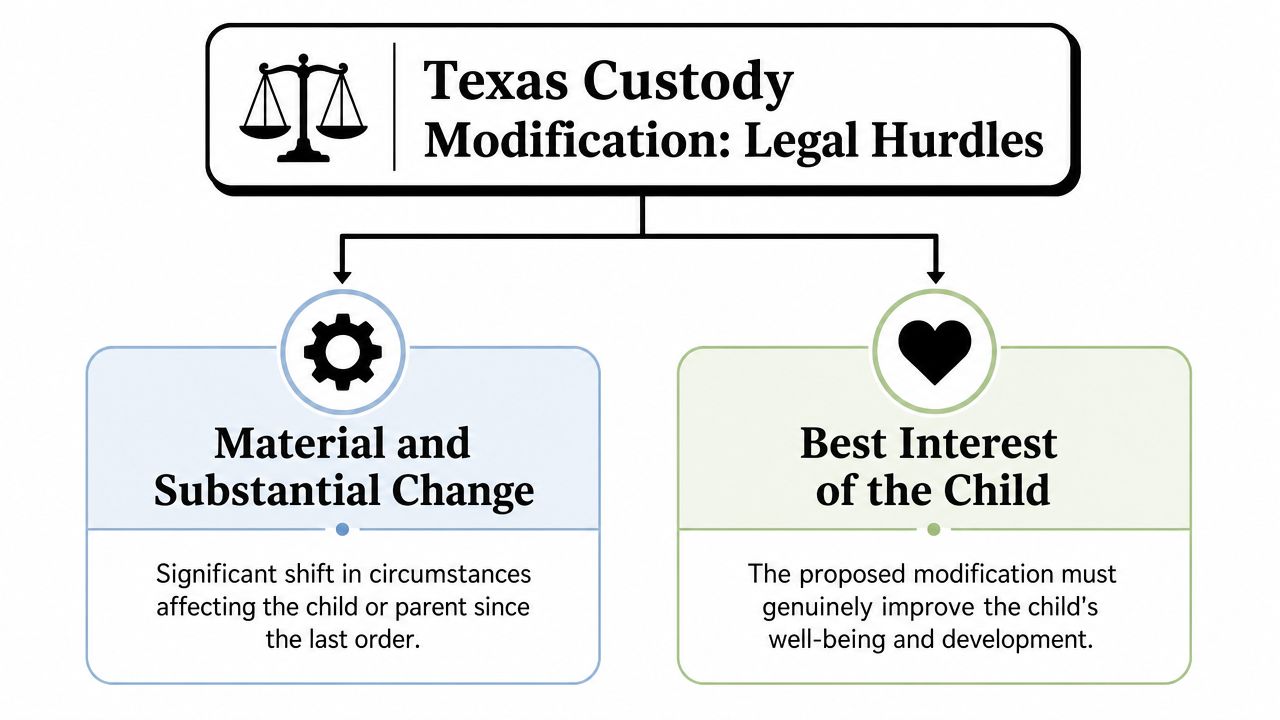
Material and substantial change
This is the gateway issue. If you can't prove a meaningful change since the last order, the court usually won't reach the second question.
Plain English examples often include:
- A relocation problem that makes the current exchange schedule unrealistic
- A major change in a child's needs, such as school struggles, counseling needs, or health issues
- A parent's instability, including unmanaged substance use, frequent absences, or failure to provide basic care
- A household shift, such as a new relationship or living arrangement that affects the child
The court compares life now to life when the last order was signed. Complaints that already existed back then are weaker if nothing new has happened.
Best interest of the child
Even if you prove a substantial change, you still have to show your requested order helps the child. Texas courts often evaluate best interest through familiar considerations drawn from Texas case law, including the Holley factors.
What judges usually care about most
The child's emotional and physical needs, the stability of each home, each parent's ability to meet day-to-day needs, any risk of harm, and whether the proposed change creates a more reliable structure for the child.
That means a good case doesn't just say, “The other parent is the problem.” A better case says, “Here is what has changed, here is how it affects the child, and here is the specific order that would improve the child's daily life.”
What works and what doesn't
A simple side-by-side helps.
| Approach | How it usually lands |
|---|---|
| “The current order is unfair to me.” | Weak |
| “The child has developed school and counseling needs, and the current arrangement is undermining consistency.” | Stronger |
| “The other parent is difficult and rude.” | Weak |
| “The other parent has repeatedly failed to follow pickup times, school attendance has suffered, and I have records.” | Stronger |
If you're trying to learn how to win a custody modification case in Texas, this is the starting point. The court isn't looking for a better co-parenting argument. It's looking for a proven change and a child-focused solution.
Strategic Timing and Filing in Montgomery County
When you file can matter almost as much as what you file.
Texas places a major limit on early modification requests. A parent usually faces a 1-year waiting period after the order is entered before seeking a custody modification without the other parent's agreement, unless there are extenuating circumstances harmful to the child. During that first year, the parent asking for the change must show that the child's current circumstances significantly impair the child's physical health or emotional development, which is a much higher burden than an ordinary dispute, and the harmful condition generally must have arisen after the prior order took effect, as discussed in this overview of modifying child custody in Texas.

Filing too early can hurt a good case
Parents sometimes want to file immediately after a bad month or a fresh argument. That impulse is understandable, but filing before your proof is developed can backfire.
If you're inside that first year and you don't have evidence of current significant impairment, the case may look premature. Judges in Montgomery County tend to separate true child-endangerment facts from ordinary parenting conflict. A scheduling dispute, communication failure, or clash over rules usually won't carry an early custody change by itself.
Where to file matters
A modification case generally belongs in the court that issued the original order under the same cause number. That's part of continuing, exclusive jurisdiction under the Texas Family Code.
For local families, that means many cases tied to The Woodlands, Conroe, or surrounding Montgomery County communities stay in the same Montgomery County family court unless there has been a lawful transfer. Filing in the wrong place creates delay, added expense, and credibility problems before the main issues are even heard.
Local practical points
Parents often ask what Montgomery County judges want to see at the filing stage. They usually want clarity.
Bring your lawyer these basics early:
- The last signed order
- A timeline of changes since that order
- Any urgent facts affecting safety, school, health, or stability
- A realistic request, not a wish list
In local practice, narrow requests often perform better than sprawling ones. If the true problem is school-night stability or unsafe supervision, ask for relief aimed at that problem.
A well-timed case gives the court a clean story. A rushed filing often gives the other side room to argue you're reacting emotionally rather than responding to a real change.
Building Your Evidence File to Win in Court
Most parents don't lose modification cases because they care too little. They lose because they show up with conclusions instead of proof.
Research on child-custody adjudication found that concrete factual findings strongly influence outcomes, and a published model analyzing appellate custody decisions reported over 85% accuracy in predicting outcomes from those facts. The same research found that when parents had a very poor relationship, the chance of obtaining joint custody fell to less than 0.5%, which is why evidence and demonstrated cooperation matter so much in these cases, as explained in this published custody adjudication study.
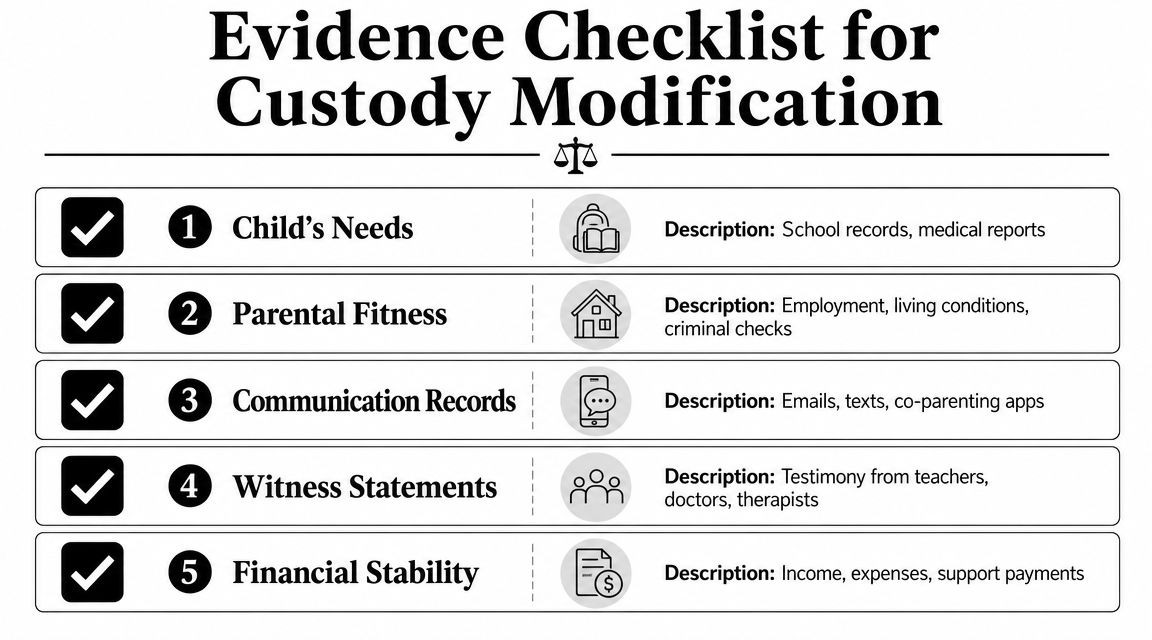
What belongs in your case file
Start building a file as if someone who knows nothing about your family will need to understand the problem from scratch.
- Messages and emails. Save texts, emails, and co-parenting app messages that show missed exchanges, refusals, threats, admissions, or repeated unreliability.
- School records. Attendance notices, tardy records, teacher emails, report cards, and counselor notes can connect parenting problems to the child's daily life.
- Medical and therapy records. These can show missed appointments, inconsistent medication handling, or changes in the child's emotional condition.
- Photos and videos. Use them carefully. They should document conditions, injuries, or relevant living environment issues, not embarrass the other parent.
- A detailed journal. Dates, times, what happened, who saw it, and how it affected the child.
- Financial and work documents when relevant. If the modification issue involves availability, housing, or inability to provide care, records can matter.
If you're organizing forms, signatures, and written agreements outside the courtroom, it helps to understand what makes paperwork enforceable. A plain-language overview like SendItFax's legal document guide can help you think more carefully about how you preserve records and written commitments.
One short local scenario
A mother in Panther Creek kept saying the father “never follows the schedule.” That statement alone wasn't enough.
Once she organized the evidence, the story changed. She had school attendance records showing repeated late arrivals after his school-night periods, message threads confirming last-minute exchange changes, and a written calendar showing a pattern over several months. A shared record system such as a co-parenting calendar for Texas parents can help create that kind of organized timeline.
The point wasn't to prove he was a bad person. The point was to prove a repeated pattern affecting the child.
Evidence that usually helps less than parents think
Some items feel powerful but often don't move the case much on their own:
- Long screenshots without context
- Friends repeating what you told them
- Old complaints from before the current order
- Recordings or posts offered mainly to show the other parent is rude
Judges care far more about “What happened, when did it happen, and how did it affect the child?” than “Who seems more upset?”
A better way to organize proof
Use a simple structure:
- Event
- Document
- Effect on child
- Requested fix
That format helps your lawyer build a persuasive narrative instead of dumping papers into a folder and hoping the court sorts it out.
Using Discovery and Experts to Strengthen Your Case
Once a modification suit is filed, the case enters a more formal phase. Here, broad suspicions get tested.
What discovery actually does
Discovery is the process of forcing useful information into the open. If you think the other parent is hiding documents, changing stories, or minimizing serious concerns, discovery gives you tools to pin down the facts.
Common tools include:
- Interrogatories, which are written questions the other side must answer
- Requests for production, which seek documents, messages, records, calendars, and other materials
- Depositions, which put a witness under oath outside the courtroom so testimony is preserved and inconsistencies can be exposed
For a fuller explanation of how these tools work in family litigation, this guide to the Texas divorce discovery process is useful because the mechanics often overlap in custody modification disputes.
How discovery helps in Montgomery County practice
Discovery changes advantage.
A parent may claim they always exercise possession, always notify the other side, and always take the child to appointments. A calendar export, school record, or sworn deposition answer may tell a different story. That can matter at mediation, in temporary hearings, and at trial.
It also helps narrow the case. Sometimes discovery shows the feared problem isn't provable. That's valuable too. It lets you focus on what the court can act on.
The strongest family cases usually become simpler as discovery progresses. Weak cases usually become louder.
When experts become important
Some modification disputes need more than parent testimony.
An amicus attorney may be appointed in certain cases to help the court evaluate the child's interests. In higher-conflict matters, a psychologist, counselor, or other qualified professional may provide records or testimony about the child's functioning, a parent's mental health concerns, or the impact of conflict. In some cases, a formal custody evaluation may be worth considering.
Experts aren't useful just because they sound impressive. They're useful when they answer a question the judge can't resolve from text messages and parent testimony alone.
A trade-off many parents miss
Experts can strengthen a good case, but they also add cost, time, and scrutiny. If your facts are already clear through school records, medical records, and neutral witnesses, a leaner presentation may be smarter.
If the dispute centers on allegations the other side denies and the child is caught in a high-conflict environment, expert input can become far more important. That evaluation has to be strategic, not automatic.
Negotiating a Settlement vs Preparing for a Hearing
A lot of parents walk into mediation assuming the other side will finally "hear reason." In Montgomery County, that approach usually wastes time and money. Cases settle when each side sees the proof, understands the judge's likely reaction, and has a workable proposal on paper.

Settlement works best when your hearing file is ready
In Montgomery County, mediation is common before a temporary hearing or final trial setting. Judges expect serious participation. They also tend to favor parents who can present a child-centered plan instead of a list of grievances.
Come prepared with a concise packet your lawyer can use quickly in the mediation room:
- A clean timeline of the events that support modification
- The few records that matter most
- A proposed possession schedule with specific terms
- A short list of points you will agree to and points you will not
Good mediation preparation changes the conversation. Instead of arguing about who has been more difficult, the discussion shifts to pick-up times, school stability, counseling logistics, phone contact, extracurricular travel, and holiday language a judge could sign.
If you want a practical comparison of those paths, review this discussion of mediation vs trial in Texas family cases.
What helps in a Montgomery County mediation
Local judges and mediators see through broad complaints fast. "He's toxic" or "she alienates the child" rarely moves a case by itself. Specific facts do.
Use short, concrete points tied to the child's daily life. Missed school. Repeated late exchanges. Counseling interruptions. Medical follow-up that did not happen. A parent who relocated farther from the child's school and now wants the order bent around that choice. Those details create pressure to settle because they show what a judge may focus on if the case goes forward.
Later in the process, many parents find it helpful to hear a short explanation of how custody litigation is framed in practice:
Preparing for a hearing if settlement does not happen
Treat the hearing like a credibility test. In Montgomery County family courts, disciplined testimony usually carries more weight than outrage. Judges want direct answers, organized exhibits, and a clear explanation of what order you want changed and why that change serves the child now.
That means knowing which witness proves which point. It means marking exhibits clearly and making sure each document connects to a legal issue the court can act on. It also means preparing for the weaknesses in your own case. If you have a rough text exchange, an old contempt issue, or a period where you waited too long to act, address it with context instead of hoping it stays buried.
Parents who do well at hearing usually do three things. They stay calm under cross-examination. They avoid exaggeration. They ask for relief the judge can realistically grant based on the record in front of the court.
Your Modification Checklist and Next Steps
If you're serious about how to win a custody modification case in Texas, focus on actions that improve proof and reduce noise.
What to do next
- Read your current order carefully. Many parents remember the arrangement differently than it is written.
- Start a journal today. Use dates, times, missed exchanges, school issues, and specific effects on the child.
- Save communications in one place. Texts, emails, and app records should be searchable and organized.
- Gather neutral records. School, medical, counseling, and attendance records often matter more than family opinions.
- Avoid self-help changes. Don't withhold the child or rewrite the schedule on your own unless your lawyer tells you there is a lawful emergency basis.
- Define the exact change you want. Judges prefer concrete requests over general frustration.
- Talk with a family law attorney early. A short consultation can tell you whether your facts support filing now or whether you should keep documenting.
Quick FAQ
Can a grandparent or other caregiver modify custody in Texas?
Sometimes, but only in limited situations. Texas legal aid explains that a nonparent may seek modification only under specific circumstances, including showing the child lived with them for at least six months, that the move out occurred within 90 days before filing, and that denying custody would cause significant emotional or physical harm, as described in TexasLawHelp's article on changing a custody, visitation, or support order.
Does the Texas Family Code matter in these cases?
Yes. Modification cases are governed by the Texas Family Code, including the standards applied to conservatorship and modification requests. Local practice matters, but the statutory framework controls the legal test.
Is this article legal advice?
No. This article is for general informational purposes only. It isn't legal advice, doesn't create an attorney-client relationship, and shouldn't replace legal advice about your specific facts.
If your current custody order no longer fits your child's needs in The Woodlands or anywhere in Montgomery County, a focused legal review can help you decide whether to negotiate, keep documenting, or file now. You can schedule a consultation with The Law Office of Bryan Fagan to discuss your situation and the practical next step.
