 Skip to content
Your custody order may have made sense when it was signed. Then life moved. Your work hours changed. Your child started struggling in school. The other parent relocated, stopped following the schedule, or created a pattern that now affects your child every week.
That's usually when parents in The Woodlands start searching for a custody modification lawyer in The Woodlands, TX. Not because they want to fight, but because the current order no longer fits real life.
Texas law does allow custody orders to be changed. But it does not allow changes just because a parent is frustrated, thinks the old order is unfair, or wants a better deal. In Montgomery County, judges expect facts, records, and a clear reason tied to the child's welfare.
This guide is for parents in The Woodlands and nearby Montgomery County communities who need a practical view of what works in a modification case, what usually falls flat, and what steps to take before filing anything in court.
This article is for educational purposes only. It is not legal advice and does not create an attorney-client relationship.
When Your Life Changes But Your Custody Order Has Not
A common situation looks like this. A parent in Alden Bridge takes a new job with different hours. Pickup times that once worked now trigger weekly conflict. The child is exhausted, late to activities, and starting to show it at school. Both parents know the order is outdated, but one of them won't agree to change it informally.
Another version is harder. A parent in Creekside notices the child coming home anxious after visits. There may be new people in the other household, a sudden move, or serious instability. The parent isn't trying to “win custody.” The parent is trying to stabilize the child's daily life.
Those are not abstract family law problems. They are exactly the kind of real-world changes that push people back into court.
Practical rule: An unwritten side agreement between parents is fragile. If the other parent changes course, the signed court order still controls.
Many parents feel stuck because they assume a final order is permanent. It isn't. A Texas custody order can be modified when the legal standard is met and the facts support the request. That might involve changing who decides major issues for the child, adjusting the possession schedule, or addressing related support issues if the facts justify it.
Why local parents often wait too long
Parents in The Woodlands often try to hold things together for months before asking for help. That instinct is understandable. Nobody wants more conflict. But delay can make a case harder if the problem grows, records disappear, or a harmful new routine becomes the norm.
What usually helps is a calm early review of the facts:
- Write down the changes: Start with dates, events, and how the child has been affected.
- Separate emotion from proof: Your frustration matters, but the court will focus on evidence.
- Identify your primary goal: More time, safer exchanges, school stability, or decision-making authority are different requests and need different proof.
A good modification case is usually built long before the first court hearing.
The Legal Reason for a Custody Modification in Texas
Texas courts don't change custody orders because one parent wants a different setup. The parent asking for a change generally must prove that the requested change is in the child's best interests and that a legal ground exists, most commonly a material and substantial change in circumstances since the last order, as noted in guidance discussing Texas modification standards and the one-year filing rule in this overview of Texas child custody modification requirements.
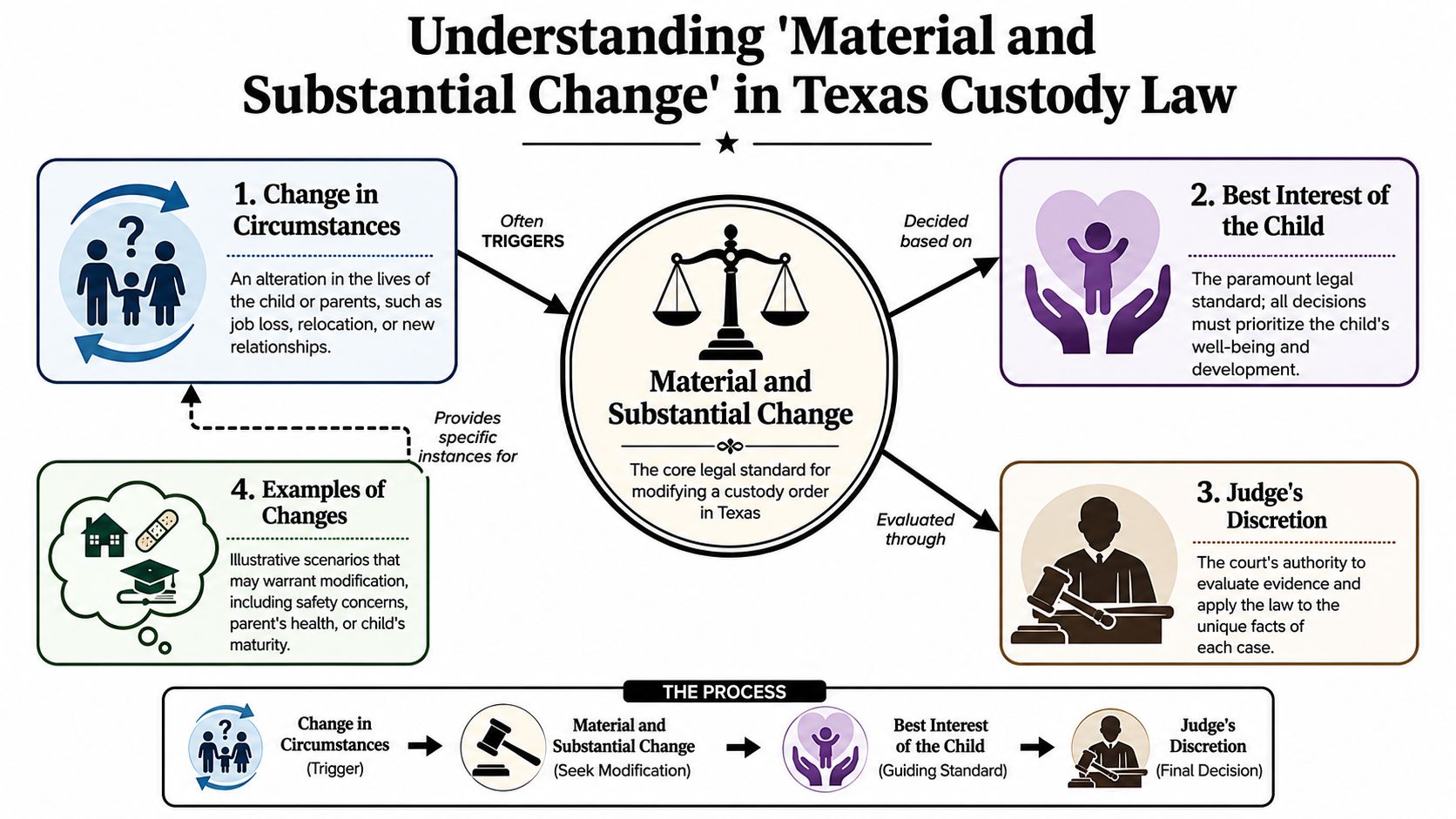
What material and substantial change usually means
This is the threshold issue in most modification cases. The court wants to know what has changed since the last order that matters enough to revisit a stable arrangement.
Examples may include a meaningful relocation, a serious shift in a parent's work or home situation, changes affecting the child's schooling or health, or safety concerns that did not exist when the last order was signed. What usually does not help is generalized dissatisfaction, personality conflict, or a parent believing the current order is inconvenient.
Think of it this way. The judge is not grading each parent as a person. The judge is deciding whether the facts have changed enough to justify changing an existing court order.
The Texas Family Code matters on timing
The Texas Family Code is especially important if the requested change involves the parent with the exclusive right to designate the child's primary residence. In some cases filed within 1 year of the prior order, the filing parent usually must submit an affidavit alleging facts that fit statutory exceptions, such as danger to the child's physical health or emotional development. That timing issue can affect whether a case gets off the ground at all.
If you're close to that one-year mark, filing strategy matters. So does the wording of the request.
A weak modification petition can create urgency for you, but not for the court. The court responds to legally relevant facts.
What works and what doesn't
Here's the practical split many parents need to hear:
| Situation | Usually stronger | Usually weaker |
|---|---|---|
| Parent's work change | Schedule shift that regularly affects exchanges, supervision, or school routine | Temporary busy season or occasional inconvenience |
| Child's needs | New educational, medical, or emotional needs tied to the current arrangement | Ordinary growing pains with no documented impact |
| Relocation | Move that changes travel, school access, or daily stability | Minor distance change with little practical effect |
| Household concerns | Specific safety, neglect, or instability facts | Broad claims that the other home is “better” or “worse” |
A custody modification lawyer in The Woodlands, TX should start by testing your facts against that legal standard, not by promising a result.
What Parts of Your Custody Order Can Be Changed
Most parents use the word “custody” to mean everything. In court, the order usually has separate moving parts. That matters because you may need to change one part, two parts, or all of them.
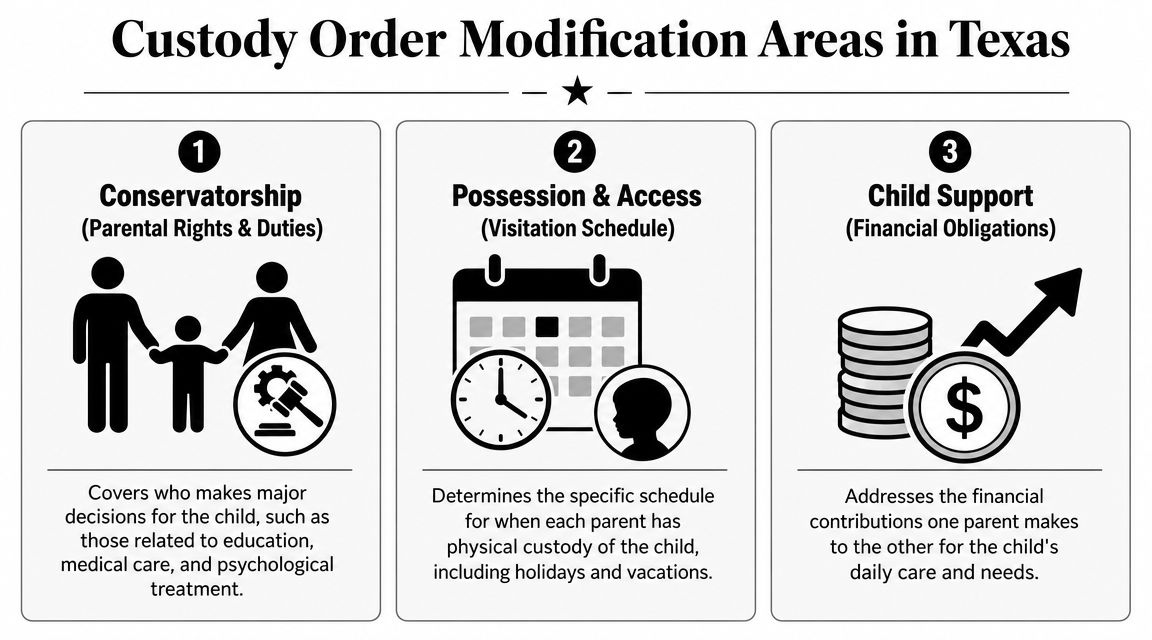
Conservatorship
Conservatorship deals with parental rights and duties. That includes who has authority over major decisions involving education, medical care, and other important issues under the Texas Family Code.
A conservatorship change is often more serious than a schedule tweak. If you're asking to change who makes major decisions, the court will want specific reasons why the current setup no longer serves the child well.
Possession and access
This is the parenting-time schedule. It covers weekdays, weekends, holidays, summer, exchanges, and practical details that control daily life.
Many modification cases in Montgomery County are really possession cases at heart. The parents may both remain involved, but the schedule no longer fits the child's age, school demands, travel distance, or the parents' current routines.
Child support and related relief
Support can also become part of the same case. Local family-law practice in The Woodlands notes that custody and visitation changes are often pursued alongside enforcement or support updates because the same factual record can affect multiple orders at once. That can improve procedural efficiency when the court is already evaluating parenting-time disruption, safety concerns, or relocation, as described in this discussion of The Woodlands family-law modification and enforcement practice.
One scenario that shows how these overlap
A parent in Sterling Ridge receives a promotion that requires frequent travel. Under the current order, that parent has midweek possession that now conflicts with overnight trips. The child has started missing homework support on those nights, and the other parent has been covering extra expenses without a formal agreement.
That one change can lead to several possible requests:
- Schedule adjustment: Shift midweek time to a more reliable pattern.
- Decision-making clarity: Add clearer rules for school communications and activity sign-ups.
- Support review: Evaluate whether the changed schedule and expenses justify updating support.
- Enforcement issues: Address repeated missed exchanges if they've become part of the problem.
When emergency action may be appropriate
A standard modification is not the same as an emergency request. If the child faces immediate safety concerns, the case may require urgent relief, sometimes including temporary restraining requests or prompt temporary orders. That is a different path from ordinary negotiation over convenience or scheduling.
If abuse, neglect, domestic violence, or immediate danger is part of the facts, treat it as an urgent legal issue, not a co-parenting disagreement.
Gathering Evidence for Your Modification Case
Most modification cases are won or lost on documentation quality. In Texas custody-modification matters, practitioners emphasize objective proof such as school records, medical updates, financial statements, or relocation evidence instead of generalized dissatisfaction, and case strength often turns on whether the evidence is tied to the child's welfare or to a meaningful change in a parent's circumstances, as described in this explanation of modification evidence in The Woodlands cases.
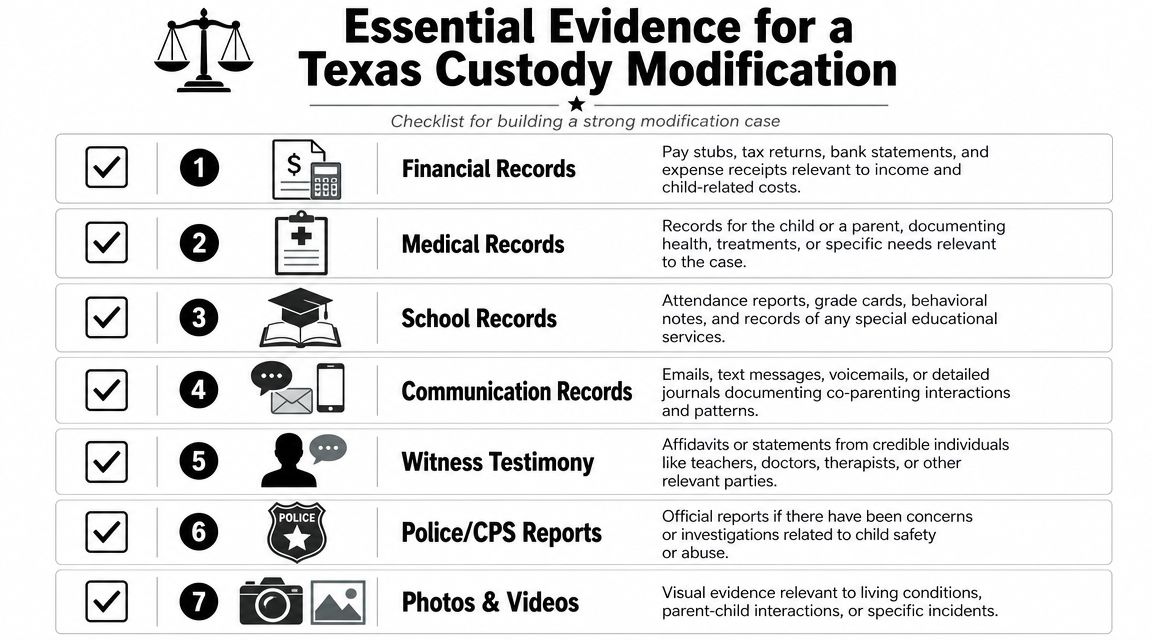
What to start collecting
You do not need every record in existence. You need the right records.
- Messages and emails: Save communications that show schedule breakdowns, refusals, threats, missed exchanges, or admissions by the other parent.
- School records: Attendance, grades, disciplinary notes, counselor communications, and records showing changes in performance or routine.
- Medical and counseling records: If the child's health or emotional condition is part of the case, get organized records and provider information.
- Financial records: If support is part of the requested modification, gather pay stubs, tax documents, benefit information, and child-related expenses.
- Relocation proof: Lease documents, move notices, school-zone changes, commute impacts, or work transfer records.
- Photos and videos: Use them carefully. They should document relevant conditions or events, not create drama.
- Witness information: Teachers, counselors, coaches, relatives, neighbors, or caregivers may help if they have firsthand knowledge.
What judges usually find persuasive
Judges tend to care about patterns more than isolated arguments. A timeline is often more useful than a stack of random screenshots.
Try organizing evidence this way:
| Type of proof | Why it matters |
|---|---|
| Chronology | Shows when the change started and whether it has continued |
| Third-party records | Often carry more weight than a parent's conclusion |
| Child-focused evidence | Connects the issue to the child's welfare, not adult resentment |
| Consistent communications | Shows repeated conduct rather than one bad day |
Case-building tip: If you can't explain why each document matters, don't assume the judge will do that work for you.
Common mistakes
Parents often hurt otherwise valid cases by overcollecting the wrong things. Recording every rude text but ignoring school records is a mistake. Bringing a general notebook full of grievances without dates is another. So is sending angry messages that later become evidence against you.
If parental alienation is part of your concern, this practical guide on how to prove parental alienation in court can help you think more carefully about what courts look for.
Keep your records clean, dated, and focused. A simple folder system usually works better than a chaotic phone gallery.
Navigating the Montgomery County Court Process
The local court process feels less intimidating once you know the sequence. Most cases in Montgomery County follow a predictable pattern, even though every case moves at its own pace.
A typical case starts with filing the petition in Conroe. The other parent must then be formally served unless service is waived in a proper agreed filing.
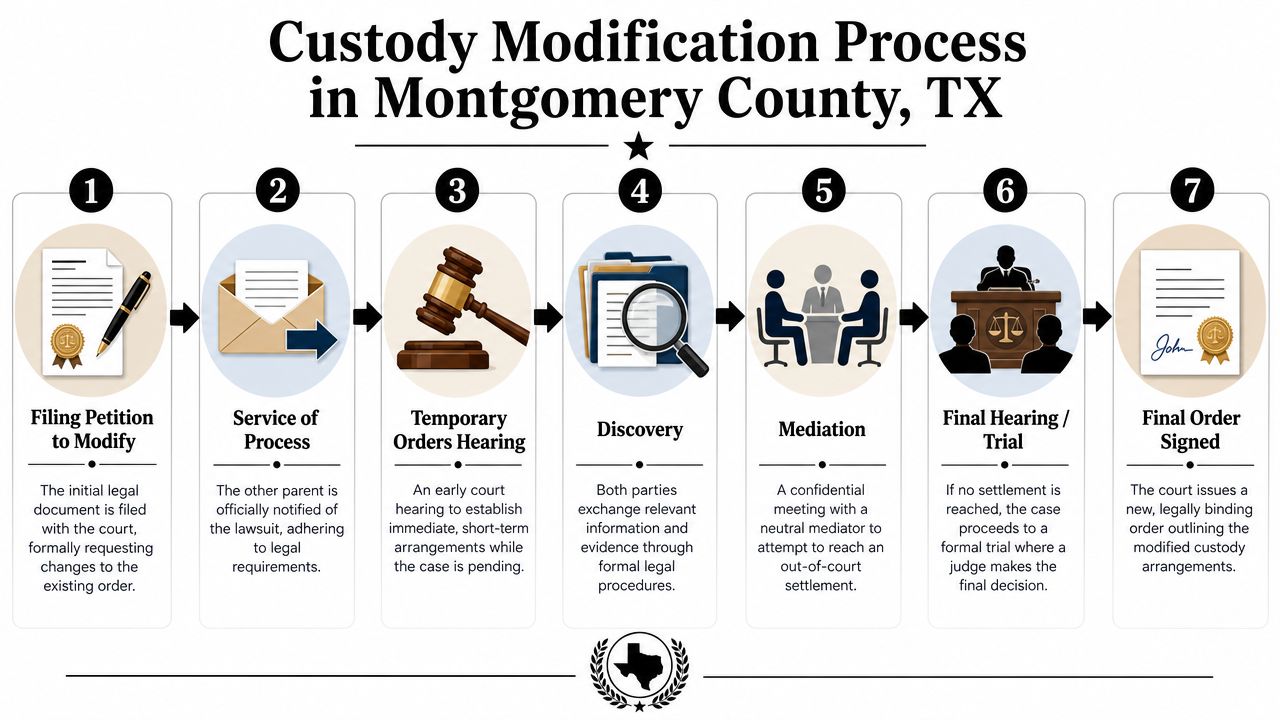
The usual path through the case
Petition to modify filed
This tells the court what you want changed and why.Service on the other parent
Proper notice matters. A strong case can still be delayed by service mistakes.Temporary orders, if needed
If the current situation can't wait until final trial, the court may hear temporary issues earlier.Discovery
Both sides may exchange records, answer written questions, and request documents.Mediation
Many family courts expect serious settlement efforts before trial.Final hearing or trial
If no agreement is reached, the judge decides based on the evidence.Final modified order signed
The new written order controls going forward.
Later in the process, many parents benefit from seeing a courtroom overview before their own hearing date.
What slows cases down
The biggest delays usually come from poor preparation, not from the filing itself.
- Incomplete records: Missing school, medical, or financial records force follow-up and continuances.
- Disorganized exhibits: If your evidence is hard to review, mediation and hearings become harder than they need to be.
- Unclear requests: Asking for broad changes without precise language invites conflict.
- Reactive communication: New arguments between parents can create fresh issues before the court resolves the old ones.
For document organization, many lawyers and litigants find it helpful to paginate exhibits before mediation or hearing. If you're handling a large set of records, this Adobe Bates numbering guide is a practical resource for keeping documents in order.
What local preparation should look like
If you're headed toward a hearing in Montgomery County, review the basics of what to expect at a child custody hearing in Montgomery County. That kind of preparation helps parents understand courtroom flow, hearing expectations, and why presentation matters almost as much as substance.
Court procedure doesn't replace good facts. But poor procedure can bury good facts.
An agreed modification may move much faster than a contested one. A high-conflict case with emergency issues, formal discovery, and a trial setting will take longer and demand more from both parents.
How a Woodlands Custody Modification Lawyer Protects You
A modification case is not just paperwork. It is claim selection, evidence control, hearing strategy, and damage prevention.
A local lawyer starts by identifying whether your facts support a filing. That matters because weak filings can inflame the other parent, increase expense, and still leave you with the same order at the end. Sometimes the right move is filing. Sometimes it is negotiating a narrow agreed revision. Sometimes it is building a stronger record before going to court.
The lawyer's job in a real case
A lawyer helps with things parents often underestimate:
- evaluating whether the facts fit the legal standard
- deciding whether to seek temporary orders
- drafting requests with enough specificity to be enforceable
- gathering evidence in admissible form
- preparing for mediation with realistic settlement positions
- presenting the child-focused theory of the case to the judge
That is especially important in high-conflict matters, where one bad text, one exaggerated claim, or one vague request can distract from the actual issue.
Local knowledge has practical value
A custody modification lawyer in The Woodlands, TX also brings local context. Montgomery County practice has its own pace, filing habits, and courtroom expectations. Knowing how to prepare a case for mediation, temporary hearings, and final presentation can change how efficiently the case moves and how clearly your position is understood.
If you're comparing representation options, The Law Office of Bryan Fagan is one local firm that handles family law matters in The Woodlands, including custody modifications and related enforcement disputes.
Confidentiality and digital caution
Parents also need to protect their own information while a case is pending. Shared devices, synced accounts, forwarded emails, and cloud-stored documents can create problems fast. This overview of digital legal protection and attorney-client confidentiality is a useful reminder to secure communications and case documents early.
A good lawyer does more than argue. The lawyer narrows the dispute, keeps the case grounded in proof, and helps you avoid mistakes that can follow you long after the hearing ends.
Frequently Asked Questions and Your Next Steps
If you're considering a modification, don't start with the petition. Start with preparation.
What to do next
- Write a timeline: List major changes since the last order and include dates.
- Pull records now: Gather school, medical, financial, and communication records before they get harder to find.
- Define the exact change you want: Primary residence, decision-making, possession schedule, support, or urgent temporary relief.
- Avoid informal side deals: If a change matters, it should be put into a signed court order.
- Protect your communication: Keep messages brief, factual, and child-focused.
- Get legal guidance early: A short consult can prevent a costly filing mistake.
Frequently asked questions
Can my child tell the judge where they want to live?
Possibly, but that does not mean the child decides the case. Under the Texas Family Code, a child's wishes can be relevant in some situations, but the court still decides based on the child's best interests and the full evidence.
What if the other parent and I agree on the change?
That is often the most efficient route. But the agreement still needs to be drafted correctly and entered as a court order. Until that happens, the existing order usually remains the one the court can enforce.
What if I was served with modification papers first?
Do not ignore them. Deadlines and response strategy matter. If you're on the receiving end, this guide on how to respond to a custody modification case in Texas is a useful starting point.
How much does a custody modification cost in The Woodlands?
There is no single answer. Cost depends on whether the case is agreed or contested, whether temporary orders are needed, how much discovery is required, and whether the matter settles in mediation or goes to trial. A focused early evaluation usually gives the clearest picture.
Do I need proof before I meet with a lawyer?
Bring what you have. A lawyer can help identify what is missing, what matters most, and what may not help at all.
This is still educational information, not legal advice. The right next step depends on your order, your facts, and your court history in Montgomery County.
If your current order no longer fits your child's life, a consultation can help you sort out whether you have a strong basis to modify it and what steps make sense next. You can schedule a confidential consultation with The Law Office of Bryan Fagan to discuss your situation in The Woodlands or anywhere in Montgomery County.
