 Skip to content
If you're heading into divorce in The Woodlands, one of the hardest parts is not the court date. It's the uncertainty.
You may know your spouse's paycheck, but not the bonus structure. You may know there are retirement accounts, but not the balances. You may suspect a business is worth more than what's being said, but you don't yet have the records to prove it. That uncertainty is exactly where the divorce discovery process matters.
In a Texas divorce, discovery is the formal way both sides gather the information needed to make fair decisions about property division, support, and sometimes custody-related issues. It can feel invasive. It can also be the step that replaces suspicion with documents, timelines, and sworn answers.
Demystifying the Financial Fact-Finding Phase of Divorce
A common scene in Montgomery County looks like this: one spouse handled the household budget, the other handled the bigger financial picture. When divorce starts, the spouse who was less involved often realizes how much is still unknown. Are all accounts disclosed? Was a bonus deferred? Is there business income mixed with personal spending?
That is what discovery is built to address.
Discovery is one of the most time-consuming and resource-intensive parts of divorce litigation, and the scope is broad. Very little is considered off limits. Financial records, real estate documents, retirement statements, and even evidence tied to marital misconduct may all be discoverable, as explained in this discussion of the discovery phase in divorce litigation.

Why discovery often lowers anxiety
Most clients don't need more legal jargon. They need a reliable process.
Discovery gives that process structure. Instead of arguing in circles about what exists, each side has to produce information and answer questions in a form the court can enforce. Under the Texas Family Code, courts divide marital property in a manner that is just and right, and that requires a real financial picture, not guesses.
Practical rule: If a document helps show income, ownership, debt, spending, or value, assume it may matter.
This is especially important in higher-asset cases in The Woodlands, where stock compensation, executive bonuses, closely held businesses, and retirement benefits can complicate the marital estate. If the numbers don't line up, a lawyer may also consider outside help such as forensic accounting for divorce disputes.
Fairness starts with a complete paper trail
Clients sometimes ask whether discovery means every issue will become a battle. Not necessarily. In many cases, it does the opposite. Once both sides can see the same records, settlement talks become more grounded.
Retirement assets are a good example. People often know the account exists but don't know whether some or all of it is community property. That issue becomes much easier to analyze once statements and plan records are on the table. For a closer look at that issue, see this guide on divorce with retirement accounts in The Woodlands.
What the Discovery Process Means in a Texas Divorce
A spouse says the business is having a slow year, the bonus was smaller than usual, and the investment account "isn't worth much right now." Then the first real records arrive, and the picture changes. Discovery is the part of a Texas divorce where assumptions get tested against bank statements, tax returns, payroll records, business books, and sworn answers.
In Texas, divorce cases don't run well on surprises. Judges in Montgomery County expect both sides to exchange relevant information so disputes over property, support, reimbursement claims, and attorney's fees can be decided on evidence instead of suspicion.
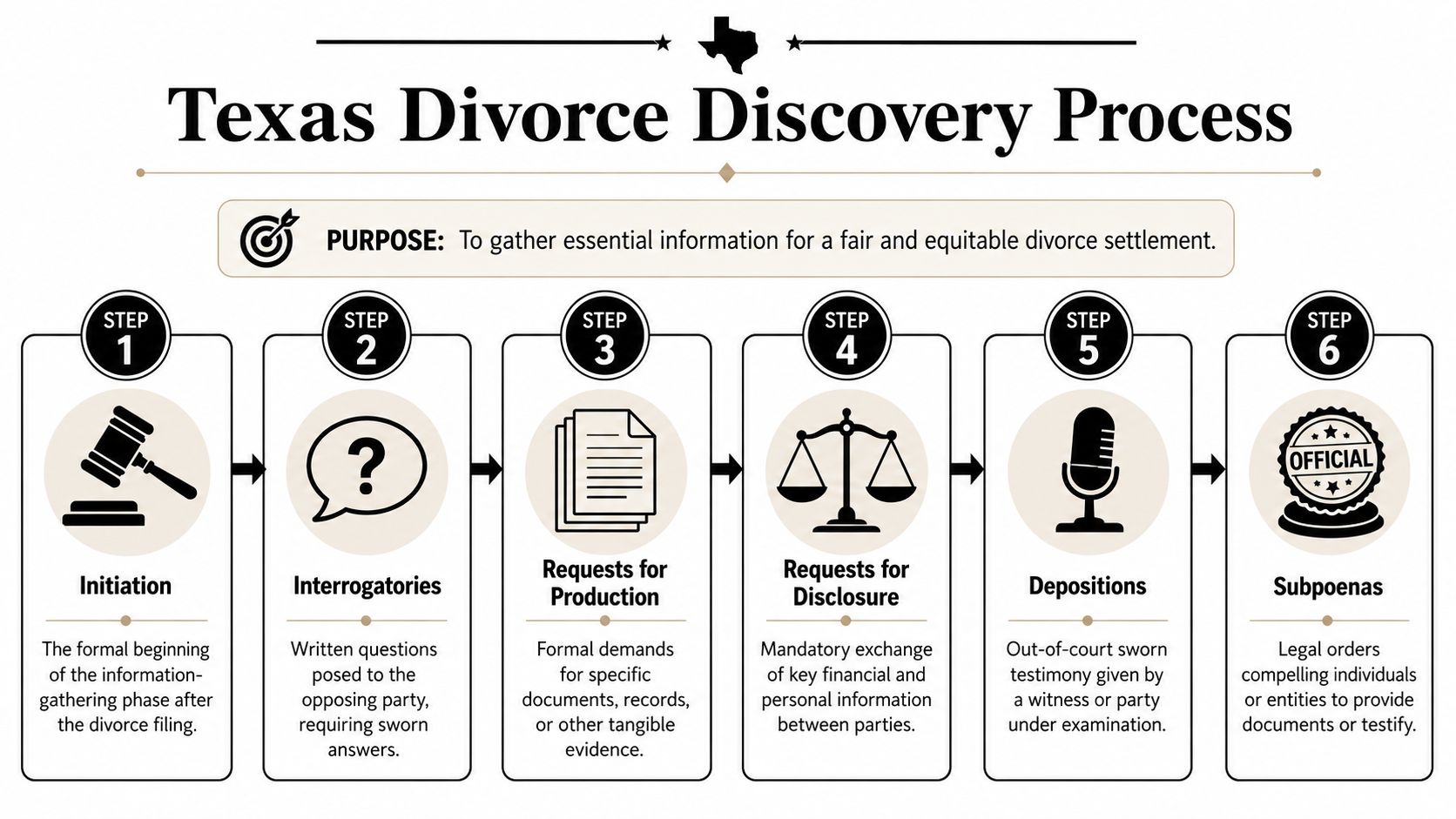
When discovery begins and what it does
Discovery usually starts after the divorce is filed and the case is underway. Its job is practical. It gives each side the information needed to value assets, trace separate property claims, test income positions, and prepare for negotiation, mediation, or trial.
In many cases, written questions and document requests trigger a response deadline measured in weeks, not months. The full process, however, can stretch much longer in a high-asset case, especially if one spouse owns a business, receives stock compensation, or controls most of the financial records. That timing affects cost. Early, organized disclosure often reduces legal fees. Delays, partial responses, and missing documents usually do the opposite.
Texas procedure also requires more than a one-time document drop. If a party learns that an earlier response was incomplete or incorrect, that response generally must be supplemented. In real terms, that can include a newly discovered account, updated compensation information, corrected business records, or a valuation document that was not produced the first time.
What honest disclosure looks like in real life
Full disclosure means usable disclosure.
A box of mixed PDFs, screenshots without account numbers, and statements with pages missing will often create more conflict than clarity. Courts and lawyers need records that can be followed from start to finish. That usually means complete statements, clear account identification, and written answers that name employers, entities, debts, income sources, and transfers with enough detail to check them.
In higher-asset Woodlands divorces, organization matters almost as much as volume. If one spouse is sorting through executive compensation, partnership distributions, deferred bonuses, or business expense reimbursements, the records need to show how money flowed and where it went. That is often the difference between a productive mediation and an expensive fight over whether the production was adequate.
Discovery works best when each side treats it like a business audit, not a personal insult.
Third-party records are often part of the process too. Banks, employers, accountants, brokerage firms, and plan administrators may hold the cleanest version of the facts. If a spouse will not produce what is needed, formal discovery tools and court enforcement can bring those records in. That step takes time and money, so strategy matters. In some cases, a narrowly targeted request gets better results than serving broad demands that invite objections.
The Texas law piece clients should know
Texas family courts need financial transparency to divide community property in a just and right manner and to address support-related disputes. The Texas Rules of Civil Procedure govern how information is requested, produced, and enforced. The Family Code shapes how that information affects the outcome.
For clients, the practical takeaway is simple. Discovery is where the advantage often shifts. A spouse who complies early may put the case in position to settle on reasonable terms. A spouse who stalls can force motions to compel, hearings, and requests for sanctions, which can increase fees and push the case closer to trial.
That is why discovery is more than paperwork. In a Montgomery County divorce, it is the record-building phase that determines whether decisions are based on estimates or proof.
The 5 Key Discovery Tools Used in Montgomery County Courts
In Montgomery County divorce cases, the tools themselves are not mysterious. The challenge is knowing which one to use, when to use it, and how broad or narrow to make the request.
The most common discovery methods across U.S. jurisdictions include interrogatories, requests for production, depositions, and requests for admissions, as outlined in this explanation of discovery during divorce. In Texas practice, parties also deal with required disclosures.
Required initial disclosures
This is the baseline exchange of core information.
In plain terms, each side provides certain basic categories of information without waiting for highly customized requests. In a Montgomery County divorce, that may include names of people with relevant knowledge, basic financial documents, and information about claims and defenses that are already in play.
Example: A spouse who says a separate property claim exists should be prepared to identify the property and the records that support tracing that claim.
Requests for production
This tool asks for documents and tangible records.
It's often the workhorse of the divorce discovery process because documents usually tell the story more clearly than memory does. Bank statements, credit card records, tax returns, loan applications, QuickBooks files, deeds, retirement statements, and employment compensation documents often come through requests for production.
Example: If a spouse in The Woodlands manages a brokerage account that wasn't discussed during the marriage, a request for production can seek statements, trade confirmations, and account opening documents.
Interrogatories
These are written questions answered under oath.
Interrogatories are useful when you need the other side to identify facts, explain positions, or commit to details that can later be checked against records. They're especially useful in cases involving businesses, side income, or disputed reimbursements.
Example: If one spouse owns a small company serving Montgomery County clients, interrogatories can ask that spouse to identify all business accounts, all owners, and whether the business has paid any personal expenses.
Requests for admission
This tool narrows disputes.
A request for admission asks the other side to admit or deny a specific fact. That sounds simple, but it can save substantial time by removing issues that shouldn't be argued about at trial.
Example: One request might ask a spouse to admit that a certain bank account existed on the date of separation. Another might ask the spouse to admit that a particular tax return was signed by both parties.
The best requests for admission don't chase every detail. They pin down the facts that matter most.
Depositions
A deposition is live questioning under oath, usually with a court reporter present.
Depositions are valuable when paper records don't answer everything, or when the records raise new questions. A deposition lets a lawyer follow up in real time, test explanations, and compare testimony against documents.
Example: If payroll records, bank statements, and expense reports don't line up, a deposition lets counsel ask why. It also helps evaluate how a witness may present at a final hearing.
Choosing the right tool
Good discovery strategy isn't about sending everything possible.
It's about sequencing. Start with the material most likely to produce a reliable financial map. Then use the next tool to test the gaps, contradictions, or omissions that remain.
Real-World Scenario Discovery in a High-Asset Woodlands Divorce
Sarah and Tom live in Sterling Ridge. Tom owns a local business. Sarah knows the company supports the family's lifestyle, but the numbers Tom mentions casually at home never seem to match the spending she has seen over the years.
When the divorce begins, Sarah's concern isn't abstract. She wants to know whether the business income is being understated and whether business accounts have been used to pay personal expenses.
How a coordinated strategy works
Sarah's lawyer starts with requests for production. The goal is simple: get the business bank statements, tax returns, profit-and-loss records, and documents showing any loans or owner distributions.
Next come interrogatories. Tom is asked to identify every business account, explain compensation received from the company, and state whether the business has paid household or personal expenses. Those answers matter because they commit Tom to a sworn version of the facts.
Then comes the deposition.
With documents already in hand, Sarah's lawyer can ask focused questions about inconsistencies. If a business account paid a family vehicle note or covered travel that appears personal, that can be explored directly under oath.
Why sequence matters
This approach works because each tool builds on the one before it. Documents first. Explanations second. Testimony third.
That order often produces better answers than starting with broad accusations. It also helps identify whether a deeper investigation is needed into hidden assets in a Montgomery County divorce.
In a business-owner divorce, the first answer is rarely the full answer. The records usually tell you where to ask the next question.
By the time mediation arrives, Sarah is no longer negotiating from instinct. She has records, sworn responses, and testimony that show whether the business value and available income were represented fairly.
Your Divorce Discovery Document Checklist
The fastest way to make discovery more manageable is to start gathering documents before anyone formally demands them. Clients who do this are usually less stressed, easier to prepare, and better positioned to spot missing pieces.
The checklist below is not exhaustive for every case, but it's a strong working file for most divorces in The Woodlands and greater Montgomery County.
Essential Documents for Divorce Discovery
| Document Category | Examples |
|---|---|
| Income documents | Pay stubs, W-2s, 1099s, recent tax returns, bonus records, commission statements, deferred compensation records |
| Bank records | Checking account statements, savings account statements, signature cards, account opening documents |
| Investment assets | Brokerage statements, stock plan documents, restricted stock or option records, dividend records |
| Retirement assets | 401(k) statements, IRA statements, pension documents, beneficiary designations |
| Real property | Deeds, mortgage statements, closing papers, refinance documents, property tax statements |
| Vehicles and personal property | Vehicle titles, loan statements, appraisals, purchase records for valuable items |
| Debts and liabilities | Credit card statements, personal loan documents, lines of credit, promissory notes |
| Insurance and benefits | Health insurance details, life insurance policies, cash value statements, long-term disability policies |
| Business records | Tax returns, profit-and-loss statements, balance sheets, payroll records, owner distributions, general ledgers |
| Child-related financial records | Tuition records, extracurricular expenses, medical expense records, childcare invoices |
How to organize the file
Don't just collect documents. Sort them.
- Create date ranges: Group statements by account and month so missing periods stand out quickly.
- Keep originals untouched: Save digital copies as received, then make working folders for review.
- Flag unusual items: Large transfers, cash withdrawals, new debts, or account closures deserve special attention.
- Separate business from personal: If a spouse owns a company, keep those records in their own folder from day one.
For cases involving a company, professional practice, or closely held entity, valuation issues often overlap with discovery. This overview of business valuation in a Woodlands divorce can help you see why those records matter.
What clients often miss
People usually remember tax returns and bank statements. They often forget:
- Loan applications: These can contain useful financial representations.
- Retirement plan summaries: They help identify account types and benefits.
- Real estate refinance paperwork: These packets often gather income and asset data in one place.
- Business payment platforms: Merchant processing records and bookkeeping exports can matter in owner-operated businesses.
A clean document set gives your attorney more than convenience. It gives your case direction.
Common Disputes and Strategic Motions in Discovery
When discovery goes smoothly, it feels administrative. When it doesn't, it becomes a litigation issue.
In high-conflict Montgomery County divorces, a common problem is an evasive spouse who delays, hides assets, or gives incomplete responses. Lawyers address that with strategic discovery requests and motions to compel, using local court procedures to force compliance, as described in this discussion of the discovery process in high-conflict divorce cases.

The disputes that come up most often
Not every objection is improper. Some requests are too broad, duplicative, or aimed more at harassment than useful fact gathering. But many discovery fights fall into a few familiar categories:
- Incomplete answers: A spouse responds, but leaves out account numbers, dates, or key details.
- Boilerplate objections: The response says the request is burdensome or irrelevant without a real explanation.
- Missing documents: Statements are produced for some months but not others.
- Last-minute disclosures: Important records appear only after deadlines or close to mediation.
- Flat refusal: A party does not answer in a meaningful way.
A weak discovery response usually has a pattern. Missing pages, vague wording, and unexplained gaps tend to travel together.
Motion to compel
A motion to compel asks the court to order the other side to provide proper discovery.
This motion is often appropriate after counsel has tried to resolve the issue without court intervention. In a Montgomery County divorce, the judge may require complete responses, order documents to be produced by a deadline, and in some situations award attorney's fees or impose sanctions for noncompliance. That possibility matters. It changes the cost-benefit analysis for a spouse who thinks delay is a good tactic.
A motion to compel is most effective when it's specific. Judges respond better to a clean record showing what was requested, what was received, what is missing, and why the missing material matters.
For a brief overview, this video helps illustrate how discovery disputes can affect divorce litigation:
Motion for protective order
A motion for protective order works from the other direction.
If the opposing side serves requests that are abusive, duplicative, or plainly designed to drive up cost rather than gather useful evidence, a party can ask the court to limit or block those requests. This is important in high-conflict cases where discovery itself becomes a weapon.
Examples include demands for irrelevant records, excessively broad requests untethered to any issue in dispute, or deposition notices structured to create burden rather than obtain information. Protective relief can help keep the case focused.
What works and what doesn't
What works is precision. Narrow requests. Clear deadlines. A documented effort to resolve disputes before asking the judge to step in.
Using discovery as punishment is ineffective. Overreaching tends to provoke resistance, increase expense, and distract from the core financial issues the court needs to decide.
What to Do Next and How Our Firm Can Help
A high-asset divorce can get expensive fast when one spouse controls the records, answers late, or turns every request into a fight. The next step is to create order before the case starts burning time and fees.
Start with preservation. Keep emails, account statements, tax returns, accounting files, loan records, spreadsheet exports, app-based payment history, and texts about money, property, or a family business. Do not clean out devices or cloud folders. In Montgomery County cases, missing records often create side disputes that cost more to fix than they would have cost to preserve.
Then build a working file. Gather what you can while access is still available and while you still remember where accounts, passwords, advisors, and business records are located. A usable file is better than a perfect one. Even partial records can help identify gaps, unusual transfers, and the right places to send targeted requests or subpoenas.
Write down the questions that keep bothering you.
That list matters more than clients expect. Suspected hidden accounts, reimbursements through a closely held business, sudden drops in income, large cash withdrawals, cryptocurrency activity, or transfers to relatives all change discovery strategy. A good plan is not just about answering what the other side asks for. It is about deciding what information will prove value, trace separate property, or expose incomplete disclosure.
Early preparation usually saves money because it keeps the case focused. It also shortens the stretch where lawyers are chasing basic documents instead of dealing with settlement, temporary orders, valuation issues, or trial preparation. In a Woodlands case involving business income, deferred compensation, or multiple real estate holdings, that difference can be substantial.
Legal guidance matters because discovery is a judgment call at every stage. The issue is not merely sending standard forms. The issue is choosing the right requests, spotting evasive answers, deciding whether a deposition is worth the cost, and knowing when to ask the court for relief. Some fights deserve a motion to compel. Others are better handled through a narrowed request, a records subpoena, or a deadline that forces a practical decision.
The Law Office of Bryan Fagan handles these issues in Montgomery County family law matters, including interrogatories, requests for production, depositions, subpoenas, and disputes over incomplete disclosure. In higher-conflict and higher-asset cases, that planning often affects settlement posture, expert costs, and trial readiness.
This article is for general information only. It is not legal advice and does not create an attorney-client relationship. Texas divorce cases turn on specific facts, local practice, and the court's orders in your case.
If you want a practical plan for your situation, a confidential consultation is the right next step.
If you are dealing with financial uncertainty, a business-owner spouse, or a discovery dispute in Montgomery County, you can schedule a confidential consultation with The Law Office of Bryan Fagan to discuss your options and build a strategy that fits your case.
