 Skip to content
You're driving through Alden Bridge after school pickup, replaying every exchange with the other parent in your head. You know you've been there for your child. You know the routine, the homework, the doctor visits, the bedtime struggles, and the soccer practices. What you may not know is how to prove any of that in a Montgomery County custody case.
That gap is where many parents get stuck.
They assume the judge will “just see” who's more involved. Courts usually don't work that way. In Texas, custody decisions turn on evidence, and the parents who present clear, organized, child-focused proof are usually in a stronger position than parents who rely on frustration, memory, or broad accusations.
If you're searching for evidence needed for child custody in Texas, you probably need more than a checklist. You need a workable process. You need to know what matters, what doesn't, and how to gather records in a way that helps in court in The Woodlands and Montgomery County.
For some families, records also involve school, medical, or immigration paperwork in more than one language. In that situation, accuracy matters. The same kind of care that goes into ensuring accuracy for USCIS applications matters when family records will be reviewed closely in a legal setting.
Navigating Your Montgomery County Custody Case

Parents in The Woodlands often come into custody disputes thinking they need one dramatic piece of proof. A video. A witness. A police report. Sometimes that exists, but more often it doesn't. Most custody cases in Montgomery County are built on ordinary facts from ordinary days.
That means school attendance records. Text messages about pickups. Medical records. Expense receipts. Calendar entries. Photos from events you attended. Logs showing who handled the day-to-day parenting work.
The hard part is emotional discipline.
When you're under pressure, it's easy to focus on what the other parent is doing wrong. That may feel important, but courts usually care more about whether you can show stability, good judgment, involvement, and a child-centered approach. A parent who shows facts calmly often comes across better than a parent who shows anger loudly.
Practical rule: Start with proof of parenting, not proof of blame.
Montgomery County judges and court staff see a wide range of custody disputes. The cases that tend to present well are the ones where the parent has kept records early, preserved them carefully, and tied them to the child's needs instead of personal grievances.
A useful way to think about your case is this:
- Your job isn't to tell the court you're a good parent. Your job is to show it.
- Your evidence shouldn't be random. It should tell a clear story.
- Your records should be current and specific. Dates, times, events, and supporting documents matter.
If you're in Panther Creek, Sterling Ridge, Creekside, Conroe, Magnolia, or elsewhere in Montgomery County, the practical challenge is the same. Gather the right evidence. Organize it before deadlines become a problem. Present it in a way a judge can follow.
Understanding the Court's Goal The Best Interest Standard
Texas custody decisions revolve around the child's best interest. Under the Texas Family Code, courts decide conservatorship, possession, and access based on what best serves the child, not what feels fair to either parent. Texas courts also assess evidence through the Holley factors, which Texas courts have used since the Texas Supreme Court's 1976 decision in Holley v. Adams, as explained by the State Bar of Texas discussion of best-interest factors.
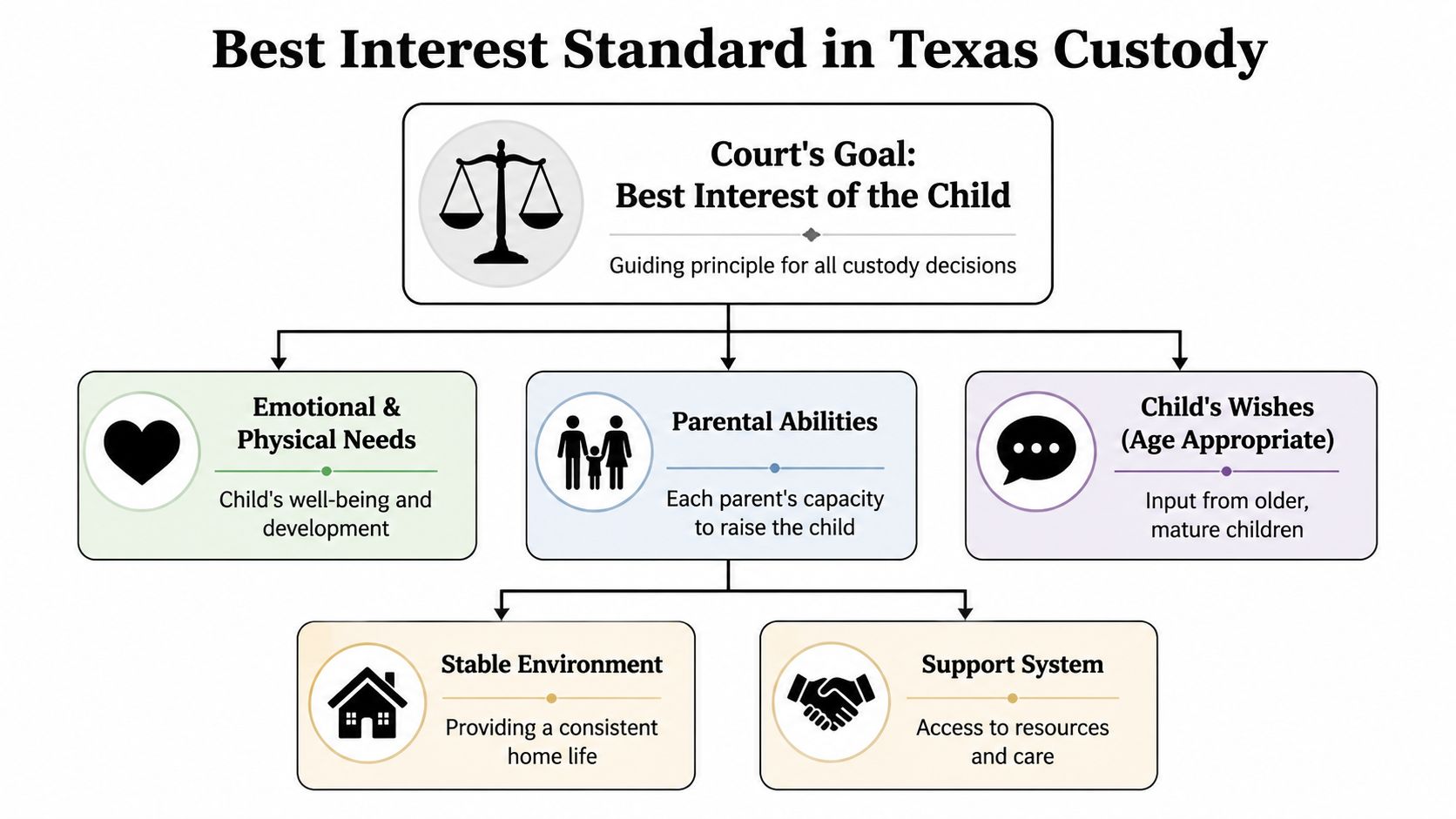
What judges are really looking at
The legal wording can sound abstract. In practice, the court is asking practical questions.
Can this parent meet the child's daily needs?
Is the home stable and safe?
Does this parent make good decisions?
Will this parent support the child's relationship with the other parent when appropriate?
The Holley factors include a parent's ability to meet basic needs such as eating, sleeping, bathing, schooling, and transportation. They also include the parent's physical and psychological health and any substance-abuse issues. That's why courts tend to value concrete records more than unsupported claims.
The main categories that matter
Instead of trying to memorize a list of factors, think in themes.
| Court concern | What that usually means in real life |
|---|---|
| Daily needs | Meals, sleep, hygiene, school attendance, transportation, routine |
| Safety | Medical care, dangerous behavior, unsafe home conditions, credible safety concerns |
| Stability | Consistent housing, reliable schedule, follow-through, predictable care |
| Parenting ability | Helping with school, attending appointments, managing activities, handling discipline appropriately |
| Judgment and health | Mental health, physical health, substance-related concerns, responsible decision-making |
| Co-parenting conduct | Communication, support for the child's relationship with the other parent, efforts to avoid conflict around the child |
Why ordinary records matter so much
A judge usually won't be persuaded by statements like “I do everything” or “she never helps.” Those are conclusions. Courts want underlying facts.
That's why records such as tax returns, pay stubs, school reports, medical records, and police or court records can matter. They connect your claims to something verifiable. If safety is an issue, records matter even more because they give the court something concrete to evaluate.
The strongest custody evidence usually looks boring on paper. That's often a good sign.
Texas law also limits what witnesses can say. A witness usually needs to testify about what they personally saw or heard. That's another reason dated messages, attendance records, receipts, and logs matter. They often support the testimony and keep the case grounded in real events.
What doesn't work well
Some evidence hurts more than it helps.
- Broad attacks: “He's a narcissist” or “she's unstable” without proof.
- Reconstructed histories: A timeline created all at once right before court.
- Edited screenshots: Anything that looks incomplete or selective.
- Child coaching: Telling a child what to say or pushing the child into the dispute.
If you keep the best-interest standard in mind, your evidence choices get easier. Every record should answer one question: how does this help show what arrangement serves the child?
Key Evidence Types in a Texas Custody Case
Not all evidence carries the same weight. Some records show a pattern of parenting. Others just create noise. In current custody practice, digital proof matters a great deal. A family-law source reports that 92% of family law attorneys regularly use digital evidence in custody matters, with social media identified as the most frequently cited form, as discussed in this family-law overview of digital evidence in custody cases.
The evidence categories that usually matter most
For parents in The Woodlands and Montgomery County, these are the categories that often come up first:
| Evidence Type | What It Can Prove |
|---|---|
| Text messages and emails | Who communicated clearly, who confirmed plans, who escalated conflict, and who stayed focused on the child |
| Parenting app records and calendars | Exchange history, schedule compliance, missed time, and effort to co-parent |
| Pay stubs and tax records | Financial stability and ability to provide for the child |
| School records and teacher communications | Attendance, academic involvement, behavior follow-up, and who handles school responsibilities |
| Medical records and appointment logs | Who schedules care, attends visits, follows treatment, and responds to health needs |
| Photos and videos | Home conditions, event attendance, child routines, and the parent-child relationship |
| Receipts and expense records | Day-to-day support for the child, including school, activities, and medical costs |
| Social media posts | Judgment, lifestyle choices, credibility, hostility, or inconsistency with what a parent claims in court |
| Police reports or court records | Safety concerns, prior incidents, and legally documented events |
| Witness testimony | Third-party observations from people who actually saw parenting conduct firsthand |
A short real-world scenario
A father in The Woodlands tells the court he keeps a stable home and avoids conflict. The other parent produces screenshots from his social media showing late-night posts, hostile comments, and pictures that don't fit the image he presented. At the same time, she also has school emails showing she handled repeated teacher issues and appointment reminders.
The problem for him isn't just the post itself. It's the contradiction.
A single post may not decide a case. But social media can support a larger argument about judgment, credibility, and day-to-day parenting reality.
What helps: records that line up with your story.
What hurts: records that make your story look selective.
Digital proof can help or backfire
Phones preserve a lot. That's good if your communication is calm, organized, and child-focused. It's bad if your messages are threatening, insulting, impulsive, or full of personal attacks.
Parents often underestimate how ordinary records become persuasive when they show consistency over time. A string of school emails, pickup messages, and appointment confirmations may say more than a dramatic accusation ever could.
If alienating behavior is part of your case, this guide on how to prove parental alienation in court may help you think about what patterns and records matter.
Evidence that usually carries less value
Some parents bring stacks of material that don't move the case forward much:
- Long written narratives without attachments
- Screenshots with no date or context
- Friends repeating what someone else told them
- Photos that can't be connected to a time, place, or issue
- Dozens of insulting messages that only show both parents were fighting
Good custody evidence is selective. It shows the child's routine, your role, and the pattern over time.
A Step-by-Step Guide to Gathering Your Evidence
The parents who handle this process best usually don't do anything flashy. They build a record in layers. Guidance on Texas custody practice emphasizes a three-part approach: obtain official records, preserve contemporaneous logs, and package the material for discovery and trial. That same guidance also notes that discovery responses to requests for disclosure are generally due within 30 days, and that cases filed after September 1, 2023 no longer involve mandatory initial disclosures, which makes early record preservation even more important, as explained in this Texas custody evidence and discovery guide.
Here is the workflow I'd want a parent in Montgomery County to follow.
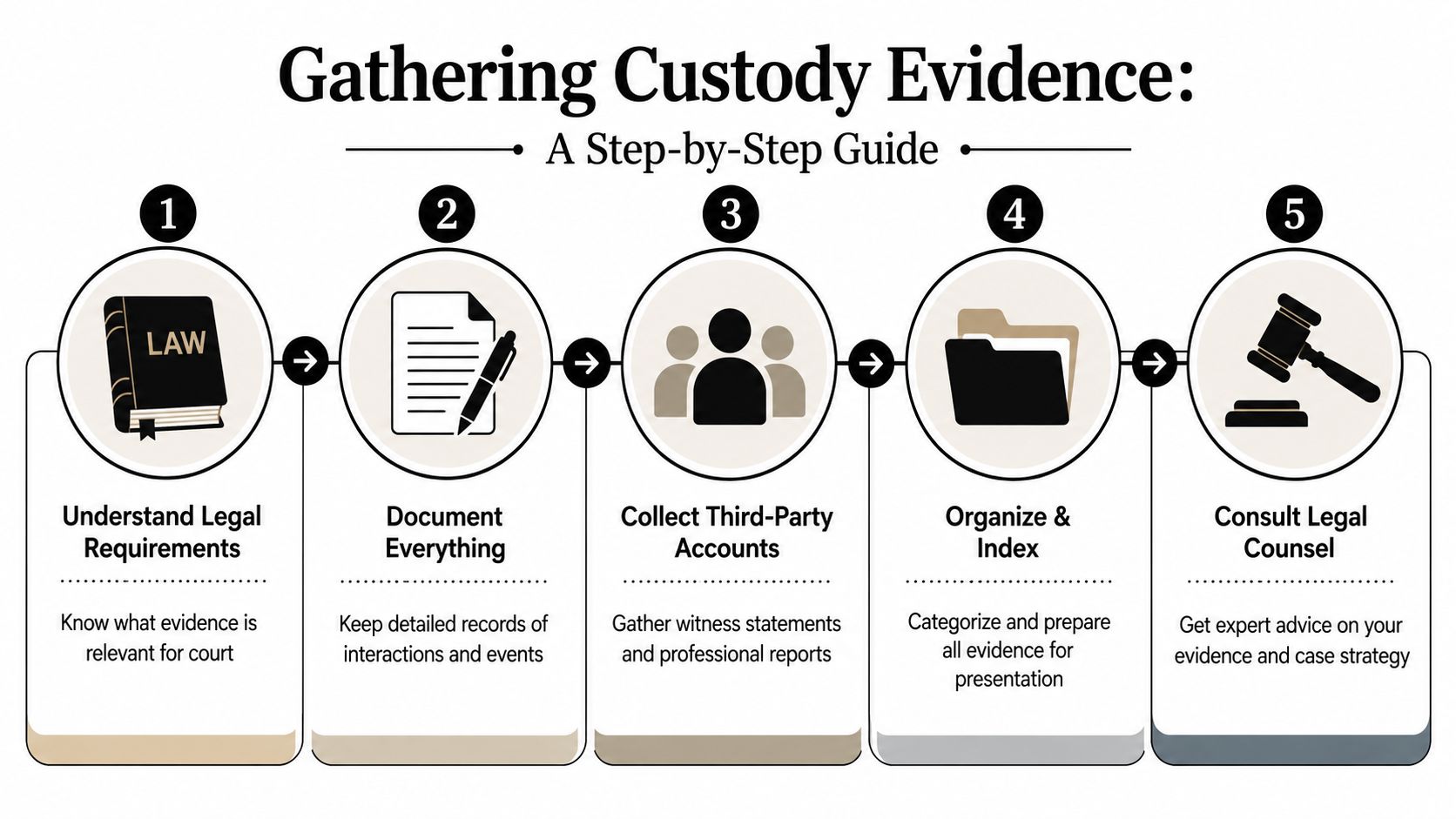
Start a custody journal today
You don't need a dramatic event to begin. Start with a notebook, spreadsheet, secure notes app, or a dedicated folder system. What matters is consistency.
Log events in real time or as close to real time as possible. Include:
- Exchange details: date, time, location, who was present, whether anyone was late
- Missed parenting time: what was missed, how notice was given, how you responded
- Child-related issues: school concerns, medical events, behavior issues, homework problems
- Communication summary: what was said, by whom, and whether the issue was resolved
- Expenses: activity fees, school costs, medical copays, transportation, supplies
Keep your tone neutral. Write like someone who knows a judge may read it later.
Bad entry: “She was selfish and manipulative again.”
Better entry: “Pickup scheduled for 6:00 p.m. at school. Other parent arrived at 6:40 p.m. I texted at 6:10 p.m. and 6:25 p.m. asking for an update. Child appeared tired and had no homework folder.”
Preserve digital evidence the right way
Don't assume your phone will keep everything forever. Messages get deleted. Apps update. Devices fail.
Create a routine for saving digital proof:
- Screenshot important texts with visible dates and names.
- Export emails into a folder by month or issue.
- Save photos and videos with original file dates if possible.
- Back up everything to a secure cloud folder and one secondary location.
- Keep the full conversation thread when context matters. Don't save only the most inflammatory message.
This can also be a good time to move co-parent communication into a more structured system. Parents often do better when they use a shared calendar or co-parenting tool instead of scattered texts. A practical starting point is this overview of co-parenting calendars.
A short video may also help you think through evidence collection habits before a hearing:
Gather official records in categories
Don't keep everything in one pile. Build folders that match the issues courts care about.
Use digital folders like these:
- School
- Medical
- Financial
- Communication
- Parenting time
- Incidents and safety concerns
- Photos and videos
- Court documents
Inside each folder, name files clearly. “2026-02-12 teacher email re tardy” is much more useful than “screenshot 14.”
For parents who want structure, even a simple system works:
| Folder | What goes inside |
|---|---|
| School | Report cards, attendance notices, teacher emails, activity notices |
| Medical | Appointment records, prescriptions, visit summaries, billing statements |
| Financial | Pay stubs, tax returns, child-related receipts, reimbursement requests |
| Communication | Text screenshots, emails, app exports, schedule confirmations |
| Parenting time | Calendars, exchange logs, missed visit notes, pickup records |
Identify witnesses early
Think about who has firsthand knowledge. Teachers, counselors, daycare staff, coaches, relatives, neighbors, and medical providers may all have useful observations, but only if they personally saw or heard something relevant.
Don't pressure people into taking sides. Instead, make note of who observed what and when.
A useful witness usually does one of these things:
- Observed your involvement at school, activities, or appointments
- Saw a specific event such as an exchange problem or concerning condition
- Can authenticate records they created or maintained
- Can describe the child's routine from direct contact
Don't create evidence after the fact if you can avoid it
Judges and lawyers can often spot a record that was built all at once. That doesn't mean it has no value. It means it may face more scrutiny.
Keep records as events happen. The closer the record is to the event, the more useful it usually becomes.
If your case is already underway, start now anyway. A late start is still better than no system.
Know when legal help fits into the process
You can gather a lot on your own, but strategy matters. An attorney can help you separate helpful records from distractions, identify what needs to be requested formally, and prepare the material in a way that fits Montgomery County court practice. In some cases, families also work with a local family-law team such as The Law Office of Bryan Fagan to review records, prepare discovery responses, and build hearing exhibits.
Organizing and Presenting Your Evidence in Court
A custody case can fall apart even when the facts are good, because the presentation is messy. Courts can consider relevant facts under the best-interest standard, and Texas legal guidance also stresses that contemporary records like texts and logs tend to carry more weight than after-the-fact reconstructions, as discussed in Texas Law Help's explanation of the best-interest standard.

Build a timeline, not a document dump
Your evidence should tell a clean story from one date to the next. That usually means a timeline with supporting exhibits attached.
A useful timeline might include:
- Key parenting events
- School issues
- Medical appointments
- Missed exchanges
- Important communications
- Any court-related developments
Then match each event to proof. If you claim you attended a school meeting, attach the school email, calendar invite, and any follow-up message. If you claim repeated denied visitation, show the dates, the texts, and your effort to resolve it calmly.
Label exhibits so someone else can understand them fast
If your lawyer asks for records, don't send a giant camera roll and a stack of unsorted PDFs. Name and sort exhibits logically.
A strong exhibit system might look like this:
| Exhibit label | Description |
|---|---|
| Exhibit 1 | School attendance record |
| Exhibit 2 | Email chain with teacher about assignments |
| Exhibit 3 | Text thread confirming exchange location |
| Exhibit 4 | Medical visit summary |
| Exhibit 5 | Expense receipt and reimbursement request |
That kind of organization saves time and reduces mistakes. If you'll need hard copies for mediation, attorney review, or hearing prep, parents sometimes use professional legal printing services to keep large exhibit packets readable and consistent.
Local procedure matters
Montgomery County custody cases don't just turn on facts. Procedure matters too. If evidence isn't requested, disclosed, authenticated, or presented correctly, it may be harder to use effectively.
That's one reason local counsel matters. An attorney familiar with Montgomery County courts can help you prepare for hearings, manage discovery, and avoid common presentation mistakes. If you want a clearer picture of how evidence fits into a local hearing, this guide to a child custody hearing in Montgomery County is a good next read.
Organized evidence doesn't just make your lawyer's job easier. It makes your parenting story easier for the court to trust.
Your Next Steps and Final Checklist
If you remember three things, remember these.
Start now. Stay factual. Keep everything organized around your child's needs.
Parents looking for evidence needed for child custody in Texas often think they need one perfect piece of proof. Usually they need something more practical: a credible record of daily parenting, preserved over time and presented clearly. That approach protects your parental rights far better than reacting late.
What to do next
- Start a custody journal today: Write down exchanges, missed time, school issues, medical events, and key communications.
- Create a dedicated evidence folder: Separate school, medical, financial, communication, and parenting-time records.
- Preserve digital proof carefully: Save screenshots, emails, photos, and app records with dates and context.
- Request official records early: School and medical records often take time to gather.
- Think about witnesses now: Identify teachers, daycare workers, coaches, or others with firsthand knowledge.
- Stay off emotional social media posting: Assume anything public may be reviewed in a custody case.
- Review your temporary orders or current court orders: Your evidence should connect to what the court is already watching.
- Talk with a family-law attorney before a hearing: Strategy, discovery, and exhibit preparation matter.
This article is for informational purposes only. It is not legal advice and does not create an attorney-client relationship. Every custody case is fact-specific, and the right strategy depends on your child, your court orders, and the evidence available in your situation.
If you're in The Woodlands, Magnolia, Conroe, Montgomery, Spring, or elsewhere in Montgomery County, a focused legal review can help you decide what to collect, what to leave out, and how to present your case without unnecessary mistakes.
If you need help preparing for a custody dispute in Montgomery County, you can schedule a consultation with The Law Office of Bryan Fagan to discuss your evidence, your court orders, and the next practical steps for protecting your relationship with your child.
