 Skip to content
A lot of parents in The Woodlands read their custody order once, set a few reminders, and hope the schedule will run itself. Then real life hits. School early release changes pickup. A soccer practice gets moved. One parent says, “I told you last week,” and the other says, “No, you didn’t.”
That’s where co parenting calendars stop being a convenience and start becoming protection. In Montgomery County family cases, a good calendar helps two ways. It keeps the child’s routine stable, and it creates a cleaner record when a dispute lands in front of a judge.
If you’re dealing with missed exchanges, holiday confusion, or constant texting about who has the child and when, this is one of the most practical tools you can put in place.
The Constant Juggle of Co-Parenting Schedules
Friday afternoon in Creekside or Alden Bridge often looks the same. One parent expects pickup after school. The other says the holiday schedule started at dismissal. Nobody agrees on what the order meant, and the child is standing there with a backpack waiting for adults to sort it out.
That problem is common because co-parenting after separation is common. In the United States, 12.9 million custodial parents were responsible for 21.9 million children under 21 as of 2018, with over one-quarter of all children living in divided family households, according to child custody by the numbers. The scale of that reality shows up every day in Montgomery County.
A co-parenting calendar gives structure to a situation that usually falls apart in the gaps. It answers basic questions before they turn into arguments. Who has pickup. When does the weekend begin. Which parent handles the dentist appointment. What happens when school is closed on Monday.
Why a calendar changes the tone
A calendar doesn’t fix a high-conflict relationship by itself. It does something more useful. It moves the discussion away from memory and toward a shared record.
That matters if you’re following a Texas Standard Possession Order or a customized possession schedule. If you’re not sure how your decree lines up with the default framework, review a Standard Possession Order in The Woodlands. The order controls, but the calendar is what makes daily compliance possible.
Practical rule: If a schedule change isn’t recorded clearly, expect a dispute later.
Many parents try to manage this with scattered texts, screenshots, and mental notes. That usually works for a week or two. It rarely works through school breaks, sports seasons, and holidays.
If your household already feels like a full-time logistics job, it can help to think like operations staff and delegate to an executive assistant in your own process. Not by handing off parenting, but by using systems that reduce preventable mistakes.
One short example
A Panther Creek parent once had a simple issue turn into a major one. The school released early before a long weekend. One parent thought the normal pickup applied. The other relied on the holiday language in the order. A shared calendar with the school release time and holiday override would have settled the issue before the child left campus.
That’s the main value here. Less chaos for you. More predictability for your child.
More Than Just Dates What a Co-Parenting Calendar Tracks
A useful co-parenting calendar is not just a row of colored boxes. It’s the family’s operating record.
Parents often start by entering exchange days only. That’s better than nothing, but it leaves too much room for conflict. A court-ready calendar needs to track the child’s actual life, not just possession labels.
The core items to include
Start with the possession order exactly as written. Under the Texas Family Code, possession and access terms matter. Don’t paraphrase them from memory.
Then build out the details around that order:
- Base schedule: Weekends, Thursdays, midweek dinners, or any custom rotation in the decree.
- Holiday overrides: Thanksgiving, winter break, spring break, Mother’s Day, Father’s Day, and summer elections.
- School information: First day, teacher workdays, early dismissals, and campus closures.
- Activities: Practices, games, tutoring, church events, and recitals.
- Medical needs: Appointments, therapy sessions, prescriptions, and follow-ups.
- Communication notes: Requests to trade weekends, notices about delays, and confirmations of agreement.
A calendar that tracks all of that becomes the closest thing to a neutral family timeline.
Why that level of detail matters
Detailed calendars support stability. That isn’t just a convenience issue. A 2023 meta-analysis found that children in 50/50 shared parenting arrangements perform equally well as those in nuclear families across academic, emotional, behavioral, and physical health measures, as noted in family research discussed earlier. The practical takeaway is simple. Children tend to do better when adults make transitions predictable and consistent.
The best co parenting calendars reduce surprise. Children feel the difference even when parents don’t say a word.
Parents in Montgomery County sometimes ask whether they should track every small item. My answer is this: track anything that could later become a disagreement or affect the child’s routine.
Think of it as Family HQ
A strong calendar works like a central hub. It should answer:
| Question | What should be recorded |
|---|---|
| Who has the child tonight | Overnight possession entry |
| Who handles pickup | Exchange time, place, and responsible parent |
| Does a holiday change the normal week | Holiday override entry |
| What if school closes | School event added when district releases calendar |
| Was a change requested and accepted | In-app request and response |
This is also where many parents make a damaging mistake. They keep schedule information in one place, medical information in another, and activity reminders in text threads. That fragmentation creates confusion.
Keep the child-related logistics in one shared system whenever possible. If a judge ever reviews the history, a clean record is more persuasive than a pile of disconnected screenshots.
Comparing Calendar Types Paper Digital and Custody Apps
Not every family needs the same tool. A low-conflict case with reliable communication may function with a simple system. A high-conflict case in Montgomery County usually won’t.
Here’s the comparison most parents need.
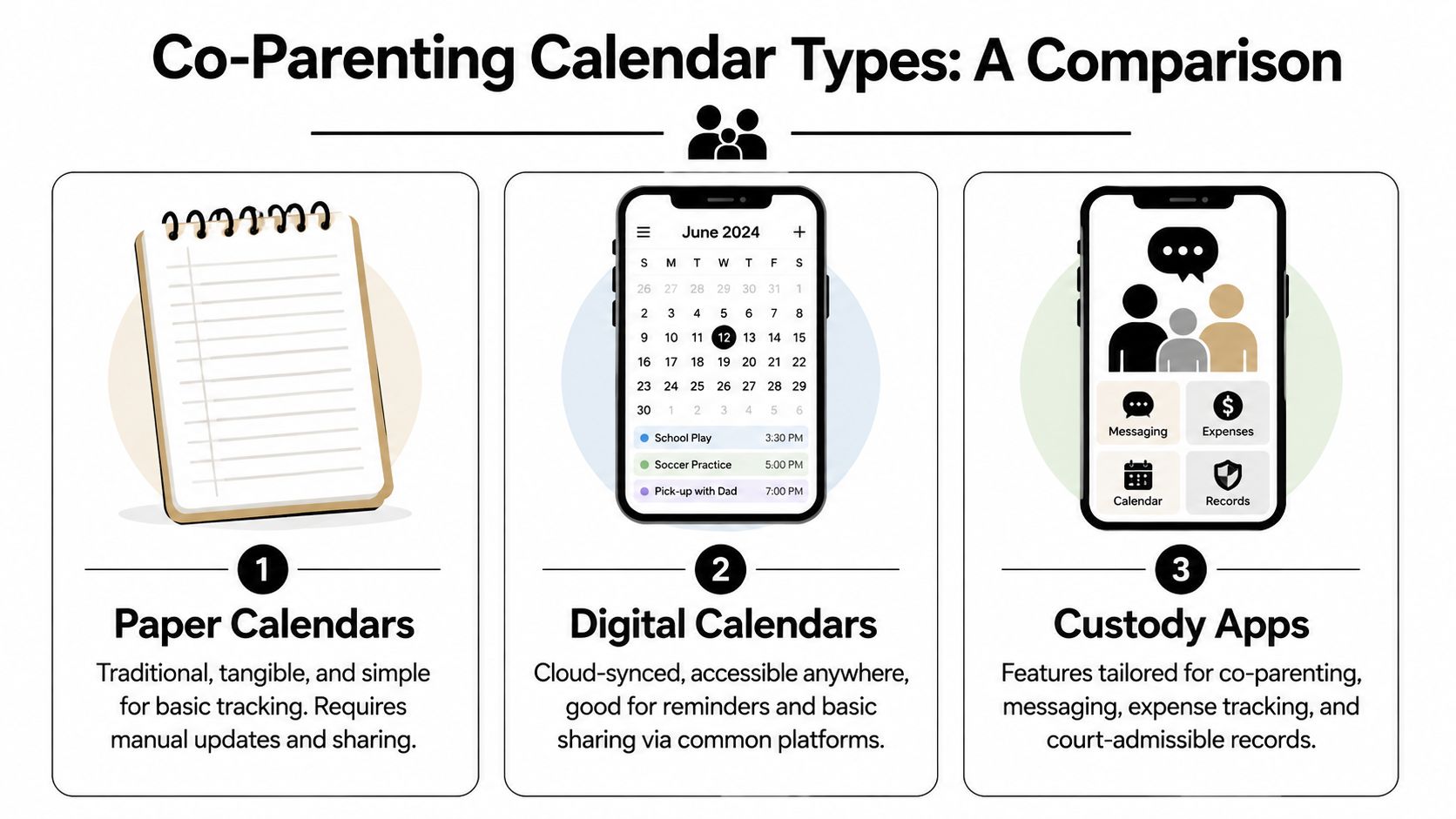
Co-Parenting Calendar Options Compared
| Feature | Paper Calendar | Shared Digital Calendar (e.g., Google) | Specialized Co-Parenting App |
|---|---|---|---|
| Ease of setup | Very easy | Easy | Moderate |
| Sharing updates | Manual | Automatic sync | Automatic sync |
| Change history | Weak | Limited | Stronger audit trail |
| Communication logging | None | Separate from calendar | Built into many apps |
| Best for low-conflict cases | Yes | Yes | Yes |
| Best for high-conflict cases | No | Usually no | Usually yes |
| Court use | Less persuasive | Better than paper, but can be challenged | Often more useful because entries and messages are logged |
| Extra tools | None | Reminders | Trade requests, expenses, journals, document storage |
Paper calendars
Paper works if both parents cooperate and the schedule rarely changes. It’s tangible, simple, and familiar.
It also has obvious weaknesses. It can be lost. It can be rewritten. It doesn’t show who changed what or when. If one parent later disputes the entry, the notebook won’t answer the key evidentiary question.
Shared digital calendars
Google Calendar or Apple Calendar is a step up. These tools are easy to access, easy to update, and useful for reminders.
For some families, that’s enough. For contested cases, it often isn’t. General calendar platforms usually don’t combine schedule entries with message logs, trade requests, expense records, and a clearer modification history.
If your child’s week is packed with athletics, school events, and changing practice times, even a general system can get messy. Parents juggling games and training may find ideas in the Vanta Sports guide to sports management apps, especially when one child’s schedule affects both households.
Specialized co-parenting apps
Apps like OurFamilyWizard, TalkingParents, and Custody X Change are built for exactly the problems divorced parents run into. They usually offer shared calendars, recorded communications, and a clearer history of requests and responses.
That doesn’t mean they solve every problem. They cost money. One parent may resist using them. Some people find them less intuitive than standard phone calendars.
A specialized app is often worth it when the real issue isn’t scheduling. It’s proof.
If your case is calm, use what’s practical. If your case is tense, use what creates a cleaner record.
Your Calendar as Evidence in Montgomery County Courts
A co-parenting calendar becomes legally important when one parent stops following the order, asks for a modification, or makes allegations that don’t match the record.
That’s where many parents in The Woodlands make a costly mistake. They assume the judge will sort through emotional explanations and decide who sounds more believable. Courts don’t work that way. Judges want facts tied to dates, times, and conduct.
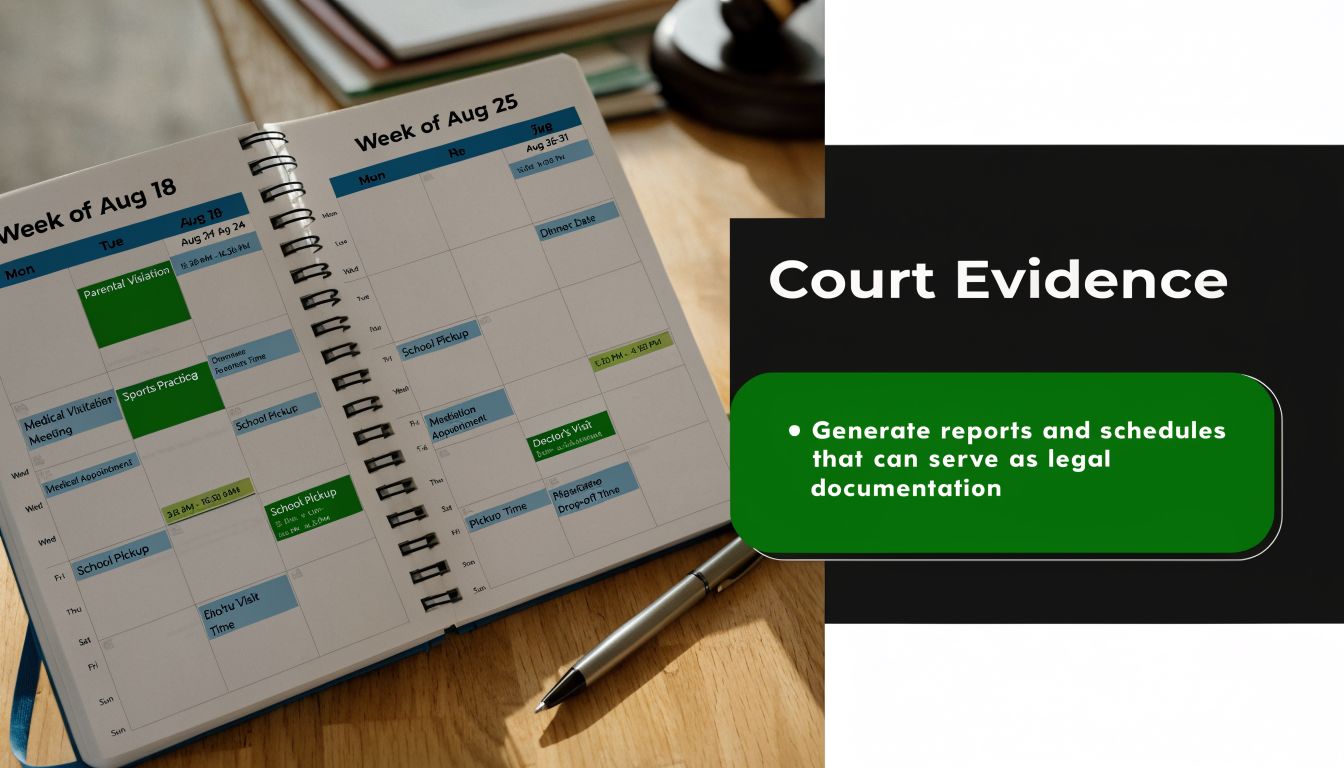
What the court is looking for
Under the Texas Family Code, possession, access, and modification disputes turn on evidence. If you claim the other parent repeatedly denied your time, interfered with exchanges, or failed to keep you informed, you need a record that shows a pattern.
A solid calendar can help prove:
- Missed possession periods
- Late pickups or drop-offs
- Repeated last-minute changes
- Unilateral scheduling of activities during the other parent’s time
- Consistent involvement by one parent in school or medical matters
- The actual schedule the parties followed, if it differs from the written order
For hearings in Montgomery County, that timeline can matter just as much as the witness testimony.
If you’re preparing for litigation, it helps to understand what happens at a child custody hearing in Montgomery County. The cleaner your documentation, the easier it is for your attorney to present a focused case.
Why audit trails matter
In contested cases, specialized tools are often stronger than handwritten notes or editable calendar entries. Shared digital apps with audit trails can reduce “he said/she said” disputes by an estimated 70%, according to Custody X Change’s discussion of co-parenting calendars. That matters because clearer records can also reduce the need for repeated enforcement motions.
This doesn’t mean every app screenshot automatically wins the day in court. Authentication still matters. Context still matters. Your attorney still needs to present the record correctly.
If you’ve ever wondered why some digital records hold up better than others, Call Loop’s guide to digital evidence gives a useful general explanation of why timestamps, preserved records, and authorship matter.
Judges tend to give more weight to records that were created in the ordinary course of co-parenting, not records assembled after the dispute exploded.
What doesn’t work well
Three things routinely weaken otherwise valid complaints:
Backfilling the calendar later
Recreating six months of events from memory looks less reliable.Mixing arguments into schedule entries
Keep entries factual. Save legal arguments for your attorney.Using multiple platforms at once
If exchanges are in texts, vacations are in email, and appointments are on paper, the record gets muddy.
The strongest calendar is boring. It’s factual, consistent, and complete.
How to Create a Court-Ready Custody Calendar
Most parents overcomplicate this at the start and under-document it later. The better approach is simple. Build from the order, then maintain it consistently.
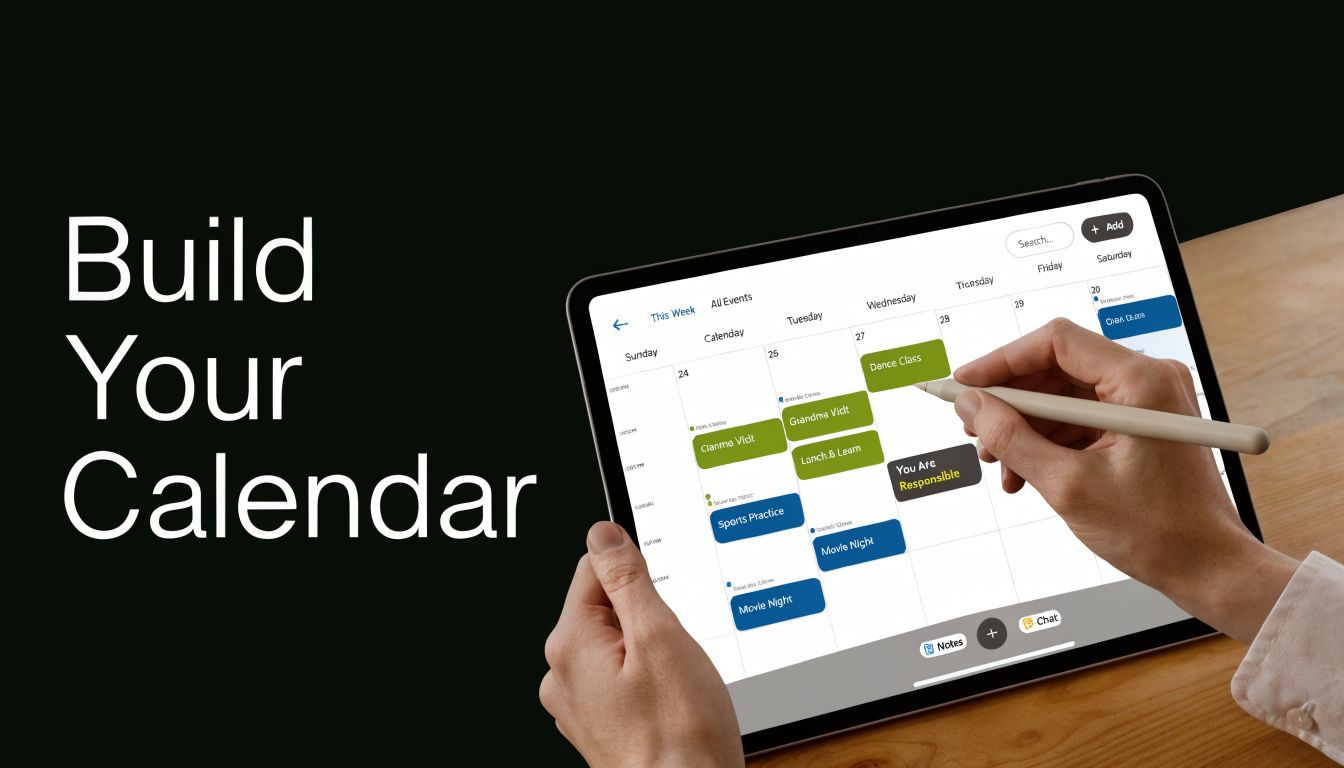
Step one starts with the court order
Pull out your current order, decree, or temporary orders. Read the possession language carefully. Don’t rely on memory, and don’t rely on what the other parent says the order means.
Start by entering the base schedule. This might be a Standard Possession Order, an expanded Standard Possession Order, a week-on/week-off plan, or a custom arrangement. If your case later involves a change request, a custody modification in The Woodlands will often depend on whether the existing order was followed and how the actual schedule functioned.
Layer in the real-world details
After the base schedule is in place, add the items that usually cause conflict:
- School calendar first: District holidays, teacher workdays, early release days, and breaks.
- Then holiday elections: Summer selections, Thanksgiving, Christmas split, and spring break rules from the order.
- Then recurring events: Therapy, tutoring, practice, games, and lessons.
- Then exchange details: Time, location, transportation responsibilities, and any right-of-first-refusal terms if your order includes them.
For Texas parents working around non-equal schedules, details matter. In common 60/40 custody splits, a 4-3 schedule provides about 219 overnights per year for the minority parent, and digital calendars are useful for tracking that time because overnights can affect child support issues under Texas guidelines, as discussed in OurFamilyWizard’s overview of 60/40 schedules.
Record changes the right way
A lot of usable evidence often gets lost. Parents agree to a switch by text, then forget to update the shared calendar. Months later, nobody can reconstruct what happened.
Use one method every time:
- Enter the requested change.
- Send the request through the same app or platform.
- Wait for a clear acceptance or denial.
- Keep the original entry visible if the platform preserves history.
- Add a short factual note if the exchange changed in practice.
Don’t editorialize. “Parent arrived at 6:22 p.m. for 6:00 p.m. pickup” is useful. “Parent was selfish and irresponsible again” is not.
A short visual explanation can help if you’re trying to set up the system cleanly from the start:
Keep the calendar clean enough for a judge
If you expect your calendar may later be reviewed by opposing counsel, a mediator, or the court, use these habits:
- Be factual: Record events, not emotional commentary.
- Be prompt: Enter information as it happens or as soon as you receive it.
- Be consistent: Use the same platform each time.
- Be child-focused: Track school, health, and possession issues that affect the child.
- Be complete: Don’t only log the other parent’s mistakes. A balanced record is more credible.
The Law Office of Bryan Fagan often advises parents in family law matters to use a shared digital calendar as one practical part of staying organized around holidays, summer, and possession exchanges. That’s not a substitute for legal strategy, but it does make legal strategy easier to support.
A Woodlands Scenario and What to Do Next
A parent in Sterling Ridge signs a child up for summer camp during the other parent’s week. The second parent objects, saying camp interferes with possession and transportation. In a lot of cases, that turns into a week of angry texts and a threat to file something in court.
With a proper co-parenting app, the problem is smaller. The camp dates are already on the shared calendar. The parent requesting enrollment sends the proposed logistics through the app. The other parent responds in the same place. If they agree, the calendar reflects the transportation plan. If they don’t, the record shows who requested what, when, and why.
That doesn’t guarantee agreement. It does prevent confusion from masquerading as misconduct.
What to do next
- Pull your current order: Use the exact possession language, not your memory of it.
- Choose one calendar system: If conflict is high, use a specialized co-parenting app.
- Enter the full year: Add school dates, holidays, summer, and recurring activities.
- Document change requests in writing: Keep them in the same platform whenever possible.
- Stay factual: Write entries as if a judge may read them later.
- Talk to a family lawyer early: Especially if missed possession, support issues, or modification concerns are building.
This article is for general information only. It is not legal advice and does not create an attorney-client relationship. Texas custody cases turn on the wording of your order, your facts, and local court practice in Montgomery County.
If you’re dealing with recurring schedule disputes in The Woodlands, Panther Creek, Alden Bridge, Creekside, or elsewhere in Montgomery County, a consultation can help you decide whether your calendar is just a planning tool or evidence you may soon need.
If you want help reviewing your possession order, choosing the right documentation system, or preparing for enforcement or modification issues, you can schedule a consultation with The Law Office of Bryan Fagan.
