 Skip to content
A lot of people in The Woodlands reach the same point the same way. They sit across from each other at a coffee shop, or at the kitchen counter after the kids go to bed, and ask the question they've been avoiding for months: if this marriage is ending, what happens next?
The next question usually comes even faster. Should we try mediation, or are we headed for court?
If you're searching for mediation vs trial divorce in Texas, which is better, the honest answer is that neither path is automatically better. The right path depends on your level of conflict, the kind of assets involved, whether children are in the middle, and whether both spouses are dealing honestly.
The Two Paths for Your Montgomery County Divorce
In Montgomery County, most divorces move in one of two directions. The first is mediation, where the spouses try to negotiate a resolution with help from a neutral mediator. The second is trial, where a judge decides the disputed issues after hearings, evidence, and testimony.
For many families in The Woodlands, Conroe, Magnolia, and nearby communities, the choice doesn't feel clean or simple. One spouse may want peace and privacy. The other may be angry, suspicious, or impossible to negotiate with. A case can also start with settlement talks and still end up in court if the hard issues don't get resolved.
That's why this decision should never be framed as “good people mediate, difficult people go to trial.” That isn't how divorce works in real life. Some cases belong in mediation. Some require courtroom tools from the start. Many use both.
The practical question isn't whether mediation sounds nicer. It's whether it can produce a safe, workable, enforceable result for your family.
In Montgomery County courts, mediation is often part of the practical process even when a case is contested. Judges expect serious settlement efforts in many family cases, and parties often go to mediation before a final trial setting.
If you live in The Woodlands and you're trying to decide what comes next, focus on outcomes. Who will make the final decisions. How fast the case needs to move. Whether sensitive financial details need protection. Whether your spouse can negotiate in good faith.
This article is for informational purposes only and is not legal advice. Divorce outcomes depend on specific facts, local court procedures, and the details of your case.
Understanding the Divorce Process in Texas
Texas divorce procedure feels less overwhelming when you separate the paths and look at what happens in each one.
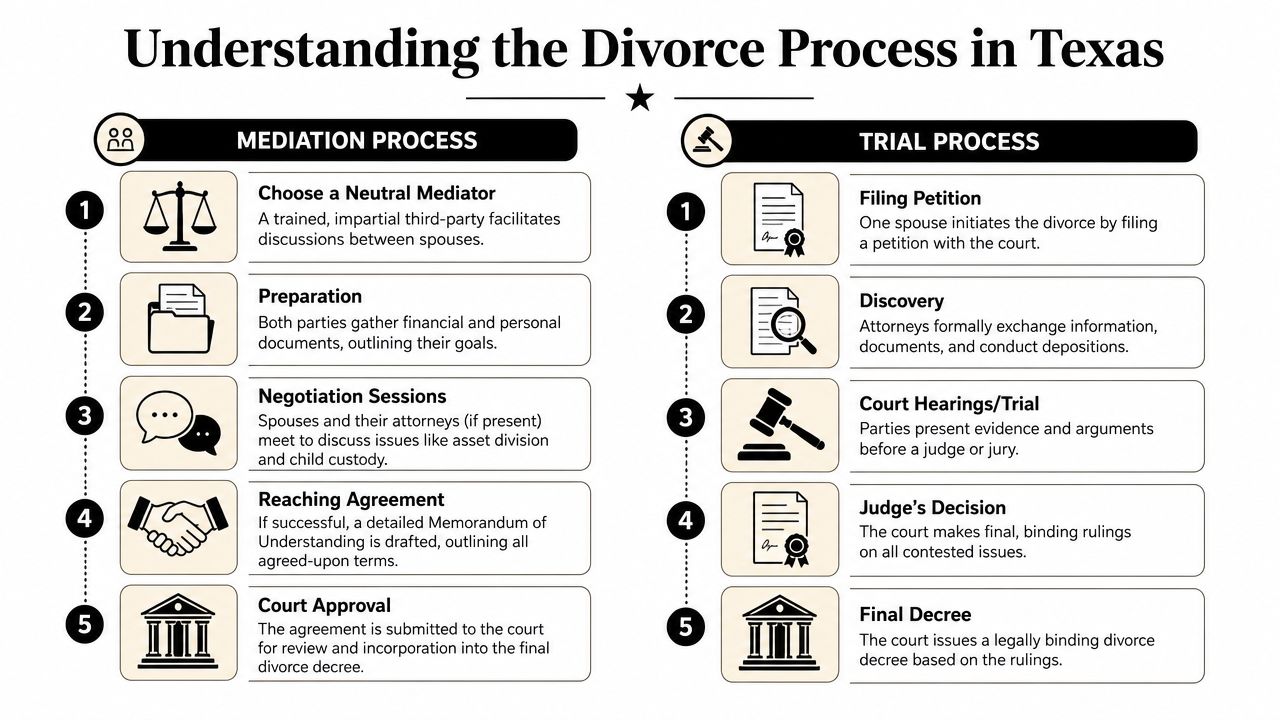
How mediation usually works
Mediation is a structured negotiation process. The mediator doesn't act as a judge and doesn't decide who wins. The mediator works to help both sides reach agreements on property division, custody, support, and other terms.
A typical Texas mediation path looks like this:
- A mediator is selected. Sometimes the parties agree on one. Sometimes the court directs the process.
- Preparation happens with counsel. Financial records, parenting concerns, proposed schedules, and settlement positions are organized before the session.
- The mediation session takes place. Many sessions involve the parties in separate rooms while the mediator moves back and forth.
- An agreement is reduced to writing. In Texas divorce practice, that often means a Mediated Settlement Agreement.
- The final decree is drafted and entered. If the agreement covers all issues, the case may end without a trial.
Under Texas Law Help's discussion of divorce mediation, a court may refer a divorce case to mediation under Texas Family Code § 6.602(a). That same resource explains that if a judge orders mediation, the parties must attend unless a family-violence objection is properly raised. It also explains that a properly signed Mediated Settlement Agreement is binding, and estimates that about 90% of divorce cases that go to mediation result in settlement.
How a trial case usually unfolds
A trial case is more formal and more demanding. One spouse files the divorce petition, the other spouse responds, and the case moves through the court system until settlement or final hearing.
Common trial-stage steps include:
Filing and temporary orders
Early disputes often involve possession of the home, parenting schedules, temporary support, and basic financial restraints.Discovery
Discovery involves attorneys using formal tools to gather information. That may include document requests, written questions, subpoenas, and depositions.Pretrial hearings
Judges address disputes that need rulings before trial, such as discovery fights, temporary parenting issues, or procedural matters.Trial
Witnesses testify. Documents are introduced. Each side argues for its preferred result.Final ruling
If the parties don't settle, the judge decides the disputed issues and signs a final decree.
What clients usually miss
People often think mediation and trial are two separate roads. In practice, they often overlap. A divorce may be filed as contested, proceed through discovery, and still go to mediation before trial. That's especially true when the court wants the parties to try to narrow the issues first.
The key difference is simple. In mediation, you and your spouse control the agreement. In trial, the judge controls the result.
Direct Comparison of Control Cost Timeline and Privacy
If you want a practical answer to mediation vs trial divorce in Texas which is better, start with four factors: control, cost, timeline, and privacy.
| Factor | Mediation | Trial |
|---|---|---|
| Control | Spouses negotiate the outcome | Judge decides disputed issues |
| Cost | Often lower overall | Often much higher due to discovery, hearings, and trial prep |
| Timeline | Usually shorter if both sides engage | Usually longer because the court controls the schedule |
| Privacy | Private settlement discussions | Court filings and hearings are generally less private |
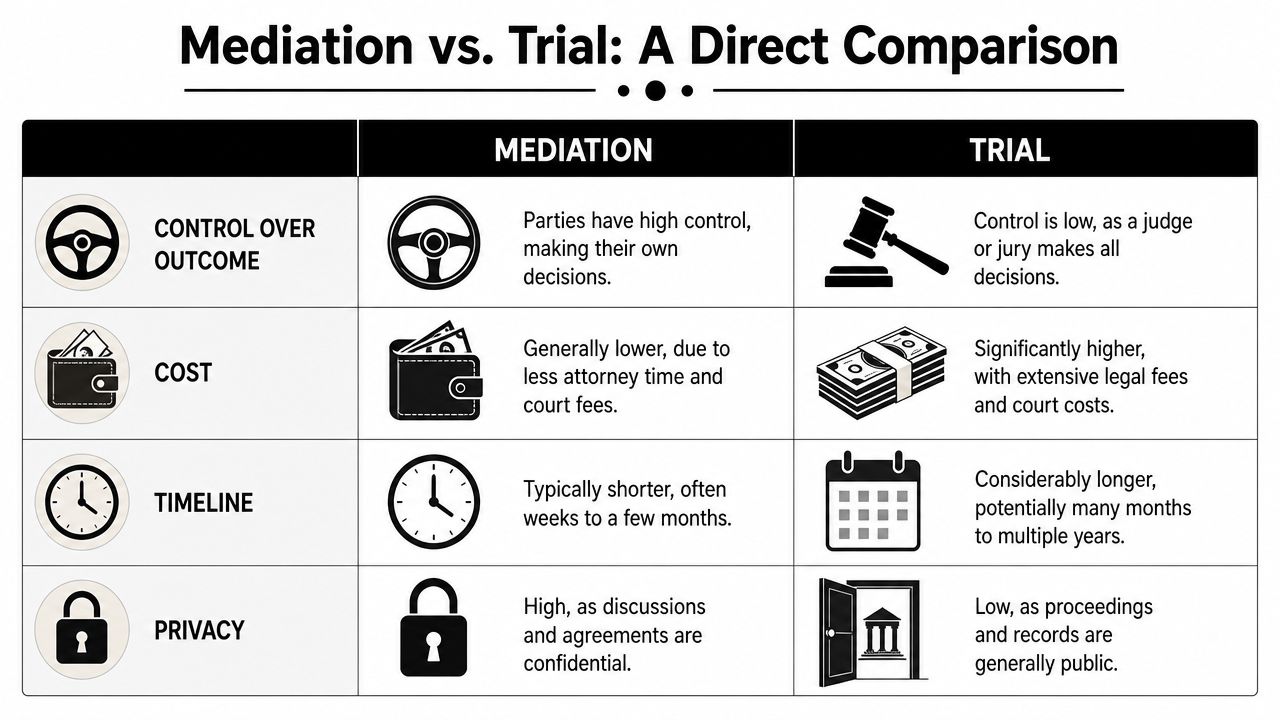
Control over the outcome
This is the biggest difference.
In mediation, the parties can build terms around real life. That matters for Woodlands families with unusual work schedules, children in multiple activities, or assets that don't divide neatly. A judge can enter orders, but a judge won't know your family the way you do.
Most important difference: trial gives you a decision, but it takes away your ability to shape that decision in detail.
A common example involves parenting schedules. A court order may be workable on paper but awkward in practice. Mediation gives parents more room to create holiday rotations, exchange locations, communication rules, and pickup times that fit the children's routines.
Cost and timeline
The financial spread can be substantial. According to a Dallas-area discussion of alternative dispute resolution in Texas divorce, mediation is described as costing about $3,000 to $7,000 total including attorney preparation and mediator fees, while a fully litigated divorce that reaches trial can cost $15,000 to $50,000 or more per spouse. The same source describes mediated cases as often finishing in 3 to 6 months after the mandatory 60-day waiting period, versus 12 to 18 months or longer for litigated cases in congested dockets.
If you're trying to understand the local financial side in more detail, this overview of how much a divorce may cost in The Woodlands, Texas can help frame the budget issues that usually drive strategy.
Privacy in a small-community setting
Privacy matters more than many clients expect. In mediation, the negotiations themselves happen outside open court. That's valuable for business owners, physicians, executives, and anyone who doesn't want family conflict aired publicly.
Trial is different. Court filings, testimony, financial disputes, and accusations often become part of the formal record. In a place like Montgomery County, where personal and business circles overlap, that exposure can create stress long after the divorce is over.
One real-world scenario
A couple in Sterling Ridge owns a small service business and has two school-age children. They disagree about money, but both want the children to stay in the same schools and activities. Mediation lets them build a parenting schedule around business travel, baseball practice, and a midweek dinner that a standard court schedule might not capture well.
If that same couple went to trial, the court could still enter workable orders. But the result would likely be more standardized, less customized, and more expensive to reach.
How Mediation and Trial Handle Key Divorce Issues
The process matters, but the decree matters more. What most clients care about is where they'll live, when they'll see their children, who pays what, and how property gets divided.
Child custody and possession
Mediation usually gives parents more flexibility. They can build a schedule around school start times, one parent's travel calendar, a child's therapy appointments, or holiday traditions that matter to the family.
At trial, the court focuses on what evidence supports the child's best interest. That can produce strong orders when parents can't cooperate, but it often leads to more rigid results. If your family life doesn't fit a standard pattern, mediation may give you a better chance to create something realistic.
For parents trying to think through practical schedules before a mediation session, this guide for busy co-parents is a useful outside resource because it helps translate broad custody ideas into day-to-day calendars.
Child support and spousal support
Mediation can help spouses address support in a more practical way. They may agree on payment timing, handling of extracurricular costs, uninsured medical expenses, or short-term support arrangements that help one spouse transition after separation.
A trial puts the issue into a more formal legal framework. The court applies Texas law and evaluates the available evidence. That's sometimes exactly what's needed, especially when one spouse is withholding income information or refusing to contribute voluntarily.
Property division
Property division is where high-asset and high-conflict divorces often turn.
Under Texas Family Code § 7.001, the court must divide the marital estate in a manner the court deems just and right. That standard gives the judge discretion. It does not promise a result either spouse will like.
A judge can divide property fairly under the law and still divide it in a way that feels inefficient in real life.
Mediation gives couples room to trade assets creatively. One spouse may keep a business interest while the other receives a larger share of retirement, equity, or liquid accounts. That kind of problem-solving can preserve value and reduce post-divorce disruption.
Trial is often less elegant. The court can divide property, but it may not have a practical way to preserve the structure both spouses would have chosen themselves. That's especially true with closely held businesses, professional practices, stock options, or irregular compensation.
When Mediation Is the Clear Choice for Your Family
For most families in Montgomery County, mediation should be the first serious option considered.
That's especially true when both spouses can communicate without intimidation, both want to protect the children from prolonged conflict, and both understand that compromise is cheaper than fighting over every issue. In those cases, mediation isn't just more peaceful. It's more efficient.
Green lights for mediation
You can still exchange information openly
You don't have to agree on everything. You do need enough trust to believe the other side will negotiate in good faith.You want to protect children from courtroom conflict
Parents who will continue dealing with each other after divorce usually benefit from a process that lowers hostility instead of escalating it.Privacy matters
If you own a business, work in a visible profession, or prefer not to have personal details discussed in open court, mediation is usually the better fit.You want to control the outcome
Mediation is strongest when the family needs custom solutions instead of a one-size-fits-most ruling.Your top goals are efficiency and closure
Many families want a durable agreement, a manageable budget, and a clear path forward.
For local readers considering that route, this overview of divorce mediation in The Woodlands, Texas gives a more focused look at how a mediated case is typically handled.
A practical point matters here. Mediation is not weakness. In a healthy case, it's disciplined decision-making. It lets people preserve resources for their children, housing, and post-divorce life instead of spending those resources on avoidable legal combat.
When a Trial Might Be Necessary in Montgomery County
Some cases don't belong in a cooperative model, at least not on the issues that matter most.
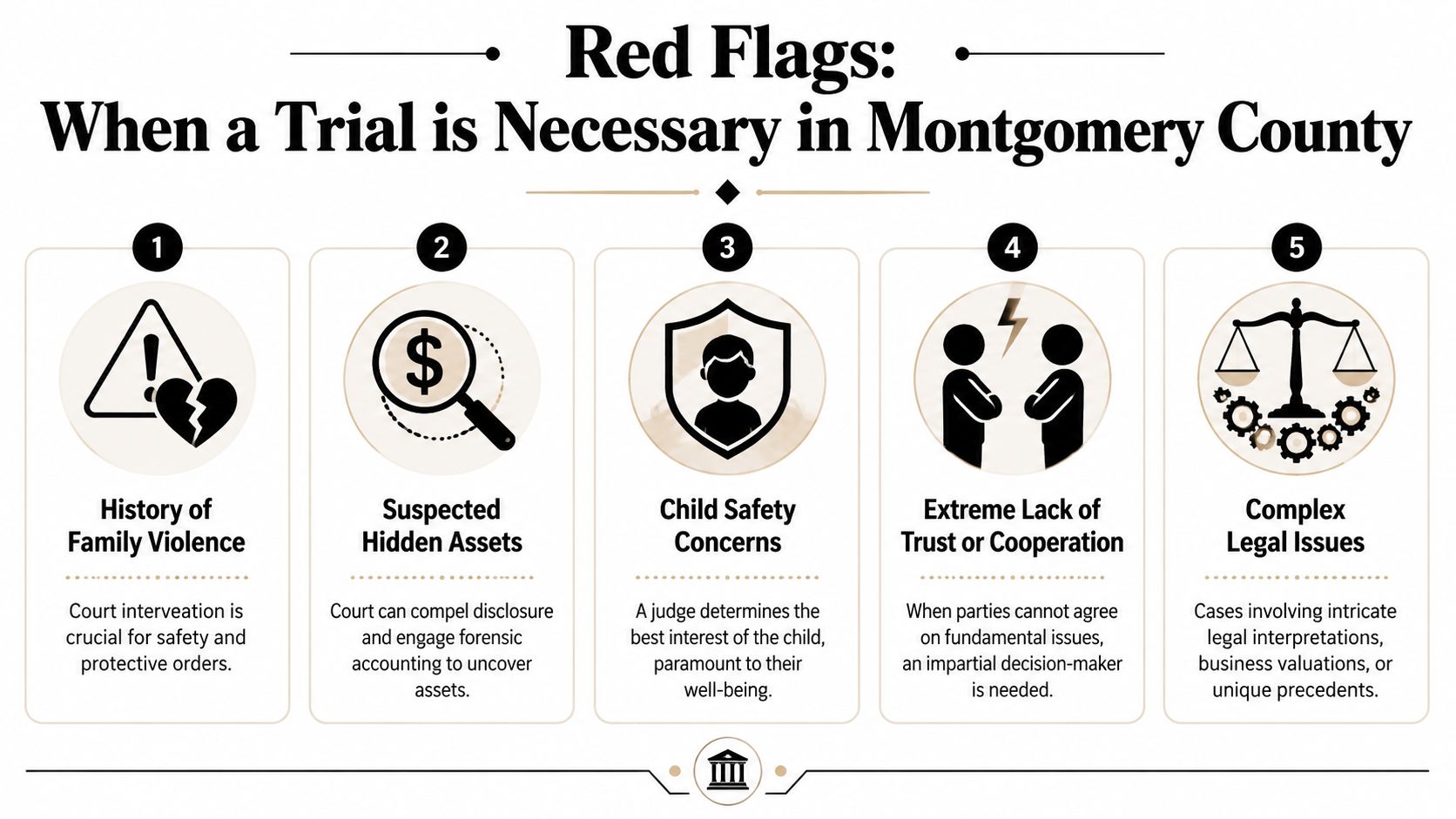
Red flags that change the analysis
According to a Texas divorce litigation comparison discussing mediation limits, mediation is not equally effective when there are hidden assets, power imbalances, or safety concerns, and litigation may be the better tool for evidence access and formal protections.
That lines up with what happens in real life in Montgomery County. Trial may be necessary when:
There's a history of family violence
Safety comes first. A negotiated setting may not be appropriate if one spouse has used threats, coercion, or intimidation.You suspect hidden assets or manipulated finances
Informal discussion won't uncover missing accounts, false business expenses, or incomplete disclosures. Discovery tools might.One spouse refuses to negotiate in good faith
If every proposal is met with delay, gamesmanship, or stonewalling, the court may be the only place where deadlines and consequences have teeth.The child-related issues are serious
Allegations involving neglect, substance abuse, or unsafe conduct often need judicial findings and enforceable orders.The property issues are unusually complex
Business valuation fights, reimbursement claims, tracing issues, and competing financial narratives can require a courtroom record.
Trial doesn't always mean every issue is tried
Even in hard cases, mediation can still be useful. A spouse may not be able to settle the business valuation dispute, for example, but may still resolve personal property, interim parenting details, or sale terms for the home.
That issue-narrowing matters. A case with fewer contested topics is easier to prepare and easier for a judge to decide.
In high-conflict divorce, the smart strategy is often mixed. Use litigation for protection and evidence. Use mediation where settlement is still safe and realistic.
For clients facing that kind of dispute, this page on contested divorce in The Woodlands, Texas is relevant because it focuses on the kind of courtroom-driven issues that don't resolve through simple negotiation.
On the document-heavy side, some lawyers and support teams also look at tools that help organize litigation materials more efficiently. For example, resources on transforming legal documents with AI show how technology is being used to review records and support case preparation. Those tools don't replace legal judgment, but in a paper-heavy divorce they can support the work.
Your Decision Checklist and Next Steps
If you're stuck between mediation and trial, don't start with the legal labels. Start with the facts of your family.
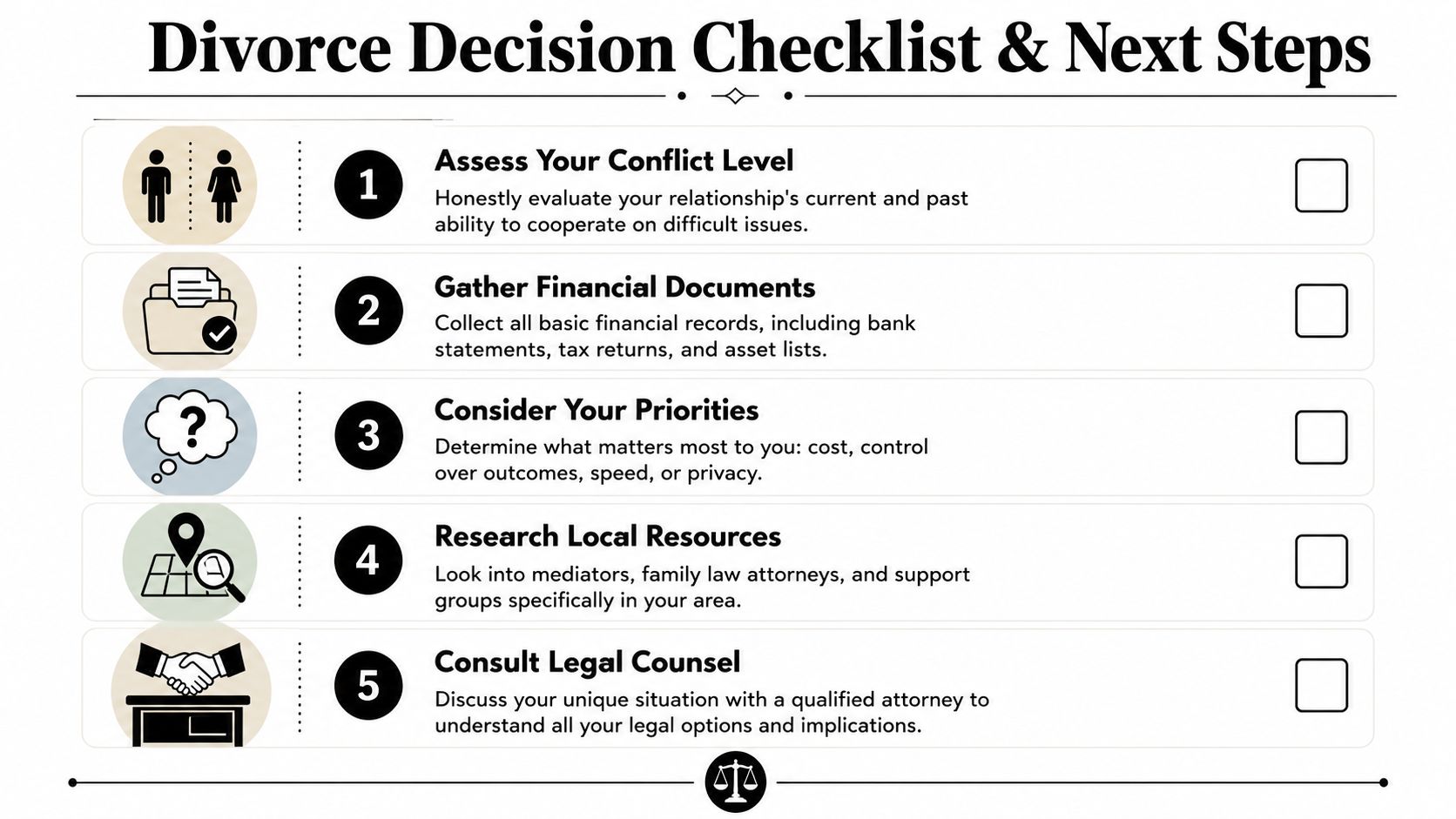
What to do next
Assess the conflict level
Ask whether the two of you can exchange information, discuss options, and make decisions without fear or manipulation.Gather core financial documents
Pull bank records, tax returns, retirement statements, debt information, pay records, and basic asset lists.Decide what matters most
Some people prioritize privacy. Others need speed. Others care most about control over parenting or protection of a business.Expect mediation to be part of the process
Even many cases that head toward trial still use mediation to try to resolve some or all issues.Get case-specific advice early
Timing matters. Early mistakes with documents, communications, or temporary arrangements can make a later settlement harder.
If you're comparing attorneys, mediators, and support tools, broader directories such as Ivory Mind's legal solutions can be one way to review options and think through what kind of help you need.
In Montgomery County, local court expectations and local case facts drive strategy. One option some families consider is The Law Office of Bryan Fagan, which handles both mediated divorce matters and contested family litigation in The Woodlands and surrounding communities.
This article is not legal advice. A consultation is the right next step if you want advice suited to your property issues, parenting concerns, and court posture.
Frequently Asked Questions About Texas Divorce Paths
What happens if we only agree on some issues in mediation
That still helps. Partial agreements can narrow the case and leave only the hardest issues for the judge. As discussed in a Texas family-law discussion on mediation before trial, mediation can reduce the number of disputed issues even when it does not end the case, which matters because contested divorces that proceed to trial commonly reach $50,000+ in total fees and costs.
Is a Mediated Settlement Agreement legally binding
Yes, generally. In Texas, if the agreement is signed in the required form, it is typically binding and can support a final decree. That's why mediation should never be treated as casual conversation. If you sign an enforceable deal, it can decide your case.
Can my spouse force me to go to trial
Not if a complete settlement is reached. But if one spouse refuses reasonable settlement, refuses disclosure, or won't agree on necessary terms, trial may become the only way to get a final ruling. A court can decide the issues even when the parties cannot.
Does this apply in Conroe, Spring, or Magnolia
Yes. If your case is in Montgomery County, the same Texas family-law principles apply across The Woodlands, Conroe, Magnolia, and nearby communities, even though the facts of each family are different.
If you're weighing mediation against trial and want a realistic strategy based on your family, your assets, and your level of conflict, consider scheduling a consultation with The Law Office of Bryan Fagan. A focused case review can help you decide whether your best next move is settlement, court preparation, or a combination of both.
