 Skip to content
You may be reading this because something feels off at home.
A parent in Panther Creek misses medication. An uncle in Sterling Ridge starts paying the same bill twice. A loved one with a developmental disability turns 18, and the family suddenly realizes that helping with medical or financial decisions may now require formal legal authority. In those moments, people often search for a guardianship attorney in The Woodlands, TX because they need clarity, not more legal jargon.
Guardianship can protect a vulnerable adult, but it's also one of the most serious court actions a family can file. A judge may give one person legal authority to make decisions for another adult. Texas law treats that as a last resort, not a default fix.
When a Loved One in The Woodlands Needs Help
A common local story begins subtly. A daughter in Alden Bridge notices her mother forgetting familiar routes, leaving food on the stove, and struggling to keep up with bank mail. At first, the family explains it away as stress or normal aging. Then the missed doctor appointments start, and someone has to ask the hard question. Is it time to step in legally?

If you're in that position, you're not alone. In Montgomery County, where The Woodlands is located, the county court at law and probate court handle guardianship matters, and Montgomery County processed approximately 95 new guardianship cases in 2024, according to the county's community resources guide for local courts. That local number matters because it shows this isn't a rare issue. Families across The Woodlands, Magnolia, Conroe, and nearby communities face it every year.
What guardianship means in plain English
A guardianship is a court-supervised arrangement for an adult who can't manage some or all personal or financial decisions safely. Under the Texas Estates Code, the court must focus on the person's rights and limit any guardianship to the narrowest scope necessary.
Guardianship isn't a family permission slip. It's a legal tool the court uses when less restrictive options won't do the job.
Practical rule: If a judge can protect your loved one with a simpler legal option, the judge should choose that option instead of full guardianship.
That's why families often need to slow down before rushing to file. If you're still trying to understand whether what you're seeing is ordinary aging or a deeper cognitive decline, a practical starting point may be this guide on early signs of memory loss in aging parents.
A common point of confusion
Some people search for emergency forms first. Temporary relief can exist in the right case, but it doesn't replace understanding the broader process. If you're trying to sort out whether urgent action might be part of the picture, this overview of a temporary guardianship form in Texas can help you frame the issue before you file anything.
The hard part is emotional, not just legal. You're trying to protect someone you love without taking away more independence than necessary. That balance sits at the center of every Montgomery County guardianship case.
Guardianship in Texas Explained
Texas guardianship law makes more sense when you separate it into two buckets. One covers daily life and medical choices. The other covers money and property.
Under the Texas Estates Code, the court looks at whether an adult lacks capacity to provide for personal needs, manage property, or both. The answer shapes what type of guardianship, if any, may fit.
Two main types of adult guardianship
A helpful way to think about this is caregiver versus financial manager.
- A guardian of the person handles personal decisions, such as living arrangements, consent to some medical care, and day-to-day well-being.
- A guardian of the estate handles finances, such as protecting income, paying bills, and managing assets.
Some cases involve only one of those roles. Others involve both. The court doesn't automatically grant all powers just because a family asks.
| Responsibility Area | Guardianship of the Person | Guardianship of the Estate |
|---|---|---|
| Medical decisions | May help make or consent to certain care decisions | Usually not the main role |
| Living arrangements | May decide where the ward lives, if approved and appropriate | Usually not the main role |
| Daily support | Focuses on safety, care, and personal needs | Not the primary focus |
| Bills and banking | Limited unless also appointed over the estate | Central responsibility |
| Property management | Usually limited | Central responsibility |
| Court supervision | Yes | Yes |
Why families often mix these up
A son may think, “I only need access to Mom's checking account.” But if the deeper problem is unsafe medication use or missed treatment, a financial tool alone may not solve it. On the other hand, if your father is physically frail but still understands his medical choices, the court may see no need for a guardian of the person.
That's one reason local procedure matters. A general overview of Montgomery County Family Courts: A Local Guide can help readers understand how court matters proceed in Montgomery County courts serving The Woodlands, even though guardianship itself is handled through the probate side of the system rather than a standard family court case.
Limited authority is often the goal
Texas law doesn't treat guardianship like an on-off switch. A judge can tailor authority to the actual problem. If a person can still choose where to live but can't safely manage investments or recognize scams, the court may focus on the estate side. If a person can understand small purchases but not major medical consequences, the court may narrow the powers differently.
Guardianship should fit the person's actual limits, not the family's frustration level.
Many people find this process overwhelming. They assume filing means proving a loved one can't do anything. That's not the right perspective. The crucial question is which specific decisions, if any, the person can no longer make safely and consistently.
The Montgomery County Guardianship Process
The process in Montgomery County feels more manageable when you see it as a sequence rather than a blur of forms and court dates.
Residents of The Woodlands usually need to file in Montgomery County, not Harris County, because under Texas law the application must be filed in the county where the proposed ward resides. Texas also requires a Physician's Certificate of Medical Examination dated no more than 120 days before filing, as explained in the Texas Law Help guardianship overview.
A local process overview can also help families understand how probate filings move through the courthouse. This guide to the Montgomery County probate court process gives useful local context.
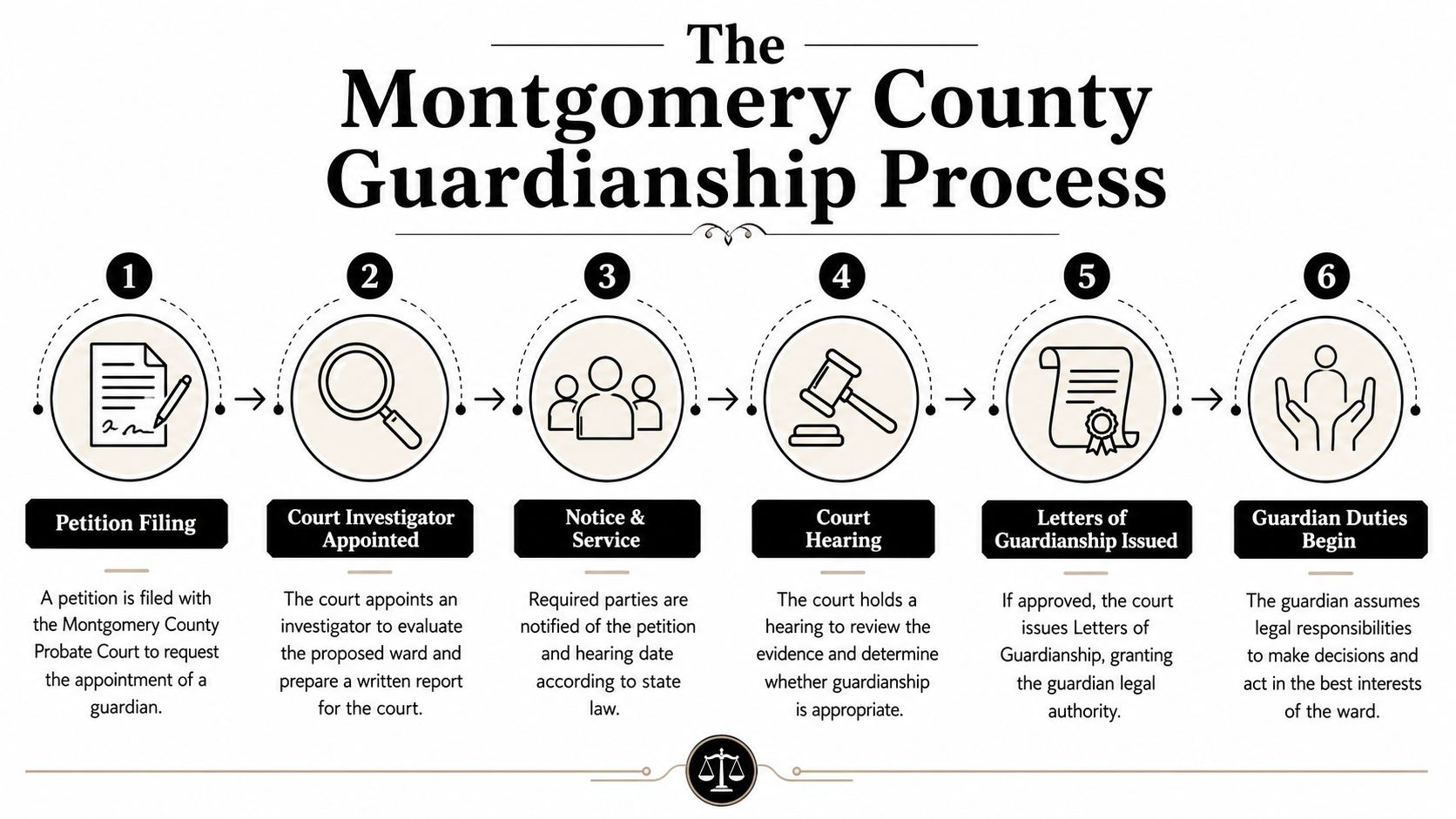
Step by step through the courthouse
Prepare the application
The filing starts with an application for appointment of guardian. The paperwork identifies the proposed ward, the proposed guardian, the type of guardianship requested, and the reasons the order is needed.Obtain the current medical certificate
The court needs a recent medical evaluation. If the certificate is outside the allowed time window, the filing can fail before the court even reaches the bigger issues.Give legal notice
Interested persons must receive notice as required by law. The court expects proof that notice was done correctly.Court review and investigation
The court may appoint an attorney ad litem or another court participant to help protect the proposed ward's interests and evaluate the request.Attend the hearing
At the hearing, the judge considers evidence about incapacity, the proposed guardian's qualifications, and whether a less restrictive option could work.Complete post-appointment requirements
If appointed, the guardian must complete the required oath, bond, and other steps before acting under the court's authority.
For families who prefer a visual walkthrough, this short video gives a useful overview of how guardianship proceedings work in practice.
Where families often get stuck
The biggest confusion usually isn't the filing itself. It's timing and proof.
People often wait too long to schedule the medical evaluation. Then they gather records, talk with siblings, and delay filing until the medical certificate is stale. Others assume county lines don't matter because The Woodlands overlaps local identity and mailing habits. For court venue, residence controls.
Bring the timeline into focus early. Medical records, doctor scheduling, notice requirements, and hearing prep all move at different speeds.
Another point that helps families: guardianship isn't like Enforcement of Court Orders in The Woodlands, which deals with enforcing divorce decree and custody order provisions in Montgomery County. Guardianship is its own probate court process, with different evidence, different forms, and a different legal standard.
Why You Must Consider Alternatives First
This is the part many online guides skip, and it's often the most important part of the case.
Texas courts must consider less restrictive alternatives before granting guardianship. That means a judge in Montgomery County won't just ask, “Does this person need help?” The judge will also ask, “Can this problem be handled with something less intrusive than guardianship?”
A local discussion of this issue notes that many Woodlands guardianship pages focus on filing steps but overlook the court's mandatory requirement to examine alternatives first. That same discussion explains that families who evaluate options early gain more control over the outcome and that lawyers should be prepared to show why tools like powers of attorney are not enough in a given case, as described in this article on Texas guardianship alternatives and strategy.
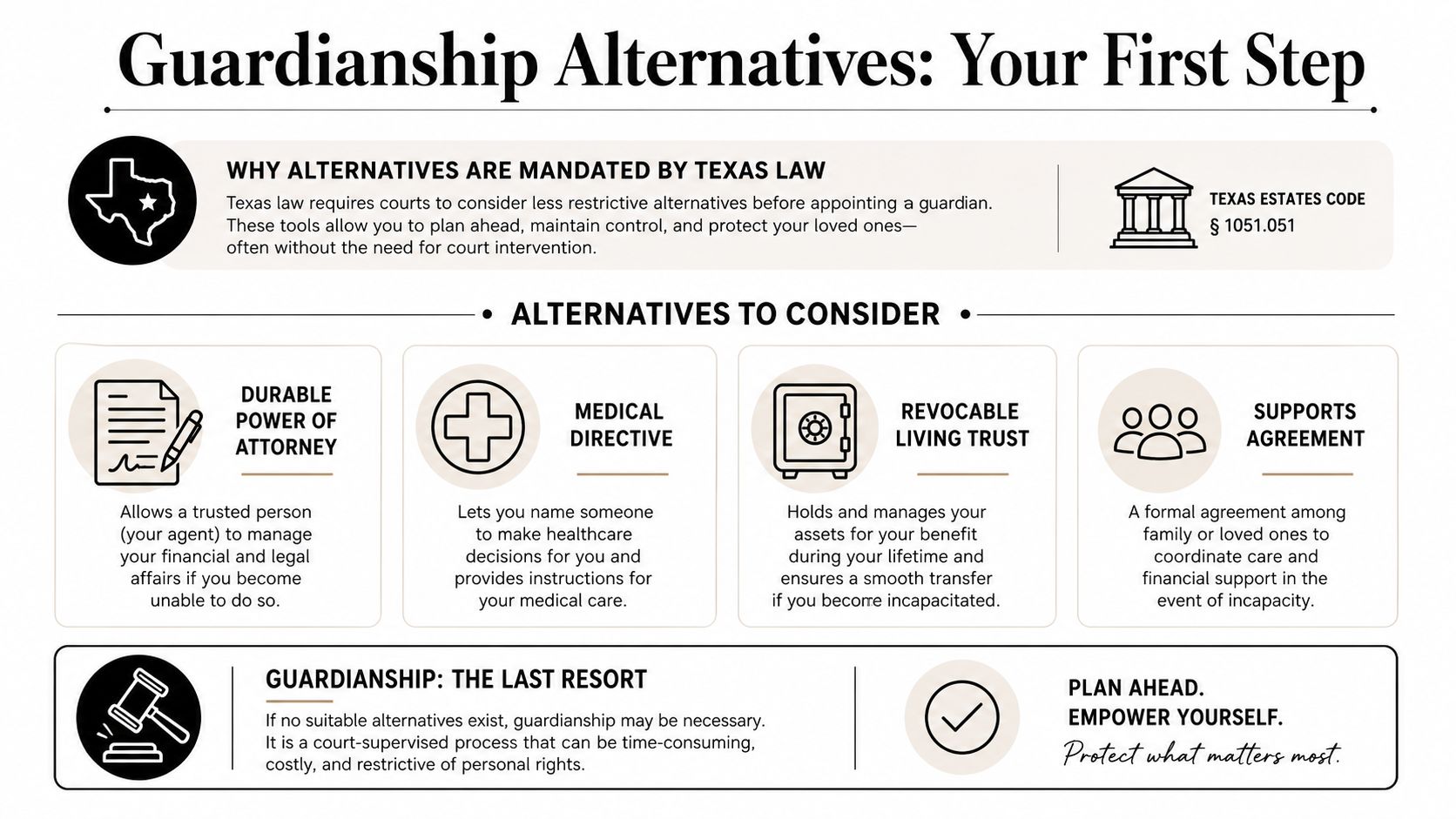
What counts as a less restrictive alternative
In real life, this can include tools such as:
- Durable power of attorney for financial help
- Medical power of attorney for health care decisions
- Supported decision-making agreements for adults who need help understanding choices but can still participate
- Other planning tools that organize care and finances without removing broad legal rights
If you're comparing planning tools, this overview of power of attorney help in The Woodlands is one practical starting point.
One short real-world scenario
A brother in Creekside worries about his sister after a brain injury. She can still talk through choices, but paperwork overwhelms her and she forgets appointments. The family first explores a medical power of attorney, a durable power of attorney, and structured care planning. A resource like the Carevo Home Health Care planning guide can help families think through home care, support systems, and decision-making logistics before going to court.
In that scenario, if the sister still understands her choices and can sign valid planning documents, guardianship may be unnecessary. If she can't understand what she is signing, rejects essential care without comprehension, or has become vulnerable to exploitation, the family may need to show the judge why those alternatives won't protect her.
How to think like the judge
Don't frame the case as “we want authority.” Frame it as “we considered narrower options, and here is why they don't solve the specific risk.”
That may mean showing one or more of these facts:
- The person can't understand the meaning of a power of attorney.
- Existing planning documents were never signed, were revoked, or can't be used effectively.
- The person's condition prevents consistent participation in supported decision-making.
- Financial exploitation, medical refusal, or severe confusion creates ongoing risk that less restrictive tools can't control.
The judge isn't just testing whether your family is worried. The judge is testing whether guardianship is truly necessary.
Common Guardianship Pitfalls to Avoid
Families rarely run into trouble because they care too little. They run into trouble because the process is technical.
A Montgomery County guardianship case can stall when the facts are serious but the paperwork is sloppy. The court still expects compliance with the Texas Estates Code, filing rules, notice rules, and post-appointment duties.
Four mistakes that cause trouble
Using an outdated medical certificate
The court needs a current evaluation. If the doctor's certificate is too old, the court may reject the filing before the family reaches the hearing stage.Missing or defective notice
Proper notice matters. If interested persons aren't served the right way, the court may delay the case or require the family to start correcting procedural problems.Arriving at the hearing with general concerns instead of proof
“Dad is getting worse” isn't enough by itself. Judges need concrete examples tied to decision-making, safety, finances, or medical care.Forgetting the work that comes after appointment
Guardianship doesn't end when the judge signs the order. Ongoing duties can include reports, renewals, and bond-related tasks, which means the role carries continuing responsibility.
How to avoid those problems
Start with a timeline. Put the medical evaluation, filing date, notice deadlines, and hearing preparation on one calendar.
Build a simple evidence folder. Include doctor information, examples of unsafe incidents, financial warning signs, and records showing why other planning tools haven't solved the problem.
For families also thinking ahead about incapacity planning and important end-of-life decisions, it helps to separate emotional conversations from courtroom proof. Those talks matter, but the judge still needs legally relevant evidence.
A practical hearing mindset
Don't try to prove everything that has gone wrong in the last five years. Focus on the present problem the court must solve.
Bring examples, not conclusions. “He signed checks to strangers” helps more than “He's terrible with money.”
That approach usually makes testimony clearer, calmer, and more useful to the court.
How a Woodlands Guardianship Attorney Protects Your Family
A good local lawyer does more than fill in blanks on forms. In a guardianship case, the attorney helps the family make three separate judgments. Is guardianship necessary at all, what scope makes sense, and how should the case be presented to a Montgomery County judge?

What a local attorney actually does
A guardianship attorney in The Woodlands, TX usually helps with work such as:
Screening the case early
The lawyer can identify whether a power of attorney, supported decision-making arrangement, or another narrower tool may fit before anyone files in court.Matching the facts to the right type of guardianship
Some families need help with medical decisions. Others need estate protection. Some need both. The legal theory should match the core problem.Coordinating compliant paperwork
This includes the application, medical support, notice requirements, and local filing details.Preparing for the less restrictive alternative issue
This is often where strategy matters most. The attorney helps present evidence showing that the family considered narrower options and why they don't adequately protect the proposed ward.Advising after appointment
Once someone becomes guardian, the role carries fiduciary duties and court supervision. That part needs careful handling too.
Why local familiarity matters
Montgomery County practice has its own rhythms, filing expectations, and courtroom habits. A lawyer who regularly works with The Woodlands and nearby communities often understands how to organize the case in a way the court can evaluate efficiently.
One option families may consider is The Law Office of Bryan Fagan, which serves families in The Woodlands and surrounding Montgomery County communities in probate and related family matters.
What to do next
If you think guardianship may be needed, use this checklist:
- Write down recent examples of unsafe decisions, missed medications, scams, confusion, or inability to manage bills.
- List existing legal documents such as powers of attorney, directives, trusts, or supported decision-making paperwork.
- Confirm the person's residence so you know the proper county for filing.
- Schedule a medical evaluation early enough that the court will receive a current certificate.
- Identify family members and interested persons who may need notice.
- Ask a lawyer the narrow-scope question. Do we need full guardianship, limited guardianship, or a non-guardianship solution?
That checklist won't replace legal counsel, but it will make the first consultation much more productive.
Your Next Steps for Guardianship in Montgomery County
If your family is facing this issue, the key point is simple. Guardianship is a serious legal remedy meant to protect a vulnerable adult, not a shortcut for family decision-making. In The Woodlands, those cases usually move through Montgomery County probate court, and success depends on careful preparation.
The most overlooked issue is often the most important one. Before asking for guardianship, you need to evaluate and be ready to discuss less restrictive alternatives. That isn't optional under the Texas Estates Code. It's part of the court's core job.
A thoughtful first step is to gather records, identify current risks, and review any existing planning documents. From there, a local attorney can help you decide whether court involvement is necessary and, if it is, how to present the case clearly and respectfully.
Disclaimer: This article is for informational purposes only and is not legal advice. Reading it does not create an attorney-client relationship. Guardianship cases are fact-specific, and you should speak with a Texas attorney about your family's situation before taking action.
If you're weighing difficult choices for a parent, sibling, or disabled adult child in The Woodlands or elsewhere in Montgomery County, a consultation can help you understand the safest and least restrictive path forward.
If you'd like to talk through your situation with a local team, you can schedule a consultation with The Law Office of Bryan Fagan to discuss guardianship, alternatives to guardianship, and the Montgomery County court process.
