 Skip to content
A lot of families in The Woodlands start thinking about a power of attorney at the worst possible moment. A parent is in the hospital. A spouse can't sign bank paperwork. A divorce is underway, and someone realizes an old document still gives the other spouse authority over accounts or medical decisions.
That's when people start searching for a power of attorney lawyer in The Woodlands, TX.
A power of attorney, or POA, isn't just an estate planning form. In Montgomery County, it can become a practical tool for paying bills during a medical crisis, keeping a business running, handling real estate, and avoiding avoidable conflict in probate or family court. It can also become a problem if it's outdated, too broad, or signed incorrectly.
Planning for the Unexpected in The Woodlands
A family in Alden Bridge gets a late-night call. Their mother has been taken to the hospital after a sudden medical event. One adult child assumes he can step in and handle the bills. Another believes she can talk to doctors because she's the closest child. The bank won't discuss account access. The hospital asks who has legal authority to make decisions if their mother can't.
The stress gets worse when nobody can find a valid power of attorney.
That scenario is common because people treat POAs like paperwork for later. In reality, they're part of a working plan for today. They let a trusted person act when you can't, whether that means paying the mortgage, dealing with insurance, or making healthcare decisions after a doctor documents incapacity.
In The Woodlands, that need isn't abstract. The community has a meaningful senior population. As of the 2010 census, 7.6% of residents were age 65 or older, which underscores why local families need legally enforceable planning documents, especially because hospitals often reject homemade versions, as noted in The Woodlands elder law resources.
Practical rule: A power of attorney should be drafted before a crisis, not during one.
Why local families run into trouble
The problem usually isn't bad intentions. It's bad timing and bad forms.
A document pulled from the internet may not match Texas requirements. A principal may have named the wrong agent years ago. A family may have plenty of trust issues already, and a broad POA can magnify them. That's especially true where family law and estate planning overlap.
Families with significant property, business interests, or layered financial holdings often also think about broader asset protection for HNWIs, because POA planning works best when it fits into the larger structure of how assets are owned and controlled.
A POA also shouldn't be drafted in isolation from the rest of your plan. If you're reviewing who should manage money, healthcare, or property, it often makes sense to review your will and trust documents at the same time through a wills and trusts lawyer in The Woodlands.
Understanding the Types of Power of Attorney in Texas
A principal is the person giving authority. An agent is the person receiving it.
The simplest way to understand the different POAs is to think of them as different keys. One key opens the financial side of your life. Another opens healthcare decision-making. Some keys stop working at incapacity. Some keep working because the document is durable.
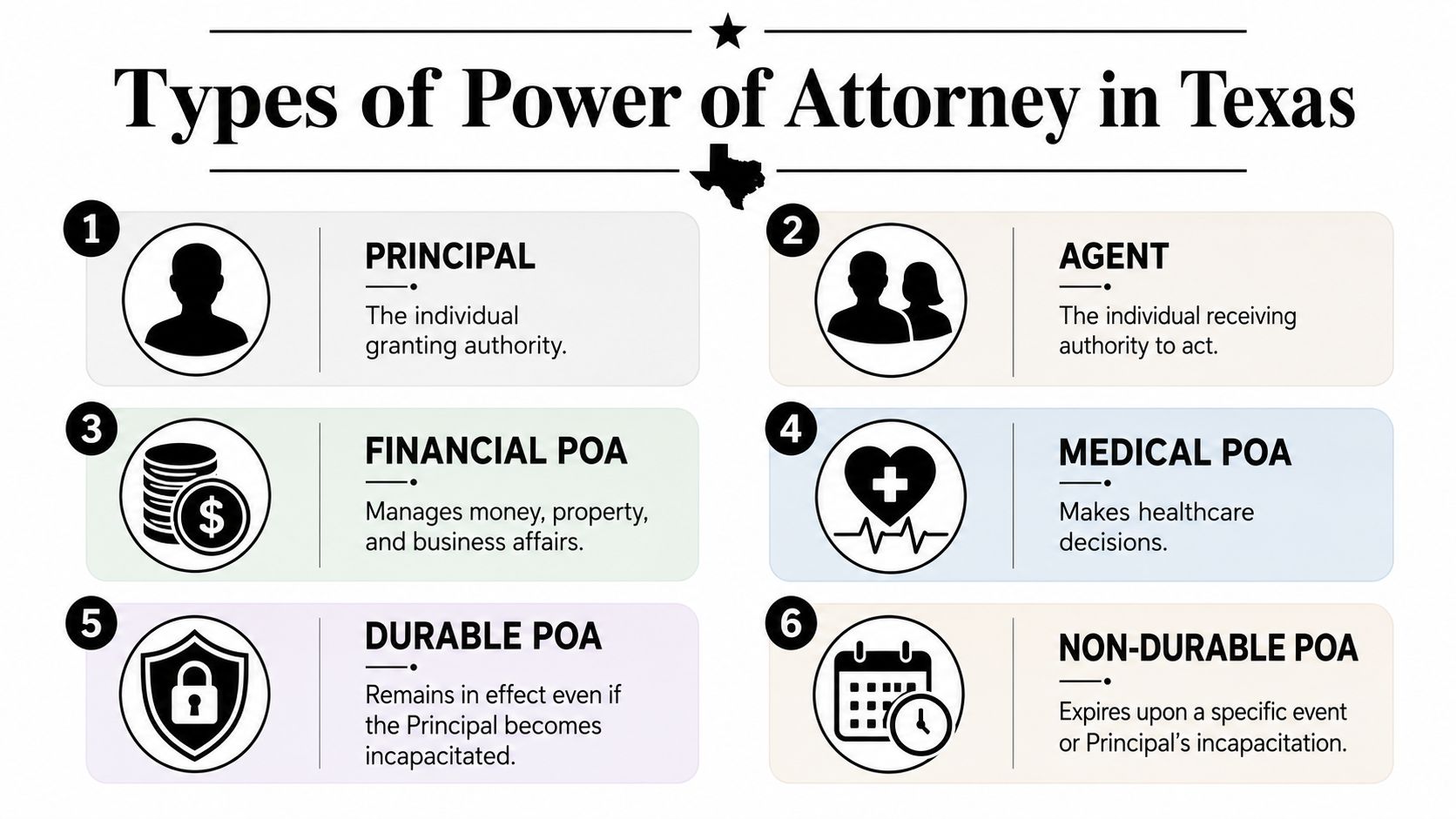
Under Texas Estates Code Chapter 14 requirements summarized here, a power of attorney in Texas must be signed by the principal and either two witnesses or a notary to be valid, authorizing the agent to make decisions.
The main POA types that matter
A general power of attorney gives broad authority, but it doesn't automatically solve incapacity planning. In Texas, a general POA ends when the principal dies, when a non-durable POA principal becomes incapacitated, when the document reaches its end date, when the principal revokes it, or when a guardian of the estate is appointed, as outlined in the Texas power of attorney guide.
A durable financial power of attorney covers money and property matters. It can allow an agent to manage bank accounts, taxes, bills, and similar financial tasks. The key feature is durability. If the document is drafted as durable, the authority continues even if the principal later loses capacity.
A medical power of attorney is different. It covers healthcare decisions, not financial ones. It only activates after the required incapacity standard is met.
A medical POA and a durable financial POA are not interchangeable. They solve different problems.
Texas Power of Attorney at a Glance
| POA Type | Primary Purpose | When It's Active |
|---|---|---|
| General POA | Broad authority for legal and financial tasks | While valid under its terms, but not after incapacity if it isn't durable |
| Durable Financial POA | Money, property, and financial management | As stated in the document, including during incapacity if properly drafted as durable |
| Medical POA | Healthcare decision-making | Upon incapacity under the required medical standard |
| Limited POA | Specific task or short-term authority | Only for the limited purpose or period stated |
What works better in practice
Most families in The Woodlands don't need the broadest document possible. They need a document that matches the actual risk.
If you're a business owner in Town Center, your agent may need authority over banking and contracts. If you're helping an aging parent in Panther Creek, the focus may be bill payment and healthcare coordination. If divorce is on the horizon, naming a spouse without a backup can create immediate risk.
The best POA is rarely the most expansive one. It's the one that gives enough authority to function and enough structure to prevent misuse.
Texas Legal Requirements for a Valid POA
A valid Texas POA needs more than good intentions. It has to be executed correctly and written clearly enough that third parties can rely on it.
Texas law requires a POA to be in writing, to name the agent, and to be signed and notarized, with the formality rules depending on the type of authority involved, as described in the earlier state law sources. Capacity matters too. The principal must be an adult and of sound mind at signing. That's the practical starting point under the Texas Estates Code for most POA disputes.
The durable clause isn't optional
Many families encounter significant hardship. A financial POA that lacks the proper durable language can fail at the exact moment the family needs it most.
The practical consequence is serious. Without the durable specification, a Financial POA terminates upon incapacity, which can force a court-appointed guardianship, as explained in this Texas estate planning discussion.
If your family is already dealing with conflict, guardianship adds another layer of expense, delay, and public court involvement in Montgomery County.
A POA that stops working at incapacity is often worse than no POA at all, because families assume they're protected until a bank or court says otherwise.
What an agent can't do
Families also need to understand the limits.
An agent's authority ends at the principal's death. At that point, control shifts to the executor or administrator through the probate process, not through the POA. An agent also can't use a POA as a shortcut around every legal process. The document only allows the powers the principal granted.
If a family law issue is already active, that matters. In a household dealing with property division, custody, or support obligations, an overbroad or stale POA can affect practical decisions about accounts, records, and control. That's one reason related issues sometimes overlap with services like a Child Support Attorney in The Woodlands, where families are establishing, modifying, and enforcing child support in Montgomery County.
Filing and notice issues
Not every POA must be filed. But if the agent will handle real estate transactions, the document may need to be filed with the county clerk where the property is located under Texas practice rules discussed in the earlier legal materials.
Revocation also requires follow-through. If the principal revokes the POA while mentally competent, the agent and third parties relying on it need actual notice. A revoked document left in circulation causes real damage.
When You Need a POA Scenarios for Woodlands Families
A power of attorney matters in ordinary life, not just at the end of life. In Montgomery County, the biggest mistakes usually happen when people assume a spouse or adult child can automatically act for them.
Scenario one with an aging parent in Panther Creek
An older father lives alone in Panther Creek. His daughter helps with groceries and doctor visits, but he still handles his own money. After a sudden decline, bills go unpaid and insurance paperwork piles up. The daughter learns that being the helpful child doesn't make her the legal decision-maker.
A properly signed financial POA would have allowed someone he trusted to step in quickly. A medical POA would have addressed healthcare decisions once incapacity was established under the legal standard.
Scenario two with a younger professional in Town Center
A younger professional rents near Town Center, travels often, and assumes POAs are for retirees. Then a serious accident leaves him unable to communicate for a period of time.
His parents can't automatically access accounts, deal with lease issues, or direct care because they're family. Authority has to come from the right document.
That's the part many people miss. A POA is not age-specific. It's incapacity planning.
Scenario three with divorce in Sterling Ridge
A couple in Sterling Ridge is going through a hard divorce. Years earlier, each signed broad POAs naming the other as agent. Nobody revisited those documents when the marriage started breaking down.
Then one spouse has a medical emergency. The other spouse is still the named agent. That creates immediate conflict over access, decision-making, and whether the old authority should still be trusted.
Under Texas law, a Medical POA only activates upon incapacity and requires two witnesses or a notary, while a Durable POA is for finances. In Montgomery County, courts scrutinize POAs where one spouse retains post-divorce authority over the other's assets or medical care, as noted in the Texas medical powers of attorney guide.
That's where POA planning intersects with divorce strategy. If a marriage is deteriorating, review every POA immediately. A stale document can undermine the practical goals of a divorce case or emergency family proceeding. In some situations, families also need to look at court options such as temporary guardianship in Texas if capacity has already been lost and valid planning documents aren't in place.
Old POAs create some of the worst surprises in family law. People remember the will. They forget the agent authority they handed over years earlier.
Your Step-by-Step Guide to Creating a POA
Creating a POA doesn't need to be complicated, but it does need to be deliberate.
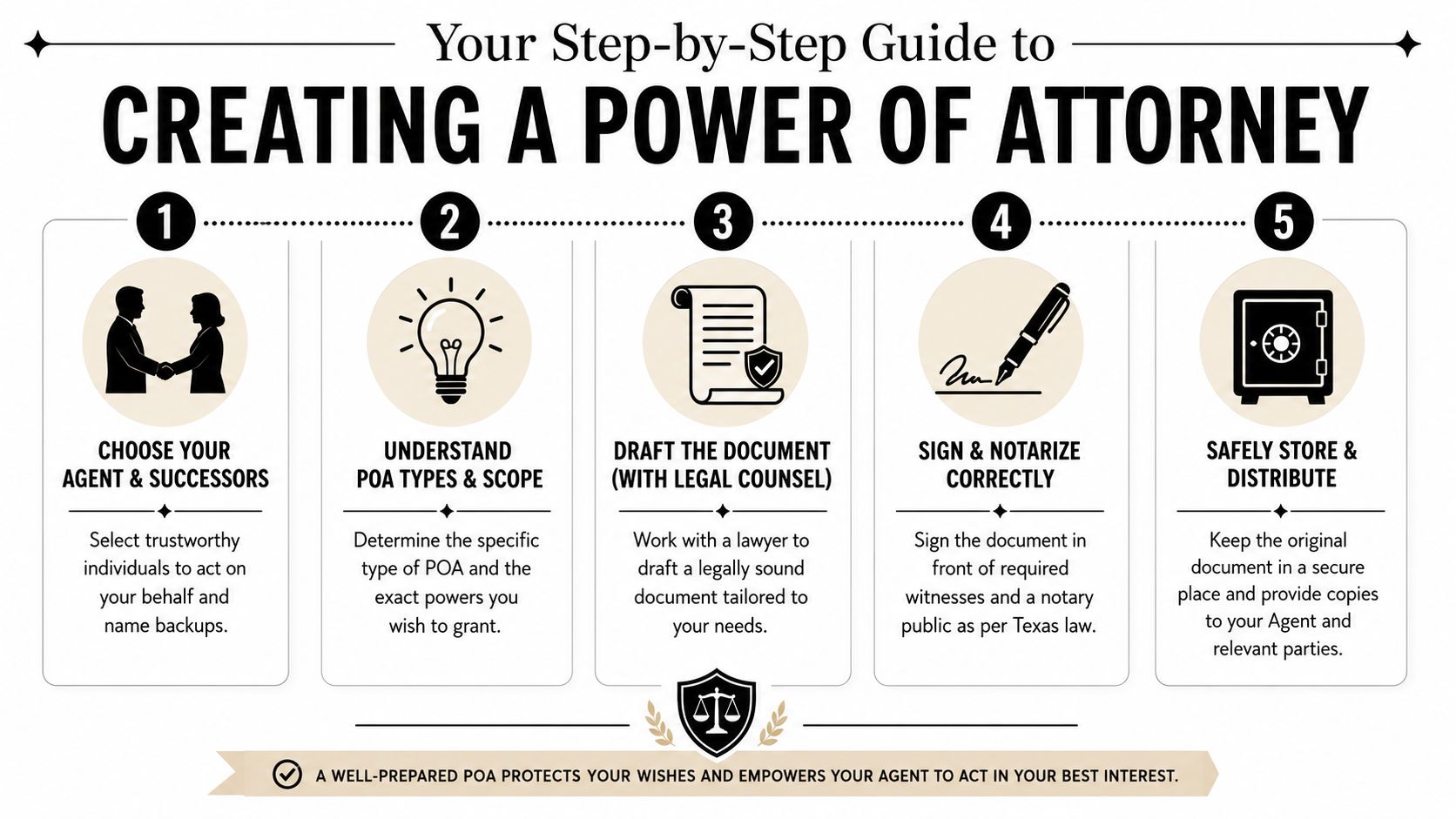
Step one through step three
Choose the right agent
Pick someone trustworthy, organized, and calm under pressure. Don't choose by birth order or to avoid hurt feelings. Choose the person who can do the job.Define the scope carefully
Some people need broad financial authority. Others need a limited document for a specific property, account, or transaction. The document should fit your life, not a generic template.Get legal help before signing
This is where local context matters. A lawyer should ask about family dynamics, divorce risk, business interests, real estate, and whether you need backups. If you're building a broader plan, a local estate planning attorney in The Woodlands can help coordinate the POA with the rest of your documents.
Step four and step five
Before you watch the walkthrough below, keep one point in mind. Execution errors often destroy otherwise solid plans.
Sign it the right way
Texas formalities matter. If the signature, witness, or notary requirements aren't met, the document may be challenged when you need it.Store and share it properly
The original should be secure but accessible. Your agent should know where it is. If a bank, doctor, or facility will need it, don't wait until a crisis to find out whether they'll review it.
What to do next
- List your decision-makers: Write down your first-choice agent and at least one backup.
- Review your risk areas: Think through divorce, estrangement, blended family issues, and business ownership.
- Gather related documents: Include wills, trusts, deed records, and prior POAs.
- Set a signing appointment: Don't leave a drafted POA unsigned in a folder.
- Tell the right people: Your agent, key relatives, and relevant institutions should know a valid document exists.
Costs Red Flags and Choosing Your Lawyer
Families usually ask two practical questions first. What does this cost, and how do I avoid doing it wrong?
For many people in The Woodlands, a POA is part of a larger estate planning package rather than a stand-alone service. A basic estate planning package including a will and powers of attorney typically ranges from $1,500 to $3,000, while more complex revocable living trust packages generally range from $3,000 to $6,000, according to The Woodlands estate planning pricing information here.

That range doesn't answer whether your plan is appropriate. It only tells you the market for common packages. The more important question is whether the lawyer is drafting for your real life or just filling in blanks.
Red flags that should make you stop
- They don't ask about family conflict: If nobody asks whether a divorce is pending, whether adult children are fighting, or whether one child controls finances already, the drafting is too shallow.
- They use one-size-fits-all language: Generic online forms miss the exact limits and safeguards many Montgomery County families need.
- They ignore successor agents: If your first choice can't serve, the whole plan can stall.
- They don't discuss revocation of old POAs: Old documents often linger and create conflicting authority.
- They never mention third-party acceptance issues: A useful POA has to work in practice, not just on paper.
Questions worth asking in a consultation
Ask direct questions.
How do you handle POAs when divorce is pending? How do you limit agent abuse without making the document unusable? What happens if the principal owns real estate in Montgomery County? How do you draft around blended-family conflict?
A lawyer who deals with POAs seriously should also talk about acceptance and oversight. Texas guidance also notes a practical issue many families don't hear about. Third parties must accept or reject a POA within 10 days with written justification, and families can reduce risk by thinking ahead about oversight and misuse, as discussed in Texas Law Help's POA article.
The cheapest POA can become the most expensive document in your file if it triggers a guardianship fight or a family dispute.
It can also help to read how lawyers in other markets frame agent authority and document design. For example, David Brillant's POA expertise is a useful outside comparison for thinking about how attorneys evaluate authority, scope, and the risk of misuse.
How The Law Office of Bryan Fagan Protects You
Power of attorney planning gets more complicated when family law and probate issues overlap. That's common in The Woodlands. A document that looks fine in a quiet household can become a major pressure point when a marriage is ending, when adult children disagree, or when a parent's capacity is fading.
That's why the legal work has to account for more than signature formalities. It has to account for likely conflict.
In Montgomery County, careful POA drafting often means looking at who currently has access to property, whether divorce or custody litigation is active, whether a spouse should still serve as agent, and whether the document should include practical guardrails. Those guardrails may include narrower powers, successor agents, or clearer limits on financial authority.
The Law Office of Bryan Fagan serves families in The Woodlands and surrounding Montgomery County communities in divorce, child custody, child support, property division, and probate matters. That local family law and probate experience matters when a POA could affect asset control, medical decision-making, or the practical strategic advantages in a contested case.
A final word of caution
This article is for general informational purposes only and is not legal advice. Reading it doesn't create an attorney-client relationship. Texas POA issues turn on specific facts, including capacity, wording, execution, revocation, and family dynamics.
If you live in The Woodlands, Sterling Ridge, Alden Bridge, Panther Creek, Creekside, or elsewhere in Montgomery County, it's worth having your current documents reviewed before a crisis forces the issue.
If you'd like to talk through your situation privately, you can schedule a consultation with The Law Office of Bryan Fagan. A focused review can help you spot outdated POAs, reduce family conflict, and put the right documents in place before they're tested.
