 Skip to content
A lot of families in The Woodlands reach this point without much warning. A parent has a stroke. An adult child with disabilities turns eighteen. A relative starts making unsafe financial decisions, forgetting medications, or signing papers they don't understand. Suddenly, the question isn't abstract anymore. It's very practical. Who has legal authority to help?
That's where many people start searching for a guardianship lawyer in Montgomery County. They're not looking for legal jargon. They want a clear path. They want to know whether guardianship is even the right answer, what the court expects, and how to avoid filing the wrong paperwork at the wrong time.
A common local example looks like this. A family in Panther Creek has been helping an aging mother for months. At first, they're organizing doctor visits and paying bills online with her permission. Then her condition changes. She can't explain her choices, doesn't understand medical recommendations, and becomes vulnerable to financial mistakes. The family realizes informal help may no longer be enough.
In Montgomery County, those decisions run through a specific local court process. That matters. Local practice, required medical proof, and the court's preference for less restrictive options can shape whether a case moves smoothly or stalls. If you're weighing guardianship in The Woodlands, Conroe, Magnolia, or nearby communities, it helps to understand the legal purpose of guardianship before you file anything.
Introduction
Guardianship is often misunderstood because people use it to describe several different legal ideas. In Texas, guardianship usually refers to a court-supervised process for an adult who can no longer make sound decisions about life, property, or finances under the Texas Estates Code definition of guardianship. It's serious because the court may transfer decision-making power from one person to another.
That's why families should slow down before assuming they need a full guardianship. The court doesn't treat guardianship like a convenience tool. It treats it like a last-resort safety measure. If a loved one can still act with support, or if another legal tool would work, the judge may expect that option to be considered first.
Practical rule: Guardianship is about protection, not control.
In Montgomery County, court handling is centralized rather than scattered. Guardianship matters are managed through County Court at Law No. 2, which gives families a more defined local process than many expect. That can be helpful, but it also means technical mistakes tend to matter.
People usually get confused in the same places:
- Whether the case involves an adult or a minor
- Whether full guardianship is necessary
- What medical proof the court requires
- How local filing logistics work in Montgomery County
Those points decide more than paperwork. They affect time, cost, and whether your family preserves as much independence as possible for the person who needs help.
Understanding Key Concepts
The easiest way to think about guardianship is this. It's a court-built safety net for an adult who can't make sound decisions anymore. The safety net may cover personal decisions, medical decisions, financial decisions, or all of them, depending on what the court finds necessary.
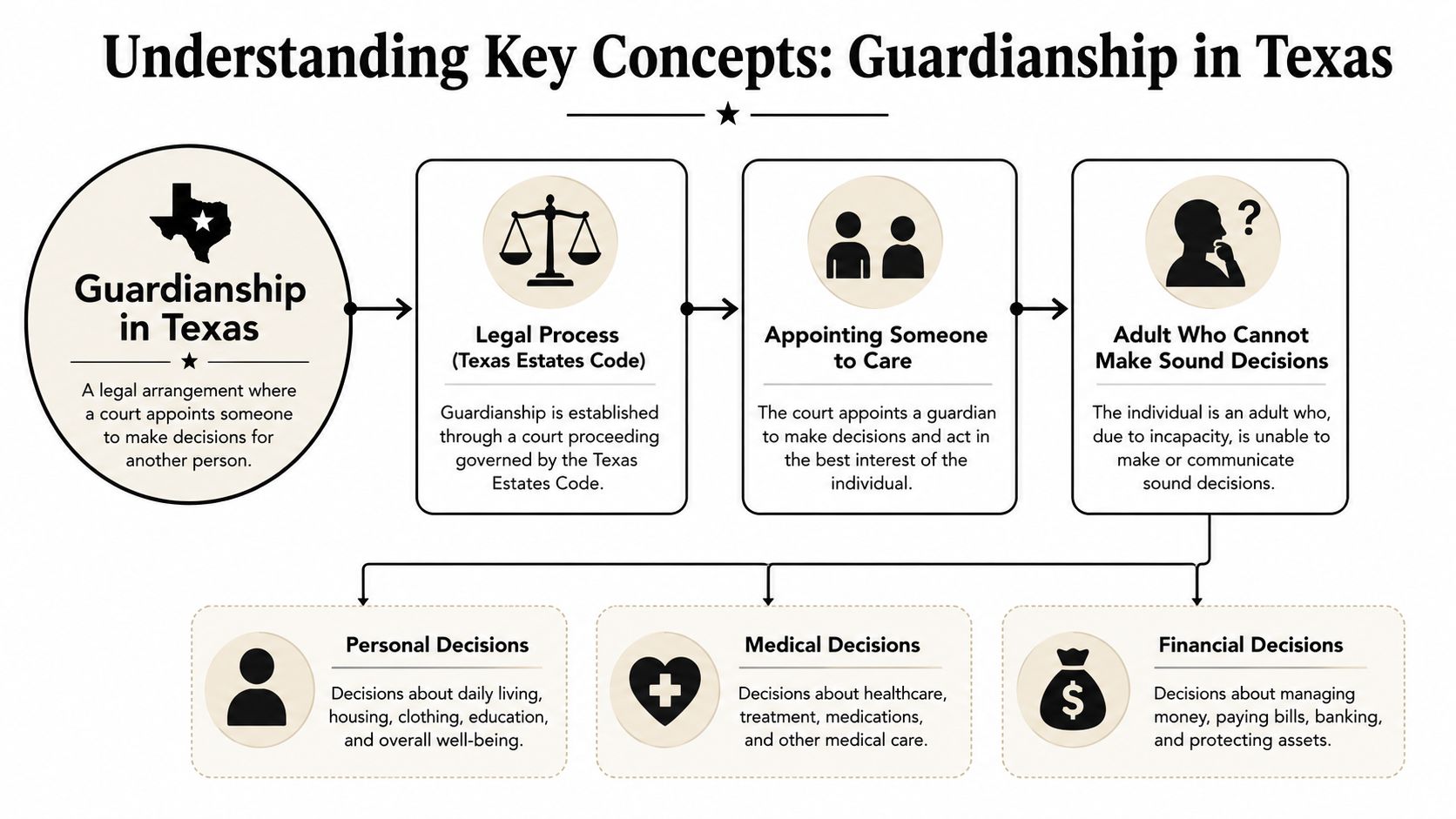
Guardianship versus conservatorship
In local conversations, people sometimes mix up guardianship and conservatorship. Texas law separates them. Guardianship usually applies to incapacitated adults under the Estates Code. Conservatorship applies to minors under the Family Code, as explained in this overview of Texas conservatorship issues involving children.
That distinction matters in The Woodlands because families often search using the wrong term. If the person needing help is an adult parent, adult sibling, or adult child with diminished capacity, you're usually in guardianship territory, not conservatorship.
Least restrictive alternatives come first
This is the part many articles skip, and it's one of the most important. Texas courts are supposed to consider whether a less restrictive alternative could solve the problem before imposing guardianship. According to Montgomery County guardianship information published by D.A.D.S., over 60% of proposed wards in Texas could retain autonomy through these options.
That means the right first question often isn't “How do we get guardianship?” It's “Do we need guardianship at all?”
Examples of less restrictive alternatives include:
- Powers of attorney, if the person still has capacity to sign them
- Supported decision-making, where the person keeps legal rights but gets help understanding choices
- Representative payee arrangements, for certain benefits management
- Limited help with daily affairs, without asking a court to remove broad rights
Some families file too early because they're reacting to stress. The law asks a different question. What is the narrowest tool that still keeps the person safe?
If you're trying to organize medical records, deadlines, and signatures, some firms also look at workflow tools and CasePulse insights on legal software to understand how legal teams keep estate and probate matters organized. That doesn't replace legal judgment, but it helps explain why document management matters so much in guardianship work.
Types of Guardianship and Eligibility
Texas law divides these cases by both who needs help and what kind of help they need. For adults, the court may appoint a guardian for personal decisions, financial decisions, or both.
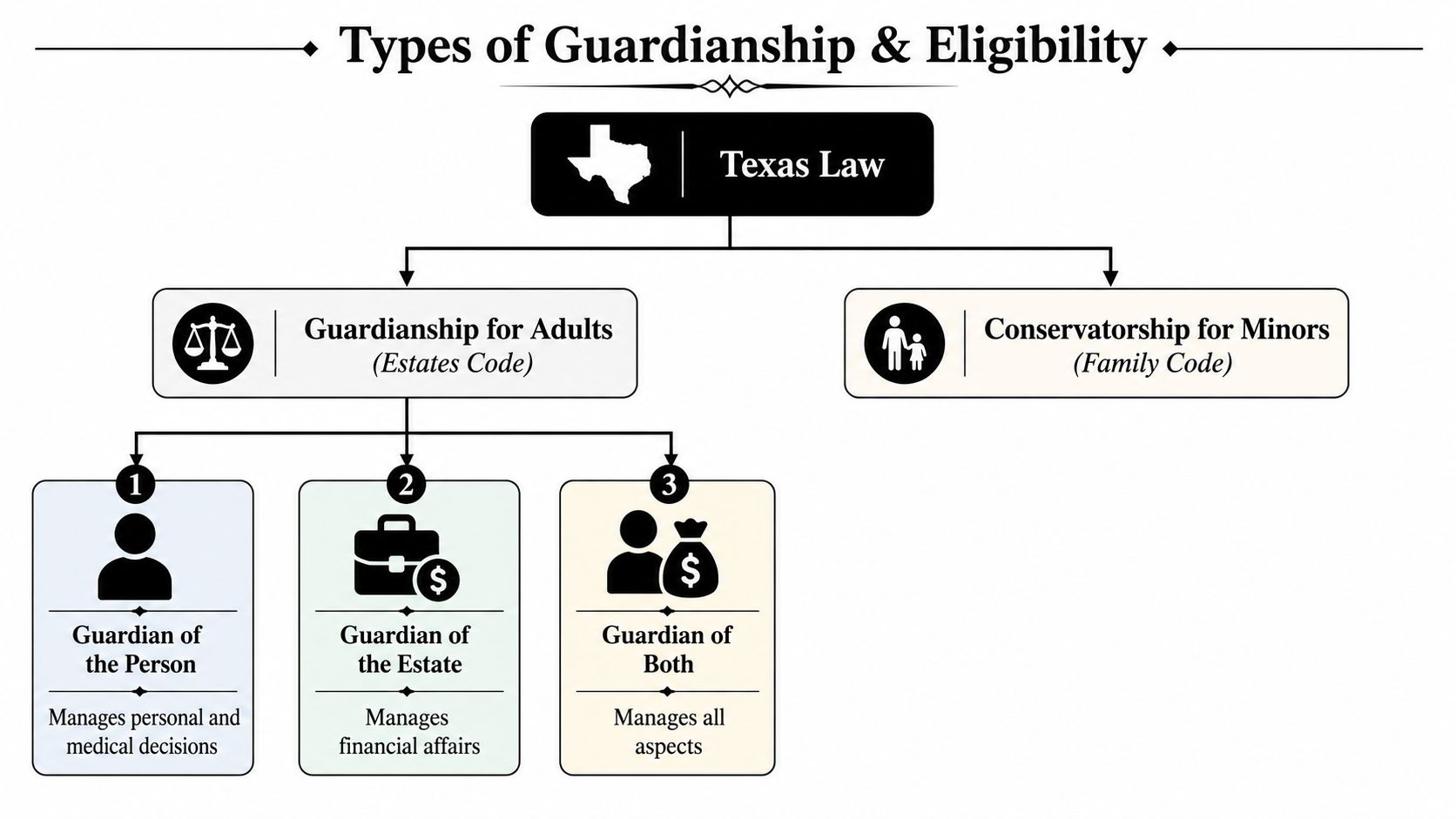
The main adult guardianship categories
Here's the practical breakdown.
| Type | What the guardian handles | Common example |
|---|---|---|
| Guardian of the person | Medical care, living arrangements, daily welfare | An adult who can't understand treatment choices |
| Guardian of the estate | Money, property, financial decisions | An adult who can't manage accounts or assets safely |
| Guardian of both | Personal and financial matters | An adult with broad incapacity affecting both areas |
A judge doesn't automatically grant the broadest form. The court should match the order to the actual need.
Who may qualify as a ward
For adult cases, the legal issue is incapacity. The Estates Code standard focuses on whether the person can understand or communicate decisions and provide for basic needs. In real life, that can involve memory loss, developmental disability, serious injury, or medical decline.
Families sometimes confuse bad judgment with legal incapacity. They aren't the same thing. Being stubborn, spending money unwisely, or making choices relatives dislike doesn't automatically justify guardianship.
The court also evaluates the proposed guardian
The judge isn't only examining the person who may need protection. The judge also looks at the person asking to serve. The court wants to know whether that person can handle the duty responsibly and whether a conflict exists.
If the underlying family situation includes other court orders, especially in cases involving children, related legal issues can overlap with matters such as Enforcement of Court Orders in The Woodlands, which involves enforcing divorce decree and custody order provisions in Montgomery County. That's a different legal lane, but families sometimes encounter both kinds of proceedings at once.
Key point: The court isn't choosing who loves the person most. It's choosing who can legally and practically serve the person's interests.
Court Process and Timelines
A family in The Woodlands often reaches this stage after a hard moment. A parent leaves the stove on, misses medication, or signs papers they do not understand. Everyone wants help quickly, but the court does not move on urgency alone. It follows a sequence designed to protect the proposed ward's rights and to make sure guardianship is the least restrictive option available under Texas law.
In Montgomery County, that sequence runs through a specific court setting. County Court at Law No. 2 and its Guardianship Coordinator handle guardianship case administration, and Judge Claudia Laird presides there. The county's dedicated coordinator is Amber Park, with contact information listed in the county guide as 936-538-3570 and [email protected]. That local structure matters. Families are not guessing which court handles the case, and lawyers can often avoid delays by following the coordinator's filing and scheduling expectations from the start.
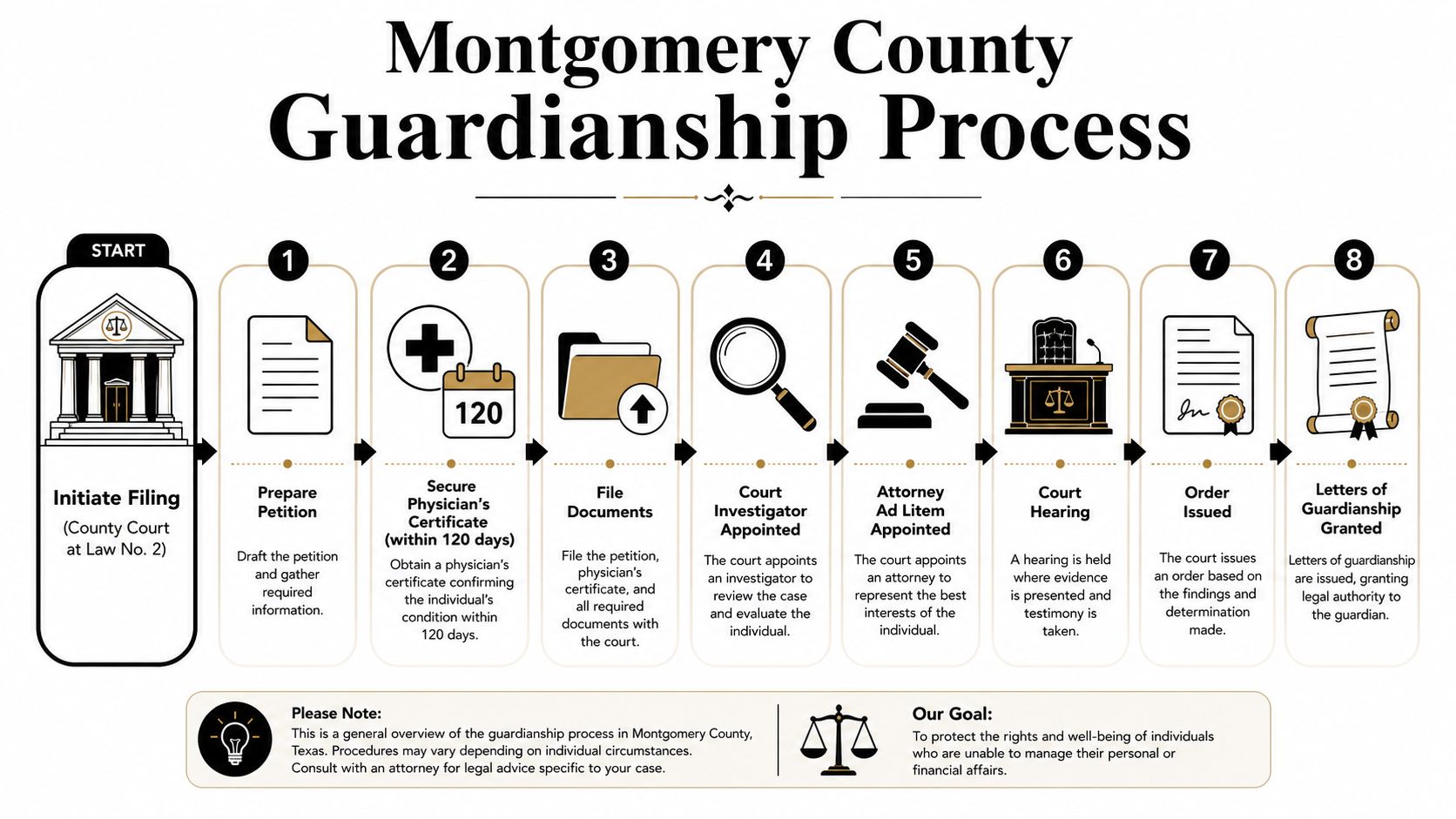
Filing starts the case, but it also frames the problem
The application for guardianship does more than ask for authority. It tells the judge what kind of help is needed, why lesser options will not adequately protect the person, and whether the request should cover the person, the estate, or both. In plain English, the filing acts like a blueprint. If the blueprint is too broad, too vague, or inconsistent with the medical proof, the case can slow down before it ever reaches a final hearing.
For local filings, county materials identify the District Clerk as Melisa Miller, with official case inquiry records maintained at 301 N. Main Street, Suite 103, Conroe, TX 77301. Families who want a local roadmap can review this guide to the Montgomery County probate court process to see how guardianship cases move through the court system here.
Medical evidence often controls the pace
For adult guardianship cases, the physician's certificate has to be current and legally sufficient, as noted earlier. If that certificate is outdated, vague, or does not match the authority requested, the court may require corrections before the case can move ahead.
This is a common point of confusion. Families often have stacks of medical records and assume that is enough. The court is looking for a medical opinion that lines up with the legal standard for incapacity, not just proof of diagnosis or aging. A person can have serious health problems and still retain decision-making ability in some areas.
That is one reason least restrictive alternatives matter so much. If the medical evidence shows the person needs help with paying bills but can still make personal decisions, a full guardianship may be broader than the facts support. A narrowly defined request is often easier for the court to evaluate because it matches the actual problem the family is trying to solve.
A short overview may also help before you gather documents:
After filing, the court shifts into review mode
Once the case is filed, the court usually requires notice to interested parties and may appoint an attorney ad litem to represent the proposed ward's interests. That step is easy to underestimate. Guardianship cases are protective proceedings, but they also remove rights. The court therefore checks procedure carefully before signing any order.
In practical terms, families should expect several moving parts at once. Service and notice must be correct. Medical paperwork must be in order. The hearing cannot do its job if those pieces are missing.
Montgomery County's dedicated Guardianship Coordinator adds a useful local layer here. Amber Park does not give legal advice, but her office can help lawyers and families understand scheduling procedures, required court settings, and filing expectations. That is an insider tip many families miss. In counties without a dedicated coordinator, people often spend more time figuring out process details through trial and error.
How long does it take?
There is no single deadline that fits every case. An uncontested case with complete medical proof, accurate family information, and a precisely defined request usually moves faster than a disputed case or one that needs corrected filings.
The better question is what tends to cause delay.
Common slowdowns include:
- Waiting too long to schedule the medical exam
- Requesting broader powers than the facts support
- Listing relatives or interested parties incorrectly
- Missing county-specific filing or scheduling steps
- Treating a guardianship case like ordinary paperwork instead of a rights-based court proceeding
A helpful way to view the timeline is to compare it to building inspection. You can finish quickly if each stage passes inspection the first time. If one part is incomplete, the whole project pauses until that issue is fixed.
What families can do now
Preparation changes the timetable more than hope does. Start gathering family information early. Get the medical evaluation lined up before the filing date becomes urgent. Ask whether a power of attorney, supported decision-making arrangement, or limited guardianship would solve the problem with fewer restrictions. Then make sure the court filing explains that analysis clearly.
That last point matters in Montgomery County. Judges want to see that guardianship is being used carefully, not as the automatic first choice. Families who show the court they considered less restrictive alternatives, and who use the coordinator's process guidance wisely, often put themselves in a stronger position for a smoother hearing.
Required Forms and Costs
Guardianship paperwork works a lot like a court-built safety system. Each document answers a different question for the judge. Who needs help? What kind of help? How much authority is necessary? In Montgomery County, that last question matters more than many families expect, because Texas law favors the least restrictive option that will still protect the person at the center of the case.
That means the forms are not just paperwork. They are the court's way of testing whether a full guardianship is needed, or whether a narrower request makes more sense.
One form often drives the whole timeline in an adult case. The physician's certificate has to be current, and if it is stale or incomplete, the court may treat the filing as missing a foundation. As noted earlier, timing matters. So does content. A doctor's note that speaks in broad medical terms but does not address functional limits often creates follow-up problems.
Forms families commonly hear about
Families in The Woodlands and across Montgomery County are often asked for some combination of these documents:
Application for Guardianship
This opens the case and tells the court who is asking, who needs protection, and what powers are being requested.Physician's Certificate of Medical Examination
This supports the claim that the proposed ward cannot manage certain personal or financial decisions independently.Proposed Order and Letters of Guardianship
If the judge approves the case, these documents reflect the specific authority granted. This distinction matters because the court may approve less than what was requested.Inventory, appraisement, and related estate filings
These usually come into play when the guardian will handle money, property, or other assets.Bond paperwork
The court may require a bond in estate-related cases to protect the person's finances.County-specific settings or coordinator forms
Montgomery County families are often surprised by this part. The dedicated Guardianship Coordinator can be a practical source for filing and scheduling guidance, which helps families avoid preventable corrections and wasted trips to the courthouse.
If you are trying to sort out whether the situation is urgent or standard, this overview of a temporary guardianship form in Texas can help clarify the difference.
What costs usually come up
Families often expect one filing fee and little else. Guardianship rarely works that way.
The cost picture is more like several smaller buckets: court filing fees, issuance and service costs, medical exam charges, certified copies, bond premiums if required, and sometimes attorney's fees. In some cases, there are also record-gathering costs, notary fees, or expenses tied to hearing preparation.
Here is a practical way to look at it:
| Form or Cost Item | Why it matters | Cost pattern |
|---|---|---|
| Application for Guardianship | Starts the case | Court filing fee usually applies |
| Physician's Certificate of Medical Examination | Supports incapacity allegations | Medical provider sets the charge |
| Letters of Guardianship | Proof of appointment after approval | Clerk copy or issuance costs may apply |
| Inventory and estate filings | Reports assets when financial authority is involved | Preparation and filing costs can apply |
| Bond forms and bond premium | Protects estate funds in some cases | Amount depends on the case |
A useful local tip is to ask early which expenses are one-time and which repeat. Letters, bonds, annual reporting, and later accountings can create costs after the hearing, especially in guardianship of the estate matters.
Families also sometimes wonder whether they should record doctor meetings or family conversations to keep facts straight. Before doing that, make sure you understand recording consent laws, because good intentions do not erase legal rules.
Bring a written expense list to the first lawyer meeting. That simple step often leads to better questions, a more realistic budget, and a filing request that fits the least restrictive path the court is most likely to approve.
How a Guardianship Lawyer Helps
A guardianship case looks simple from the outside. File papers, get a doctor's note, go to court. In practice, that's not how most families experience it. The hard part is fitting legal standards, medical proof, notice rules, and local procedure together without creating delays.
That's why experience matters in this niche. In Montgomery County, Avvo lists 16 lawyers focused on guardianship, compared with 55 child custody attorneys. That gap tells you something important. Guardianship is a smaller, more specialized corner of local practice.
What a local lawyer actually does
A good guardianship lawyer doesn't just fill in blanks. The lawyer helps decide whether the case should exist at all, and if so, how narrow it can be.
That usually includes:
- Screening for alternatives so the family doesn't pursue an unnecessary full guardianship
- Drafting the petition carefully to match the facts and requested authority
- Coordinating with the doctor so the medical certificate addresses the right legal issues
- Managing service and notice to reduce avoidable procedural problems
- Preparing for hearing questions about capacity, family dynamics, and suitability
Lawyers also help when the issue is not initial appointment
A lot of online material stops at “how to get guardianship.” Real life doesn't. Sometimes the problem is misuse of funds, a bad fit, family conflict, or the need to restore rights. Disability Rights Texas explains that a person already under guardianship has the right to choose a lawyer for a guardianship hearing. That matters when someone wants to challenge, modify, or end a guardianship.
Families also sometimes collect recordings, voicemails, or conversations as part of a dispute. Before doing that, it helps to understand recording consent laws, because evidence-gathering can create separate legal issues if handled carelessly.
If you're looking at representation options in this area, one local resource is a guardianship attorney in The Woodlands, TX, which addresses probate-related guardianship matters in this region.
Real World Scenario and What to Do Next
The Rodriguez family in Panther Creek had been helping Mrs. Rodriguez after her stroke. At first, they thought informal support would be enough. They drove her to appointments, sorted medications, and helped with bills. Then her doctors started asking for formal decision-making authority because she could no longer communicate clear medical choices.
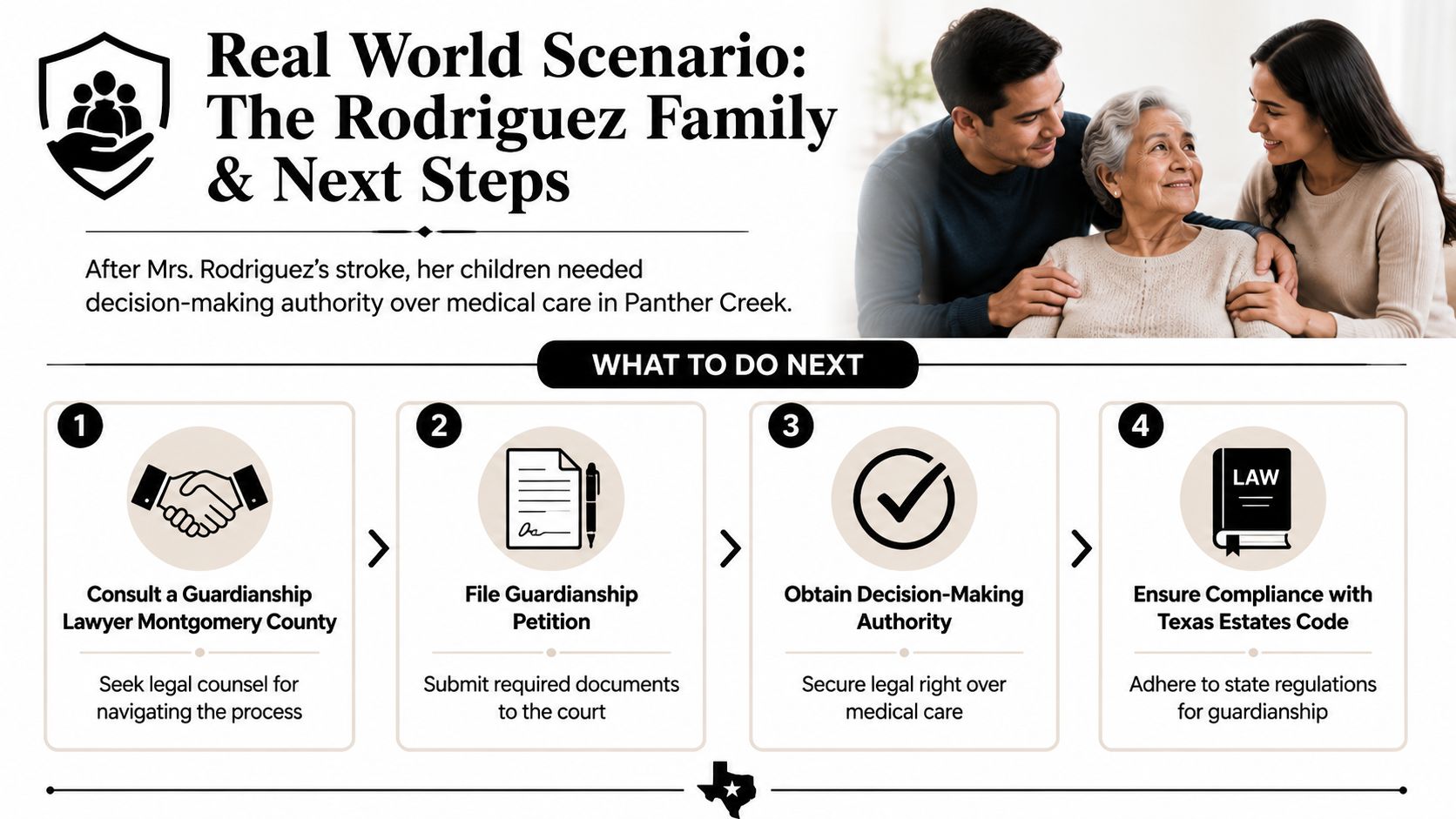
Their next step wasn't rushing to court. It was asking whether a less restrictive option would work. Once it became clear that it would not, they gathered medical support, prepared the filing, and moved through the Montgomery County process with a clearer sense of what the court needed.
If your family is in a similar spot, practical support outside the courthouse may matter too. If you're seeing day-to-day warning signs, this guide on signs of needing in-home care can help you think through care needs alongside legal planning.
What to do next
- Pause before filing: Ask whether supported decision-making, a power of attorney, or another narrower option could work.
- Get current medical information: Adult guardianship cases depend on timely, legally useful medical evidence.
- Map the actual problems: Separate medical decisions, living arrangements, and financial issues so you request only the authority needed.
- Identify local court logistics: Montgomery County practice is specific, and local process matters.
- Speak with a lawyer early: Even one planning meeting can help you avoid filing the wrong case.
This article is not legal advice. Guardianship decisions depend on the facts of the individual, the medical evidence, and the court's requirements under the Texas Estates Code or, for minor conservatorship matters, the Texas Family Code.
If you need help sorting out whether guardianship is appropriate in The Woodlands or Montgomery County, you can schedule a consultation with The Law Office of Bryan Fagan. A consultation can help you evaluate alternatives, understand the local court process, and decide on the next practical step for your family.
