 Skip to content
Your daughter lives in Conroe. She gets sent overseas for work with very little notice. Her child is staying with you in Alden Bridge for a while, and by Monday morning the school office wants paperwork before it will let you handle enrollment, records, or routine issues.
That's when many Montgomery County families start searching for a temporary guardianship form Texas. The problem is that this phrase often gets used for two very different things. One is a parent-signed authorization that can work well in a cooperative family situation. The other is a court process used when there's conflict, urgency, or a real need for judicial authority.
If you're a grandparent, aunt, uncle, or family friend in The Woodlands, Magnolia, Conroe, or Spring, the right first question usually isn't, “Where do I get the form?” It's, “Do I need a form at all, or do I need a court order?”
That distinction saves time, avoids rejected paperwork, and helps you protect the child without stepping into a legal mess. Families looking for broader context on probate and emergency authority often also review guardianship matters in The Woodlands before deciding what path fits.
A Guide for The Woodlands and Montgomery County Families
A lot of people come in using the same words for very different problems. They'll say they need a temporary guardianship form when what they really need is permission to take a child to the doctor, sign school papers, or manage day-to-day care while a parent is away. Other times, they say they only need a form, but the facts point straight to court.
That happens often in Montgomery County because family situations move fast. A parent gets hospitalized. A job takes someone out of state. A child has already been living with a grandparent in The Woodlands, but no one handled the paperwork until school registration or a medical issue forces the question.
The issue usually starts with a practical problem
In a simple case, the parent still agrees and is available to sign. In a harder case, one parent objects, one parent can't be found, or the caregiver needs authority that a basic authorization won't reliably provide.
If a school, clinic, or daycare asks for “guardianship papers,” that doesn't automatically mean you need probate court. It means the institution wants clear authority it can trust.
Texas law creates different tools for different situations. For minors, the Texas Family Code can come into play. For adult incapacity situations, the Texas Estates Code is often the governing framework. The documents, the deadlines, and the level of court involvement are not the same.
A quick local example
A grandmother in Sterling Ridge may be able to handle summer care with a notarized authorization signed by a cooperative parent. A family friend in Creekside may need a court filing if the other parent is contesting every decision or the caregiver needs something stronger than a limited consent document.
That's why this topic needs straight answers in plain English. Most families don't need legal jargon. They need to know what works, what gets refused, and what to do next.
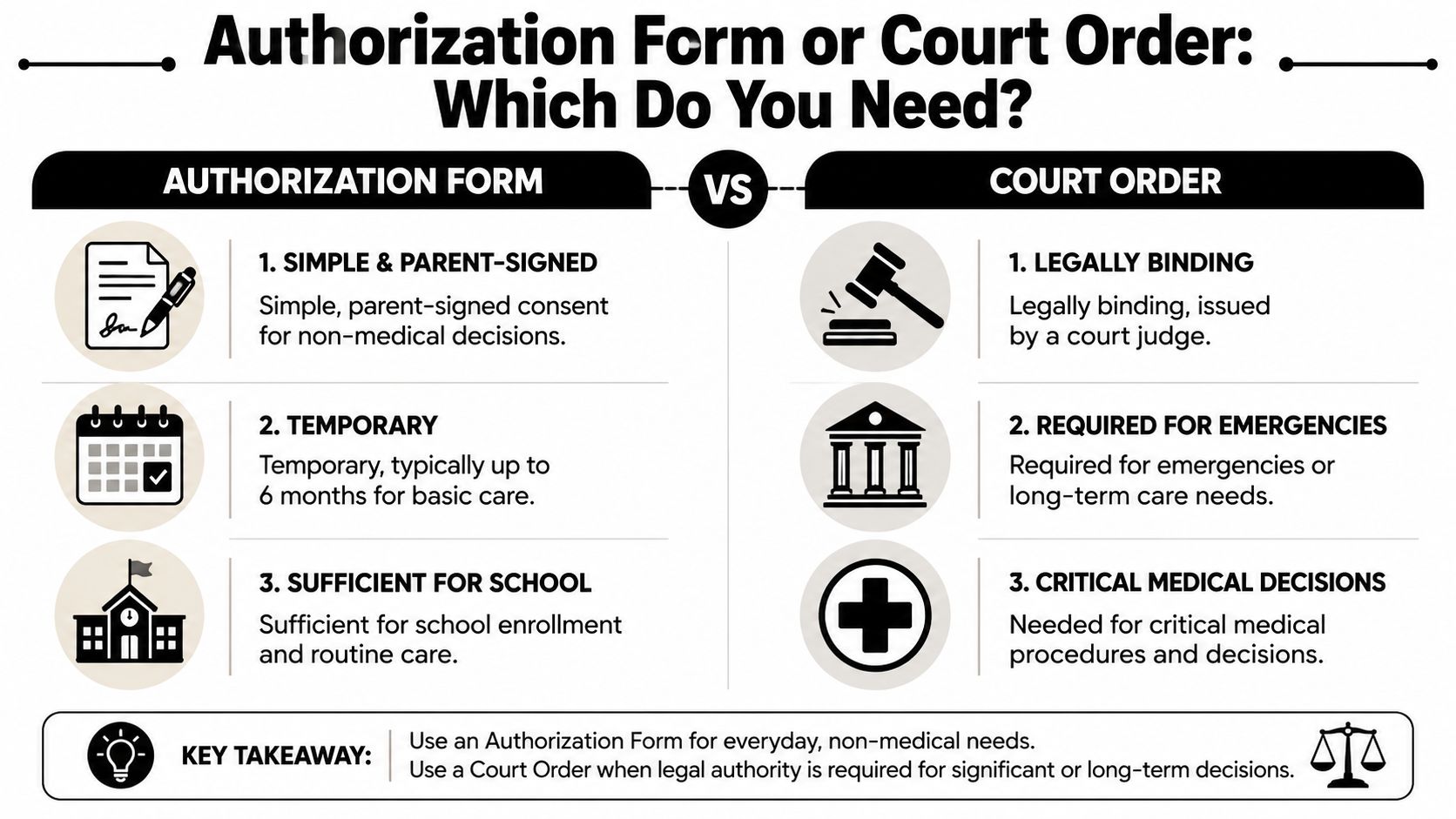
Authorization Form or Court Order Which Do You Need
The biggest mistake I see is choosing the wrong tool at the start. People hear “temporary guardianship” and assume there's one standard Texas form. There isn't. For a child, the first fork in the road is usually a parent-signed authorization agreement versus a court order.
This side-by-side view helps.
When the authorization form is usually enough
Texas consumer guidance makes this point clearly. Families often use the phrase temporary guardianship form loosely, but the central issue is whether a simple parent-signed authorization agreement is enough or whether court relief under Family Code Chapter 35 is necessary, as explained in Texas Law Help's nonparent caregiver guidance.
An authorization form usually fits when:
- A parent agrees: At least one parent is available, cooperative, and willing to sign.
- The need is practical: School enrollment, routine medical care, and day-to-day supervision are the main issues.
- No one is fighting over the child: There isn't an active conflict that makes the form unreliable.
- You don't need to replace parental rights: The parent wants help, not a transfer of legal status.
A common Montgomery County example is a grandparent in Creekside Park caring for a child over the summer while both parents agree the grandparent should handle school and doctor visits. In that setting, the authorization path is often the sensible first move.
When you likely need a court order
A court filing is usually the better path when the family situation is unstable, contested, or more serious than routine care.
You should stop and look closely if:
- The other parent objects
- A parent is unavailable or cannot be found
- There's concern about safety
- An institution wants formal judicial authority
- The caregiver needs stronger decision-making power than a limited authorization provides
That's also when related conservatorship and possession issues may overlap with what a Child Custody Lawyer in The Woodlands, TX handles for local families.
Practical rule: If everyone is cooperating, a narrow written authorization often works. If people are fighting, hiding, or refusing, a paper signed at the kitchen table usually won't solve the problem.
Later in the process, schools and medical providers often care less about what you call the document and more about whether the authority is specific, signed correctly, and dependable if challenged.
A short overview can also help if you prefer video before paperwork.
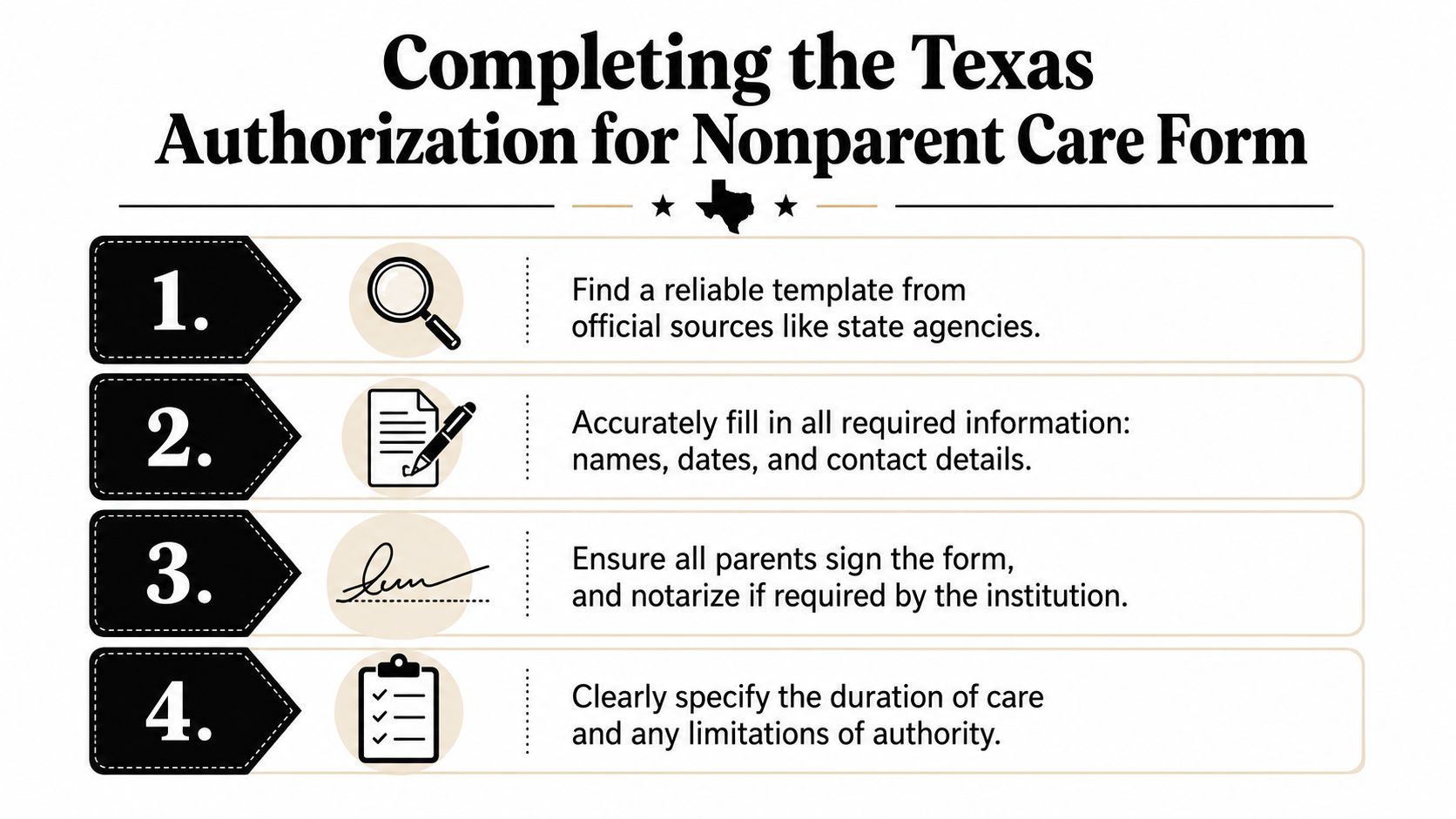
Completing the Texas Authorization for Nonparent Care Form
If your situation is cooperative and you've confirmed that a simple authorization is the right fit, details matter. The form works best when it reads like a clear instruction document for a school registrar, pediatric office, counselor, or daycare director.
What the form needs to say
For a minor, Texas practice guidance stresses a six-month maximum duration unless extended by a court, and the document should clearly identify the child, the current legal guardian's information, the temporary caregiver's information, the exact start and end dates, and the scope of authority. It should also be notarized so schools and healthcare providers can rely on it, as discussed in this Texas temporary legal guardianship form overview.
That means the form should include:
- Who the child is: Full legal name and identifying details.
- Who is giving authority: The parent or legal guardian with authority to sign.
- Who is receiving authority: The grandparent, relative, or family friend who will act for the child.
- When the authority starts and ends: Specific dates, not vague phrases.
- What the caregiver may do: School matters, medical consent, records access, and daily care authority should be described with enough precision that an institution can understand them.
If you're preparing, revising, or saving signed documents electronically before notarization, a practical guide to free Mac PDF tools can help you clean up signatures, dates, and fillable fields so the final paperwork is easier to read.
How to define authority so schools and clinics accept it
Many forms fail in this regard. People write “medical care” and assume that covers everything. It often doesn't.
Use direct language tied to real tasks:
- For school: enroll the child, obtain records, communicate with staff, sign routine school documents
- For healthcare: consent to routine care, access records, receive discharge instructions
- For daily care: supervise activities, communicate with childcare providers, handle ordinary scheduling issues
A Magnolia ISD registrar or pediatric clinic employee isn't trying to make your life difficult. They're trying to see whether the document clearly authorizes the exact act being requested.
Vague authority gets delayed. Specific authority gets processed.
Common drafting mistakes
The most common problems are easy to avoid:
- Missing dates: Institutions want to know whether the form is active now.
- Incomplete names or contact information: If they can't identify the signer or caregiver, they may refuse it.
- Overbroad assumptions: The caregiver doesn't become the child's legal parent.
- No notarization: Even good content can be questioned if execution is sloppy.
If you're relying on a temporary guardianship form Texas families commonly discuss online, slow down and confirm you're using the correct nonparent care authorization and not a generic document pulled from another state or a non-Texas template.
Navigating the Montgomery County Court Process for Guardianship
A grandparent in The Woodlands can usually get a school form notarized in a day. A court case in Montgomery County is different. If a parent cannot be found, is actively objecting, or the child needs protection that schools and clinics will not honor without a judge's order, the private form route has run its course.
In practice, families often say they need “temporary guardianship,” but that phrase covers two very different paths. One is a signed authorization that lets a caregiver handle limited day-to-day decisions. The other is a court order entered after filing, notice, and a hearing in Conroe. The second path takes more work, costs more, and gives stronger authority.

For minors, the court wants facts, notice, and a legal basis
For a child, a court case usually becomes necessary when the caregiver needs enforceable authority that a notarized authorization cannot provide. Texas Law Help explains that a court-based Temporary Authorization for Care of a Minor Child may be available if the child has lived with the petitioner for at least 30 days, and the case requires service of the petition and notice of hearing on each parent, conservator, or guardian, with proof of service filed at least 3 days before the hearing, as described in Texas Law Help's Chapter 35 guide.
That notice requirement is where many self-filed cases get stuck. The court is not just checking whether you have good intentions. The judge needs a clear explanation of why the child is with you, what decisions must be made right now, where the parents are, and what notice has gone out.
Montgomery County families should pay close attention to three practical points:
- File in the correct court and county: Jurisdiction problems slow a case down before the judge ever reaches the merits.
- Use precise facts in the petition: Dates, addresses, the child's living arrangement, and the reason court involvement is needed matter.
- Handle service correctly: If a parent was not served properly, the hearing may be reset or the requested relief may be denied.
I tell clients to treat the hearing request like a sworn explanation, not a family summary. “Mom is unstable” is a conclusion. Specific facts about absence, drug use, incarceration, untreated mental health issues, or refusal to consent to care give the court something it can act on.
Adult temporary guardianship is a separate emergency process
If the issue involves an incapacitated adult, the case falls under a different set of rules. Temporary guardianship for an adult is an emergency remedy used when immediate protection is needed and lesser options will not work. It is short-term by design, and judges expect evidence of immediate risk to the person or property.
That trade-off matters. A court order can let someone act quickly, but it also brings sworn medical evidence, formal notice, tighter deadlines, and close court supervision. Families sometimes ask for guardianship when a power of attorney would have solved the problem months earlier. By the time they reach court, they are dealing with a crisis instead of planning.
If you are trying to gauge what a temporary hearing in this county looks like, this overview of navigating a temporary custody hearing in Montgomery County gives useful local context.
Courts and institutions may also review a caregiver's history more closely once a matter becomes contested or more formal. This plain-English VolunteerBadge background check guide is a useful general primer.
The practical question is simple. If the parent agrees and the issue is routine school or medical coordination, the authorization form is often enough. If there is conflict, disappearance, danger, or a need for binding legal authority, expect to file in Montgomery County and prepare for a real hearing.
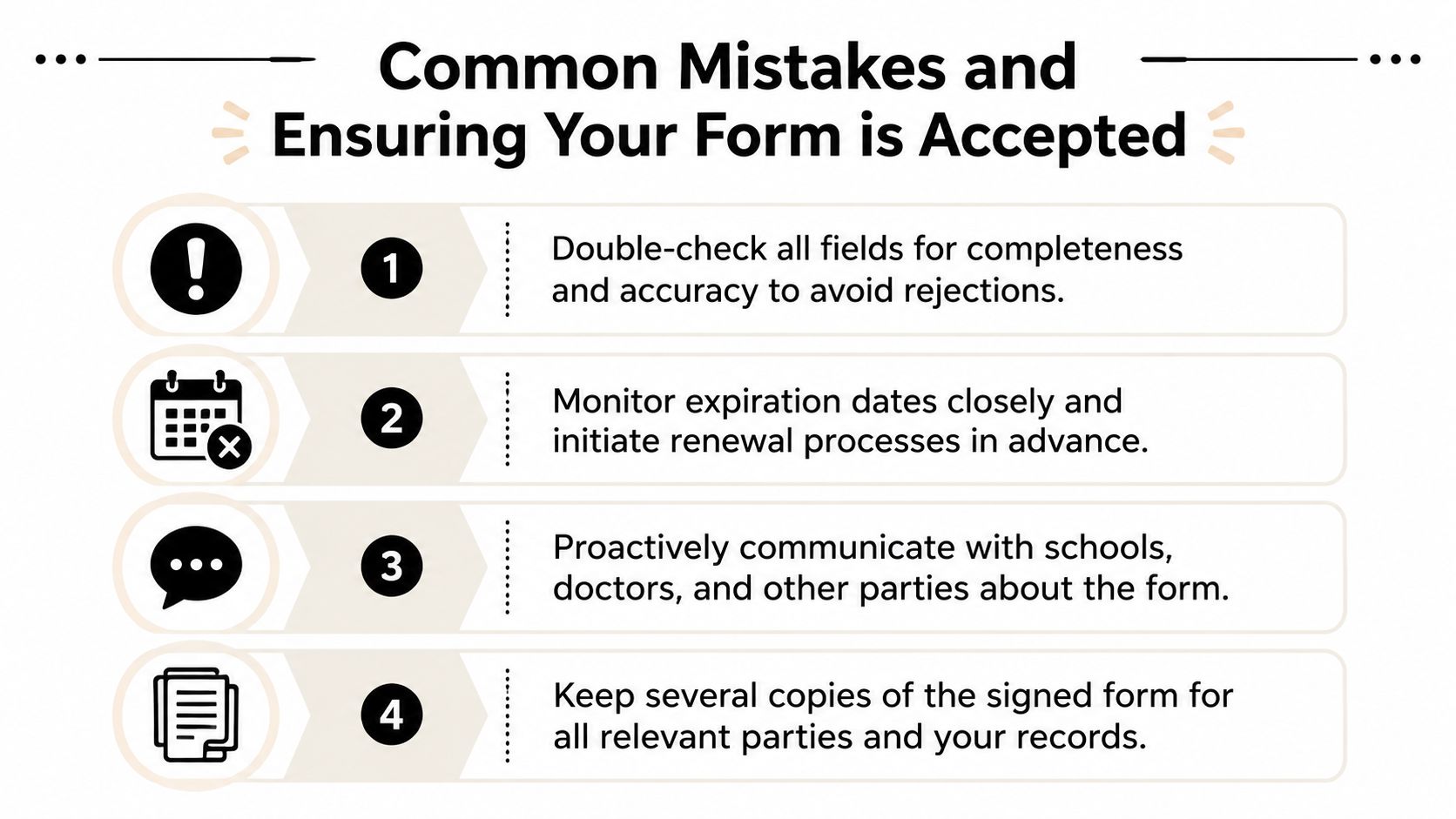
Common Mistakes and Ensuring Your Form is Accepted
The document isn't the finish line. Acceptance is. A signed form that a school secretary, urgent care clinic, or daycare director won't honor doesn't solve your problem.
Why institutions reject otherwise decent paperwork
Most rejections come from one of three issues. The form is incomplete, the authority is too vague, or the staff member believes the situation calls for a court order instead.
Texas Law Help notes an operational issue many families miss. At least one parent and the nonparent must sign, and a copy must be mailed to the other parent within 10 days by certified mail and regular mail. That same guidance also notes the agreement does not authorize abortion or emergency contraception, which shows how limited and specific this authority can be under Texas authorization agreement guidance for nonparent care.
What works in practice
If you want the form to function smoothly in The Woodlands or surrounding Montgomery County communities, handle it like a working file, not a single sheet of paper.
- Bring multiple notarized copies: One for school, one for the pediatrician, one for activities, and one for your records.
- Keep parent contact details ready: Staff often want a phone number or email to confirm cooperation.
- Mail the required copy correctly: Use both certified mail and regular mail to the other parent when required.
- Call ahead before the first appointment: Ask what the office wants to see so you're not arguing at the front desk.
- Watch the expiration date: Don't wait until the last week if the arrangement still needs to continue.
A limited authorization can be perfectly valid and still be narrower than what a caregiver hoped it would do.
If the other parent objects
An objection changes the temperature fast. If the other parent starts disputing the arrangement, trying to revoke consent, or telling schools not to honor the document, you may be moving out of form territory and into court territory.
That's especially true when the child's housing, medical treatment, or school placement is being challenged. At that point, the issue usually isn't drafting. It's legal authority.
Your Next Steps and When to Call a Lawyer
A grandparent usually calls at the point where the paper in hand no longer matches the problem at home. The parent may have agreed at first, then stopped answering. A school may accept the form for enrollment but refuse to discuss a discipline issue or special services. A doctor's office may ask harder questions than expected. That is the moment to stop guessing about labels and decide whether you need a signed authorization or a court order.
The practical question is authority. A notarized authorization works best when the parents are cooperating and the caregiver only needs limited, day-to-day permission. A court case is often the better choice when a parent is objecting, unavailable, impaired, or creating instability for the child. In Montgomery County, that distinction matters because schools, hospitals, and agencies tend to respond very differently to a private form than to signed court papers.
What to do next
- Identify the core issue: Is this about school pickup and routine care, or do you need authority that will hold up during conflict?
- Match the tool to the facts: Use the authorization form for cooperative arrangements. Consider a court filing if consent is shaky or the child's placement may be challenged.
- Review the paperwork like a third party will: Names, addresses, dates, and signatures should be consistent across every document.
- Get organized before the first dispute: Keep copies, parent contact information, and any related orders in one folder.
- Act sooner if the child's safety, housing, or medical care is unstable: Delay usually makes emergency filings harder, not easier.
Some situations need legal advice right away.
Call a lawyer promptly if a parent is threatening to take the child without notice, revoking prior consent, blocking medical care, disputing school enrollment, or if there is already a SAPCR, custody case, or probate matter pending. The same is true if you are caring for a child after a parent's incarceration, hospitalization, relapse, or disappearance. Those cases often turn on details that are easy to miss and hard to fix after the wrong document is signed.
This article is for general information only. It is not legal advice and does not create an attorney-client relationship. Texas family law and guardianship questions depend on the specific facts, including who has parental rights, whether another case is already on file, and whether immediate court action is needed.
If you are in The Woodlands, Conroe, Magnolia, or elsewhere in Montgomery County and need help choosing the right next step, you can request a family law consultation in The Woodlands.
If you're dealing with a temporary guardianship form Texas issue and need help sorting out whether you need a simple authorization or a court order, The Law Office of Bryan Fagan works with families in The Woodlands and Montgomery County on family law, custody, and probate-related matters. A consultation can help you identify the right path before a school deadline, medical issue, or family dispute makes the situation harder.
