 Skip to content
Your phone is buzzing. Someone from CPS is at the door, or they just called and want to “stop by.” Your chest tightens, your mind starts racing, and your first instinct is to explain everything.
Stop.
If you're in The Woodlands or anywhere in Montgomery County, this is the moment to slow down and get disciplined. A CPS case can turn on what you say in the first conversation, what you hand over in the first day, and whether you let panic run the house. If you're looking for an Emergency CPS Lawyer in The Woodlands, you don't need vague comfort. You need a plan.
A CPS Investigator Is At Your Door in The Woodlands What Now
You are standing at your front door in Creekside, Indian Springs, or Sterling Ridge. A CPS investigator gives you a card, asks to come inside, and starts talking like this is routine. For you, it is not routine. It is the first test.

Treat the first contact like a legal event, because that is what it is. The investigator is collecting statements, judging the home, watching your child, and deciding whether to push for more access fast. In Montgomery County, that file can move from a doorstep conversation to an emergency court fight much faster than parents expect.
Your job is simple. Slow the scene down. Get information. Make no careless admissions.
Start with control
Do not try to win the investigator over on the porch. Do not fill the silence because you are scared. Do not let embarrassment make decisions for you.
Use a short script and stick to it:
- Ask for identification. Get the investigator's full name, office, phone number, and business card.
- Ask why they are there. You want the general allegation, who is involved, and whether they claim there is immediate danger.
- Keep your answers brief. Confirm basic identifying information. Nothing more.
- Do not consent blindly. Entry, photos, interviews, drug tests, and signed safety plans all matter.
- Call local counsel fast. A CPS investigation lawyer in The Woodlands can help you handle the first contact with Montgomery County procedure in mind, not generic Texas advice.
One bad sentence can become the center of the case.
What to say at the door
Use calm, plain language:
"I will cooperate through counsel. Please give me your card and tell me the allegation you are investigating."
If they ask to come in, say:
"I want to speak with my lawyer before I consent to entry or interviews."
If they push for a statement right then, say:
"I am not refusing to cooperate. I am choosing to respond carefully."
That approach protects you without picking a fight. Parents in The Woodlands get into trouble when they confuse being polite with giving away control.
What matters in the first few minutes
The investigator is forming impressions immediately. Your tone matters. So does your discipline.
| Situation | Bad response | Better response |
|---|---|---|
| CPS arrives unannounced | Long emotional explanation | Short, calm questions |
| Investigator asks to enter | Immediate consent out of fear | Pause and decide after legal advice |
| Allegation sounds false | Arguing about the reporter | Focus on the accusation and process |
| Children are present | Discussing details in front of them | Move the contact outside or keep it brief |
This is especially serious if you already have a divorce, custody, or modification case pending in Montgomery County. CPS allegations often get pulled into family court. A sloppy doorstep exchange can show up later in temporary orders, conservatorship claims, or restrictions on possession.
Stay steady. Stay brief. Get organized. In The Woodlands, the first move is not about explaining your whole life. It is about keeping control of the first 30 minutes so the next 72 hours do not get worse.
Your First 72 Hours The Critical Dos and Don'ts
The first three days decide whether this case stays manageable or starts controlling your family. In Montgomery County, parents get in the most trouble during this window because they talk too much, sign too fast, and fail to keep a clean record of what CPS asked for.
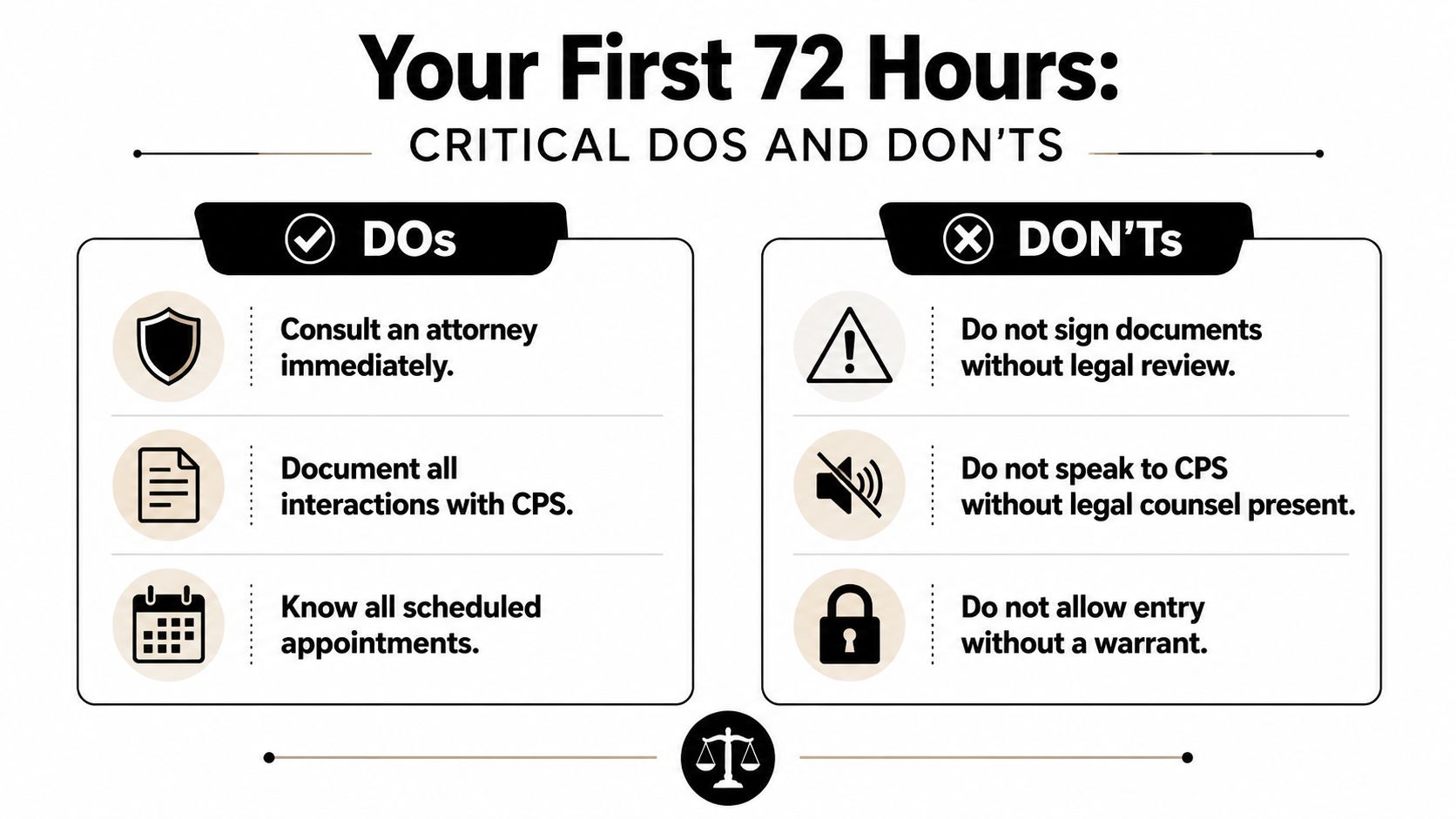
Treat the first 72 hours like evidence preservation and damage control. Your job is simple. Record every contact, stop casual conversations, protect records before anyone edits or deletes anything, and make sure one adult controls communications. If your case is likely headed into local court quickly, parents often start by looking for a Montgomery County CPS attorney who handles emergency settings and knows how these cases move here.
Do these things immediately
Take these steps in order.
Start a case log now
Use your phone, a notebook, or both. Write down every call, text, voicemail, visit, and request. Include exact times, names, badge information if you have it, and who heard the conversation.Preserve records before you send anything
Pull texts, school records, medical records, photos, prior court orders, daycare notices, and anything tied to the allegation. Save screenshots and full files. Do not crop, summarize, or "clean up" anything.Pick one point of contact
One calm adult should handle all communication. If Mom, Dad, a grandparent, and the other parent all start replying separately, you create contradictions CPS can write down as facts.Build a 72-hour timeline
Write out where the child was, who supervised, school attendance, medical visits, exchanges, and any recent conflict with the other parent. Parents in The Woodlands often know the story generally but cannot place events by day and time when pressure hits.Secure your house and your people
Tell relatives and older children not to discuss the case with anyone. Gather medications, lock up firearms, make sure the home is orderly, and confirm the child has what they need. If CPS returns, you do not want avoidable issues sitting in plain view.
A local option parents often look for is a CPS Defense Attorney in The Woodlands, which is defense against CPS investigations for The Woodlands families.
Here's a quick explainer that reinforces the same point about early discipline:
Avoid these common mistakes
Parents in The Woodlands hurt their cases when fear takes over and every conversation turns into an explanation session. CPS does not need your full life story on day one.
- Don't sign on the spot: Safety plans, medical releases, and written statements can limit your options before you understand the allegation.
- Don't hand over your phone: Provide records carefully after you review them with counsel.
- Don't let family members freelance: One emotional text from a relative can end up in the file.
- Don't guess: If you do not know a date, time, or detail, say you need to verify it.
- Don't discuss the case in front of the children: That creates stress for them and gives CPS more observations to write down.
- Don't consent to entry casually: A quick invitation inside can change the tone of the investigation fast.
Say this instead: “I want to cooperate appropriately, but I want to speak with an attorney before answering questions or allowing entry.”
A short local scenario
A father in Sterling Ridge gets a surprise visit after an argument with the child's other parent. He is angry and sure the report is false, so he starts talking. He explains the custody dispute, scrolls through texts in front of the investigator, and agrees to a walk-through because he thinks refusing will make him look guilty.
That choice gives CPS more material, more context, and more room to interpret things against him.
A better response is controlled and boring. Log the contact. Confirm the allegation category if they will tell you. Preserve your records. Keep the child out of the middle. Get legal help before the second conversation, not after the first bad one.
Finding and Retaining an Emergency CPS Lawyer Quickly
Not every family lawyer should handle an emergency CPS case. That's the truth. A lawyer who mainly handles agreed divorces or routine support matters may not be the right person when CPS is pressing for immediate action in Montgomery County.
You need someone who understands how local judges, DFPS lawyers, and emergency settings work. Generic Texas knowledge isn't enough. Local procedure matters. Timing matters. Presentation matters.
Why a specialist matters
A true emergency CPS lawyer does more than “show up in court.” That lawyer should control contact with CPS, review records before submission, spot overlap with an existing custody fight, and prepare for removal or temporary orders fast.
If a lawyer can't explain how a CPS case may affect your pending SAPCR, divorce, or modification, keep looking.
Use a local benchmark. If you're screening lawyers, one relevant category to compare is a Montgomery County CPS attorney. What matters is not the label. What matters is whether the lawyer regularly handles CPS pressure inside Montgomery County courts.
Questions to ask in the consultation
Don't waste the consultation on vague questions like “Have you done family law?” Ask things that test whether the lawyer is built for this kind of emergency.
| Ask this | Why it matters |
|---|---|
| Have you handled CPS cases in Montgomery County? | Local court practice isn't interchangeable |
| How do you handle overlap with custody litigation? | Many CPS reports are tied to family conflict |
| What should I stop saying or doing today? | Good lawyers give immediate tactical advice |
| What records do you want first? | Urgency shows competence |
| Who will actually manage my case? | You need clarity, not a bait-and-switch |
Red flags you shouldn't ignore
Some lawyers talk big and move slow. That's dangerous here.
Watch for these warning signs:
- They promise outcomes: No serious lawyer can guarantee what CPS or a judge will do.
- They don't ask for documents immediately: That signals a lack of urgency.
- They focus only on trial: Most of the important work happens before trial.
- They brush off the custody angle: In The Woodlands, that can be where the main danger sits.
The one time I want parents to be demanding is this. Ask hard questions. You're not buying calm words. You're hiring judgment under pressure.
The Emergency Hearing Process in Montgomery County
Once CPS pushes the case into court, parents often feel blindsided. The process moves quickly, the paperwork is dense, and every hearing sounds more final than it is. You need to understand what each stage means.
What the court is looking at
Under the Texas Family Code, emergency child protection proceedings often turn on whether CPS claims immediate danger, whether removal was necessary, and what temporary orders the judge believes are appropriate. If a child has already been removed, Texas law under Family Code Chapter 262 is the framework your lawyer will be working inside.
You may also have related conservatorship issues under the Texas Family Code if there is already a custody case pending in Montgomery County. That overlap matters. Judges don't view these cases in a vacuum.
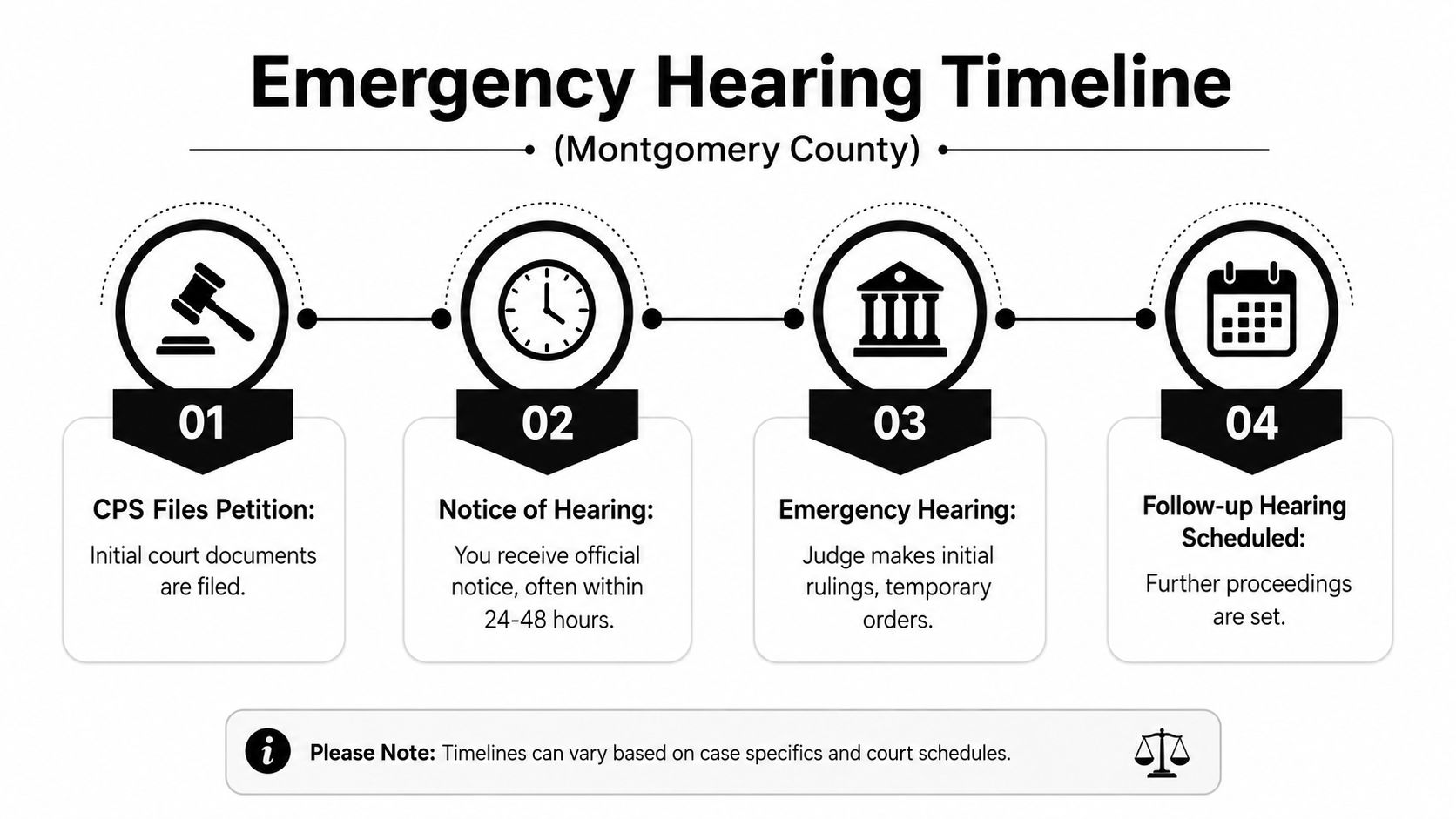
The likely hearing sequence
The hearing timeline is fast, but it's not random.
- Initial filing by CPS: CPS files court papers asking for relief.
- Notice of hearing: Families may get notice quickly, and the matter can move on a compressed schedule.
- Emergency hearing: The judge makes initial rulings and may enter temporary orders.
- Follow-up proceedings: The court sets the next date and outlines what must happen next.
If you're facing that stage, this local resource on a CPS removal hearing in The Woodlands is directly relevant to what happens when CPS asks the court to intervene.
Court is not where you start explaining from scratch. Court is where your lawyer presents a structured answer to the story CPS is trying to tell.
Why preparation changes the hearing
An emergency hearing is not a therapy session. It is not the place to vent about your ex, the reporter, or how unfair this feels. It is about evidence, risk, and temporary decision-making.
That means your lawyer needs clean records, a coherent timeline, and a realistic plan for the child. If there is a safe family placement option, that can matter. If school records or medical records undercut the allegation, that matters.
In some families, the broader legal issues later shift into a very different posture. For example, some Montgomery County families who once dealt with CPS later need entirely different help, such as an Adoption Attorney in The Woodlands, TX for adoption representation for families in The Woodlands. Different legal stage. Different objective. Right now, the only objective is stabilization.
What to expect from your role
Your job isn't to control the courtroom. Your job is to help your lawyer do theirs.
Bring order to the facts:
- Stay consistent: Inconsistent statements can do real damage.
- Arrive prepared: Have your records, contacts, and timeline organized.
- Follow instructions: Don't improvise testimony in the hallway.
- Focus on the child: Judges want to hear concrete safety and care plans.
If the hearing is coming fast, that doesn't mean you're powerless. It means preparation has to happen faster than your panic.
Gathering Your Evidence and Creating a Proactive Safety Plan
By the time CPS is circling your family, memory isn't enough. You need documents, names, photos, and a plan that makes sense to a judge.
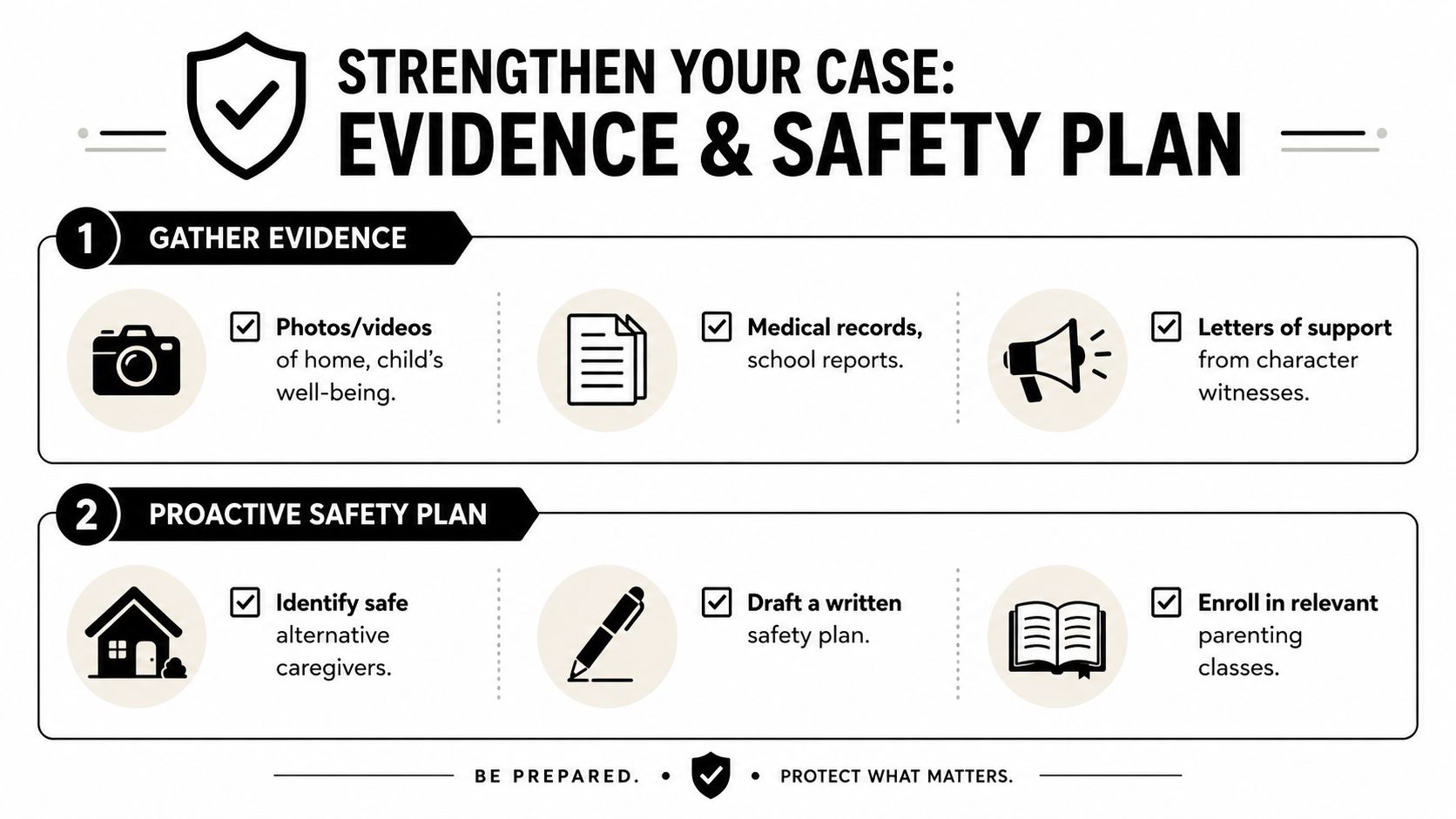
Build your evidence file
Think like a careful adult, not like someone defending themselves in an argument. Gather the material your lawyer can use.
Start with these:
- Medical records: Appointment summaries, prescriptions, vaccination records, discharge instructions.
- School records: Attendance, teacher notes, counselor communications, report cards.
- Home condition evidence: Clear photos and video of sleeping arrangements, food, medication storage, and general living conditions.
- Witness contacts: Teachers, daycare staff, relatives, neighbors, coaches, doctors.
- Prior court orders: Divorce decrees, custody orders, modification orders, protective orders if any exist.
If you're collecting or signing documents under stress, it helps to understand the basics of what makes paperwork enforceable. A plain-English resource on how to ensure binding agreements for businesses is useful here because the same core idea applies. Don't sign something important unless you understand what it commits you to.
Be careful with any safety plan
A CPS safety plan can look informal. It isn't harmless just because it isn't dressed up like a court order.
If CPS hands you a “voluntary” plan, slow down. Read every line. Ask what happens if you sign it, what happens if you don't, who keeps the child, who can supervise, and how long it lasts. Then let your lawyer review it.
A rushed signature can create restrictions you spend months trying to unwind.
Create a proactive plan before CPS creates one for you
The stronger move is working with your lawyer on a proactive safety plan. That shows the court you're taking concerns seriously without surrendering control blindly.
A practical plan might include:
| Issue | Proactive response |
|---|---|
| Temporary care concern | Identify a trusted relative in Creekside or Sterling Ridge |
| Supervision question | Arrange a reliable adult presence after school |
| Parenting concern | Enroll in a relevant class if your lawyer advises it |
| Home condition complaint | Document corrections and current living conditions |
This isn't about admitting wrongdoing. It's about showing the court that your child has safe options within the family, not only through foster care or agency control.
Your Immediate Checklist and Protecting Your Family's Future
When parents are frightened, they need a short list they can follow without overthinking. Here it is.
What to do next
Get the investigator's full information
Name, phone number, office, and what they say they're investigating.Stop talking about the case to everyone else
Don't explain it to relatives, neighbors, or the other parent in text messages.Start your case log immediately
Dates, times, requests, witnesses, and what was said.Preserve records
Save texts, school communications, medical records, and existing court orders.Don't sign documents without review
Especially safety plans, releases, and written statements.Don't consent to extra access casually
Stay calm and measured if CPS asks for home entry or interviews.Hire local counsel fast
You need someone who knows Montgomery County practice, not someone learning on your case.Prepare for court even if you hope it won't happen
Hope is not a plan.
The bigger picture
A CPS case is never just about the day of the knock. It can affect your custody position, your credibility in family court, and the shape of your life for a long time. That's why control matters from the beginning.
If you're in The Woodlands, Conroe, Magnolia, or another Montgomery County community, treat CPS contact as a legal event, not a misunderstanding you'll smooth over with a long explanation. A calm parent with a plan is in a far better position than a frantic parent trying to talk their way out of trouble.
Important disclaimer
This article is for educational purposes only. It is not legal advice and does not create an attorney-client relationship. CPS cases are fact-specific, and you should get advice from a qualified Texas lawyer about your own situation.
You don't need to panic. You do need to move.
If your family is dealing with urgent CPS contact in The Woodlands or Montgomery County, The Law Office of Bryan Fagan serves local families in custody and high-conflict family law matters, including CPS-related disputes. A confidential consultation can help you understand your position and decide on the next step.
