 Skip to content
A family crisis usually doesn't arrive at a convenient time. It shows up in the kitchen before work, in a school pickup line, or in a late-night text thread that suddenly makes it clear your marriage, custody arrangement, or financial situation can't keep going as it has.
In The Woodlands and across Montgomery County, that first impulse is often the same. You want answers right now, but you may not know whether to collect documents, protect your children, move money, respond to a message, or call a lawyer first.
A good family lawyer The Woodlands TX consultation should bring order to that moment. It should help you understand what matters, what can wait, and what mistakes to avoid before your case ever reaches a courtroom. Texas families face these issues every day, and Texas divorce filings are estimated at about 70,000 to 80,000 each year. That doesn't make your situation less personal. It does mean you're not alone, and there is a path forward.
That First Moment You Realize You Need a Lawyer
A common local pattern looks like this. A spouse in Alden Bridge sees unusual bank transfers. A parent in Creekside gets a message that the other parent wants to keep the child beyond the agreed return time. Someone in Sterling Ridge learns their spouse has already spoken with a lawyer. Panic follows quickly.

What works in that moment is simple. Slow down enough to protect facts, not feelings. Save texts. Screenshot account activity. Write down dates. Keep your communication with the other side brief and civil. If children are involved, focus on immediate safety, stability, and who has the child right now.
What doesn't work is trying to solve everything in one night. People often make the situation harder by sending long emotional messages, cleaning out accounts without advice, or agreeing to “temporary” parenting changes that later become the practical status quo.
When the problem is urgent
Some situations can't wait for a routine appointment. If you believe your child may be at immediate risk, if a parent is threatening to disappear with the child, or if access to money has suddenly been cut off, the consultation needs to focus on triage. That may involve temporary orders, emergency relief, or immediate filing strategy rather than a broad discussion of divorce.
Practical rule: Before the first meeting, preserve evidence and avoid escalation. Judges in family court often care as much about conduct during the conflict as they do about the conflict itself.
Texas family law gives courts broad authority over conservatorship, possession, support, and temporary relief under the Texas Family Code. In plain terms, that means a court can step in early when family stability is at risk. But your lawyer can only act on what you can show. Good records matter from the first day.
One short real-world scenario
A mother in Panther Creek called after a routine exchange turned into a serious custody dispute. The other parent began sending messages about keeping the child “until things calm down.” She did two useful things before the consultation. She saved every text in order, and she wrote a clean timeline with dates, pickup times, and the child's school schedule.
That preparation turned a vague fear into a concrete legal discussion. Instead of spending the consultation trying to reconstruct events, the meeting focused on whether temporary orders made sense and what evidence would matter first.
Understanding Your Consultation Options in The Woodlands
The first decision is often simpler than people expect. You are choosing the kind of meeting that fits your problem right now.

In The Woodlands, family law consultations usually fall into two categories. Some firms offer a short intake call or introductory meeting. Others offer a paid strategy session with time to review facts, documents, and immediate options. Both can be useful. They just answer different questions.
Free consultation versus paid consultation
Here is the practical difference:
| Option | Usually best for | What you can expect |
|---|---|---|
| Free consultation | People deciding whether they need counsel at all | Basic issue spotting, conflict check, fit assessment, and next-step guidance |
| Paid consultation | People needing case-specific legal analysis | Deeper review of facts, procedural options, likely trouble points, and early strategy |
A free meeting is often enough to answer threshold questions. Is this a divorce matter, a custody modification, an enforcement case, or something outside family court? Do you need to act now, or can you spend a few days getting organized first? Is this lawyer someone you would trust with sensitive facts and a stressful process?
A paid consultation usually makes more sense when the situation is already complicated. Prior court orders, disputes over parenting time, business ownership, sudden account changes, separate-property claims, or a need for temporary orders often require more than a short screening conversation.
Sometimes clients do not need a long legal lecture at the first meeting. They need an order of operations.
Why the format matters
The quality of the consultation depends less on whether it is free or paid, and more on whether the format matches the urgency, complexity, and stakes of the problem. A short intake can save time if you are still figuring out whether you need a family lawyer at all. A longer strategy session is often a better use of money when the facts are already moving toward court.
That difference matters in Montgomery County, where many people call a lawyer after weeks of confusion, partial information, and advice from relatives or friends. By that point, the most useful consultation is the one that turns scattered facts into a workable plan. If you want to get more out of that first meeting, this Texas divorce consultation preparation guide explains what to gather before you sit down with counsel.
How to decide which format fits
Choose a shorter intake-style meeting if:
- You are still identifying the issue and need to confirm whether it belongs in family court.
- You have no active hearing, filing deadline, or immediate child-safety concern.
- You want to compare lawyers before committing more time and records.
Choose a deeper strategy meeting if:
- You need advice tied to your exact facts, not general information.
- You may need temporary orders soon for custody, support, property use, or financial restraint.
- You suspect concealment, relocation, or a serious parenting dispute that will require evidence and quick decisions.
A good consultation should leave you with more than a general impression. You should know what kind of case you likely have, what needs attention first, what documents matter most, and what mistakes to avoid before the next step.
How to Prepare for Your First Meeting
The strongest consultations usually begin before the phone call. A spouse has moved money, a pickup time was missed, or papers were left at the door. In that moment, it helps to slow down and organize the facts before stress starts filling in the gaps.
##
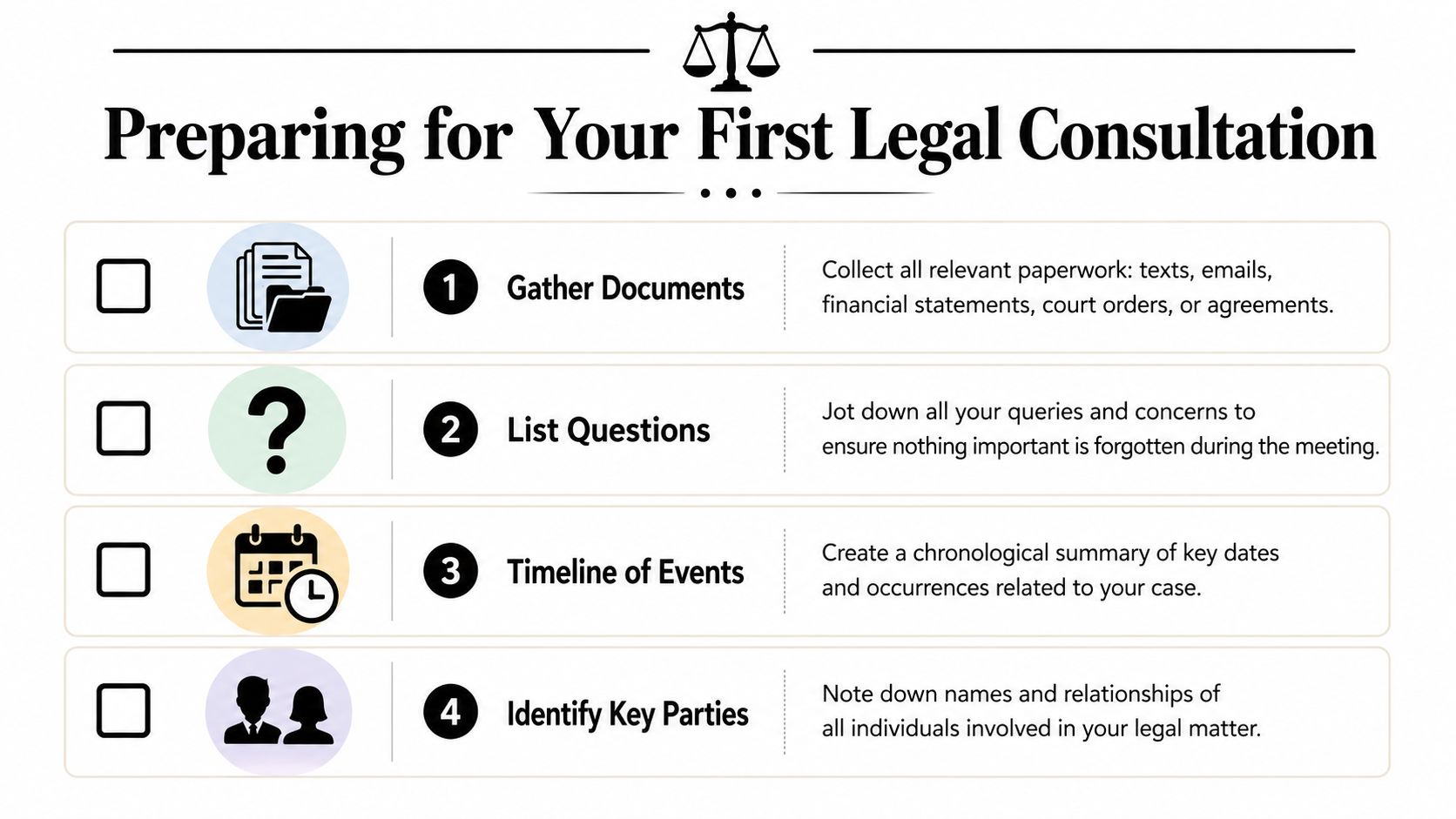
Good preparation saves time, lowers confusion, and gives your lawyer something solid to work with. In The Woodlands and across Montgomery County, family cases often arrive with emotion first and records later. Reverse that pattern. If you want a practical starting point, this guide on how to prepare for a divorce consultation in Texas can help you get organized before the meeting.
Build a short timeline first
Start with one page. Keep it chronological and plain. Include the marriage date, separation date if there is one, the children's names and ages, any prior court orders, major changes in income or living arrangements, and the event that made you seek legal advice now.
This is not the place to argue your whole case. A lawyer can do more with a clean timeline than with six pages of understandable frustration.
To see the checklist in motion, this video gives a helpful overview of what people often need before meeting counsel.
Gather the records that help
Texas family cases turn on proof. If the question involves children, money, property, or safety, documents usually matter more than memory.
Bring what you have now. Do not postpone the meeting because your file is incomplete. A partial set of useful records is enough to identify what matters and what should be collected next.
- Financial records. Recent pay stubs or other income records, tax returns, bank statements, retirement account statements, credit card statements, mortgage information, vehicle loan statements, and business records if either spouse has an ownership interest.
- Child-related records. School calendars, attendance records, report cards, medical information, therapy records if relevant, and organized communication with the other parent.
- Legal documents. Prior divorce decrees, custody orders, child support orders, protective orders, premarital or postmarital agreements, estate planning documents, and any current court notices.
- Digital evidence. Text messages, emails, photographs, shared calendar entries, and messages from parenting apps. Keep them in original form when possible.
Protect evidence without making the problem worse
Preserve what you already have lawful access to. Save messages. Download statements. Keep screenshots clear and dated. If a social media post matters, capture the full post and note when you saw it.
Do not guess passwords. Do not edit screenshots. Do not delete messages, even if they are embarrassing.
Those mistakes create side issues that distract from the primary dispute and can hurt your credibility.
Bring the boring documents too. Utility bills, school notices, account summaries, and calendar screenshots often fill factual gaps that emotional retellings miss.
Parents dealing with immediate instability should also write down a few current details before the meeting. These are easy to forget under stress and often shape the first legal decision.
- Current possession status. Who has the child today.
- Upcoming exchanges. Date, time, and place.
- School and medical needs. What cannot be interrupted this week.
- Immediate financial access. Whether rent, mortgage, groceries, and insurance can still be paid.
A prepared consultation does not solve the case in one sitting. It does put you in a better position to get focused advice, avoid preventable mistakes, and decide what needs attention first.
Key Questions to Ask Your Potential Family Lawyer
The first meeting is not only about your facts. It's also about whether this lawyer is the right person to guide your case through Montgomery County.
Many people ask only about cost. Cost matters, but it isn't enough. You also need to know how the lawyer thinks, how they communicate, and whether they can separate urgent issues from background noise.
Questions that reveal judgment
A stronger consultation usually includes questions like these:
- What do you see as the biggest legal risk in my case right now
- If you were handling this today, what would you do first
- Do you expect this matter to begin with negotiation, mediation, or a filing
- What facts do I still need to document before any next step
- How do you handle urgent custody issues or temporary orders in Montgomery County
These questions push past marketing language. They force practical analysis.
A useful follow-up is whether the lawyer sees your matter as primarily a property case, a parenting case, a support case, or a credibility case. Many family-law disputes look broad from the outside, but one issue usually drives the outcome.
Questions about communication and fit
You'll also want to know what working together will feel like after the consultation.
- Who will answer routine questions
- How quickly do you usually respond to clients
- Will I work mainly with you, an associate, or paralegal staff
- What should I do if something urgent happens after hours
- What kind of client helps you do your best work
That last question is underrated. Some lawyers work best with clients who want frequent updates. Others work best with clients who want concise direction and fewer calls. Neither style is wrong. Fit matters.
If you want a more complete list, this article on questions to ask a divorce lawyer in Texas is a good planning tool before you walk into the room.
A good consultation should leave you calmer, not more confused. Even if the facts are hard, the next steps should sound clearer by the end of the meeting.
Listen for what isn't being promised
Be cautious if a lawyer sounds certain about outcomes too early. Family cases turn on facts, documents, opposing counsel, and judicial decisions. Confidence is helpful. Guarantees are not.
The better sign is disciplined thinking. You want someone who can explain trade-offs plainly. File now or wait. Push for temporary orders or negotiate first. Gather more records or move on what you already have.
What Happens After the Handshake
Once the meeting ends, the lawyer is sorting your case into categories. Is there a legal claim the court can act on? What relief matters first? Are the facts documented enough to proceed? Can the firm ethically take the case?
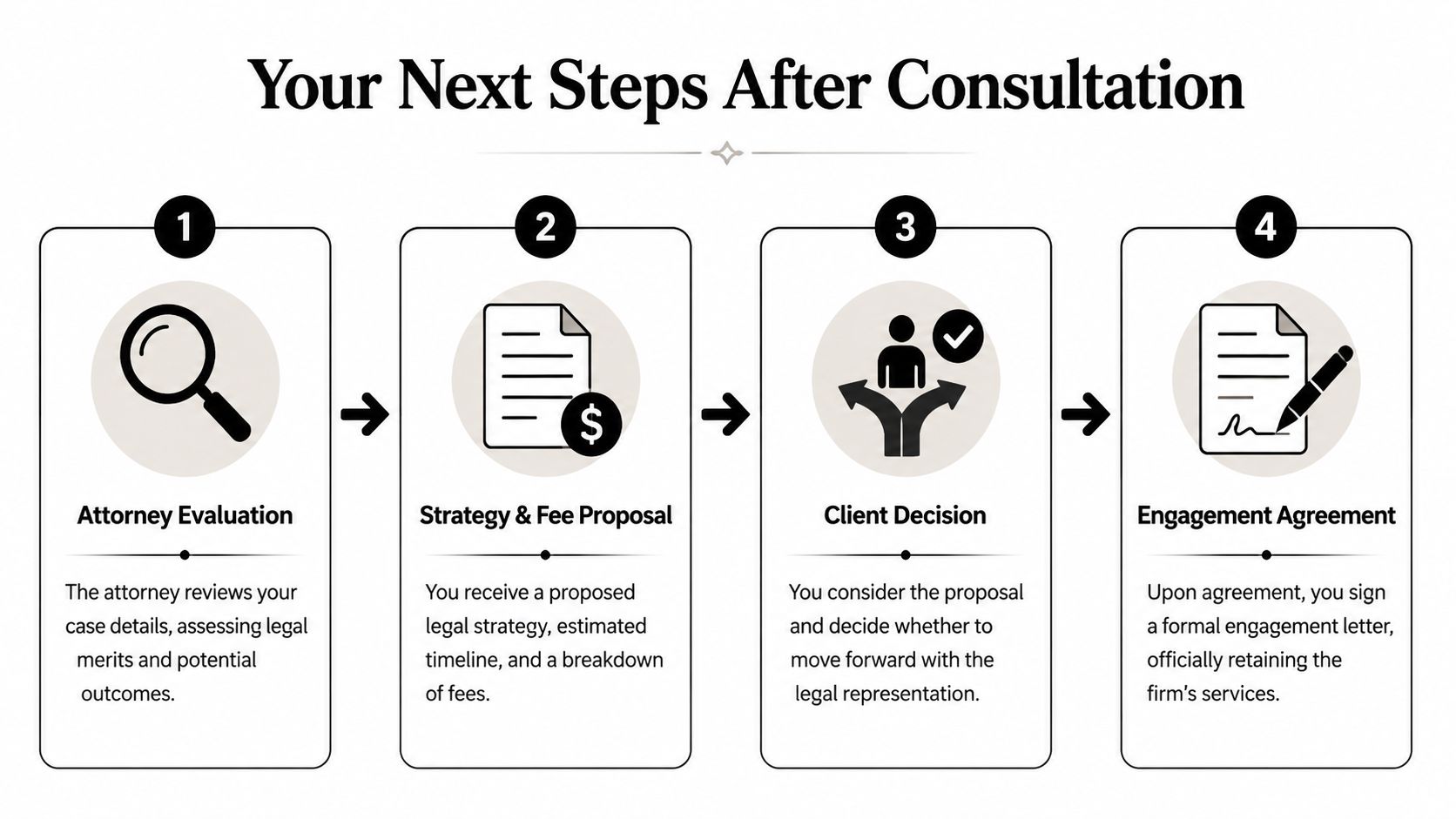
From your side, the post-consultation period is where emotion needs to give way to decision-making. You are weighing strategy, cost, timing, and trust.
What you should expect next
After a productive consultation, the next communication usually does one or more of these things:
- Confirms the scope of the issue, such as divorce, modification, enforcement, or temporary relief
- Outlines immediate priorities like preserving documents, avoiding harmful communication, or preparing for filing
- Provides engagement terms if the lawyer is offering representation
- Requests more records if key facts are still missing
If children are involved, Texas Family Code provisions on conservatorship and best interest considerations often shape the next move. If property is the main concern, the focus may shift to account tracing, debt review, and identifying what may be community versus separate property.
A short local scenario
Sarah in Sterling Ridge came to a consultation believing she needed to “file for full custody” immediately. After reviewing her facts, the issue was narrower and more urgent. The child had an unstable exchange pattern, school-week confusion, and escalating communication, but there was already a standing order in place.
The better next step was to evaluate temporary relief and enforcement options rather than rush into broad claims she couldn't support. That's a common outcome of a good consultation. It narrows the problem until it becomes manageable.
Most family cases improve when the first legal step matches the real problem. Overreaching early can distract from the relief a judge is actually willing to consider.
What to do next
Use this checklist right after your meeting:
- Review the proposed strategy. Make sure you understand the immediate objective.
- Read the engagement agreement carefully. Look at scope, billing, and who will handle your matter.
- Send the requested documents promptly. Delay after consultation often delays relief.
- Follow communication advice. If you were told to keep messages brief and child-focused, do that.
- Decide on representation quickly if the matter is urgent. Waiting can change your position, evidence quality, and scheduling.
If you decide not to hire that lawyer, keep your notes. A good consultation should still leave you better organized for the next one.
Choosing Your Advocate for the Path Ahead
The right lawyer for your situation isn't just the person who knows the law. It's the person who can apply it calmly to your facts, explain trade-offs in plain English, and help you act without making the conflict worse.
That matters in The Woodlands because family cases here are personal, local, and often fast-moving. The best fit may be the attorney who asks disciplined questions, spots the issue you missed, and gives you a realistic plan instead of a dramatic one. If you're still comparing options, this guide on how to choose a divorce lawyer in The Woodlands can help you think through the decision.
This article is for informational purposes only and is not legal advice. Reading it does not create an attorney-client relationship. You should speak directly with an attorney about the facts of your own case.
If you're ready to take the next step, schedule a consultation when you can bring facts, questions, and a clear timeline. That first meeting is often where control starts to come back.
If you need guidance on divorce, child custody, child support, property division, or urgent family-law issues in Montgomery County, you can schedule a consultation with The Law Office of Bryan Fagan. The goal of that first meeting is simple: understand where you stand, what to do next, and how to protect your family moving forward.
