 Skip to content
A lot of people start this search the same way. They're sitting at a kitchen table in Alden Bridge, in a coffee shop near Market Street, or in the parking lot after dropping the kids off at school, typing “divorce attorney near The Woodlands Texas” into their phone and hoping the next step feels clearer than the last few months have.
If that's where you are, the confusion is normal. Divorce affects your home, your children, your income, your schedule, and your sense of control. What helps most at the beginning isn't legal jargon. It's a practical understanding of what happens in a Montgomery County divorce, what slows cases down, and what choices matter early.
Starting the Divorce Process in The Woodlands
The first days of a divorce case usually feel uneven. One hour you're focused on the house, the next on your kids, and then on whether your spouse is moving money or changing passwords. Clients aren't asking for a perfect outcome at the start. They want stability and a plan.

In The Woodlands, that plan usually starts with local procedure, not courtroom drama. Your case may involve temporary living arrangements, access to accounts, parenting schedules, and document gathering long before anyone talks about a final trial. If you're trying to understand the first filing step, a basic overview of filing for divorce in The Woodlands can help you see the sequence.
What clients usually need first
Some people need immediate structure. Others need to know whether they can stay in the house, how parenting time works, or whether a business interest could become part of the marital estate. The answer depends on facts, but the first move is usually the same. Get organized before conflict gets louder.
Practical rule: The spouse who gathers complete records early usually makes better decisions later.
That means collecting account statements, tax returns, pay records, retirement information, deeds, loan documents, and any communications that affect children or finances. It also means slowing down enough to avoid avoidable mistakes, especially angry texts, rushed transfers, and social media posts that don't help your case.
One important disclaimer
This article is for general informational purposes only. It is not legal advice and does not create an attorney-client relationship. Texas family law is fact-specific, and local practice matters. You should speak directly with a qualified divorce lawyer about your situation before making legal decisions.
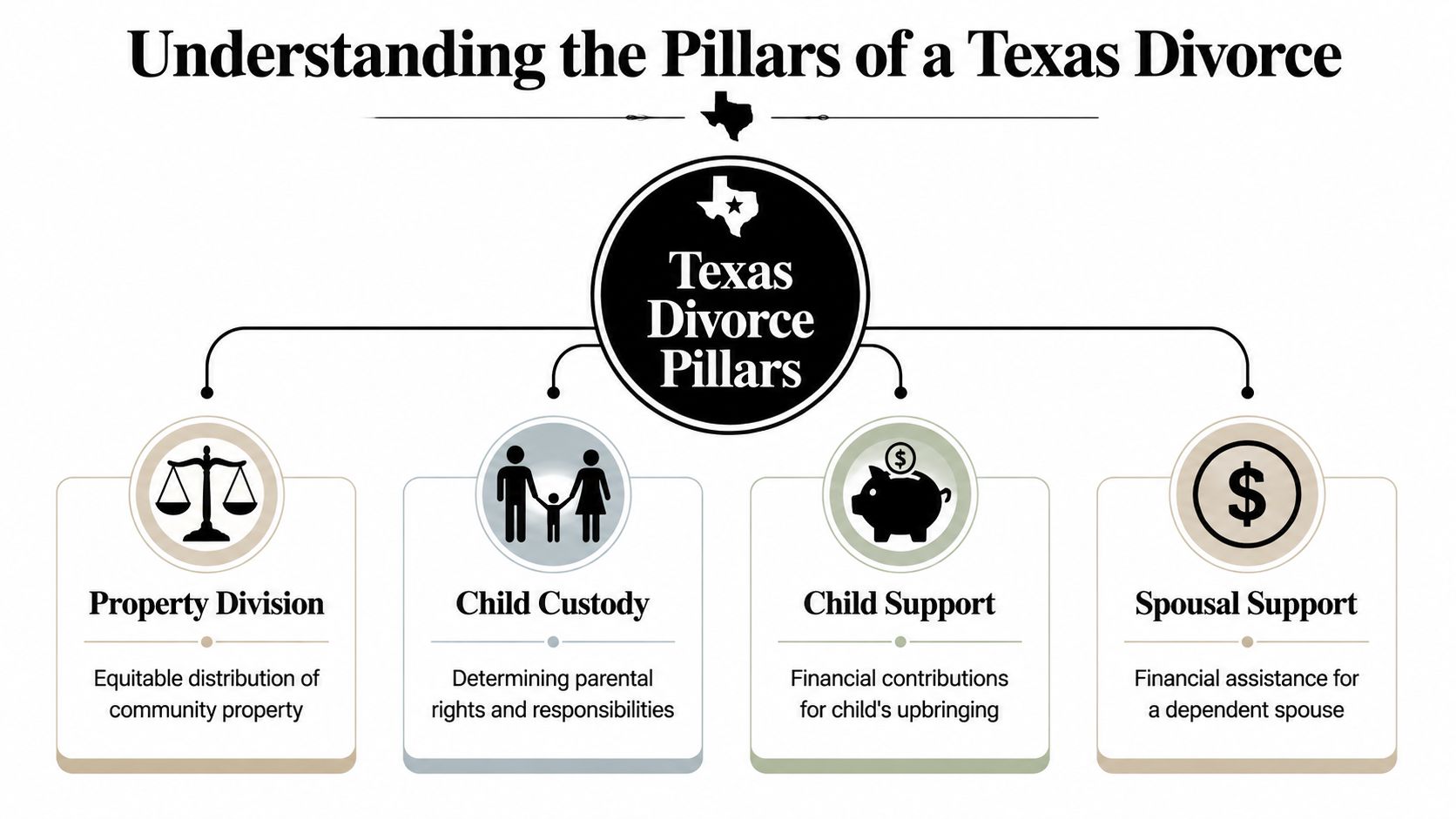
Understanding the Pillars of a Texas Divorce
Most Texas divorces rest on the same core issues. Once you understand those pieces, the process feels less abstract and more manageable.
Property division
Texas follows a community property system under the Texas Family Code. In plain English, property acquired during the marriage is generally presumed to be community property, while certain assets may be claimed as separate property, such as property owned before marriage, some gifts, and some inheritances. The fight is often less about the label and more about proof.
That distinction matters in The Woodlands because many divorces here involve layered finances. A family home may have been refinanced. A business may have grown during the marriage. Investment accounts may contain both separate and community components. If your case includes complex tracing or valuation issues, High-Net-Worth Divorce in The Woodlands is one local example of a practice area focused on complex asset division.
Child custody and parenting issues
Texas uses terms that sound unfamiliar at first. The Family Code uses conservatorship instead of custody, and possession and access instead of visitation. Parents often share rights and duties, but the conflict usually centers on decision-making authority, the child's schedule, and which parent determines the child's primary residence.
A judge won't reward the parent who sounds more upset. The court looks for stability, credibility, and a workable parenting plan. Parents who keep the focus on the child tend to present better than parents who make every disagreement a character trial.
A short explainer can help if you want a visual overview before diving deeper.
Child support and spousal maintenance
Child support in Texas is guided by statute in the Family Code. The details depend on the facts, but the larger point is that support isn't just a number on paper. It connects to possession, insurance, who pays recurring expenses, and whether income is straightforward or difficult to verify.
Spousal maintenance is narrower than many people expect. Texas law allows it in specific circumstances, and eligibility often becomes a serious point of negotiation rather than an automatic result. A client who assumes maintenance is guaranteed can make poor settlement decisions.
The timeline starts with one fixed rule
Texas law imposes a 60-day waiting period after the petition is filed before a divorce can be finalized, which means even straightforward cases in The Woodlands usually take at least two months from filing to decree, as noted in this overview of a The Woodlands divorce lawyer.
The waiting period is a floor, not a promise. In real cases, valuation disputes, custody conflict, and document delays usually matter more than the calendar minimum.
Navigating the Montgomery County Court System
The biggest difference between a generic divorce article and useful local guidance is this. Your divorce doesn't happen in theory. It happens in a specific county, under specific procedures, in front of specific courts.
For The Woodlands residents, that means Montgomery County practice matters. Filings, settings, mediation timing, and the court's expectations shape outcomes in ways many online guides ignore. If you want a local procedural overview, this guide to divorce court in Montgomery County Texas gives useful context.
Local procedure changes strategy
A spouse may tell you, “We agree on most things, so this should be quick.” Sometimes that's true. Often it isn't. Cases slow down because records aren't complete, experts need time, or the court requires steps before a contested hearing can move forward.
That issue becomes sharper in high-asset cases. Industry data indicates that high-asset divorces in metropolitan counties average 12 to 18 months, but local Montgomery County procedural delays, such as mandatory mediation scheduling, can extend this by 30 to 40%. That doesn't mean every complex divorce takes that long. It means local scheduling pressure can materially change how early you need to prepare.
Why local familiarity matters
A lawyer who regularly handles Montgomery County divorces usually approaches the case differently from someone treating it like a standard form matter. Local experience affects practical decisions such as:
- When to push for temporary orders: Some issues need immediate court structure. Others are better developed through records and negotiation first.
- How to prepare for mediation: In many cases, mediation isn't a side event. It's a major pressure point that can resolve or reshape the case.
- What documents to have ready early: Courts and opposing counsel tend to move faster when disclosures are organized.
- Whether a case is “simple”: Cases that look easy at intake can turn once compensation packages, reimbursement claims, or parenting disputes come into focus.
A good local strategy isn't just knowing the law. It's knowing when the court expects movement, when delay hurts you, and when settlement leverage is strongest.
Judicial tendencies affect outcomes
Clients often want to know how a particular judge tends to view discovery fights, parenting disputes, or business valuation issues. That's a fair question. No honest lawyer should promise results based on the assigned court, but ignoring judicial tendencies is also a mistake.
Judges differ in how they manage dockets, how much patience they have for incomplete financial records, and how quickly they expect parties to narrow disputes. In a high-conflict or high-asset divorce, those differences can affect whether your case feels controlled or chaotic. The right preparation usually matters more than any single hearing.
How to Choose the Right Divorce Attorney
Not every divorce needs the same lawyer. That's one of the most important hiring decisions people miss.
A straightforward agreed divorce calls for one set of skills. A custody fight with emergency issues needs another. A case involving executive compensation, business ownership, and retirement plans requires a lawyer who knows how to build the record, work with financial documents, and prepare for litigation if settlement fails.
Match the lawyer to the problem
A critical factor in choosing a divorce attorney near The Woodlands is whether the firm is positioned to handle both high-conflict and high-net-worth matters, because local providers explicitly identify that work in Montgomery County, as shown on this page for a The Woodlands divorce lawyer.
That point is practical, not cosmetic. A lawyer who mainly handles low-conflict agreed cases may not be the right fit if your spouse owns a company, receives deferred compensation, or uses parenting time as a bargaining chip in a financial dispute.
Sarah, a professional in Sterling Ridge, is a good example. Her spouse's pay wasn't just salary. It included bonuses, stock-related compensation, and retirement benefits. A generalist might ask for pay stubs and stop there. A lawyer used to complex divorces knows to look for plan documents, compensation summaries, tax records, and the timing of vesting or payout events.
Questions that actually help
A lot of consultation questions sound useful but don't tell you much. “Are you aggressive?” isn't a serious screening question. “How would you approach temporary orders in a case with disputed finances and children?” is better.
This overview on how to choose a divorce lawyer in The Woodlands TX is a good starting point if you're comparing options.
Use a practical framework:
| Criteria | What to Look For | Why It Matters |
|---|---|---|
| Attorney's local court experience | Regular work in Montgomery County family courts | Local procedure and scheduling affect leverage and timing |
| Case-type fit | Experience with contested, high-conflict, or asset-heavy cases if that matches your facts | A mismatch in experience can lead to missed issues |
| Communication style | Direct answers, realistic expectations, clear next steps | Divorce clients need clarity, not vague reassurance |
| Fee structure | Clear explanation of billing, scope, and likely pressure points | Cost usually rises with conflict, poor preparation, and repeated emergencies |
| Financial issue spotting | Ability to identify valuation, tracing, retirement, and compensation questions | Financial mistakes in divorce can outlast the case itself |
What works and what doesn't
What works is hiring a lawyer who can explain trade-offs plainly. Sometimes that means filing quickly. Sometimes it means gathering records before taking a hard position. Sometimes it means pushing toward mediation. Sometimes it means preparing for a hearing because the other side won't behave reasonably.
What doesn't work is choosing based only on office proximity, the cheapest consultation, or the most confident promise. Divorce representation isn't about who sounds toughest online. It's about who can move your case through Montgomery County in a way that protects your rights and keeps avoidable mistakes off the record.
One local option people may evaluate is The Law Office of Bryan Fagan, which handles divorce, child custody, child support, and property division matters in The Woodlands and Montgomery County.
Managing High-Value and Complex Assets
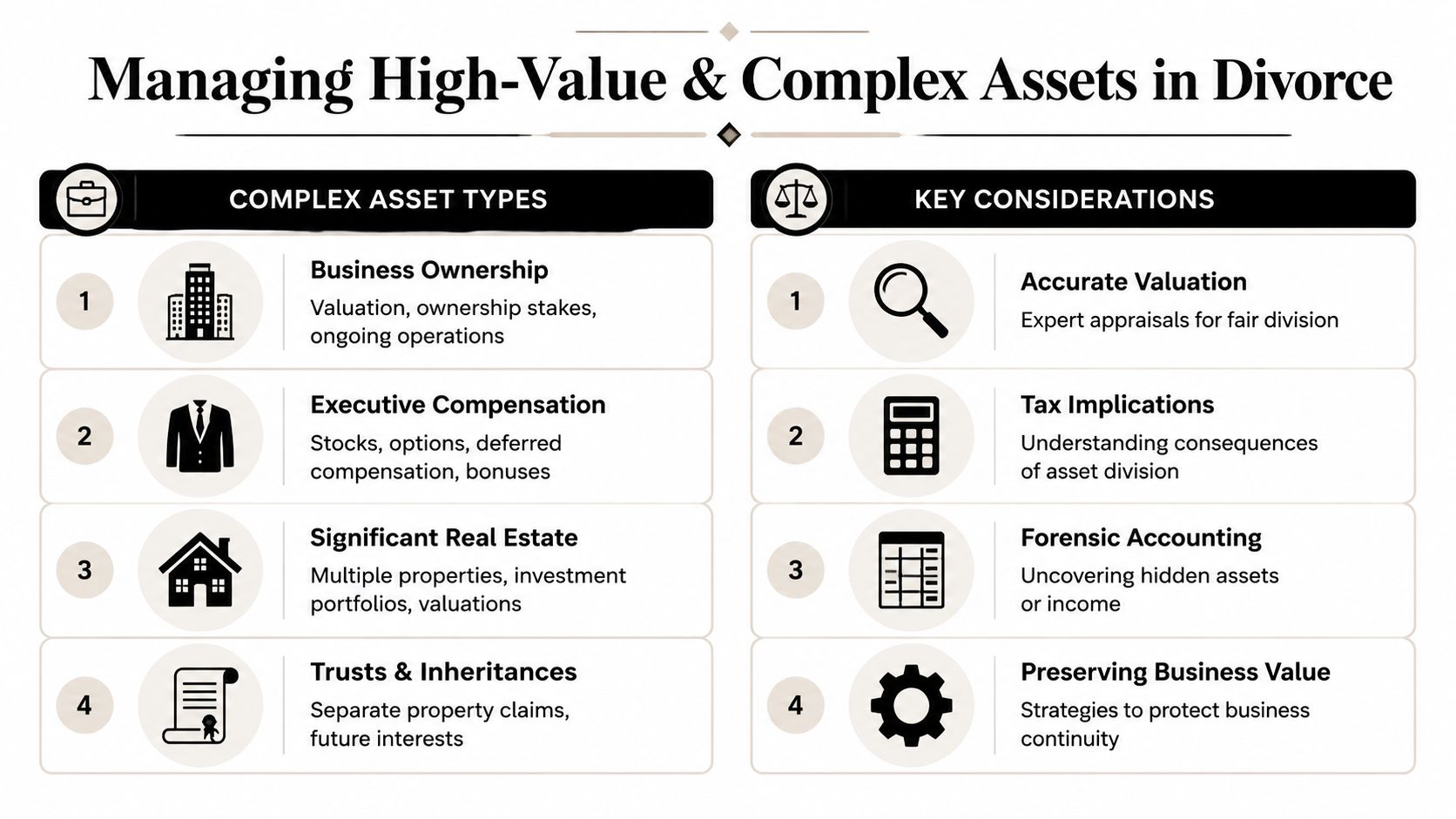
High-asset divorce isn't just about wealth. It's about complexity.
A case becomes financially difficult when assets need tracing, valuation, or special transfer documents. That often includes business interests, executive compensation, retirement accounts, real estate, trusts, and reimbursement claims between separate and community estates. The Texas Family Code governs property characterization and division, and related estate or inheritance issues can also raise questions under the Texas Estates Code when family wealth is involved.
Assets that deserve extra attention
Some categories regularly create trouble in The Woodlands divorces:
- Business ownership: A business may be a marital asset, a source of income, or both. Valuation and control issues often move together.
- Retirement plans: These look simple until the transfer process begins.
- Executive compensation: Deferred compensation, bonus structures, and plan restrictions can change the settlement analysis.
- Jewelry and collectibles: Personal property may carry more emotional weight than financial liquidity. If you're trying to approach resale value realistically, a neutral consumer resource like this guide for selling diamond rings can help frame how market value may differ from purchase price.
QDROs are not optional paperwork
For cases involving retirement assets, a divorce attorney near The Woodlands must be able to manage a Qualified Domestic Relations Order, or QDRO, workflow, because that is the legal mechanism used to divide certain retirement benefits without triggering avoidable tax penalties, as explained in this resource on a Qualified Domestic Relations Order in The Woodlands.
Many self-drafted agreements often fail. The divorce decree may say one spouse receives a share of a retirement account, but the plan administrator often needs a separate order that matches plan requirements. If the decree and the QDRO don't line up, the transfer can stall or create preventable problems.
Retirement division isn't finished when the decree is signed. It's finished when the plan accepts the order and the transfer is properly implemented.
Practical handling beats broad assumptions
Clients sometimes focus on headline value and miss the hidden issue. A business may look valuable but be illiquid. A retirement account may be divisible but governed by specific plan rules. A house may carry debt, tax issues, or a sale timeline that changes its real usefulness in settlement.
That's why good asset work starts with documents, valuation strategy, and a realistic sense of what can be divided, transferred, or sold.
Your Client Readiness Checklist What to Do Next
The best first meeting is the one where you arrive prepared enough to ask better questions. That doesn't mean you need every answer. It means you should have the right materials.

What to do next
Gather financial records
Pull tax returns, bank statements, credit card statements, retirement account records, mortgage documents, and recent pay information. If a business is involved, gather ownership records and any available financial statements.Write a short household budget
List recurring expenses. Include housing, child-related costs, insurance, debt payments, and daily living costs. This helps frame temporary support and settlement decisions.List your priorities
Decide what matters most. For some people it's parenting stability. For others it's protecting a business, keeping the house, or securing a clean division of retirement assets.Prepare your consultation questions
Ask how the attorney handles temporary orders, discovery, mediation, and contested hearings in Montgomery County. Ask what documents they want first.Stop creating unnecessary evidence
Don't post about the divorce online. Don't send emotional texts that will look worse in a judge's binder than they did on your phone screen.
A simple way to think about readiness
You do not need a polished legal theory before you speak with a lawyer. You need a workable set of facts, records, and goals. Clients who do that tend to spend consultation time on strategy instead of reconstruction.
Common Questions About Divorce in Montgomery County
What is the likely cost of a divorce in The Woodlands
Cost depends more on conflict than on the petition itself. Cases usually become expensive when one spouse won't produce records, when custody issues turn personal, or when emergency motions replace steady planning. High-asset cases also cost more when valuation, tracing, or retirement division becomes disputed.
A useful question isn't “What's the cheapest divorce attorney near The Woodlands Texas?” It's “What choices are most likely to increase fees in my case?” That answer is usually more honest and more helpful.
Can we use mediation instead of fighting in court
Often, yes. Mediation is a common and important part of divorce practice in Montgomery County. It can work very well when both sides have enough information to negotiate and at least some willingness to resolve issues.
Mediation is less effective when one spouse is hiding the ball, refusing to engage seriously, or using delay as a tactic. In those cases, court pressure may be necessary before negotiation becomes productive.
How is the primary parent decided in a custody case
Texas courts use the best interest of the child standard under the Texas Family Code. No single fact decides that question in every case. Courts look at stability, the child's needs, each parent's judgment, the existing caregiving pattern, and whether the proposed arrangement is workable.
The parent who appears calmer and better prepared often has an advantage. So does the parent who can show a child-focused plan instead of a list of complaints about the other adult.
Final thought
If you're at the beginning of this process, don't measure your case by what a friend's divorce looked like in another county. Montgomery County procedure, local scheduling realities, and the specific facts of your marriage matter. The right legal guidance helps you set expectations early, protect your position, and avoid mistakes that are expensive to undo.
If you're weighing your options and want clear guidance specific to The Woodlands and Montgomery County, you can schedule a consultation with The Law Office of Bryan Fagan to discuss your circumstances, priorities, and next steps.
