 Skip to content
If you're in The Woodlands, sitting at your kitchen table with your phone in your hand, you may already know the marriage is ending. What you may not know is what to do before you call a lawyer. That uncertainty is what makes the first consultation feel heavier than it needs to feel.
Clients often walk into a divorce consultation carrying emotion, partial information, and a stack of random papers. That usually leads to a more expensive and less useful meeting. A prepared client gives the attorney something far more valuable than a story alone. They give the attorney facts, records, and a workable starting point.
The First Step Taking Control Before You Call
The first consultation isn't a surrender. It's a planning session.
In Montgomery County, the clients who get the most out of that first meeting usually do one thing well. They stop trying to solve the entire divorce in their head and start gathering the information that informs legal decisions. That shift matters. It lowers stress, shortens the learning curve, and helps your attorney spot key issues early.

What people usually feel at this point
A typical Woodlands client is often dealing with several problems at once. They may be worried about the house, the children, joint accounts, retirement, or whether their spouse is already moving money or changing passwords. They also may be embarrassed that they don't have everything organized.
That is normal. It is also fixable.
Practical rule: Don't wait until you feel emotionally ready to prepare. Start when you feel uncertain. Preparation creates clarity.
Texas divorce work isn't one-size-fits-all. Texas-focused divorce trend reporting notes that filings have generally declined, but about 10% involve couples married 20 years or more, and estimated divorce risk is higher in second marriages at 60% to 67% and third marriages at nearly 74%, which helps explain why lawyers often ask early about prior marriages, retirement issues, and blended-family obligations in the first meeting, as noted in Texas divorce statistics.
What control looks like before the meeting
Control doesn't mean confronting your spouse or making big financial moves. It means preserving information and getting organized.
Start with the facts you can secure today:
- Your basic timeline: marriage date, separation date if there is one, names and ages of children, major purchases, major debts.
- Your access points: email, banking apps, cloud storage, phone backups, shared subscriptions, password managers.
- Your concerns list: what keeps you up at night, what you need answered first, what you think your spouse may dispute.
One modern issue many people miss is online content and digital earnings. If that might be relevant in your marriage, a resource on understanding Onlyfans during divorce can help you think through how digital accounts and subscription-based income may become part of the financial conversation.
A good consultation should leave you with direction. A great one starts with enough preparation that the lawyer can talk about your case, not just divorce in general.
Gathering Your Essential Documents for a Texas Divorce
A Texas divorce consultation becomes productive when you bring records that let a lawyer evaluate property, support, and risk without guessing. In practice, that means building a clean document set before the first meeting.
Texas-focused guidance for divorce prep says clients should bring at least five years of financial history, including tax returns, bank statements, and retirement account records, and that pre-sorting those records into buckets for income, assets, liabilities, and child expenses helps an attorney assess property characterization and negotiating position more efficiently, as outlined in this Texas divorce checklist.
Start with four document buckets
Don't hand your lawyer a grocery bag full of unopened mail. Sort your records before the meeting.
Identity and marriage records
These documents establish who the parties are and basic case facts.
- Marriage certificate
- Driver's license or other ID
- Any prior divorce decrees
- Prenuptial or postnuptial agreement
- Basic address history if you've recently moved
Under the Texas Family Code, property issues can turn on whether property is separate or community, and agreements between spouses can change the analysis. If a prenup exists, bring it immediately. Don't summarize it from memory.
Income and tax records
Support and temporary orders often begin here.
- Recent pay stubs
- Tax returns
- W-2s, 1099s, or business income records
- Bonus or commission records
- Retirement contribution statements
If one spouse is self-employed, bring what you have, even if it's messy. A partial set of real records is more useful than a polished verbal estimate.
Assets and property records
Here, many Woodlands cases become more complex.
- Bank and brokerage statements
- Retirement account summaries
- Property deeds
- Mortgage statements
- Vehicle titles or loan records
- Business ownership documents
- Life insurance policy information
If you own a home in Panther Creek, Alden Bridge, Sterling Ridge, or Creekside, the deed and mortgage records matter because they often answer questions about title, debt, and timing of acquisition. Timing can be central to a separate-property claim under the Texas Family Code.
Debts and recurring obligations
Debts matter just as much as assets.
- Credit card statements
- Personal loan records
- Student loan statements
- Home equity loan records
- Medical debt
- Any support obligations from prior relationships
If a spouse says, "We don't really have much debt," the documents often tell a different story.
Divorce consultation document checklist
| Category | Documents to Gather | Why It Matters |
|---|---|---|
| Personal | ID, marriage certificate, prior divorce orders, prenup or postnup | Confirms identity, family history, and any controlling marital agreements |
| Income | Pay stubs, tax returns, W-2s, 1099s, business records | Helps evaluate support, cash flow, and temporary order issues |
| Assets | Bank statements, retirement summaries, deeds, mortgage records, vehicle documents | Helps identify community vs. separate property questions |
| Debts | Credit cards, loans, medical bills, support obligations | Shows the full marital balance sheet |
| Children | Childcare records, school costs, health insurance information | Supports early custody and child support analysis |
Paper matters, but storage matters too
Gathering records is only half the job. Keeping them secure is the other half.
If you're scanning papers or moving digital copies into one place, practical guidance on document storage tips can help you think through safe storage and access. Keep your own copies in an account or device your spouse can't alter.
A well-organized client often saves time before the first pleading is ever drafted.
If you want a clearer sense of what formal document exchange may look like later, this overview of the divorce discovery process is a useful next step. Early organization often makes later discovery narrower and less chaotic.
Preparing Your Story A Clear Timeline and Financial Picture
Once you've gathered records, the next task is turning them into a simple, usable story. Your lawyer doesn't need a perfect memoir. Your lawyer needs an accurate timeline and a snapshot of your finances.
In Texas, one threshold issue comes first. A divorce generally can't be filed until one spouse has lived in Texas for at least six months and in the county of filing for the preceding 90 days, which is why confirming Montgomery County residency is one of the first screening issues in a divorce consultation, according to Texas Law Help's divorce guidance.
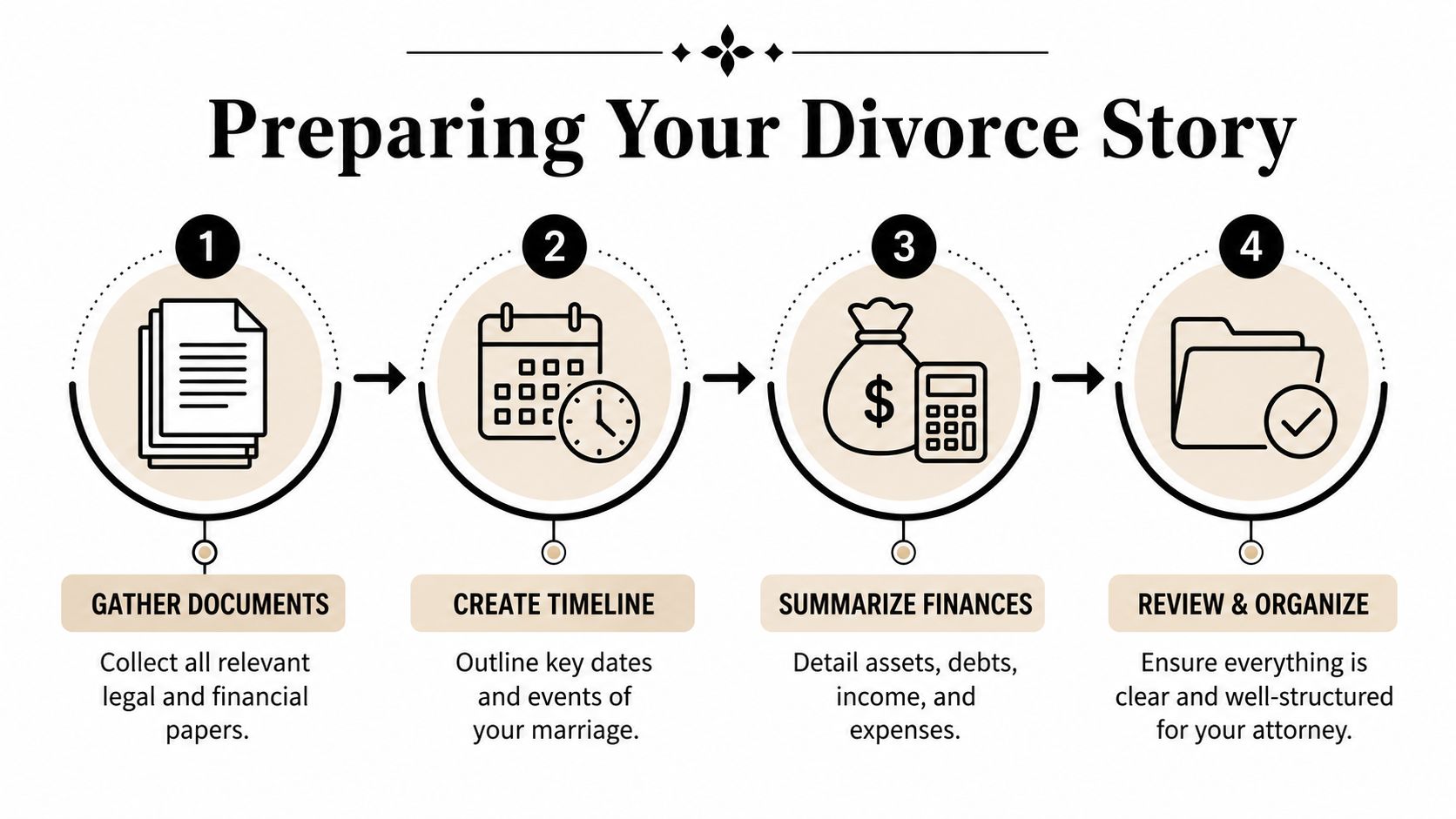
Build a one-page marriage timeline
Keep it short. One page is enough for most first meetings.
Include items like:
- Marriage date
- Children's birth dates
- Major moves
- Date a home was purchased
- Date a business was started
- Date of separation, if there is one
- Any major financial events, such as inheritance, sale of property, or a large debt
This helps an attorney identify what may fall inside or outside the marital estate under the Texas Family Code. It also keeps the meeting focused when emotions are high.
Create a plain-English financial snapshot
You don't need a spreadsheet worthy of an accountant. You need a usable starting point.
Write down:
- What you own: home, vehicles, checking, savings, retirement, brokerage accounts, business interests
- What you owe: mortgage, credit cards, personal loans, taxes, support obligations
- What comes in each month: wages, contract income, rental income, regular deposits
- What goes out each month: mortgage or rent, insurance, childcare, debt payments, groceries, tuition, utilities
If you don't know an exact number, write "estimate" and flag it. Don't leave the topic out.
Bring your uncertainty into the room. A good lawyer can work with incomplete facts. A lawyer can't work with missing categories.
A short real-world example from Sterling Ridge
A spouse in Sterling Ridge came into a consultation convinced the case would turn entirely on fault and text messages. The actual pressure points were different. Once the documents were sorted, the main issues were the house, retirement accounts, and inconsistent records on a side business.
The difference was preparation. Instead of spending the meeting on broad complaints, the consultation produced a filing strategy, a list of missing records, and a plan for temporary orders. That's what useful preparation does. It turns anxiety into decisions.
Verify Montgomery County details before you assume where to file
People in The Woodlands sometimes assume the court question is simple because they live locally now. It isn't always simple if there's been a recent move, temporary separation, or travel for work.
Before the consultation, write down:
- How long you have lived in Texas
- How long you have lived in Montgomery County
- Whether your spouse lives in another county or state
- Any recent moves
That saves time and prevents strategy built on the wrong venue assumption.
Focusing on the Children Custody and Support Preparation
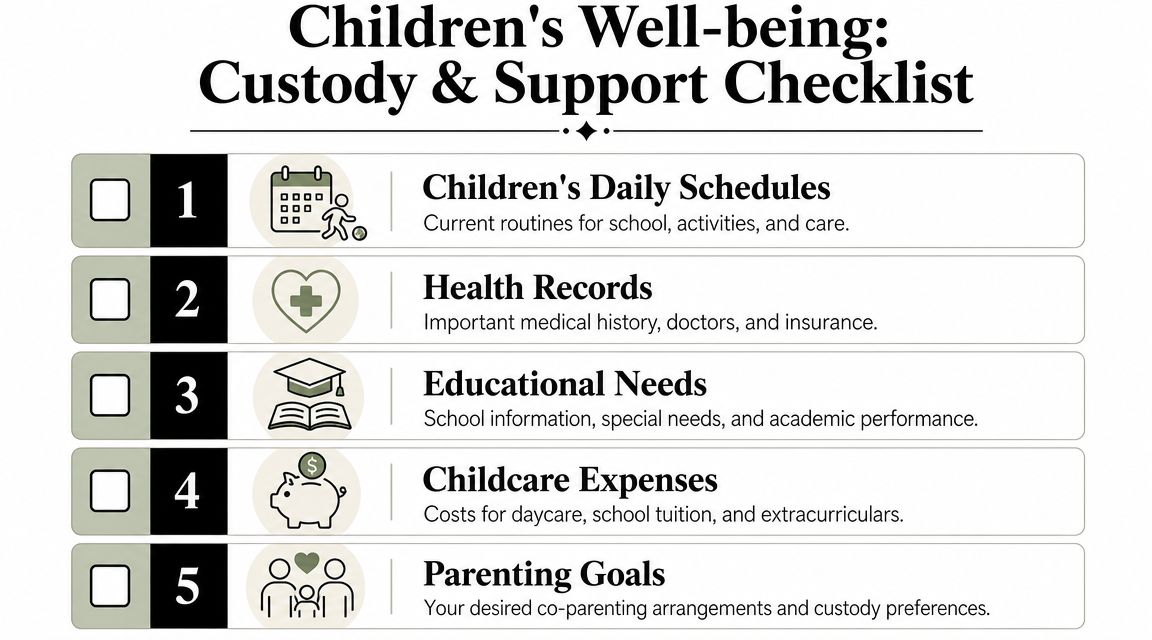
When children are involved, the first consultation should be grounded in records and routines, not just fear. In Texas family cases, custody and support decisions are tied to the child's best interest under the Texas Family Code. That standard is broad, but your preparation shouldn't be.
Start with the child's actual daily life. School, pickups, doctor visits, tutoring, therapy, sports, and bedtime routines matter because judges and lawyers need to know how parenting works in real life, not how either parent wishes it worked.
Bring support information that can be verified
Texas-specific guidance for cases involving children recommends gathering both parents' income records, healthcare premium costs, childcare expenses, and any special educational costs so support can be calculated from real inputs and filing delays can be avoided when information is incomplete, as explained in this Texas child support preparation checklist.
That means you should bring:
- Recent income records for both parents, if available
- Health insurance premium information for the children
- Childcare invoices or payment history
- School tuition or special program expenses
- Records of therapy, tutoring, or special educational support
If your child has a recurring medical or educational need, write that out in a short summary. Keep it factual.
A short video can also help frame the custody discussion in practical terms.
Think in routines, not positions
A lot of parents come in saying they want "full custody" when what they really mean is one of several different things. They may be worried about school consistency, safety, or decision-making. Your consultation will be more productive if you separate your concerns into categories.
Try this list before the meeting:
- Daily routine concerns: who handles mornings, school drop-off, homework, bedtime
- Decision-making concerns: medical, educational, counseling, extracurricular choices
- Safety concerns: substance abuse, instability, repeated no-shows, unsafe driving, inappropriate supervision
- Schedule concerns: holidays, summers, exchanges, work-related travel
If you need a more detailed local overview, this parent's guide to your child custody hearing in Montgomery County gives useful context for what parents should expect.
The strongest parenting presentation is usually the calmest one. Specific facts beat broad accusations.
Don't coach children, don't ask them to pick sides, and don't turn the consultation into a character review of the other parent. Bring school calendars, receipts, schedules, and concerns tied to the child's day-to-day needs.
Key Questions to Ask Your Potential Divorce Attorney
Your consultation is also an interview. You're not just asking whether you can get divorced. You're deciding whether this lawyer understands the practical and local realities of your case.
That matters in The Woodlands and Montgomery County. Family law is statewide, but results often turn on preparation style, hearing readiness, and how well the lawyer spots local procedural issues before they become expensive problems.
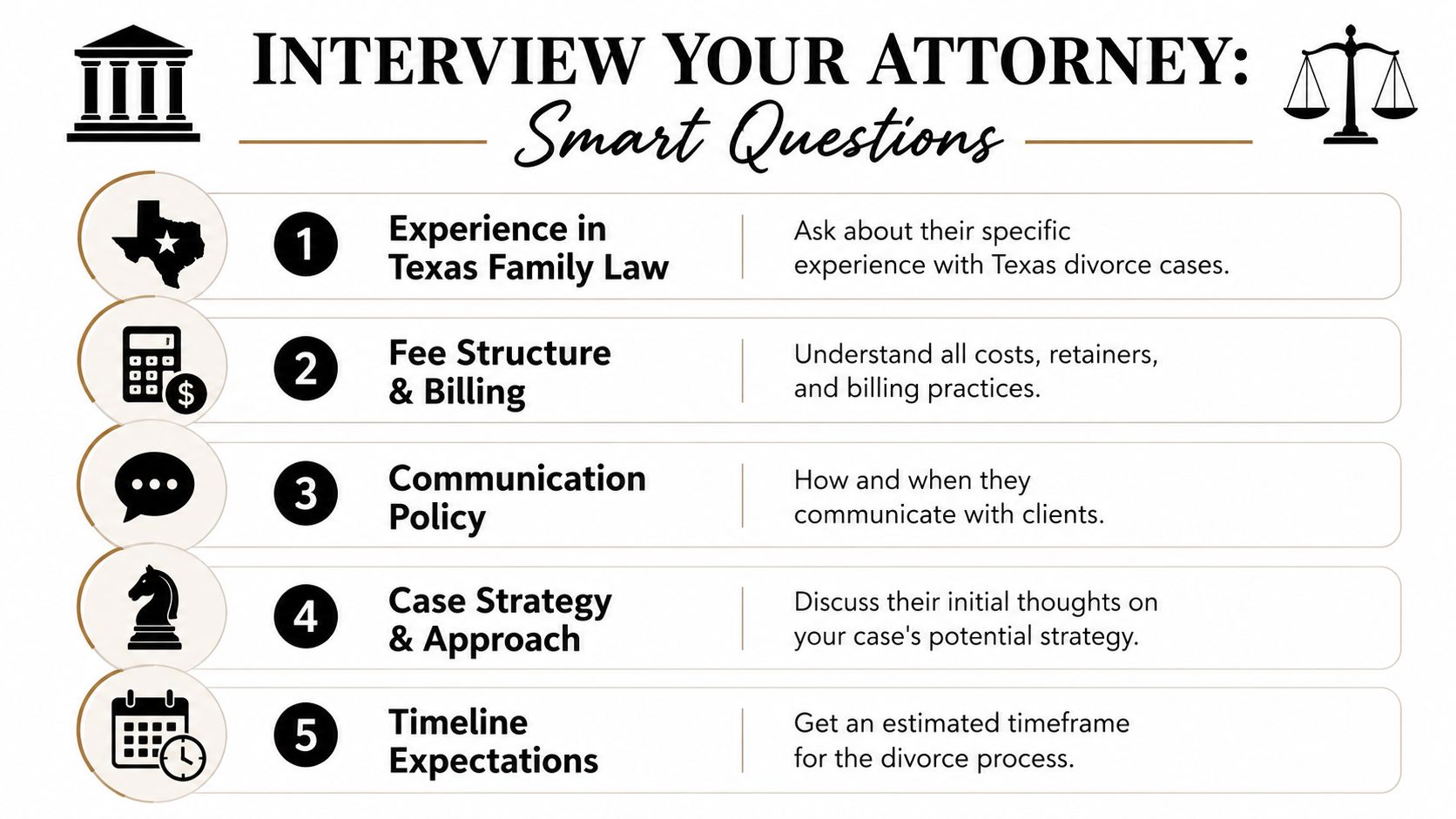
Ask questions that reveal how the lawyer thinks
Basic fee questions are important, but they shouldn't be the only questions.
Ask things like:
- How often do you handle divorce cases in Montgomery County?
- What issues do you think matter most in my case based on what you've seen so far?
- Do you usually push early settlement, temporary orders, mediation, or immediate discovery in a case like this?
- How does your office communicate with clients about urgent issues?
- What records should I secure before anything is filed?
Those questions tell you more than a polished overview ever will.
Ask directly about digital evidence
Many consultations fall short in a critical regard. Shared digital life often matters as much as paper records now.
Texas-focused divorce preparation guidance warns that a critical and often-missed step is preserving digital evidence before a spouse changes access, especially in shared cloud storage, messaging apps, and online banking platforms, as discussed in this digital divorce preparation checklist.
Ask the lawyer:
- What should I preserve from shared cloud drives or family photo storage?
- Should I screenshot account balances, payment apps, rewards accounts, or subscription dashboards?
- How should I handle shared passwords without violating privacy rules?
- What should I avoid deleting from my phone, email, or social media?
- If my spouse controls the finances, what records should I capture now?
A modern divorce lawyer should be comfortable discussing Venmo, PayPal, Apple or Google account access, cloud backups, brokerage apps, and shared calendars. If the lawyer brushes past that issue, keep asking.
A simple warning: preserve access lawfully, preserve information promptly, and don't start playing amateur forensic investigator.
Ask whether the lawyer's approach fits your case
Some cases need quick stabilization. Others need patient information gathering. Some need immediate filing because the financial picture is changing too fast.
If you're comparing lawyers, this guide on how to choose a divorce lawyer in The Woodlands can help you think through fit, communication, and strategy. Firms such as The Law Office of Bryan Fagan handle divorce and family law matters in Montgomery County, and a consultation should tell you whether the lawyer's process matches your priorities.
The right lawyer doesn't just know the law. The right lawyer notices what could go wrong next.
What to Do Next Your Post-Consultation Checklist
After the meeting, individuals often feel two things at once. Relief, because they finally have direction. Overload, because they now have a list.
The right next step is not to do everything at once. It is to do the next few things in order and protect the information that matters most.
What to do next
- Review the lawyer's notes and fee agreement: Make sure you understand the proposed scope of work, communication expectations, and immediate priorities.
- Gather the missing records: If the lawyer asked for account statements, deeds, business records, or child-related expenses, collect them while access is still easy.
- Secure your digital life: Change passwords on your own lawful accounts, enable account security features, and preserve screenshots or downloads of shared financial information you are authorized to access.
- Avoid damaging reactions: Don't empty accounts impulsively, don't delete texts, and don't post about the divorce on social media.
- Write down deadlines and questions: If the lawyer raised timing concerns, temporary orders issues, or filing readiness questions, put them in one list so nothing gets lost.
- Think locally: Procedures and expectations in Montgomery County matter. A lawyer familiar with The Woodlands cases will usually identify local practical issues faster than someone giving generic statewide advice.
If you were searching for how to prepare for divorce consultation Texas, the answer is simple. Bring facts, not just feelings. Preserve digital access and evidence before it changes. Organize your finances in a way another person can understand quickly. Focus on the children with records and routines, not assumptions.
This article is for informational purposes only. It is not legal advice and does not create an attorney-client relationship. Divorce and custody issues depend on the specific facts of your case, and you should get advice from a qualified Texas family law attorney about your situation.
If you're ready to talk through your situation with local counsel, you can schedule a consultation with The Law Office of Bryan Fagan. For families in The Woodlands and across Montgomery County, a focused first meeting can turn a stressful moment into a workable plan.
