 Skip to content
If you're in The Woodlands or anywhere in Montgomery County, this problem often starts the same way. A court order says support must be paid. Weeks turn into months. You keep covering groceries, school costs, gas, and doctor visits yourself while the unpaid amount grows.
Most parents don't need a lecture at that point. They need to know what works.
The confusing part is that people often hear two very different things at once. One person says, "File in family court." Another says, "This is a federal crime under the deadbeat parent act." Both ideas can be true, but they do not apply in the same way or at the same time. In most local cases, the first step is a Texas civil enforcement action. A federal case is narrower and reserved for serious interstate nonpayment.
Struggling with Unpaid Child Support in Texas
A parent in Conroe or The Woodlands may already have a valid child support order and still feel stuck. The order exists on paper, but payments don't arrive. The other parent may change jobs, ignore messages, or move away. Meanwhile, rent and child-related expenses don't pause.

This isn't rare in the broader child support system. The proportion of custodial-parent families with child support orders declined from 60.0% in 2003 to 50.6% in 2009, according to the Current Population Survey child support summary discussed by the Institute for Research on Poverty. That long-term decline helps explain why enforcement tools still matter so much.
Why parents get mixed messages
A lot of online information blurs together two separate tracks:
- State civil enforcement: This is the normal path in Texas family court when someone isn't paying as ordered.
- Federal criminal enforcement: This is the narrow path people mean when they talk about the Deadbeat Parents Punishment Act.
Those aren't interchangeable.
Practical rule: If your case is centered in Montgomery County and the unpaid support issue is still local, you're usually dealing with state family court enforcement first.
A simple example
Say a parent in The Woodlands has an order from a Texas court. The other parent lives in Texas, has stopped paying, and owes back support. That situation is serious, but it is usually handled through state enforcement remedies such as court motions, judgments for arrears, and income withholding.
Now change one fact. The owing parent leaves Texas and is living in another state while continuing to avoid support. That is where the federal deadbeat parent act may enter the conversation, but only if the legal requirements are met.
The key point is reassuring and serious at the same time. You do have options. But the right option depends on where the other parent is, how the arrears built up, and whether this is a local enforcement matter or a true interstate evasion case.
Understanding the Federal Deadbeat Parent Act
The Deadbeat Parents Punishment Act, often shortened to DPPA, is not the usual child support case filed in a county family court. It is a federal criminal law found in 18 U.S.C. § 228.
That matters because many parents hear the phrase "deadbeat parent act" and assume any missed child support automatically becomes a federal case. It doesn't.

What makes a case federal
The DPPA applies only when there is an interstate nexus. The U.S. Department of Justice explains that federal child support enforcement is limited and that state and local authorities normally handle these matters, which you can see on the Department of Justice child support enforcement page.
In plain English, that means crossing state lines matters. A parent who owes support in a case involving Texas and another state may trigger federal attention in a way a purely local Montgomery County case usually would not.
The three violation levels
Under the verified summary of the statute, the law created different criminal levels based on the amount owed, the length of nonpayment, and interstate conduct:
- Misdemeanor level: Willful failure to pay when the amount is over $5,000 or has remained unpaid for more than one year, with up to 6 months of imprisonment.
- First-offense felony level: Evading an obligation exceeding $5,000 through interstate travel, with up to 2 years of imprisonment.
- Aggravated felony level: Nonpayment exceeding $10,000 or remaining unpaid for more than two years, with up to 2 years of imprisonment.
The statute also requires full restitution of the past-due amount upon conviction, as summarized in this DPPA overview.
Federal prosecution is aimed at serious interstate nonpayment, not every late payment or every unpaid local case.
Why this still matters locally
For a parent in Montgomery County, the federal law matters because it answers a practical question. When does a local family law problem become more than a local enforcement matter?
Usually, not at the beginning.
If your case is moving through local courts, a resource like Montgomery County Family Courts: A Local Guide can help you understand how family law cases proceed in Montgomery County courts serving The Woodlands. But if the other parent has moved across state lines and is willfully evading a large, overdue obligation, the legal situation changes.
Criminal Penalties vs Civil Remedies in Texas
Most child support enforcement in Texas is civil, not federal criminal. That's the distinction many parents need most.
Under the Texas Family Code, especially enforcement provisions in Chapter 157, a court can enforce an existing order through civil procedures. The goal is usually to collect support, confirm arrears, and compel compliance. Federal prosecution under the DPPA has a different purpose. It punishes serious interstate evasion.
How the state civil process works
In a Texas civil enforcement case, a parent can ask the court to enforce an order that already exists. Depending on the facts, the court may address missed payments, arrears, and noncompliance with prior orders. Texas courts can also use tools tied to collection and compliance, including income withholding.
If you're trying to understand that tool in local terms, this guide on wage garnishment for child support in The Woodlands explains how income withholding fits into enforcement.
A local lawyer may also help with establishing, modifying, and enforcing support. For example, Child Support Attorney in The Woodlands describes work related to child support matters in Montgomery County.
Side-by-side comparison
| Aspect | Civil Enforcement State Level | Criminal Prosecution Federal DPPA |
|---|---|---|
| Main purpose | Enforce a court order and collect support | Punish willful interstate evasion |
| Where it usually happens | Texas family court | Federal criminal court |
| Who usually starts it | Parent owed support, private counsel, or state agency | Federal authorities |
| Legal basis | Texas Family Code, including Chapter 157 | 18 U.S.C. § 228 |
| Typical focus | Arrears, compliance, payment enforcement | Interstate nonpayment meeting federal thresholds |
| Result for the paying parent | Court orders, arrearage findings, possible contempt remedies | Criminal conviction, imprisonment exposure, restitution |
The practical difference for families
Civil enforcement is often the tool that gets used first because it is closer to the actual family problem. A child needs support. A parent needs enforcement of the order. The court needs a record of what is owed and what has not been paid.
Federal criminal law enters later, and only in a narrower set of facts.
A missed-payment case in Montgomery County is not automatically a DPPA case. A serious interstate evasion case might be.
This also connects to planning after divorce. Child support enforcement often overlaps with broader financial protection issues, and a practical resource on life insurance after divorce can help parents think through one of those related concerns.
Child Support Enforcement in Montgomery County
When the other parent isn't paying and the case is centered here, the usual next step is local enforcement. In Montgomery County, that often means filing in the court that issued the order or in the court with continuing jurisdiction over the family law case.
Under Texas Family Code Chapter 157, enforcement actions can address missed child support obligations and request remedies tied to noncompliance. In Montgomery County, the details depend on the existing order, the payment record, and which court is handling the case.
What usually happens first
A parent typically needs to show the court:
- The order exists: The judge needs the signed child support order.
- Payments were missed: Payment history matters.
- The amount can be proven: Arrears should be documented carefully.
The case may move through local district courts handling family matters in Montgomery County. The exact court assignment depends on the case history and where jurisdiction sits.
If you want a local overview of the process, this page on enforcing child support in Montgomery County gives a county-focused explanation.
A short local scenario
A parent in Conroe has a Texas child support order. The other parent remains in Texas for a time, then stops paying consistently. The parent owed support gathers the order, the payment record, and communication history, then files an enforcement action in Montgomery County.
The court reviews the missed payments, confirms the arrears, and issues orders aimed at enforcement. That is a common local pattern.
Now add a different wrinkle. If the owing parent later moves out of state and the facts fit federal law, the case may also raise interstate issues. But the local family court process is still the place many parents begin.
State first, federal only in narrow cases
The Department of Justice makes this boundary clear. The DPPA, codified at 18 U.S.C. § 228, applies only when the case has an interstate nexus, while purely intrastate arrears are generally handled by state and local authorities. That federal-state division is one reason many Montgomery County parents feel confused at first. They are hearing about a federal law when their immediate remedy is still local family court.
Consequences of Non-Payment and Potential Defenses
Nonpayment can bring serious consequences. But the legal system also distinguishes between a parent who won't pay and a parent who can't pay.
That distinction matters in both strategy and fairness.
Consequences can build quickly
For a parent facing enforcement in Texas, the immediate consequences are usually civil. A court may examine arrears, enforce prior orders, and consider remedies allowed under Texas law. If the facts involve willful interstate evasion and meet the federal requirements discussed earlier, the consequences can also include federal criminal exposure.
If you want a plain-language local overview of the stakes, this article on what happens if child support is not paid in The Woodlands is a useful starting point.
Poverty is not the same as evasion
One of the biggest mistakes in public discussion is treating every unpaid case as if it reflects the same behavior. It doesn't.
Research discussed by Washington Monthly on punishing fathers for being poor highlights a more nuanced reality. Many nonpaying parents are disconnected from work or face other barriers, and courts can consider actual ability to pay. That is why modifications and fact-specific defenses matter.
If a parent truly cannot meet the current order, hiding from the problem usually makes it worse. Asking the court for a lawful modification is the safer path.
Examples of issues courts may examine
- Job loss or reduced income: If the change is real and not self-created to avoid support, it may support a modification request.
- Willfulness: Courts often look at whether the parent had the ability to pay and chose not to.
- Failure to seek modification: Falling behind without taking legal action can weaken a parent's position.
- Interstate movement: If the facts show crossing state lines to evade payment, the case may become more serious.
Not every excuse works. Choosing not to work when work is available, hiding income, or disappearing to avoid enforcement can hurt badly in court. By contrast, a parent facing actual hardship should act early, keep records, and seek a modification rather than letting arrears grow.
Your Step-by-Step Action Plan
When support isn't being paid, the best next move is usually organized, not emotional. Good records and the right filing path can change the course of the case.
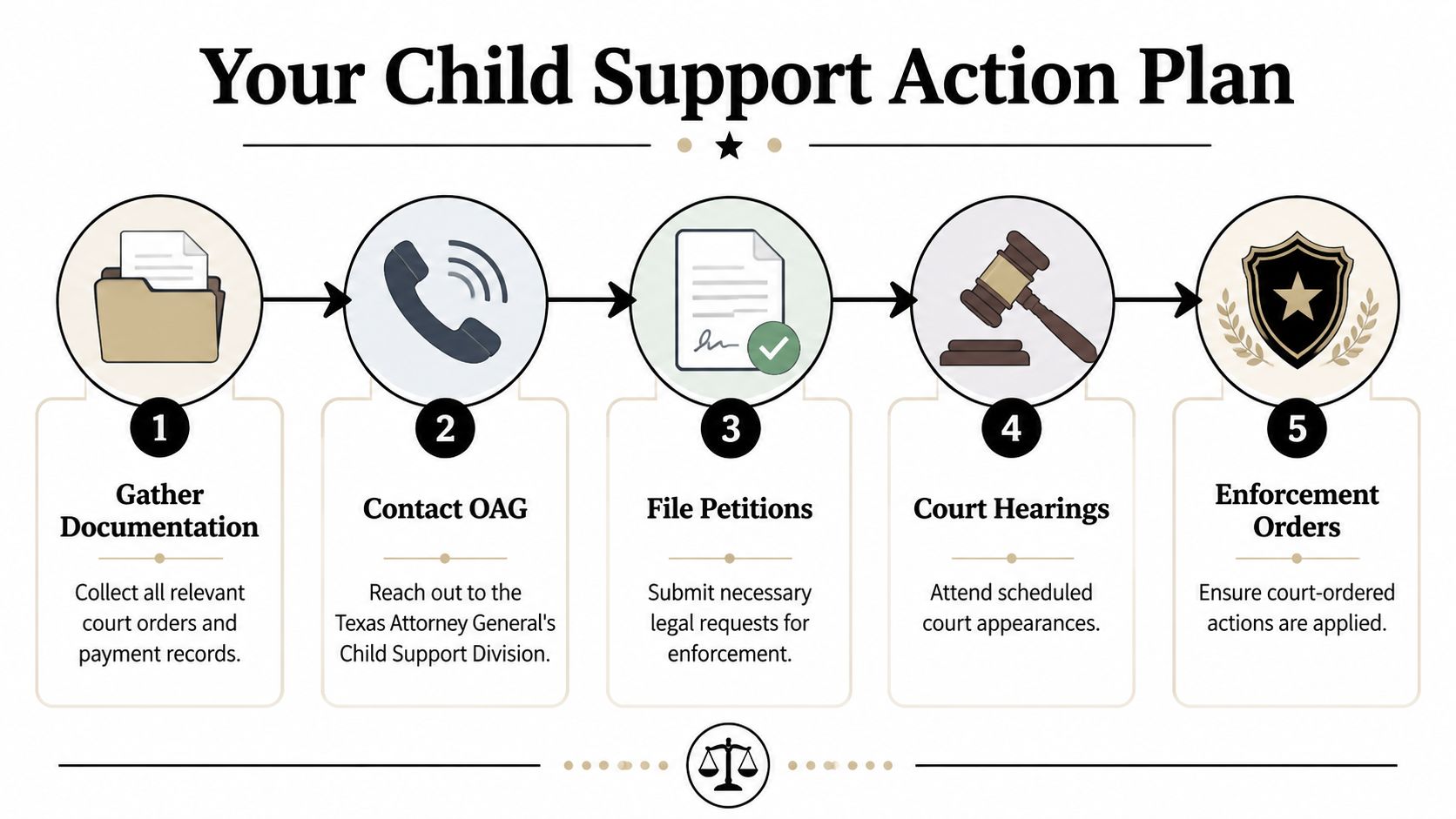
Start with documents
Gather the papers that tell the story clearly:
- Your current child support order
- A payment history
- Records of missed payments
- Messages or notices that may show avoidance
- Any information about the other parent's current location
If the other parent has moved, that last item can become especially important.
Use the local process first when appropriate
For most Montgomery County families, the first practical path is a state enforcement action. That may involve the Texas Attorney General's Child Support Division, private counsel, or both depending on the facts and how quickly you need to move.
The steps often look like this:
- Confirm the existing order: You need the enforceable order before asking the court to act.
- Match the order to the payment record: Make sure your numbers and dates are accurate.
- File the enforcement request: The court needs a clear statement of what was ordered and what was not paid.
- Prepare for hearing: Judges care about records, not rough estimates.
A short explainer may help if you'd rather watch than read:
Know when the federal issue may arise
You usually do not file your local motion and ask the Montgomery County judge to "apply the deadbeat parent act." That's not how it works.
Federal prosecution is separate. The issue becomes relevant when the facts suggest serious interstate evasion that may fit the federal law discussed earlier. In that setting, the case may be referred through enforcement channels rather than handled as a normal local collection dispute.
If circumstances changed, address them directly
If you're the parent who owes support and your income has dropped for legitimate reasons, don't wait and hope the balance fixes itself. Existing orders remain enforceable until they are changed by the court.
That means the practical action plan differs depending on your position:
- If you're owed support: document, file, and press for enforcement.
- If you owe support but can't pay the ordered amount: seek a modification quickly.
- If the other parent left Texas: preserve any evidence showing where they are and how long the nonpayment has continued.
What to Do Next in Your Case
Use this short checklist if you're dealing with unpaid support in The Woodlands, Conroe, Magnolia, or elsewhere in Montgomery County:
- Get the order: Find the most recent signed child support order.
- Pull the payment record: Write down what was paid, what was missed, and when.
- Keep location details: If the other parent moved, save any proof of the new state.
- Decide the right path: Most local cases start as Texas civil enforcement. Interstate evasion may raise federal issues later.
- Ask about modification if needed: If finances changed, don't ignore the order.
- Get help when facts are unclear: If you can't locate the other parent, a practical people tracing guide may help you think through search basics.
This article is for general information only. It is not legal advice, and reading it doesn't create an attorney-client relationship.
If your case involves substantial arrears, an out-of-state parent, or you've been served with an enforcement action yourself, it may be time to talk with a lawyer about your specific facts.
If you need help sorting out whether your case belongs in Montgomery County family court, may involve interstate enforcement issues, or requires a child support modification, you can schedule a consultation with The Law Office of Bryan Fagan to discuss your situation.
