 Skip to content
You may be here because your child used to run to the door when you arrived, and now they barely look at you. Maybe exchanges in The Woodlands have become tense. Maybe your co-parent keeps saying your child “doesn't want to go,” and every missed weekend feels like the relationship is slipping further away.
That kind of change gets parents' attention fast. It should. In Montgomery County custody cases, judges generally don't react to one bad weekend or one angry text. They do react when a parent shows a pattern of conduct that damages a child's relationship with the other parent and violates court orders or the child's emotional welfare.
When Your Child Suddenly Pulls Away
Friday pickup used to be routine. Then your child gets in the car in The Woodlands, stares at a phone, and answers every question with one-word replies. By the next visit, the child is repeating accusations that sound borrowed from an adult dispute, not a child's own experience. After that, the refusals start.
Parents usually know when something has changed.
In Montgomery County, judges see plenty of ordinary parent-child conflict. They also see cases where a child's sudden hostility lines up with missed exchanges, repeated last-minute cancellations, and a steady stream of negative messaging from the other household. Those are very different problems, and the difference matters in court.
Parental alienation claims often begin with a simple report from a parent: "My son used to want to come over. Now he says I am unsafe because I make him do homework." Standing alone, that statement will not carry much weight. What gets traction is a pattern that can be shown through records, witnesses, school information, counselor input, and the language used by the child and the other parent over time.
A local example makes the point. A father with a standard possession order had years of normal contact with his daughter. Then exchanges started falling apart. The child began refusing visits after hearing that father was "emotionally harmful" because he enforced bedtime and school rules. There was no protective order, no abuse finding, and no CPS determination supporting that claim. In a Montgomery County courtroom, that fact pattern can become serious fast if the refusals continue and the paper trail supports interference.
The first hard truth is this. Courts do not act because a parent feels replaced. Courts act when the evidence shows one parent is driving the breakdown or allowing it to continue.
The second hard truth is just as important. Sometimes a child pulls away for reasons that have nothing to do with alienation. Teen behavior, loyalty conflicts, inconsistent parenting, remarriage, untreated mental health issues, or a parent's own mistakes can all strain the relationship. Good cases are built by sorting those issues out early instead of blaming everything on the other parent.
That is why the first response should be disciplined, not emotional. Keep showing up. Follow the order. Stay calm at exchanges. Do not argue with the child about what the other parent said. In Montgomery County, a parent who keeps composure while carefully documenting interference usually presents better than a parent who sends angry texts, pressures the child, or stops exercising possession out of frustration.
One sentence I tell parents often applies here: a parental alienation case is built by proving a documented pattern of interference tied to the child's changed behavior.
This article is for informational purposes only. It is not legal advice. Every family, every order, and every Montgomery County courtroom problem has its own facts.
Understanding the Signs of Parental Alienation
The hardest part for many parents is this. Alienation often starts looking like ordinary conflict. Teenagers can be rude. Children can resist transitions. A parent can also have a strained relationship with a child for real reasons. The key is learning the difference between normal friction and a coordinated pattern.
A useful way to think about parental alienation Texas cases is this. The problem is not simple rejection. The problem is unjustified rejection shaped by one parent's conduct.
To ground this in something broader, a 2019 national survey discussed in this Texas family law article estimated that about 11–15% of children in high-conflict custody cases show behavior patterns consistent with moderate to severe parental alienation. The same source notes that Texas had approximately 31,000 divorces involving children finalized annually during that period, which suggests thousands of Texas children may experience this form of emotional harm each year.
Here's a simple checklist of common warning signs.
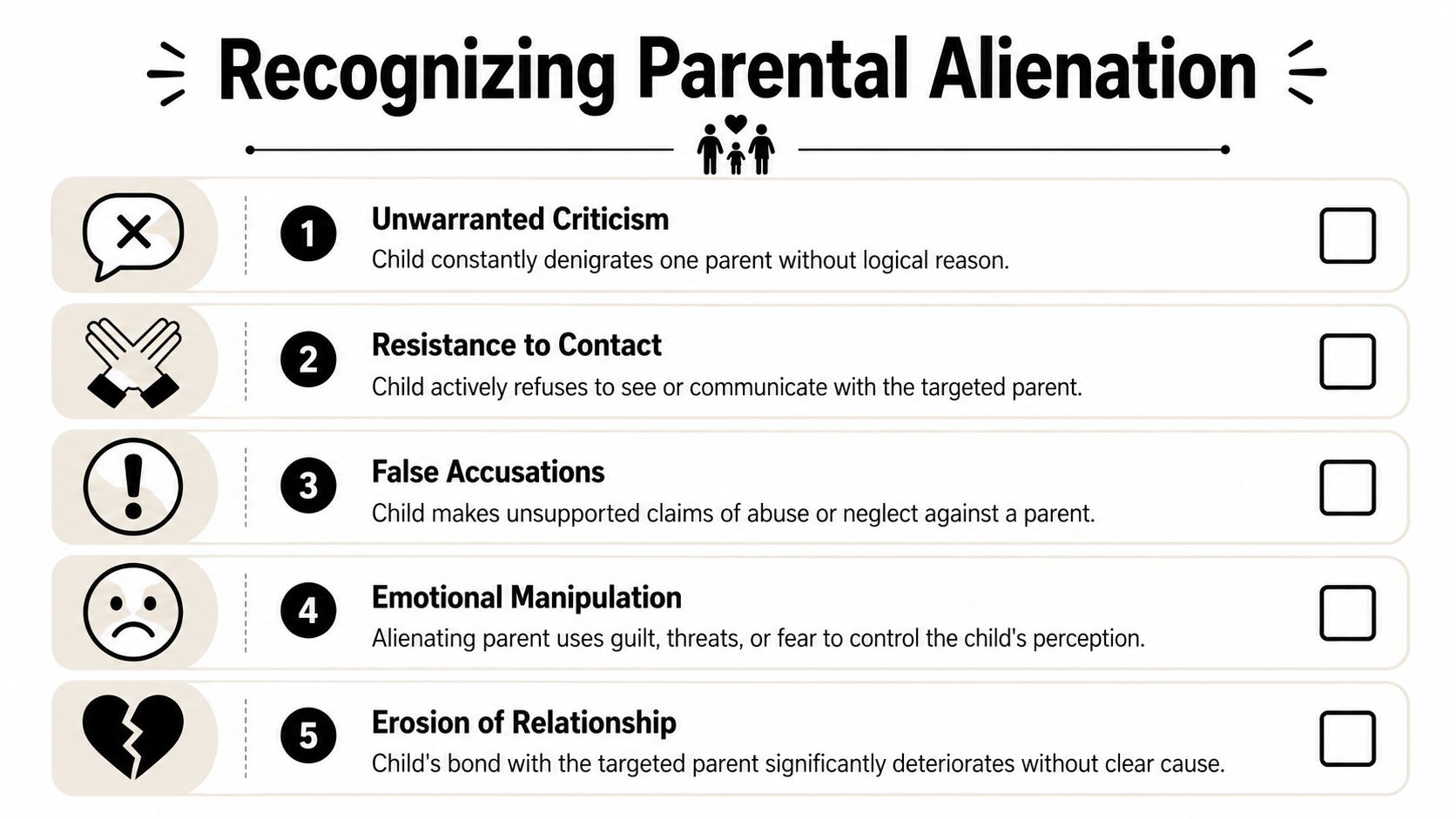
Red flags that deserve attention
- Unwarranted criticism. Your child attacks you constantly, but can't explain why in a concrete, age-appropriate way.
- Borrowed language. The child repeats adult phrases, legal terms, or emotional accusations that sound like they came from the other parent.
- No ambivalence. Healthy family relationships are mixed. A child may love a parent and still be annoyed with them. In alienation cases, one parent becomes “all bad” and the other “all good.”
- Weak reasons for strong anger. The child gives flimsy explanations for total rejection, such as “You make me uncomfortable,” with no specific conduct behind it.
- Automatic loyalty to one parent. The child defends one parent no matter what and refuses to consider any other perspective.
- Resistance to ordinary contact. Calls go unanswered. Visits are rejected. Holidays become battlegrounds.
Alienation and estrangement are not the same thing. If a child is resisting contact because of abuse, neglect, substance issues, or serious instability, that is a different problem and courts must treat it differently.
What it can look like in Montgomery County homes
In Sterling Ridge or Creekside, it may show up as repeated “schedule confusion,” school events being hidden from one parent, or the favored parent encouraging the child to decide whether the court order matters. In older children, it often shows up as moralized hostility. The child doesn't just say no. The child says you deserve the rejection.
That distinction matters.
If grandparents are also being cut off during the same conflict, related custody and access issues can overlap with Grandparents' Rights in The Woodlands in Montgomery County.
A short video can help parents spot the pattern more clearly.
What usually is not enough
The following issues, by themselves, usually won't carry an alienation claim:
- A teenager wanting more independence
- A child being upset after discipline
- Normal coparenting irritation
- One isolated missed exchange
- Your belief that the other parent “must be behind it,” without records
Judges in Montgomery County tend to look for something more disciplined and more provable than suspicion.
How Texas Law Views Parental Alienation
A Montgomery County judge does not need the label "parental alienation" to act. The court looks at conduct and its effect on the child. If one parent is undermining the child's relationship with the other parent, interfering with possession, or pressuring the child to reject a parent without a legitimate reason, judges usually treat that as a best-interest problem and, in the right case, a modification problem.

Best interest is the center of the case
Texas custody decisions turn on the child's best interest, as noted earlier. In Montgomery County, that usually means the judge will focus less on the label you use and more on proof of what has been happening in the home, at exchanges, at school, and during communication with the child.
Common questions include:
- Has one parent been chipping away at the child's relationship with the other parent?
- Did the child's resistance appear suddenly, without a clear factual basis?
- Are missed periods of possession becoming a pattern?
- Do texts, emails, school records, or counseling records show manipulation or pressure?
- Is there a real safety issue that explains the child's behavior?
Parents who want a clearer sense of how courts weigh those factors should read how judges decide child custody in Texas.
Modification requires more than suspicion
If there is already a final order, a judge usually needs a legal basis to change it. In many alienation cases, the fight centers on whether the conduct amounts to a material and substantial change in circumstances under Texas Family Code § 156.101.
That point matters in practice. A parent who says, "my child has been distant for two months," may have a real concern but not enough for a modification. A parent who shows repeated interference, escalating rejection, blocked access to school or medical information, and a child parroting adult accusations is in a stronger position.
Montgomery County courts usually respond better to disciplined proof than emotional testimony. That is harsh, but it is true.
What tends to matter in Montgomery County courtrooms
Local judges often look for two things at the same time. First, is the child being harmed by the breakdown of the parent-child relationship? Second, is the accused parent causing it, or is there another explanation such as bad coparenting, poor communication, remarriage stress, adolescence, or a legitimate safety concern?
That second question is where many cases fall apart. Judges in Conroe see plenty of parents who are sure the other side is poisoning the child. Certainty is not evidence.
Useful proof usually includes a clean timeline, consistent possession records, preserved messages, school records, and testimony from neutral people who saw the shift happen. If briefing becomes necessary, good organization matters as much as good facts. The same discipline lawyers use in how to write persuasive briefs applies here. Dates, documents, and a clear theory of the case carry more weight than outrage.
If the alienation issue is developing during a divorce, temporary orders can shape the case fast. A Divorce Lawyer in The Woodlands, TX can address possession terms, communication rules, and school access early, before a bad pattern hardens into the new normal.
Building Your Case With Evidence That Works
A parental alienation case in Montgomery County usually turns on proof quality, not volume. In the 418th, 410th, or 9th District Court, a parent who arrives with a stack of angry screenshots and no timeline often gets less traction than a parent with ten clean exhibits that show a repeat pattern.
That is the practical standard. Judges in Conroe want to see what happened, when it happened, who saw it, and how it affected possession, communication, or the child's attitude over time.
Build the record before the hearing is set
Good cases are usually built weeks or months before anyone steps into court. If you wait until a modification or enforcement is filed, you will spend expensive attorney time trying to reconstruct facts that should have been preserved in real time.
Start with a simple log. Keep it factual and dull. Dull wins.
Record:
- Date, time, and place of each exchange problem
- What the order required
- What happened
- The exact explanation given
- The child's words, quoted as closely as possible
- Any witness who was present
- What you did in response, including whether you requested makeup time or followed up in writing
A useful entry sounds like this: “Friday, 6:00 p.m., pickup at school per temporary orders. Father arrived at 5:55 p.m. Child had already been checked out at 3:10 p.m. Mother texted at 5:48 p.m. that child did not want to come. Father replied requesting pickup access and alternate makeup time.”
That kind of note helps a judge fast. Editorial comments do not.
Preserve the evidence in the form the court can actually use
Parents often save messages but fail to organize them. That mistake matters. A hundred screenshots with no dates, no context, and no tie to the possession order are hard to use in a temporary-orders hearing or final trial.
Save texts, emails, app messages, school notices, attendance records, and voicemails in folders by month or by issue. Keep originals. Do not alter filenames. If communication is supposed to happen through OurFamilyWizard, TalkingParents, or another court-approved platform, use that platform consistently.
For a practical overview of the documents and records that tend to help in conservatorship disputes, see evidence needed for child custody in Texas.
If your lawyer is preparing a hearing notebook or affidavit packet, structure matters. The same discipline that helps lawyers in how to write persuasive briefs helps here too. Put events in chronological order. Tie each exhibit to a specific point the judge must decide. Cut the clutter.
Neutral witnesses usually carry more weight than relatives
In Montgomery County, judges tend to give more attention to people who do not have a stake in the fight. Grandparents and close friends may still help, but neutral witnesses often make the difference between a complaint and a case.
Useful witnesses can include:
- Teachers who noticed sudden hostility, coached language, or abrupt changes in school behavior
- Counselors or therapists, if their testimony is admissible and properly limited
- Coaches, tutors, and activity leaders who saw repeated interference with your scheduled time
- School staff who can confirm one parent was left off records, notices, or pickup information
- Exchange supervisors or third-party monitors who personally observed refusals or conflict
The best witness is usually the one with a calendar, records, and no obvious reason to favor either side.
What to collect
| Type of Evidence | What to Preserve |
|---|---|
| Court orders | Final orders, temporary orders, standing orders, and any later modifications |
| Possession problems | Missed exchanges, late returns, denied access, and refused phone or video contact |
| Written communications | Texts, emails, parenting-app messages, and voicemails showing interference or disparagement |
| School information | Attendance notices, report access problems, contact-list changes, and event communications |
| Child statements | Exact language used by the child, especially statements that sound rehearsed or unusually adult |
| Third-party records | Notes or records from teachers, counselors, coaches, doctors, or supervisors |
| Your response | Proof that you appeared on time, followed the order, stayed measured, and asked for reasonable solutions |
Conduct that weakens an otherwise strong claim
A valid concern can still be damaged by poor choices. I see that problem often.
Do not question the child like a witness. Do not send long accusatory messages. Do not withhold the child to “teach the other parent a lesson.” Do not post about the case online. Montgomery County judges pay close attention to whether a parent is trying to fix the relationship or just build a blame file.
The court will also examine your conduct. If you missed pickups, ignored school communication, violated the order yourself, or fed the conflict, expect the other side to use that against you.
The Law Office of Bryan Fagan handles custody modifications and enforcement matters for families in The Woodlands and Montgomery County. In these cases, the practical work is usually the same. Get the timeline straight, preserve the proof, and present a record the court can trust.
What a Judge Can Do to Stop Alienation
Once a case is properly before the court, the judge has options. The right remedy depends on how severe the pattern is, whether there are active safety concerns, and how much damage has already been done to the parent-child relationship.
In many Montgomery County cases, the first procedural question is whether you need an enforcement action, a modification, or both. If the other parent is violating an existing possession order, enforcement may be necessary. If the family structure itself needs to change because the current order isn't protecting the child, modification may be the better path.
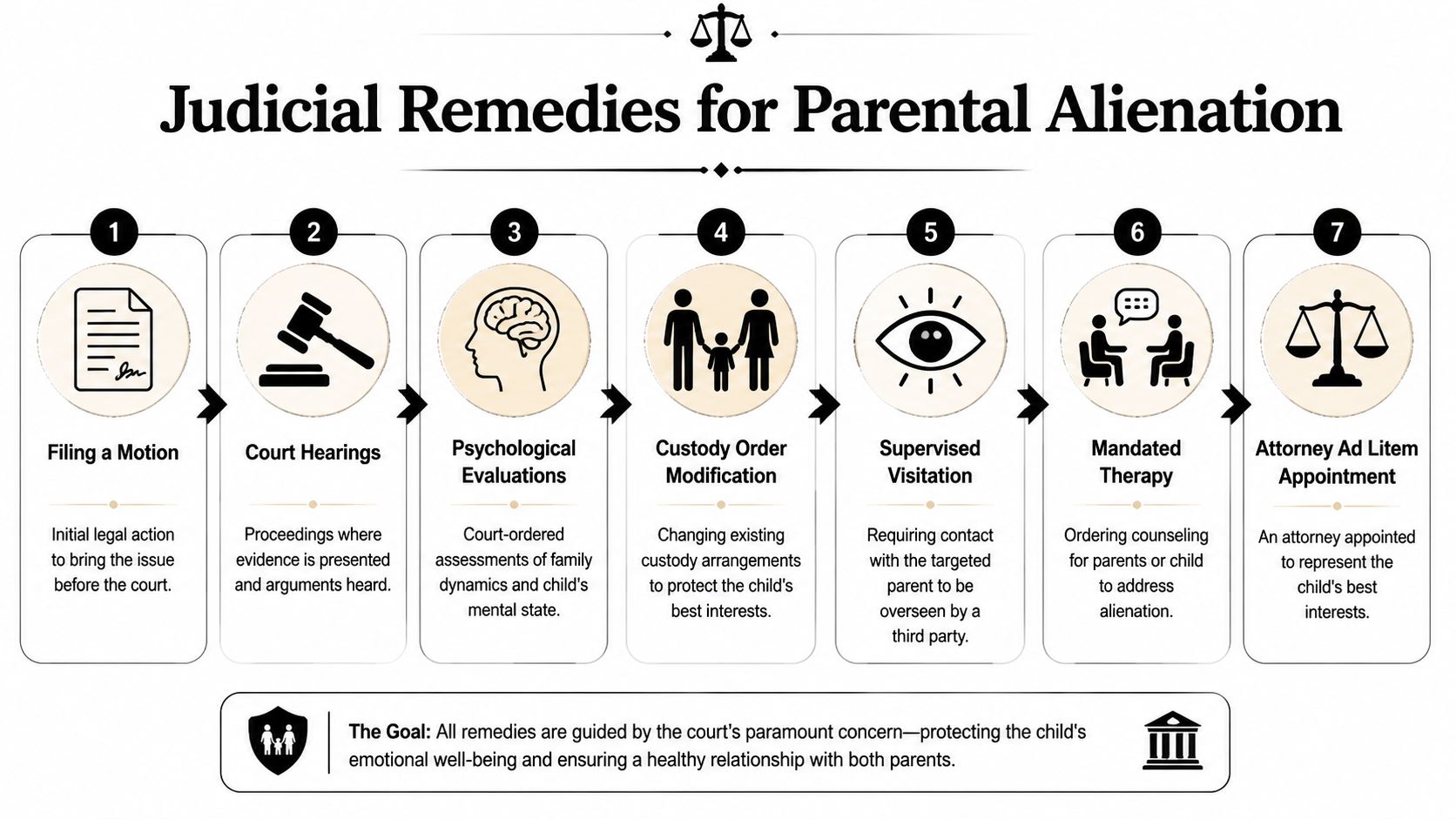
Common tools the court can use
Texas courts often rely on outside professionals in high-conflict cases. As described in this overview of parental alienation and Texas custody evaluations, courts frequently appoint neutral professionals such as child custody evaluators or parenting coordinators to provide an objective assessment of family dynamics and recommendations to address alienating conduct.
That matters because judges usually don't want to guess. They want a neutral assessment.
Other remedies can include:
- Makeup possession. Under Texas Family Code § 157.168, unauthorized interference with court-ordered visitation can lead to make-up time, sometimes called “time taken, time back.”
- Clarified exchange terms. A judge may tighten vague pickup or communication provisions that have enabled conflict.
- Parenting coordination or counseling. This can help in moderate cases where the relationship is damaged but still repairable.
- Restrictions on the alienating parent's conduct. The court may limit behavior that interferes with the child's relationship with the other parent.
- Changes to conservatorship or primary residence. In severe cases, the court can alter the custody structure to protect the child.
What works better than asking for punishment
Some parents come in wanting the judge to “teach the other parent a lesson.” That's understandable, but it usually isn't the strongest frame. Judges are more interested in fixing the child's situation than in validating either parent's anger.
A stronger presentation sounds like this:
- the order is being undermined,
- the child is being harmed,
- the pattern is documented,
- and a specific remedy is needed.
The judge's question is usually not “Who's more upset?” It's “What order will stabilize this child and protect the parent-child relationship?”
Trade-offs in real cases
Not every remedy fits every case.
A custody evaluation can be useful, but it also adds time, cost, and scrutiny for both parents. Therapy can help, but only when the professional understands high-conflict family dynamics and the case does not involve unresolved safety concerns. A request to change primary custody can be justified, but it raises the stakes and demands stronger proof.
Parents should also know this. If the child's resistance may be tied to genuine trauma, substance issues, mental health concerns, or prior CPS history, the court will expect careful distinctions. An alienation claim should never be used to erase legitimate protective concerns. Judges in Montgomery County take that seriously.
What to Do Next A Practical Checklist
If you believe parental alienation is happening, don't wait for it to “blow over.” Delay usually makes the pattern harder to unwind.
Your next five moves
Start documenting today
Create one running log. Use dates, times, exact statements, and missed exchanges. Save messages in one folder.Follow your court order closely
Show up on time. Confirm exchanges in writing. Don't give the other side easy arguments about your own compliance.Stop arguing with your co-parent in front of the child
Even justified anger can backfire. Keep communication short, civil, and focused on logistics.Don't pressure your child for answers
Reassure the child that you love them. Avoid cross-examining them about what happens at the other home.Gather your paperwork and get legal advice quickly
Pull your final decree, modification orders, temporary orders, and message records. If the situation is escalating fast, learn when an emergency custody order in The Woodlands may or may not be appropriate.
A practical note about outside attacks
Some alienation disputes spill into public smears, workplace complaints, or online attacks by an ex-partner. If that's happening alongside your custody issue, a resource like ContentRemoval.com's ex-partner attack guide can help you think through reputation containment while your family law case proceeds.
Keep your expectations realistic
You may feel urgency, but family court usually moves on procedure and proof. Quick action matters. So does patience. The parents who do best in these cases are usually the ones who stay measured, keep clean records, and ask for remedies the judge can grant.
This article is for informational purposes only. It is not legal advice and does not create an attorney-client relationship.
If you're dealing with a sudden breakdown in your relationship with your child in The Woodlands or elsewhere in Montgomery County, a consultation can help you sort out whether you're looking at enforcement, modification, or a case that needs immediate protective steps. The Law Office of Bryan Fagan can review your court orders, your evidence, and the local court options with you.
