 Skip to content
Texas has no minimum cohabitation period for informal marriage, and the legal test is agreement to be married, living together in Texas as spouses, and representing to others that you're married. If those three facts line up, a couple in The Woodlands can be married under Texas law even without a ceremony or license.
A lot of people in Montgomery County only realize this after a breakup, a custody dispute, or a probate problem. They thought they were just living together. The law may see something different.
What Common Law Marriage Means in The Woodlands
A couple in Sterling Ridge can build a shared life for years, split bills, raise children, and still never sign a marriage license at the county clerk's office. In everyday conversation, that can look like marriage. Under Texas law, it can also count as marriage if the legal proof is there.
Texas recognizes informal marriage, which many people still call common law marriage. Once a court finds it, the relationship has the same family-law effect as a ceremonial marriage. The court can treat the couple as married for divorce, property division, and later probate questions. There is no durational requirement under Texas State Law Library guidance on common law marriage, and the legal focus stays on agreement, living together in Texas after that agreement, and holding out as married in public.
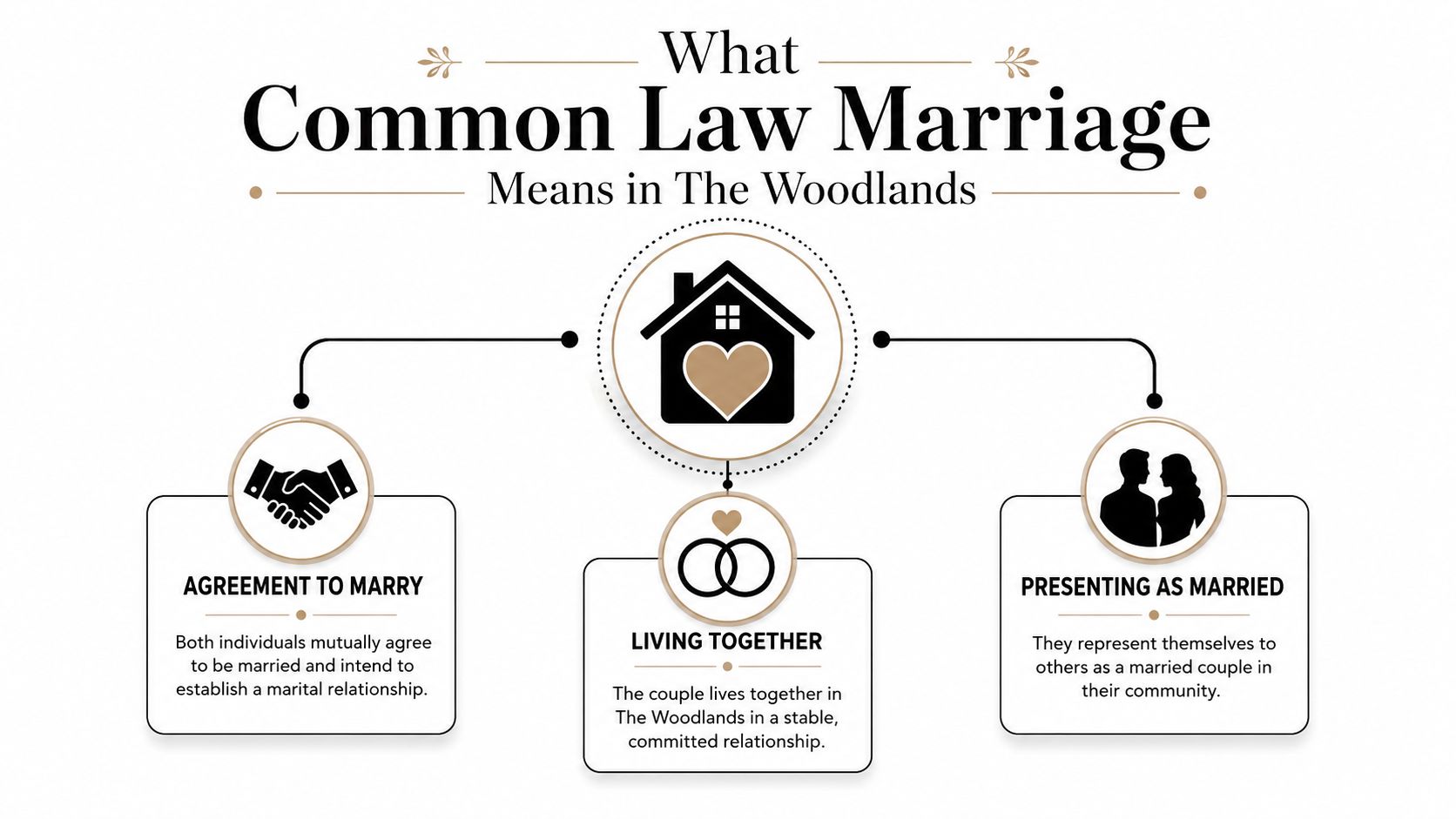
Why The Woodlands families get tripped up
Couples in The Woodlands often build a long shared life before they ever think about legal paperwork. That is where the confusion starts. Living together by itself does not create a marriage, and dating for years does not either.
The law looks for proof, not feelings. If a couple talks like spouses, lives like spouses, and presents that way to neighbors, schools, doctors, or relatives, the relationship may be treated as marital. If that proof is missing, the court may treat the same relationship as unmarried cohabitation.
The hardest cases usually are not about whether two people cared for each other. They are about whether they created a legally recognized marriage.
That distinction matters because once the relationship is proven as a marriage, the legal consequences reach far beyond the breakup itself. Property, support, custody, and inheritance can all turn on the answer.
The Three Elements Texas Law Requires
Texas Family Code § 2.401 uses a three-part test. All three parts have to exist at the same time. A future promise to marry later on doesn't count, because Texas requires a present agreement to be married when the relationship is formed.
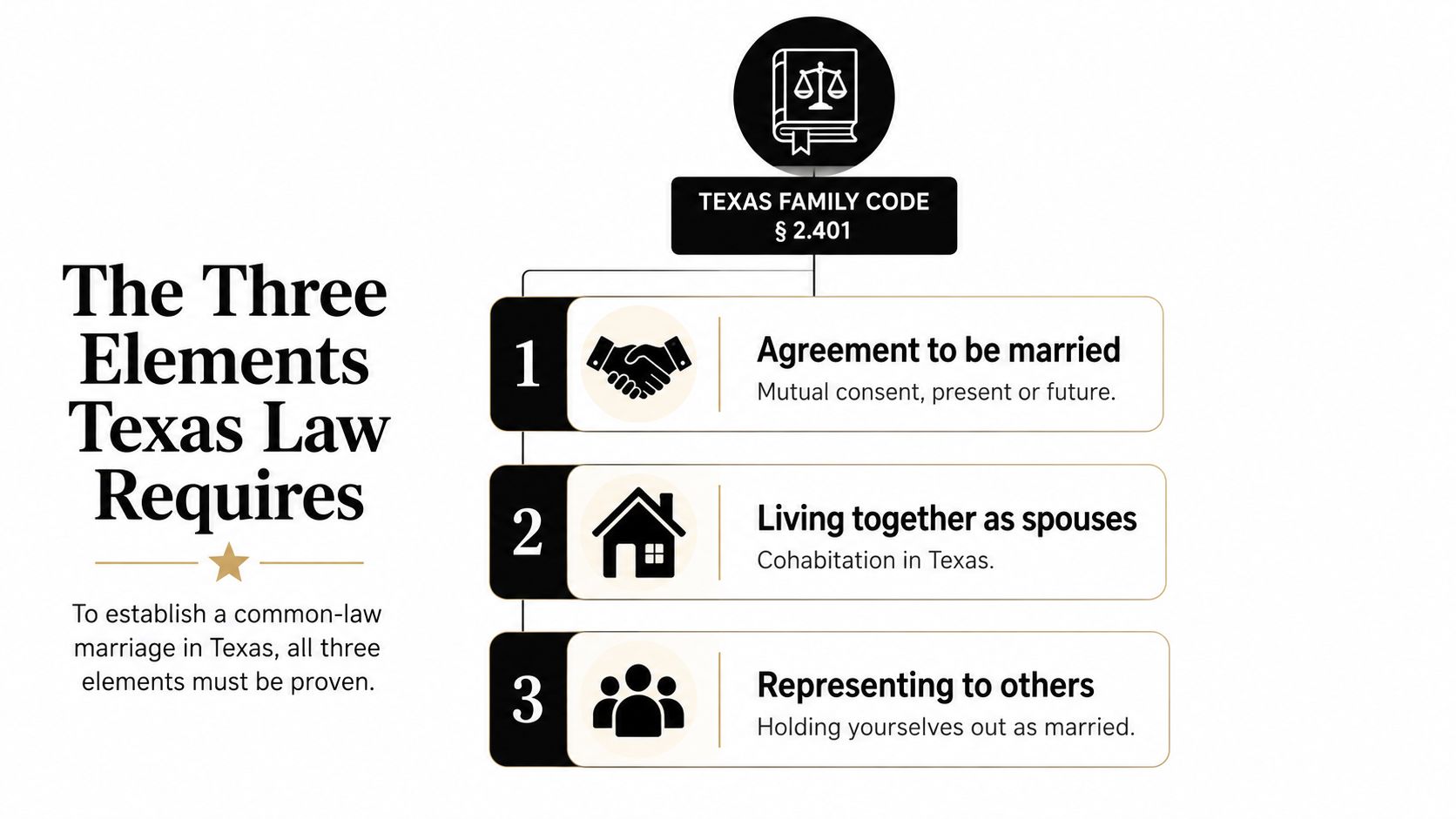
Agreement to be married
This is the part people misunderstand most. The couple must have a present agreement that they are husband and wife, not just partners who might marry someday. If someone says, “We'll get married after the house closes” or “after the baby is born,” that usually points the other way.
A Panther Creek couple might tell close friends they're married, file paperwork together, and act as spouses in daily life. If the evidence shows both people agreed to be married now, that first element may be met.
Living together in Texas as spouses
The second element is cohabitation in Texas. That means more than occasional overnight stays. The couple must live together as spouses. A lease, mortgage statement, or utility history can help show the shared household, but the legal question is still whether the living arrangement reflected a marital relationship.
Holding out to others as married
The third element is public representation. The couple must hold themselves out as married to other people. That can show up in how they introduce each other, how they appear on school forms, how they speak to neighbors, or how they handle financial accounts.
Practical rule: the court cares about what other people were led to believe, not just what the couple says privately after things fall apart.
A common source of confusion is engagement. Being engaged isn't the same as being married. A future wedding plan may show commitment, but it doesn't satisfy the Texas test unless the parties already agreed they were married and behaved that way.
Proving or Creating an Informal Marriage Locally
A Montgomery County informal marriage case usually starts in one of two ways. The couple can sign a Declaration of Informal Marriage while the relationship is still intact, or one spouse can try to prove the marriage later with records and testimony after the relationship has broken down. Texas lets couples create that written declaration, and it gives everyone a cleaner paper trail if a dispute comes up later.
The shortcut that avoids later fights
A signed declaration is the cleanest route when both people agree on their status. It reduces later arguments because the couple creates a written record while the relationship is still stable, instead of leaving a judge to sort out old memories years later. For Woodlands residents, that can matter when one partner has better paperwork than the other, or when relatives later question whether the marriage was real.
In practical terms, the declaration is filed with the county clerk in Montgomery County. That public filing can matter later in divorce, probate, or a benefits dispute because it gives a court a direct document to examine. It works like a label on a file folder, it tells the court what the parties said about themselves before the disagreement started.
What courts look at when there's no declaration
When there is no declaration, the court looks at proof. The usual proof falls into three buckets, documents, conduct, and reputation. Joint tax returns, shared mortgage records, joint insurance, and mail addressed to both spouses can all help. So can testimony from neighbors in Panther Creek or Alden Bridge who always knew the couple as married.
A Paternity Lawyer in The Woodlands can also matter when a family-law dispute overlaps with parentage issues in Montgomery County, because marital status often affects related rights and responsibilities.
How lawyers think about the proof
The best cases usually have several pieces pointing the same way. One document by itself may not settle the issue. A cluster of documents, conduct, and witness statements gives the court a fuller picture.
That is the practical lesson for Woodlands families. The Texas Family Code does not reward the couple that lived together the longest. It rewards the couple that can prove the legal elements most clearly. A stable relationship with weak records can be harder to prove than a shorter one with strong records, which is why timing and paperwork matter while the relationship is still intact.
The Two-Year Presumption That Can Cost You the Marriage
Texas law creates a problem after separation when an informal marriage was never clearly documented. If two years pass after the couple stops living together and neither person files to establish the marriage, Texas creates a rebuttable presumption against the marriage. In plain English, silence and delay can start working against you. The timeline graphic below shows how that presumption and the burden of proof can shift over time.
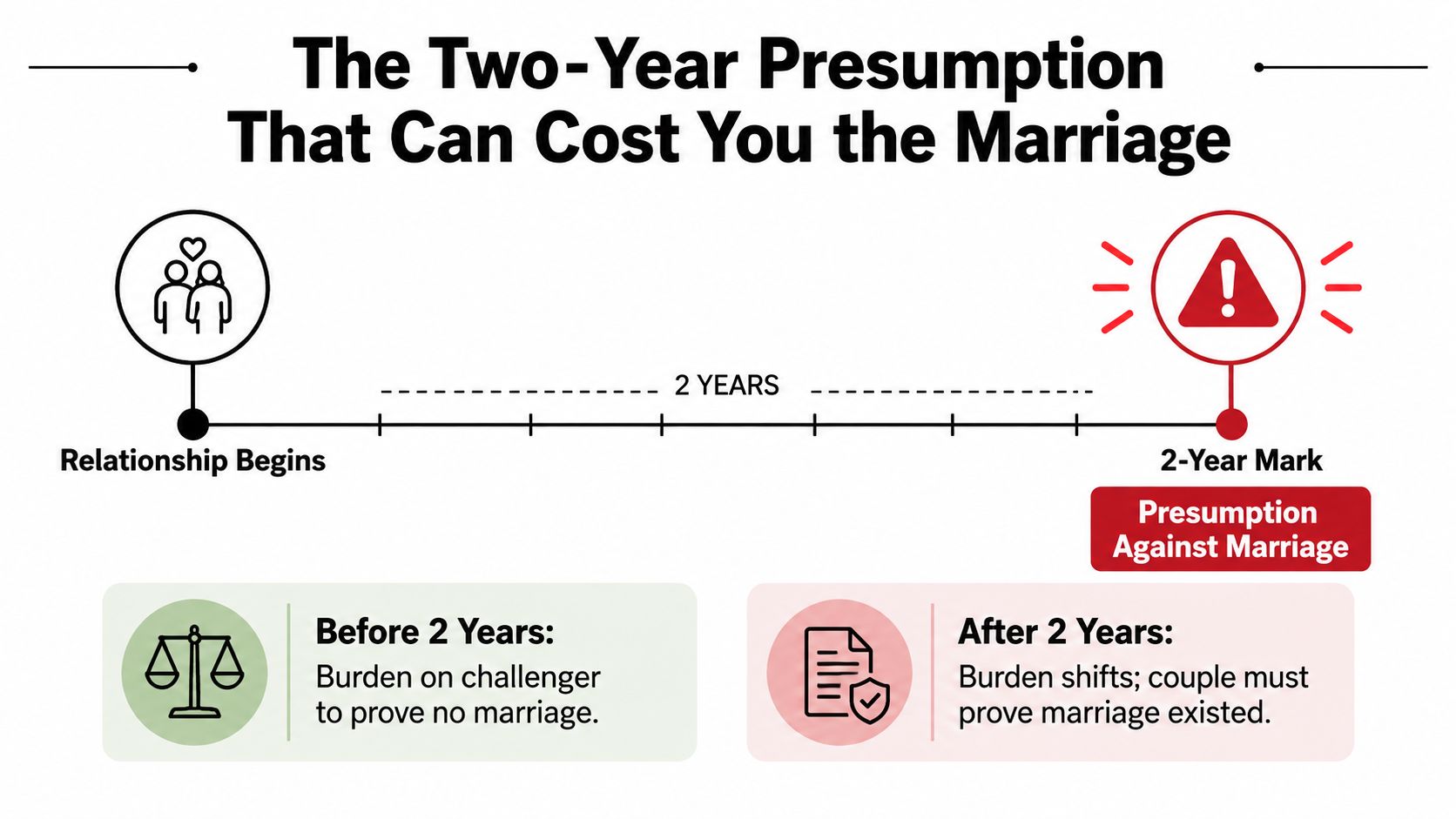
Why waiting changes the case
Before the two-year mark, the person challenging the marriage usually has the harder job. After that point, the presumption turns the pressure around and places the burden on the person claiming the marriage existed. That change matters because families often wait while they are trying to keep the peace, decide whether the breakup is permanent, or sort out a house and children without going straight to court.
A Sterling Ridge couple who separated without filing anything and then waited years before a custody or property dispute surfaced may find that the delay became the biggest problem in the case. Even a real relationship can become difficult to prove once the paper trail goes stale and witnesses start remembering things less clearly.
The strategic move after separation
If there is a real disagreement about status, timing matters. A declaratory action or other court filing may need to happen quickly to protect the claim. Waiting can weaken bargaining power, especially where property or inheritance rights are involved.
A Montgomery County lawyer will usually look at separation dates, public records, and the first point at which the couple stopped acting like spouses. That timeline often decides whether the presumption helps or hurts.
For residents sorting out related parentage questions, a paternity resource for The Woodlands can fit into the larger family-law picture, especially when children and marital status issues overlap.
How Informal Marriage Changes Divorce and Custody Outcomes
Once a court decides an informal marriage exists, Texas treats it like any other marriage for family-law purposes. That means the divorce process, property division, custody analysis, and support issues all move under the same legal framework. The way the marriage began doesn't lower anyone's rights.
Property and support follow the same rules
Community property rules can apply to assets acquired during the relationship, including a home in Alden Bridge, vehicles, retirement contributions, and other marital property. If the marriage is proven, those assets are divided under Texas community-property principles, not split based on who held the title alone. A Property Division Lawyer in The Woodlands handles disputes involving community property and complex assets for Woodlands divorces.
Child-related issues also follow the same Texas standards. Custody turns on the child's best interest, and child support is handled under Texas guidelines regardless of whether the marriage was ceremonial or informal. For a plain-English breakdown of how judges approach custody, see the firm's page on how Texas judges decide child custody.
Why the marriage label matters in court
If the relationship is recognized as a marriage, the court doesn't treat one spouse as a tenant or roommate. The court sees a family-law relationship with property rights, support questions, and parental issues attached to it. That changes what gets filed, what gets requested, and what evidence matters.
This is also why some people are surprised when a breakup becomes a full divorce case instead of a simple separation dispute. The marriage question comes first, and everything else follows from it.
If the court finds an informal marriage, the parties don't get a lighter version of divorce. They get the same divorce process everyone else gets.
That's why a careful Montgomery County review matters early. If the status is real, it should be treated seriously. If it's not provable, the case strategy changes just as fast.
Inheritance, Probate, and Estate Planning Implications
Informal marriage also matters after death. Under the Texas Estates Code, a surviving spouse in a proven informal marriage can have the same intestate inheritance rights as a ceremonially married spouse. That includes rights connected to homestead allowance, exempt property, and family allowance when there's no will or when probate issues arise in Montgomery County.
What happens when there's no will
If a Woodlands resident dies without a will, the spouse's legal status can decide who inherits and who doesn't. A proven informal spouse may inherit as a surviving spouse. An unmarried partner, by contrast, is generally treated as a legal stranger under Texas inheritance law.
That difference shows up quickly in probate court. It can change who has standing, who receives property, and who gets to ask the court for support from the estate.
For readers dealing with estate administration questions in Montgomery County, the firm's page on estate administration in The Woodlands is a useful starting point.
Why estate planning still matters
Couples who believe they are in an informal marriage should still put their wishes in writing. Wills, trusts, and updated beneficiary designations reduce the chance that a surviving spouse or adult children end up fighting over status later. An Estate Planning Attorney in The Woodlands can help families build documents that match the nature of their relationship.
Probate disputes are often messy because memory fades and records get lost. The safest move is to create proof while the couple is alive and on the same page. That makes it easier for a court, family member, or executor to understand what the couple intended.
A relationship that was treated like a marriage in life can still turn into a status fight in probate if the records were never put in order.
Your Evidence Checklist and Next Steps in The Woodlands
If you think an informal marriage may exist, start collecting proof now. The best cases are built from ordinary records that show the same story from different angles. A court in Montgomery County usually wants consistency, not just one dramatic piece of evidence.
What to gather
- Joint lease or mortgage records, because shared housing helps show cohabitation in Texas.
- Joint bank or credit accounts, because financial blending can support the marriage claim.
- Insurance policies and beneficiary forms, because they can show how the couple described itself.
- Tax filings and correspondence, especially anything filed or addressed as married.
- Messages, invitations, and public introductions, because they may show how the couple held itself out.
- Witness names, such as neighbors, relatives, or friends who heard the couple refer to each other as spouses.
What to do next
- Pull together the documents that show living together and public representation.
- Write down dates for when the relationship started, when you separated, and when status was first disputed.
- Check whether a declaration was ever filed with the Montgomery County Clerk in Conroe.
- Speak with a family law lawyer quickly if two years after separation is approaching or has already passed.
- Keep estate and child-related records together, because informal marriage often affects more than one court issue.
If the facts are messy, early legal help can keep a record from going stale. The Law Office of Bryan Fagan offers consultations for people in The Woodlands who need to sort out informal marriage, divorce, custody, property, or probate issues before a deadline becomes a problem. You can start with a free consultation with a family lawyer in The Woodlands.
Common Questions Woodlands Residents Ask About Informal Marriage
Yes, Texas recognizes same-sex informal marriages under the same legal rules that apply to opposite-sex couples. The legal test doesn't change because of the couple's gender. What matters is whether the evidence supports the three-part requirement under Texas law.
A couple can also file a Declaration of Informal Marriage while living apart, but that usually raises proof questions because cohabitation is part of the legal test. If the relationship already ended, the facts need careful review before anyone assumes the declaration will solve the problem.
A promise to marry in the future doesn't create an informal marriage. Texas requires a present agreement to be married, not a plan to become married later. That's one of the biggest myths people bring into a first meeting.
Texas does not recognize palimony as a separate claim in the way some people expect. If there's no valid marriage, the case usually turns on contract, property title, or other specific legal theories, not an automatic support claim based only on cohabitation.
This article is general information, not legal advice. Informal marriage cases turn on the exact facts, the timeline, and the records. If your situation touches Montgomery County property, custody, or probate, talk with a lawyer who can review your evidence before you lose ground.
The Law Office of Bryan Fagan helps people in The Woodlands sort out informal marriage disputes, divorce questions, property division, custody issues, and probate concerns with Montgomery County procedure in mind. If you're unsure whether your relationship counts as a marriage under Texas law, visit The Law Office of Bryan Fagan to schedule a consultation and get guidance based on your facts.
