 Skip to content
When a family problem lands on your kitchen table, it rarely arrives at a good time. It might be a spouse saying they want a divorce, a text about keeping the kids longer than agreed, or a notice that child support needs to change. For many people in The Woodlands and Montgomery County, the hardest part isn't the law. It's figuring out what to do first.
That's where a free consultation family lawyer in The Woodlands can help, if you use it the right way. A good consultation isn't just a meet-and-greet. It's a triage meeting. The point is to sort your problem into the right lane quickly: Is this an emergency? Is this a standard filing? Is this something that should be negotiated or mediated before anyone runs to court?
If you treat the consultation as a chance to “tell the whole story from the beginning,” you may leave with less clarity than you hoped. If you treat it as a focused strategy session, you'll usually get more value from the time.
Navigating Your First Step in a Family Law Matter
A lot of people call a lawyer only after weeks of stress. They've talked to friends, searched online, and replayed the same argument in their head over and over. By the time they reach out, they're often asking a broad question like, “What are my rights?” What they usually need is a much narrower answer first.
They need to know what kind of case they have.
A spouse in Alden Bridge may think they need to file for divorce immediately, when the more pressing issue is protecting access to bank records and understanding the home situation. A parent in Sterling Ridge may think they have “just a visitation disagreement,” when the underlying issue is whether the facts call for urgent temporary relief. A consultation helps sort those situations before mistakes pile up.
A free consultation works best when it turns fear into a short list of next actions.
That matters in Montgomery County because family law problems often move fast. If children are involved, if someone has already moved out, if there are threats, if money is being shifted, or if an existing order is being ignored, timing matters. Waiting too long can make a manageable problem more expensive and harder to fix.
The consultation is low-risk in one important sense. You get a first look at the legal picture before committing to full representation. You can ask direct questions, hear how the attorney frames your case, and decide whether the issue sounds urgent, routine, or suitable for settlement efforts first.
The three outcomes that matter most
Most strong consultations produce one of these early conclusions:
Emergency track
Safety concerns, credible threats, child withholding, or facts that may require temporary orders or protective-order planning.Standard court track
Divorce, custody, support, enforcement, or modification issues that need filing and a structured plan, but not same-day action.Negotiation or mediation track
Cases where both sides may still be able to exchange information, stabilize parenting, and work toward resolution without immediate contested litigation.
If you're overwhelmed right now, that's normal. But your first job isn't mastering Texas family law. It's getting your facts organized enough for a lawyer to tell you which track you're on.
Finding the Right Free Consultation in The Woodlands
At 8:30 on a Tuesday morning, one parent is calling because the other kept the children overnight and will not answer texts. Another caller wants to know whether a divorce can stay out of court if the house, retirement accounts, and parenting schedule are still open for discussion. Both are looking for a free consultation, but they do not need the same kind of meeting.
That is the point of choosing carefully. A useful consultation in The Woodlands should sort your case into the right lane early: emergency action, a standard filing, or a mediation-focused plan. If the lawyer cannot quickly identify that difference, the meeting may leave you with more anxiety than direction.
Look for a family-law practice that works in Montgomery County realities
Start with lawyers who regularly handle divorce, custody, support, modification, and enforcement matters in this area. A broad practice can be fine for some legal issues, but family cases usually turn on details that change fast, especially when children, temporary possession, or financial control are in dispute.
A local family law attorney in The Woodlands, Texas page can help you compare whether an office describes these cases in a concrete way. Clear service descriptions usually tell you more than polished marketing copy.
If the dispute centers on the marriage itself, Divorce Lawyer in The Woodlands, TX is a useful check on whether the firm handles divorce cases in The Woodlands and Montgomery County. If children are the immediate issue, pay equal attention to whether the firm regularly handles custody and possession disputes, because those cases often require faster triage than the caller expects.
Ask what kind of consultation you are actually scheduling
A short intake call and a legal consultation are different things. Intake staff often need names, the opposing party's name, the county, and a short description of the problem to screen for conflicts and book the right appointment. That is normal. It is not legal advice.
Ask these questions before you agree to the meeting:
Who will I speak with?
Lawyer, paralegal, or intake coordinator.How much time is set aside?
Ten minutes can screen a case. It rarely gives enough time to sort urgency, court posture, and immediate next steps.Will the lawyer review documents in advance?
Existing orders, a notice of hearing, or a police report can change the advice you get.Can the meeting address emergency concerns?
If a child has been withheld, there are threats, or someone is draining accounts, you need to know whether the office can evaluate immediate action.
Judge the meeting by the triage, not by the word "free"
The best free consultations are practical. By the end of the meeting, you should know which of these categories fits your case and why.
| What the lawyer should help determine | Why that matters in real life |
|---|---|
| Does this look like an emergency? | You may need immediate filing, temporary orders, or safety planning |
| Is this a standard court matter? | You can prepare for filing, service, deadlines, and a longer timeline |
| Is this suitable for negotiation or mediation first? | You may save money and stress if both sides can still exchange information and make temporary arrangements |
| What facts matter most right now? | It keeps the case focused on issues the court will care about |
One warning. Some consultations feel reassuring because the lawyer is personable, but you still leave without a clear answer about urgency, filing posture, or whether Montgomery County court involvement is likely. That is not enough. A good consultation does not need to solve the whole case, but it should tell you what kind of case you have and what should happen next.
The Woodlands has no shortage of family-law options, and that is helpful for clients. It also means you can be selective. Choose the office that uses the consultation to sort the problem, explain the trade-offs, and give you a usable plan for the next few days, not just the next phone call.
How to Prepare for Your Family Law Consultation
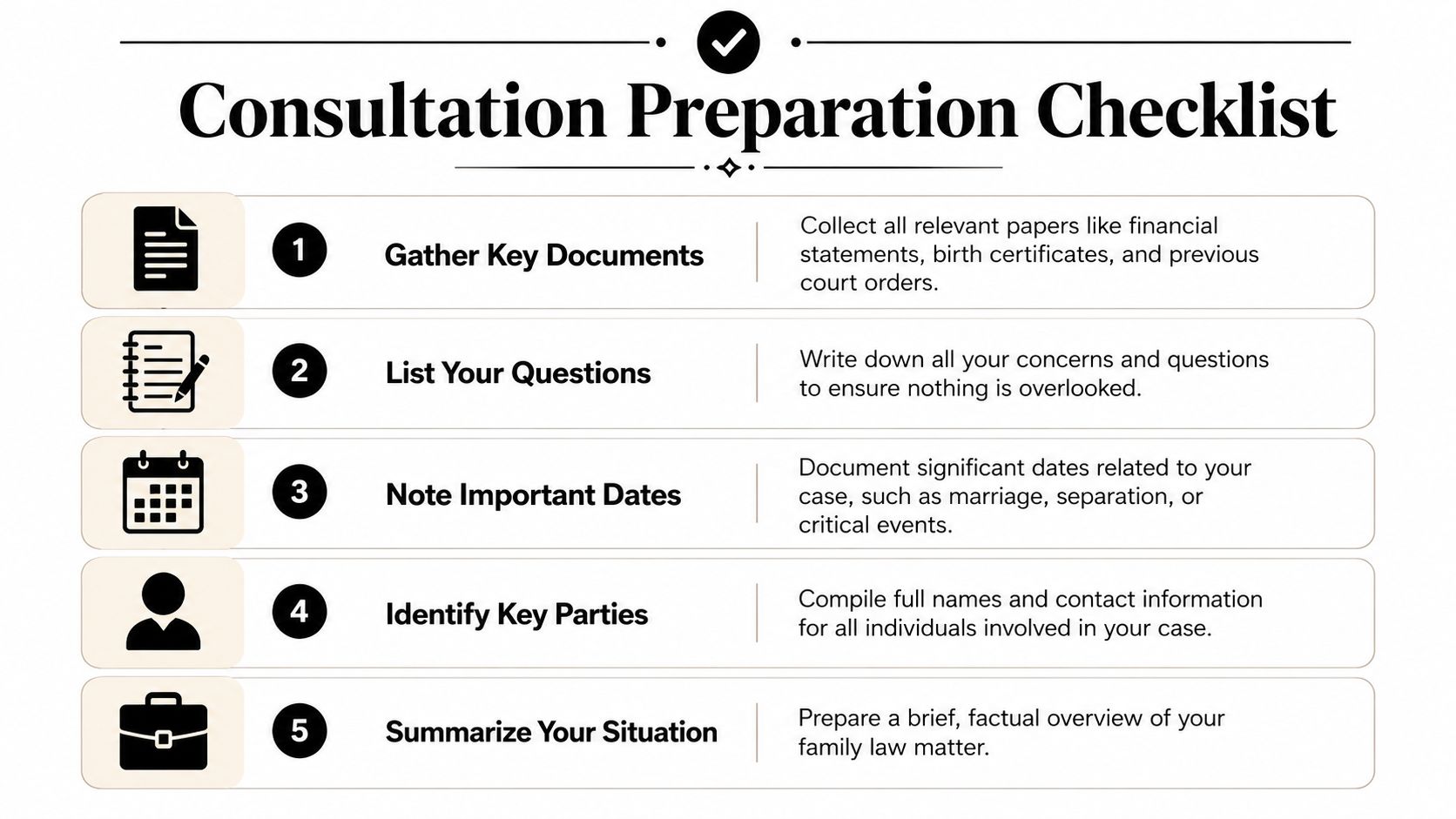
Preparation changes the quality of the meeting. If you walk in with scattered screenshots and a general sense that things are “bad,” the lawyer has to spend your time sorting basic facts. If you bring a clean timeline and the right documents, the lawyer can spend more time on options.
Texas family courts analyze custody through the child's best interests. A practical consultation works better when your facts are organized around the child's home environment, emotional ties, and any history of conflict or safety concerns, as discussed in this Woodlands family-law resource.
Bring facts, not just feelings
You don't need a perfect file. You do need a usable one.
Bring these documents if you have them
- Existing court orders such as divorce decrees, custody orders, child support orders, and protective orders
- Basic financial records including pay stubs, tax returns, account summaries, and major debt information
- A short chronology with dates of marriage, separation, moves, major disputes, and changes involving the children
- School and medical information if parenting, health, or stability is part of the issue
- Communications that show important facts, not every angry text ever sent
- Property information for homes, businesses, retirement accounts, or unusual assets if divorce is involved
If you're facing divorce, this guide on how to prepare for a divorce consultation in Texas is a useful companion to your prep.
Organize your story into legal issues
Lawyers don't need every detail first. They need the details that change the legal response.
For example, “My ex is impossible” isn't useful by itself. “There's an existing order, pickup was refused twice, and the child's school attendance has become irregular” is useful. “I think money is missing” is vague. “One account was closed after separation and I don't have statements after that date” gives the lawyer something concrete.
A short video can help you think through what to gather before the meeting.
Questions to ask in the meeting
Write these questions down before you go
- What kind of case is this under Texas law?
- Does this look urgent, or can it wait a bit?
- What facts are strongest for me?
- What facts could hurt me if the other side raises them first?
- Should I file, respond, negotiate, or mediate?
- What documents do you still need to evaluate the case properly?
- What would be included in paid representation after the consultation?
If children are involved, it also helps to know that the Texas Family Code frames conservatorship and possession issues around the child's best interests. You don't need to memorize the statute. You do need to bring facts that speak to stability, parenting history, safety, and practical schedules.
What to Expect During the Meeting with Your Lawyer
Walking into a law office can feel formal, even when everyone is friendly. Most consultations are more practical than dramatic. The lawyer is usually trying to answer a narrow set of questions fast: what happened, what orders exist, what risks are present, and what needs to happen next.

The first part of the conversation
Expect a few opening questions that may seem basic. Who is involved. Where do they live. Is there already a court order. Has anything been filed. Are there children. Are there immediate safety concerns.
That opening isn't small talk. It determines whether the lawyer can even advise you on the immediate problem and whether conflict checks or jurisdiction issues matter. Under the Texas Family Code, filing and jurisdiction questions can shape where and how a family case proceeds.
How lawyers triage the case
A consultation often becomes more productive when the lawyer scopes the matter into a category. In major-market family-law practice, that usually means divorce, custody, support, or modification/enforcement, and local offices often limit the free meeting to a short attorney discussion rather than a full case analysis, as reflected in the Woodlands office information from Cordell & Cordell.
The biggest mistake clients make in that meeting is holding back the hardest facts. If there's violence, substance use, threats, prior order violations, hidden money concerns, or a child who may not be safe, say it early. Those facts can change whether the lawyer discusses protective measures, emergency custody options, or expedited filing.
If a fact would worry a judge, it belongs in the first consultation.
A short local scenario
A parent from Creekside Park comes in saying, “I want to modify custody because the current schedule isn't working.” That sounds simple, but the follow-up questions matter more than the label.
Has there been a material change since the last order. Has the child started struggling in school. Did one parent relocate. Is the other parent missing exchanges. Is there a new safety concern in the home. Is the child older and on a very different routine now.
Those questions go straight to whether a modification claim is likely to be viable under the Texas Family Code provisions on modification. The lawyer isn't judging you. The lawyer is testing whether the facts fit the legal doorway you want to walk through.
This is also your chance to evaluate the attorney. If your issue centers on conservatorship, you may want to ask whether the firm handles a matter like a Child Custody Lawyer in The Woodlands, TX would handle, meaning custody and conservatorship representation for The Woodlands families.
Connecting Your Case to Montgomery County Court Realities
A free consultation should do more than explain family law in general. It should sort your situation into the right lane for Montgomery County. Is this an emergency that may call for immediate court action. A standard filing that needs good preparation. Or a dispute that may be better addressed through negotiation or mediation before anyone races to the courthouse.

Why local context changes the advice
The same problem can lead to very different advice once local court realities are part of the analysis. A parent asking for a custody change may need emergency relief if a child is at risk. The same parent may instead need a standard modification case with school records, calendars, and witness detail. In another home, the dispute may be mostly about scheduling and communication, which often points toward mediation rather than a hearing.
That sorting process matters in Montgomery County because timing, pleadings, and temporary-orders strategy affect both cost and stress. Filing too early can leave a case thin on proof. Waiting too long can make a preventable problem harder to fix.
A useful consultation connects your facts to practical court steps. That includes what should be filed first, whether temporary orders are likely to matter, what documents need to be organized before a hearing, and whether settlement efforts should happen before or after filing. If you want a clearer picture of the court process, this overview of divorce court in Montgomery County, Texas gives helpful local context.
Texas law provides the framework. Local practice shapes the plan.
The Texas Family Code sets the rules for divorce, conservatorship, possession, child support, enforcement, and modification. The consultation is where those rules get matched to your facts.
For example:
- Custody and conservatorship issues turn on the child's best interests, but the key question in a consultation is what proof you have now.
- Temporary orders can control parenting time, bill payment, use of the house, and possession of property while the case is pending.
- Modification and enforcement cases require facts that fit the statute, not just frustration with the current order.
Some meetings also uncover estate-related problems. A separation can raise questions about beneficiary designations, inheritance issues, probate disputes, or who controls certain assets. In those situations, family law and estate issues can overlap fast, and that affects how the case should be framed from the start.
Good advice asks a harder question than what the code allows. It asks how these facts are likely to be received by the court you are in, on the timeline you are facing.
If your issue may resolve outside a contested hearing, it can help to review negotiation structure before the meeting. Redline's separation guide is one example of the kind of planning resource people sometimes use to understand what an early agreement discussion may cover.
After the Consultation Your Clear Next Steps
After the meeting, don't judge it by whether you got every answer. Judge it by whether you now know your lane. You should understand whether the case looks urgent, what documents still matter, and what the next paid step would likely involve.
That last point matters in high-asset and high-conflict cases. A free consultation can flag issues like property tracing, business interests, retirement division, and possible valuation disputes, but it usually won't resolve them in depth. Consumers in The Woodlands often need clarity about what the free meeting covers and what requires paid follow-up work, especially in complex divorces, as discussed in this Woodlands family-attorney page.
What to do next
Review your notes the same day
Write down the attorney's view of urgency, likely claims, and missing documents.Compare clarity, not comfort alone
The right lawyer should make the process clearer, not just make you feel better for an hour.Decide whether you need immediate action
If the consultation raised safety, child access, or asset-control concerns, don't drift.Gather the follow-up documents quickly
Cases lose momentum when clients wait too long to provide records.Use practical planning tools carefully
If you're trying to understand the structure of a separation discussion before retaining counsel, Redline's separation guide can help you think through common terms and sticking points. It's a planning resource, not a substitute for legal advice.
This article is for general information only. It is not legal advice, does not create an attorney-client relationship, and isn't a substitute for getting advice about your specific facts.
If you're dealing with divorce, custody, child support, property division, or a modification issue in The Woodlands or Montgomery County, a consultation can help you figure out whether you're facing an emergency, a standard court matter, or a dispute that may be resolved through negotiation. The Law Office of Bryan Fagan serves families in The Woodlands and surrounding Montgomery County communities, and you can schedule a consultation to discuss your situation and next steps.
