 Skip to content
If you've just changed jobs, married, divorced, or finally decided to fix a name that never quite fit, the paperwork can feel oddly personal. In The Woodlands and across Montgomery County, people usually don't start with a courtroom in mind, they start with a driver's license, school records, a bank account, or a child's last name that no longer matches the family reality.
That's where a name change lawyer in Montgomery County can save time and prevent avoidable mistakes. The hard part usually isn't the idea of the change, it's getting the petition, fingerprints, venue, and local filing details lined up in the exact order the court clerk expects.
Why People in The Woodlands Change Their Names
A client in Creekside often calls after a divorce is final and every record still shows the old married name. A parent in Panther Creek may want the household to share one surname after remarriage, or after an adoption changes who the legal parent is. A recent resident in Sterling Ridge might want a name that fits daily life better, without turning it into a bigger fight than it needs to be.
These are not abstract legal projects. They usually begin with a family change, then the paperwork has to catch up with what is already true in daily life.
The most common reasons
In Montgomery County, name-change filings often come up with divorce, custody, probate, or adoption matters. The district clerk groups adult name change and minor name change cases with other family-law filings, which is a good reminder that the courthouse handles them as part of the civil case workflow, not as a casual administrative request.
That local setup matters because the reason for the change affects the filing package. A married person going back to a former name, a stepparent trying to align a child's surname, and a probate-related name issue can all involve different rules, even when the goal sounds straightforward.
If the situation overlaps with an adoption step, the legal path can change again. A lawyer handling adult adoption and related family matters in The Woodlands often sees these issues together because parentage, surname choice, and court orders can move in the same file.
The practical takeaway is simple. The reason for the name change matters because it controls which court, which forms, and which notices are needed.
Who Can File and What the Court Needs From You
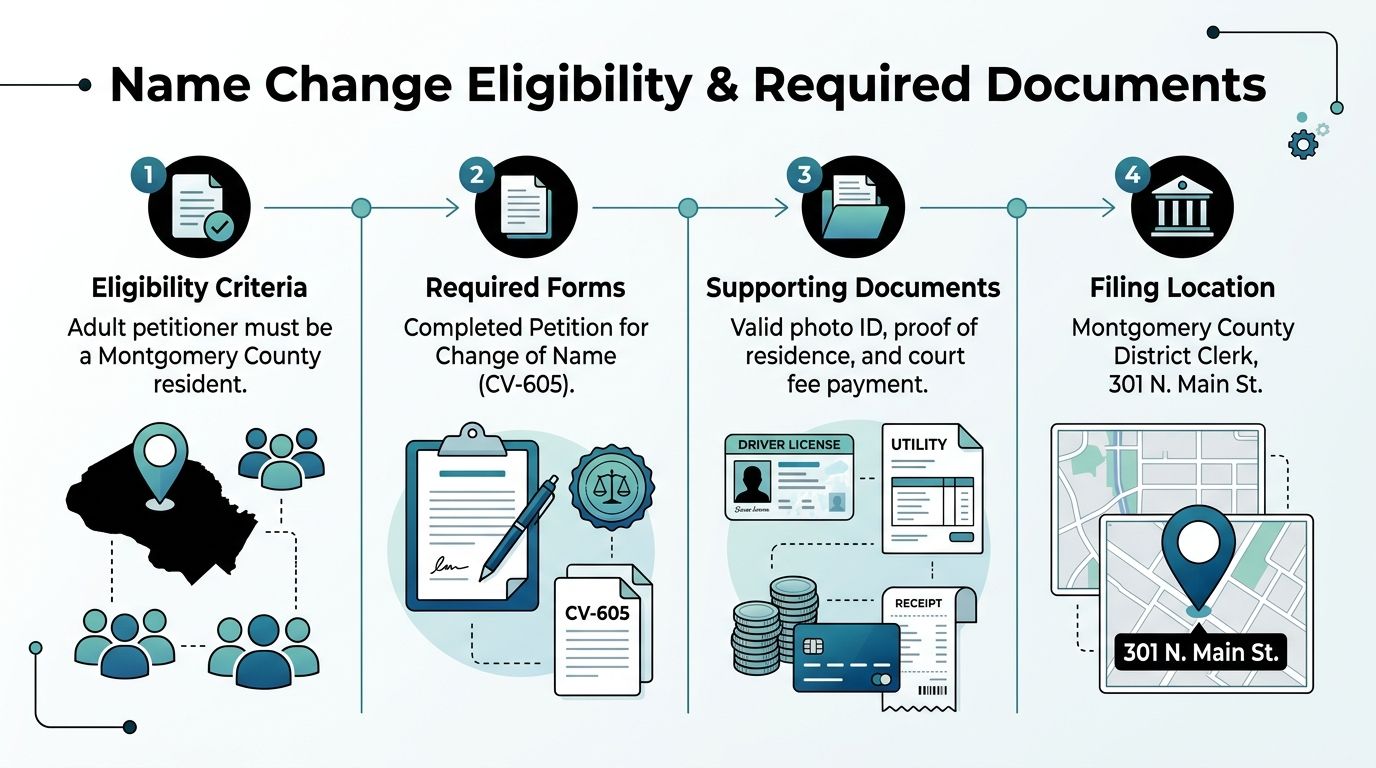
For an adult name change in Texas, venue matters first. The petition has to be filed in the county where the petitioner resides, and the petition must be verified, which means notarized under the local court process (Texas Law Help adult name change guide; Montgomery County name change checklist).
That's the part that trips people up most often. They assume the clerk will fix missing details later, but the clerk's job is to accept a properly assembled filing, not build the case for you.
The basic adult filing package
In Montgomery County, the adult petition needs the petitioner's current residence, the requested new name, the reason for the change, sex-offender registration status, and a legible complete fingerprint card acceptable to the Texas Department of Public Safety and FBI (Montgomery County name change checklist). That fingerprint requirement is a real failure point for people filing on their own, because the case can stall before a judge ever sees it if the packet isn't assembled correctly.
Texas courts also frame name-change procedure through the family-law and criminal-procedure rules that govern who files, where they file, and what disclosures go into the petition. In plain English, the court wants identity verification, venue proof, and a complete sworn filing, not just a short request for a new name (Texas Family Code and Texas Code of Criminal Procedure context in the Maryland courts' name-change guidance).
Practical rule: if the petition, fingerprint card, or notarization is off, the case usually doesn't get “fixed later” without delay.
One more local point matters if your name change is tied to family-court orders. The order-enforcement workflow in The Woodlands comes up when name changes intersect with divorce decree or custody order provisions, which is why timing and matching paperwork can matter just as much as the request itself (Enforcement of Court Orders in The Woodlands).
If you meet the residence requirement and can gather the verified petition, fingerprint card, and required disclosures, you've cleared the first hurdle. If any one of those is missing, the case can bog down before it gets to a judge.
Filing Your Petition Step by Step in Montgomery County
In Montgomery County, the work starts before anyone sets foot at the courthouse. The petition has to be assembled correctly, the supporting papers need to match, and the filing packet needs to fit the district clerk's process before the case ever reaches a judge. If the packet is incomplete, the case usually slows down right there.
The filing itself happens through the District Clerk in Conroe at 301 N. Main Street, Suite 103, Conroe, TX 77301. That local workflow matters because name-change cases here move through the county courthouse system, not a separate office that updates a record.
What usually happens first
The petition is filed, the fee is paid, and the case enters the local district-court system. After that, the court sets the matter for a hearing, and the petitioner waits for the hearing date and any notice requirements tied to the filing. The process is usually straightforward, but it depends on whether the documents were complete from the start.
The cases that move fastest are usually the ones prepared for the clerk before the filing window opens.
The hearing and publication piece
For many adult name-change filings, publication in a newspaper of general circulation in the county is part of the process. The judge also wants the petition to be sworn, consistent, and supported by the papers on file. The hearing is often brief. The judge checks identity, asks why the change is requested, and confirms that the filing fits the local requirements before signing an order.
Many people expect the hearing to be the hard part. In practice, the harder part is usually the preparation before the filing. A clean packet makes the hearing routine, while a sloppy one creates avoidable questions.
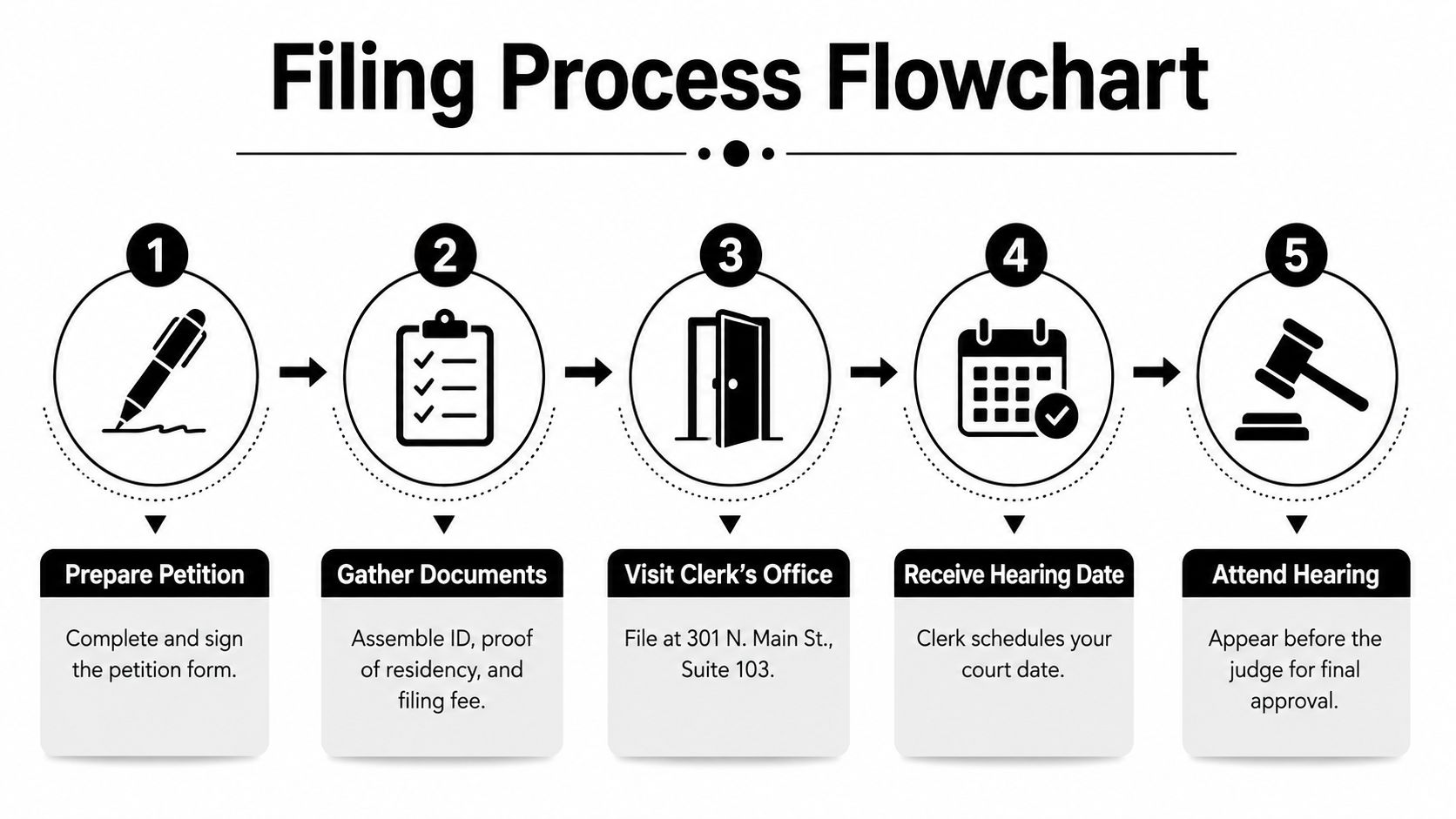
A simple filing sequence
- Prepare the petition. Put the request into the form the court will accept, with the required sworn statements in place.
- Gather the supporting papers. Bring ID, residence proof, fingerprint materials, and fee payment.
- File in Conroe. Submit the packet at the District Clerk's office on North Main Street.
- Wait for the court date. The matter is assigned and set for hearing.
- Attend the hearing. The judge reviews the request and signs the order if everything lines up.
If you are filing on your own, treat the clerk packet like a checklist, not a stack of loose forms. The failure point is usually the assembly work, not the hearing itself. Missing pages, mismatched names, or an incomplete affidavit can delay the case before a judge ever sees it.
For families handling a name change tied to a stepparent adoption, the paperwork has another layer. The adoption process can affect the surname request, so the filing needs to match the family-law order, not just the preferred name. A local stepparent adoption lawyer in The Woodlands can help sort out whether the name change belongs in the adoption paperwork, a separate petition, or both.
Special Rules for Minors and Post-Divorce Filings
Adult filings are the straightforward version. Minor name changes and post-divorce changes can be much more sensitive, because another parent, a prior decree, or a court order may already control part of the issue.
Minor child name changes
When a child's name is involved, consent and notice become central. If both parents agree, the case is usually cleaner. If one parent does not agree, the court can't treat it like a routine adult filing, because the judge has to consider parental rights and the child's best interests under the Texas Family Code framework.
That's where the paperwork stops feeling mechanical. A missing signature or a service problem can turn a simple surname change into a contested hearing.
Divorce decrees and later changes
Some people want to resume a former name as part of a divorce. That is often best handled in the divorce decree itself, because the court can sign off on the name change as part of the family-law order. If the divorce is already final, the person may need a separate name-change filing instead of trying to bolt the issue onto a closed case.
That difference matters because the court order is what controls the record trail. If the decree didn't address the name, the later filing has to stand on its own.
Adoption and surname alignment
Name changes also come up with adoption, especially when a stepparent adoption changes the legal family structure. In those cases, the surname issue is usually tied to parentage and final orders, not just preference. A stepparent adoption lawyer in The Woodlands can help line up the adoption paperwork with the name issue so the final order does what the family expects.
The practical lesson is to match the form path to the family situation. A minor child, a post-divorce change, and an adult personal-name change are not the same case, even if the desired end result looks similar on paper.
Timelines, Fees, and Common Complications
People ask about timing because they want a straight answer. The honest answer is that the timeline usually depends less on the hearing and more on whether the packet is complete when it first reaches the clerk.
That is the part people underestimate. A name change is not just a form with a signature line. The court wants the petition, the identity documents, and the venue-specific paperwork assembled correctly before the case can move forward, and the Maryland name-change guidance shows the same basic structure courts use in formal name-change matters, while the Montgomery County checklist points to the local document stack that has to be in order before filing (Montgomery County name change checklist).
What slows cases down
The most common delays are usually paper problems, not legal arguments. A fingerprint card that does not meet the required standard can send the filer back for a new set of prints. A petition that leaves out the residence statement, the reason for the change, or the sex-offender-registration disclosure can also stop the case before the judge ever gets to the request itself.
Criminal-history disclosures can add another layer of paperwork. That does not mean the petition cannot be granted. It means the file has to be prepared carefully, and every answer needs to match the record.
The other issue people do not think about
A creditor or family member can object, especially if the name change sits inside a larger dispute. That does not happen in every case, but when it does, the hearing is no longer a routine signature appointment. The court has to deal with the objection, and the filing may take longer than the person expected.
Best practice: fix the paper trail before filing, not after the clerk points out a missing piece.
Fee issues can slow things down too. Filing fees, recording charges, and any required background-check costs all need to be accounted for before the petition goes in, because a missing payment can be just as disruptive as a missing form. A clean adult filing with no dispute is usually straightforward once the packet is complete. The cases that look simple on the surface are often the ones where one omitted document causes the most delay.
When Hiring a Name Change Lawyer Actually Pays Off
A competent self-filed adult name change can work fine when the facts are clean. If you're an adult in Montgomery County, you live here, the reason is straightforward, and your paperwork is complete, going pro se may be reasonable.
That changes fast when the file has any friction. A lawyer becomes worth considering if the case involves a minor child, a non-cooperative parent, a criminal-history disclosure, a fingerprint rejection, a post-divorce timing issue, or a possible objection from someone who has legal standing to contest the filing.
A practical decision rule
If the only question is, “Do I want my name changed?” you may not need full representation. If the core question is, “Can I get this petition accepted, noticed, and signed without a refiling problem?” that's where counsel starts to make more sense.
A local attorney does the unglamorous work that keeps the case moving. That includes assembling the verified petition, coordinating fingerprinting, managing publication, and showing up at the hearing with the paperwork aligned to the clerk's process.
My rule of thumb: pay for help when the cost of a mistake is a refile, a reset hearing, or a disputed order.
The right choice isn't about whether the request is important. It's about whether the paperwork is likely to be smooth on the first pass.
What to Do Next and How to Reach Local Counsel
Before you file, get organized and stay local to the courthouse process.
What to do next
- Confirm eligibility. Make sure you file in the right county and that your situation fits the adult, minor, or post-divorce path.
- Gather identification and fingerprint records. Don't wait until the last minute to find out a card or document isn't acceptable.
- Prepare the petition carefully. The sworn details have to match your residence, requested name, and reason for the change.
- File in Conroe. The Montgomery County District Clerk's office is at 301 N. Main Street, Suite 103.
- Complete publication if required. Don't skip notice steps that the court expects.
- Attend the hearing. Bring the order-ready paperwork and answer the judge's questions directly.
This is not legal advice. It's general information about how name changes usually work in Montgomery County, Texas, and your facts may call for a different filing path.
If you want a local family law attorney to handle the paperwork and hearing for you, use the contact page for The Law Office of Bryan Fagan to schedule a consultation.
The Law Office of Bryan Fagan helps families in The Woodlands and across Montgomery County with the courthouse details that make a name change go smoothly or cause repeated delays. If you want help assembling the petition, checking the venue, and preparing for the hearing, visit The Law Office of Bryan Fagan to schedule a consultation and talk through your next step.
