 Skip to content
If you're reading this in The Woodlands or elsewhere in Montgomery County, there's a good chance you're staring at texts from the other parent, worrying about a hearing date, and wondering what a judge is going to care about.
Most parents come in with the same fear. They think custody turns on one big moment, one bad argument, or one dramatic accusation. It usually doesn't. Judges in Texas look for patterns. Who has been showing up. Who keeps the child's life steady. Who can make decisions without pulling the child into the middle.
That matters in the Conroe courthouse just as much as anywhere else in Texas. A judge isn't there to reward the more upset parent or punish the one who filed first. The court's job is to decide what arrangement serves the child best.
This article is for general educational purposes only. It is not legal advice and does not create an attorney-client relationship. If you have a pending custody case in Montgomery County, get advice based on your specific facts.
Facing a Custody Battle in Montgomery County
A parent in Alden Bridge gets served on a Thursday afternoon. By Friday morning, the questions come fast. Is the judge going to believe what happened in my house? Does my child get a say? What happens at the first hearing in Conroe, and how much can change before school starts again?
Those concerns are legitimate. A custody case reaches into the parts of life parents care about most, bedtime, school mornings, doctor visits, holidays, and who has authority to make decisions when the parents disagree.
In Montgomery County, the process also has its own pace and its own pressure points. Cases are heard at the courthouse in Conroe, and judges usually want focused evidence, organized records, and a parenting proposal that can work in real life. A parent who arrives with clear calendars, school records, message logs, and a practical schedule is in a stronger position than a parent who arrives with broad complaints and no backup.
Texas law supplies the framework. Local court practice often determines how that framework plays out in a temporary-orders hearing, mediation, or trial setting. Early hearings in particular can shape the status quo for months, which is why preparation at the start matters so much.
What parents often miss early in the case
A lot of parents walk in believing the court will spend its time deciding which parent is the better person. That is rarely how these cases are decided in practice.
Montgomery County judges usually want specific facts tied to parenting. Who gets the child to school on time. Who knows the pediatrician's name. Who follows through on counseling, tutoring, medications, and extracurriculars. Who communicates about schedule changes without creating more conflict. Who can follow a court order even when emotions are running high.
That is a different standard than "Who has the more upsetting story?"
I tell clients to prepare as if every important point will need an exhibit, a message, a school record, or a witness who can verify it. Hurt feelings may explain why the case was filed. They do not prove what order the judge should sign.
What steady, credible preparation looks like
If your case is just starting in The Woodlands or elsewhere in Montgomery County, focus on three things first:
- Clean up communication: Keep messages short, polite, and about the child.
- Protect the child's routine: Preserve school attendance, medical appointments, exchange times, and extracurricular commitments.
- Start a record now: Gather report cards, attendance records, medical information, calendars, and screenshots before deadlines start stacking up.
One more local reality matters. Judges in Conroe often see parents who overstate and underdocument. That hurts credibility fast. The parents who present well usually have something more useful than a dramatic accusation. They have a timeline that matches the records, a proposal the court can enforce, and conduct that shows they can put the child's needs ahead of the conflict.
The Best Interest of the Child Standard Explained
A parent can walk into court in Conroe convinced one bad incident will decide the case. That is usually not how Montgomery County judges approach custody. They look for a pattern. Which parent has been meeting the child's needs consistently, making sound decisions, and offering a plan the court can enforce.
The legal standard is the best interest of the child. Judges often organize that analysis around the Holley factors, which include the child's needs, any risk of harm, each parent's abilities, the stability of each home, and the plans each parent has for the child. Texas courts also do not give either parent an automatic advantage based on being the mother or father. This discussion of Texas custody factors and the no-sex-preference rule gives a useful overview.
In Montgomery County, that standard becomes very practical very quickly. Judges in The Woodlands and Conroe are not deciding which parent sounds more sincere. They are deciding which proposed arrangement fits the child's real life, including school, medical care, transportation, routines, and each parent's track record of cooperation.
Here is the visual version of that framework:

What judges are really measuring
Some parts of the analysis are straightforward. A judge will look closely at the child's emotional and physical needs. That includes school performance, health issues, counseling, behavior, supervision, and whether a parent understands what the child needs now, not just in theory.
Other parts come down to judgment under stress. Parental abilities means more than love for the child. It means getting the child to school on time, handling medications correctly, responding to problems without unnecessary drama, and making room for the other parent when the court expects cooperation.
Home stability also carries real weight in Montgomery County courts. Continuity usually helps if the current arrangement is healthy. A parent who can show a dependable home, predictable schedule, and fewer disruptions often has an advantage over a parent offering a plan that sounds good but is thin on details. If your case may involve a standard schedule, it helps to review how a standard possession order works in The Woodlands before a temporary-orders hearing.
Later in the case, many parents find this overview helpful before a hearing:
Myths that hurt custody cases
One myth causes damage early. Some parents still assume mothers start with an advantage. They do not. In court, the stronger position usually belongs to the parent who can prove consistent caregiving, stability, and sound decision-making with records, witnesses, and a workable proposal.
Another mistake is assuming passion wins points. Judges expect parents to care. What matters is whether the requested order makes sense for this child, with this school, this distance between homes, these work schedules, and these medical or behavioral needs.
A strong custody case connects legal factors to ordinary parenting facts the judge can verify.
A plain-English version of the legal standard
In plain English, the best-interest standard leads judges to questions like these:
| Question a judge asks | What that looks like in real life |
|---|---|
| Is this child safe here? | No abuse, no neglect, no dangerous people, no reckless behavior |
| Will this parent meet daily needs? | Meals, homework, attendance, medical care, routines |
| Is the home stable? | Consistent housing, dependable schedule, less disruption |
| Can this parent support the other relationship? | Fewer loyalty conflicts, fewer games, more cooperation |
| Does this plan fit the child? | Age, temperament, school, activities, health needs |
Parents often search for one decisive fact that will swing the case. Montgomery County courts usually decide custody by weighing many facts together. The parent in the better position is usually the one who can prove a steady history, present a realistic plan, and support each point with credible evidence.
Conservatorship Rights vs Possession Schedules
A parent can win more weekends and still lose the right to choose the child's primary residence. I explain that difference early because parents in Montgomery County often use "custody" to describe two separate fights, and the judge will not treat them as the same.
Conservatorship deals with legal rights and duties. Possession and access deals with the calendar. If you ask for the wrong relief, or fail to support the right issue with specific facts, your case can drift off target fast.
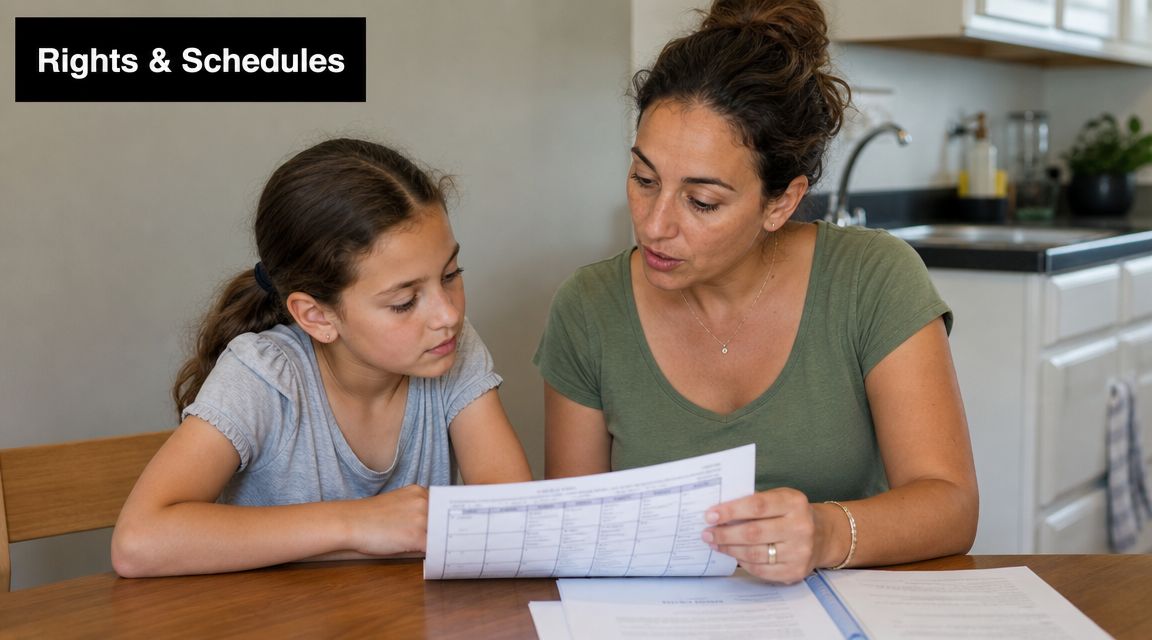
Conservatorship is about rights
Conservatorship answers questions like who can consent to medical treatment, who can make educational decisions, who receives school records, and who has the exclusive right to determine the child's primary residence. In many cases, both parents keep a role in major decisions, but not always in the same way or to the same extent.
In The Woodlands and Conroe courts, the primary residence issue usually carries more weight than parents expect. It affects school zoning, commute time, after-school logistics, and bargaining power in mediation. A parent may ask for "50/50 custody" and still face a hard dispute over which home anchors the child's school week.
Judges also look closely at whether a requested allocation of rights will reduce conflict or feed it. If parents have a long record of deadlock over school, counseling, or medical care, the court may give one parent the final say in a specific area rather than order endless joint decision-making that fails in practice.
Possession is about time
Possession and access answers a narrower question. When is the child with each parent?
For many families, the starting point is a standard possession schedule, then the details get adjusted to fit real life. School start times, the distance between homes, shift work, childcare help from grandparents, and a young child's tolerance for frequent transitions all matter. Parents looking for a local baseline can review this Standard Possession Order for The Woodlands families.
Here is the practical difference:
| Issue | What it decides |
|---|---|
| Conservatorship | Who holds specific legal rights and who makes major decisions |
| Possession and access | When each parent has parenting time |
| Primary residence | Which parent chooses where the child mainly lives, often within a geographic area |
| Restrictions | Whether limits apply, such as supervision, geographic boundaries, or conditions on exchanges |
A parent can have frequent possession and still not control residence, school choice, or nonemergency medical decisions. That result surprises people, but it is common.
What Montgomery County judges usually want to see
Judges here respond better to a workable order than to broad statements about fairness. A proposed plan should answer ordinary questions clearly. Who handles Monday school drop-off. Where do exchanges happen. How will parents share information about tutoring, prescriptions, and extracurricular fees. What happens if one parent works late or travels.
The strongest proposals are specific without being petty. The weakest ones ask for expanded rights or extra time with no operational detail behind them.
That is the trade-off parents need to understand. A broad request can sound appealing, but a narrower request backed by a realistic schedule often has a better chance in court.
Evidence That Matters to a Montgomery County Judge
A custody case is won or lost on proof. Not suspicion. Not outrage. Proof.
Texas law generally presumes that both parents should usually serve as joint managing conservators, so the practical fight is often over who gets to determine the child's primary residence and how parenting time is structured. That is why records like school documents, medical appointments, and calendars showing day-to-day caregiving can matter so much. Texas Law Help's explanation of the best-interest standard and documentation captures that point well.
The evidence hierarchy in real life
In the Conroe courthouse, parents usually start by testifying themselves. That matters, but it rarely carries a case by itself. Judges hear competing stories every day.
Objective records are stronger.
If you say you take the child to the doctor, bring appointment records. If you say you've handled school logistics, bring attendance notices, teacher emails, and calendar entries. If you say the other parent refuses to communicate, show the messages in context.
A useful practical guide on evidence needed for child custody in Texas can help parents organize the basics before temporary orders or mediation.
What usually helps most
The best evidence often comes from ordinary life:
- School records: Attendance, tardies, report cards, disciplinary notices, teacher communication.
- Medical records: Appointment history, prescriptions, therapy scheduling, follow-up compliance.
- Parenting calendars: Pickups, drop-offs, overnights, activities, homework help, missed exchanges.
- Messages between parents: Texts and emails that show cooperation, refusal, conflict, or gatekeeping.
- Photos and logs: Useful when tied to a date, event, or issue. Less useful when presented without context.
Third-party professionals
Some cases involve outside professionals. That might include a social study, an amicus attorney, or a custody evaluator in the right case. These people don't replace the judge, but they can influence how the facts are framed.
What parents often miss is this. A professional evaluation doesn't rescue a disorganized case. If your records are scattered, your timeline changes, or your communication is hostile, those problems usually show up in the evaluation process too.
Bring the judge something they can rely on. A labeled binder, a clean timeline, and exhibits tied to specific issues are more persuasive than a stack of screenshots with no explanation.
What hurts credibility fast
Some mistakes damage a case quickly:
- Editing the story: If your position changes every hearing, the court notices.
- Overclaiming: Saying "never" and "always" usually backfires.
- Coaching the child: Judges are alert to it, and it rarely helps.
- Weaponizing minor issues: Complaining about every inconvenience can make you look unreasonable.
A strong custody presentation is boring in the best way. It is organized, documented, and consistent.
The Custody Case Timeline from Filing to Final Order
Most Montgomery County custody cases follow a predictable path, even though the details vary from family to family. Knowing the sequence helps you make better decisions early, especially before temporary orders are entered.
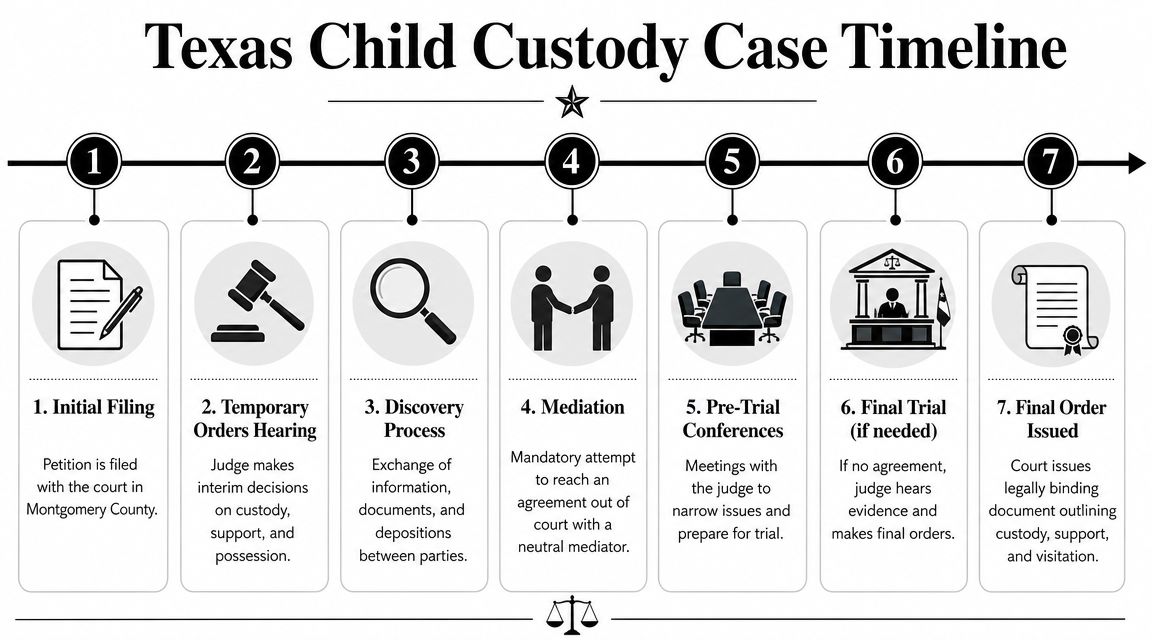
What the process usually looks like
A case often begins with the filing of a suit affecting the parent-child relationship, or with custody issues inside a divorce. The other side is served, and the court may address urgent concerns early.
Then comes the stage many parents underestimate. Temporary orders. These interim rulings can set the tone for the rest of the case by establishing where the child stays, how exchanges happen, and who pays support while the case is pending.
Discovery follows. That is the formal exchange of information, records, and sometimes written questions or depositions. Mediation is commonly part of the process before final trial. Many cases resolve there, especially when both sides finally see how a judge may evaluate the evidence.
A short Montgomery County scenario
Take a couple from Sterling Ridge. They separate after months of conflict over school decisions and weekday care. One parent files. At the temporary orders hearing, the judge doesn't try to solve every grievance. The judge focuses on immediate stability. Where will the child sleep on school nights? Who has been handling homework? Is there a workable exchange plan?
During discovery, each side gathers records and communication history. Mediation forces hard trade-offs. One parent gives ground on a holiday schedule to keep the right to establish the child's primary residence at issue for final trial. By the time the final hearing arrives, the case is no longer about broad accusations. It is about credibility, records, and which plan fits the child's life better.
Why procedural details matter
Deadlines and service issues can affect momentum. If you're trying to locate someone for service or verify where papers can be delivered, a practical background resource on how to find an address can help you understand the process and the limits of public information.
A typical case often turns on these pressure points:
Initial filing and service
The case starts. Urgent requests may be raised early.Temporary orders hearing
The court creates rules for the case while it is pending.Discovery and document exchange
Organized parents often gain an advantage at this stage.Mediation
Settlement becomes possible once both sides see the evidence.Final trial or agreed final order
If no agreement is reached, the judge decides.
Temporary orders are not the final outcome, but they often shape negotiation power, routines, and how the case is perceived afterward.
The Texas Family Code addresses temporary orders in family cases. In practice, that means you should treat the early stage of the case with the same seriousness as trial preparation.
Handling High-Conflict Issues like Relocation and Abuse
A parent gets a job offer in Dallas. The other parent says the move will gut midweek time, disrupt school, and make exchanges harder. Or a parent walks into court saying the child is not safe, but brings only screenshots without dates and no records to back up the claim. In Montgomery County, cases like these turn fast on proof and on the remedy being requested.
High-conflict custody disputes usually involve two questions. Is there a real risk to the child? If so, what order will reduce that risk without creating new problems the judge cannot manage? Judges in The Woodlands look for specific facts they can tie to a workable order, not broad claims that one parent is bad.
Relocation changes leverage and logistics
Relocation cases are usually framed as a best-interest issue, but in practice they are also about logistics. A judge will want to know how the move affects school continuity, extracurriculars, medical care, travel time, makeup periods of possession, and each parent's ability to stay involved in daily decisions. A proposed move that looks reasonable on paper can still fail if the details are thin.
Geographic restrictions often become the center of the fight. If one parent wants to move outside Montgomery County or outside the area named in the order, the court will look closely at the reason for the move and at the proposed possession schedule. A parent asking to relocate should be ready with a transportation plan, a revised calendar, school information, and a clear explanation of how the child will maintain a meaningful relationship with the other parent. This page on a relocation custody case in The Woodlands explains how that issue tends to play out locally.
Abuse claims need disciplined evidence
Abuse, neglect, substance abuse, and coercive control can justify major restrictions, but only when the evidence is organized and tied to the child.
Montgomery County judges see exaggerated accusations often enough that unsupported allegations can hurt the parent making them. The better approach is to present a clean record. Police reports, medical records, photographs, CPS records, counseling records, school reports, prior protective orders, witness testimony, and messages that show a pattern all carry more weight than a stack of emotional texts without context.
The requested relief matters too. If the concern is unsafe exchanges, ask for protected exchange terms. If the concern is intoxication during possession, ask for testing or supervised time tied to specific facts. If the concern is violence in the home, explain how that risk affects the child and what restriction would address it. Judges are more likely to act when the request is narrow enough to enforce and supported by evidence they can trust.
Present safety concerns as facts, dates, records, and a proposed protective order the court can actually enter.
When immigration issues overlap with family violence
Some parents stay quiet about abuse because immigration status, dependency on a spouse, or fear of reporting makes the situation more complicated. Family court still focuses on the child's safety, but those outside pressures can affect how a parent documents abuse and seeks help. For background on that overlap, the Pro Psychological Analysis immigration guide is a useful starting point.
As noted earlier, Texas law gives judges room to tailor conservatorship and possession to protect a child. In a high-conflict case in Montgomery County, the stronger argument is usually the one that connects a specific risk to a specific restriction, backed by records the court can verify.
What to Do Next A Practical Checklist for Parents
A parent walks into my office in The Woodlands after a rough exchange weekend and says the same thing I hear often: "My child is old enough to tell the judge where they want to live." In Montgomery County, that can matter, but it does not carry a case by itself. Judges here want a workable plan, a clean record, and proof that the parent asking for relief can keep the child's routine steady.
If your child is 12 or older, the court may hear the child's preference in chambers. That does not decide conservatorship or possession on its own. This discussion of a child's preference in Texas custody cases gives helpful background. The judge still decides based on safety, consistency, follow-through, and the child's day-to-day needs.
That is why preparation usually matters more than argument. In the 418th, 410th, 359th, and other Montgomery County family courts, parents do better when they show up organized and ask for terms the court can enter and enforce.
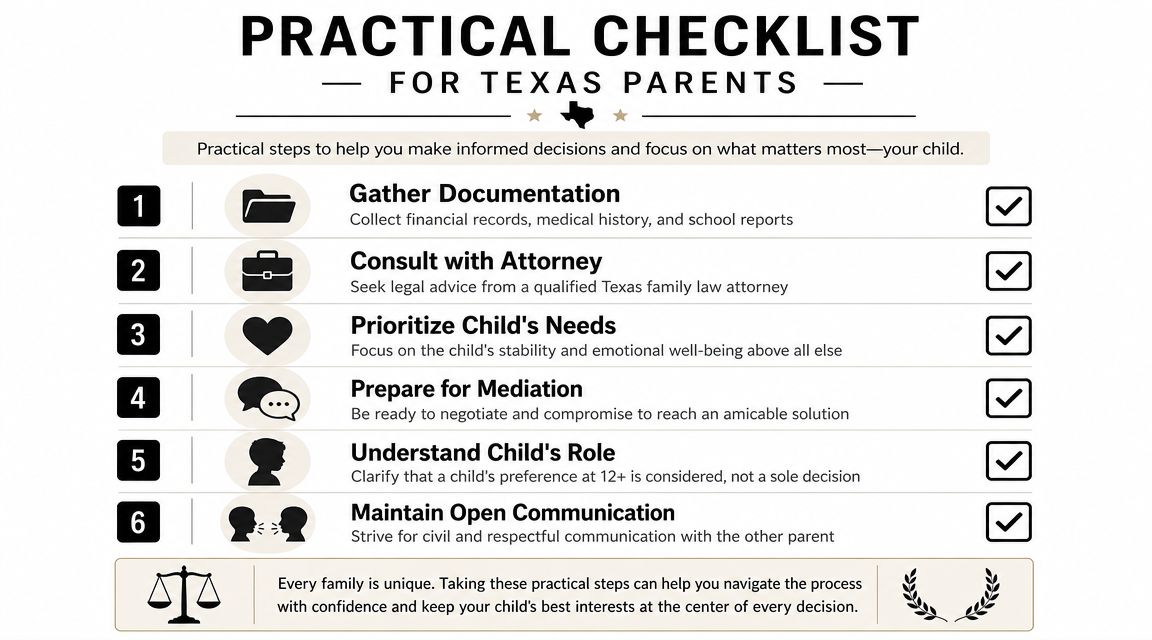
What to do next
- Gather records now: Put school records, medical records, daycare information, attendance notes, calendars, and parent communications in one folder. Bring the documents that show patterns, not just isolated bad days.
- Keep a factual parenting log: Record dates, exchange times, missed visits, late pickups, school problems, and medical appointments. Write it as if a judge will read it in a temporary orders hearing.
- Fix your communication habits: Use short, child-focused messages. Polite communication helps your credibility and gives your lawyer cleaner exhibits if the case turns contested.
- Be careful online: Social media posts, comments, and shared photos often become exhibits. If privacy is part of the problem, learning how to remove data online may help reduce unnecessary exposure.
- Draft a real schedule: Spell out school drop-offs, holidays, summer periods, extracurriculars, transportation, and who handles medical and educational decisions. Vague proposals create problems in court and in mediation.
- Keep your child out of the case: Do not coach, pressure, or ask the child to report on the other parent. Judges and amicus attorneys tend to spot that quickly.
- Prepare for mediation with priorities: Know where you need firm language and where you can compromise. Parents who walk in with no bottom line often leave with terms they regret.
- Talk to counsel before the first major hearing: Temporary orders often shape possession, decision-making, and the tone of the case for months.
One final practical point
If you need help organizing exhibits, preparing for temporary orders, or testing whether a proposed settlement will work in daily life, it makes sense to consult a Montgomery County family law firm that handles custody litigation, mediation, modifications, and enforcement, such as The Law Office of Bryan Fagan, along with any other qualified Texas family lawyer you are considering.
This article is not legal advice. The facts, the judge, and the stage of your case affect what makes sense.
If you're facing a custody dispute in The Woodlands, Conroe, Magnolia, Spring, or anywhere in Montgomery County, a calm, fact-driven strategy usually beats panic. Schedule a consultation with The Law Office of Bryan Fagan to discuss your situation, your evidence, and the next practical step in your case.
