 Skip to content
You're staring at a marriage that collapsed fast, and now you want out without dragging this into a long divorce fight. Maybe you were married in The Woodlands, maybe the facts feel messy, and maybe someone told you, “Just get it annulled.” That advice is usually too casual for Texas.
In Texas, annulment is not a shortcut for a bad marriage. It's a narrow legal remedy, and the judge only grants it if the facts fit one of the limited grounds recognized under state law, such as fraud, force, mental incapacity, bigamy, underage marriage without proper consent, or intoxication at the time of marriage, along with related grounds often raised in practice like permanent impotence and concealment of a prior divorce (Texas annulment overview). That narrow setup is exactly why people in Montgomery County should stop guessing and start looking at proof.
Texas divorce filings are substantial, with roughly 70,000 to 80,000 divorces filed annually statewide in recent years (Texas annulment overview). Annulments are a small, specialized slice of family law work, so a bad filing wastes time and usually leads right back to divorce anyway.
This is educational information, not legal advice. If the facts don't fit a real annulment ground, pushing for one just burns money and delays the inevitable. If the facts do fit, move fast and preserve evidence before cohabitation or delay weakens your position.
Common Misconceptions About Texas Annulment
A Woodlands resident walks into the office saying the same thing I hear all the time, “We only made it a few months, it was awful, so this has to be an annulment.” That instinct makes sense emotionally. It also misses the law.
Texas does not grant an annulment just because a marriage was short or unhappy. The state limits annulment to specific legal grounds, and that makes it much narrower than divorce. The court is not deciding whether the relationship failed. It is deciding whether a legal defect existed at the start of the marriage.
The critical mistake people make
People confuse “I regret this marriage” with “the law lets me erase it.” Those are different questions. If the marriage does not fit a statutory ground, the judge will not turn disappointment into an annulment.
Practical rule: If your story sounds like a breakup, it is probably a divorce case. If it sounds like a legal defect at the start of the marriage, it may be an annulment case.
That distinction matters in Montgomery County because courts still require proof, service, and proper procedure. The Woodlands sits inside a mature Houston-area family-law market, and local law firms may be clustered around places like High Timbers Drive, Timberloch Place, Research Forest Drive, and Technology Forest Boulevard, but the legal standard still comes from Texas law, not from a lawyer's office location (The Woodlands annulment guidance).
Why speed can be misleading
Annulment sounds faster than divorce, and sometimes it is. But only if the ground is real and the proof is clean. If you spend weeks chasing an annulment theory that does not fit, you have lost the very time you were trying to save.
That is the strategic problem. A narrow remedy can be efficient, but only when the facts line up. Otherwise, it is a detour.
Texas Annulment Grounds and the Evidence Judges Expect
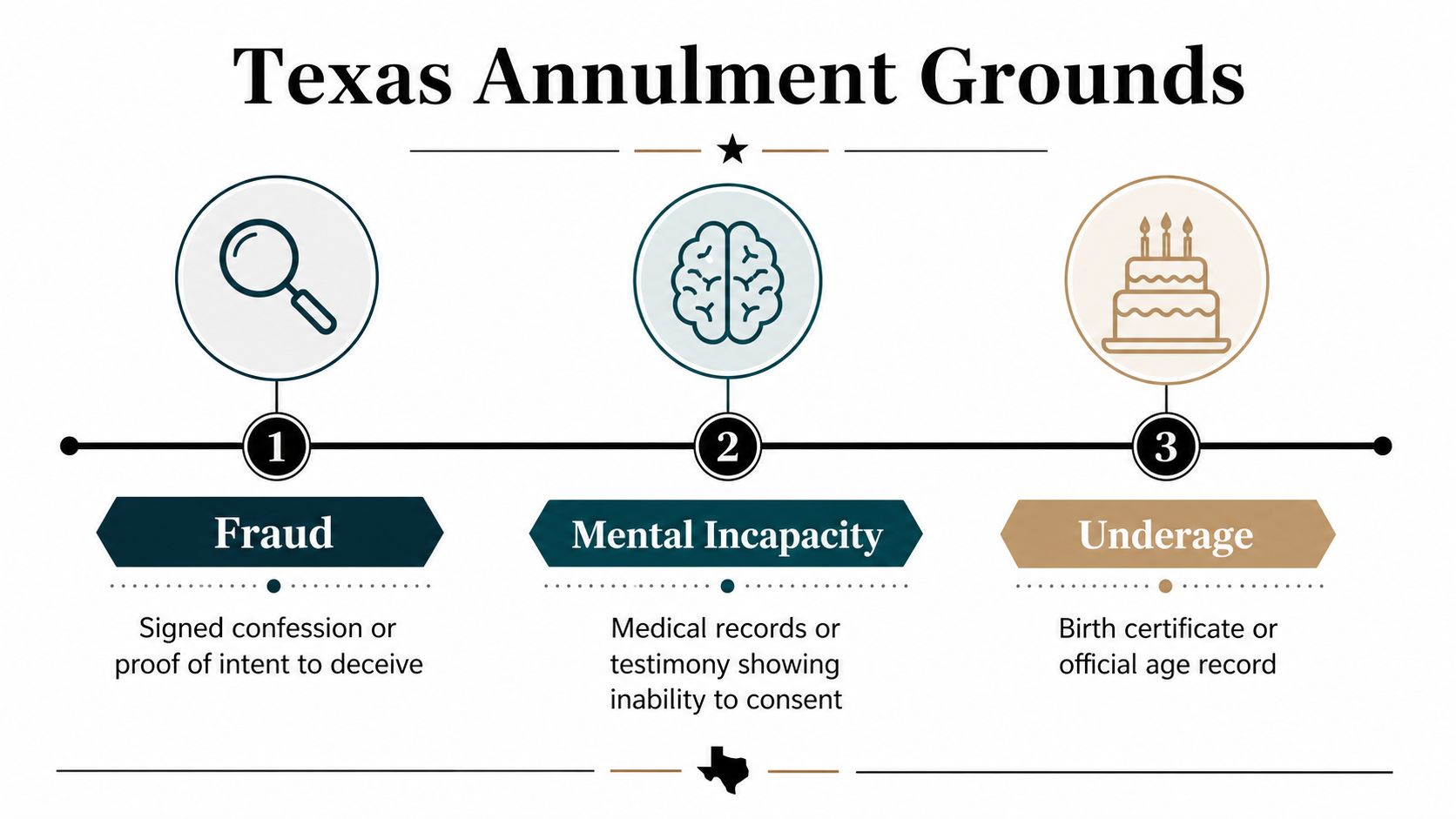
Texas courts want three things to line up, the ground, the proof, and the timing. If one of those pieces is weak, the judge can deny the case even when the marriage was a bad decision from the start.
The grounds that matter most
Texas annulment cases usually turn on a short list of legal grounds, fraud, force or duress, mental incapacity, bigamy or a prior existing marriage, underage marriage without proper consent, intoxication at the time of marriage, permanent impotence, and concealment of a prior divorce (Texas annulment overview, criteria for annulment). The filing rules also have to fit the court you use, as Texas Law Help explains in its annulment guide (Texas Law Help annulment guide).
The evidence has to match the ground you claim. For fraud, the judge wants proof that one spouse knowingly lied about a material fact. For intoxication, the question is whether the spouse had enough capacity to consent at the time of the ceremony. For mental incapacity, the issue is whether the person could give valid consent at all. For bigamy, you need records showing the earlier marriage was still in effect. For underage marriage, age records and consent documents matter. For duress or force, the court looks for proof that the marriage was not entered into freely. For impotence, the key point is whether the condition was permanent and existed at the start of the marriage. For concealment of a prior divorce, the record of the earlier divorce and the concealment itself matter (Texas annulment evidence guidance, Texas attorney filing guidance).
Timing rules can end a case
Timing is where a lot of people lose these cases. One Texas legal guide says intoxication-based claims must be filed within 30 days of the marriage, fraud or duress claims within 4 years of discovering the fraud, mental-incapacity claims within 1 year, and underage claims before the minor spouse turns 18 (Texas annulment filing requirements). Another Texas source says the petition must be filed within four years of the marriage date and that Texas does not impose a statutory waiting period before filing (Texas annulment filing guidance).
Those rules are not flexible just because the marriage ended badly. If you wait, keep living together after discovering the problem, or delay while you decide what you want, you can damage the claim beyond repair.
A practical example makes that clear. A spouse learns about a hidden fact, stays in the marriage for months, and then asks about annulment later. That delay can undercut a fraud claim because continued cohabitation after discovery can weaken the argument that the misrepresentation controlled the decision to marry (Dallas divorce and annulment guidance).
What judges require as evidence
Judges do not want a story, they want proof tied to the legal ground. Medical records help with incapacity. Marriage records help with timing. Prior divorce records help with concealment. Birth records help with underage cases. If children are involved, a separate paternity or parent-child issue can come up, and a Paternity Lawyer in The Woodlands may be needed to sort out legal paternity and related rights in Montgomery County. If you are trying to decide whether the case is worth filing at all, the better starting point is a full review of your facts and the filing path, like the one in this Woodlands divorce filing guide.
A clean annulment case is built on documents first and emotion second. If the facts are messy, the lawyer's job is to sort the proof and tell you whether annulment is realistic, or whether divorce is the better move.
Filing for Annulment in Montgomery County
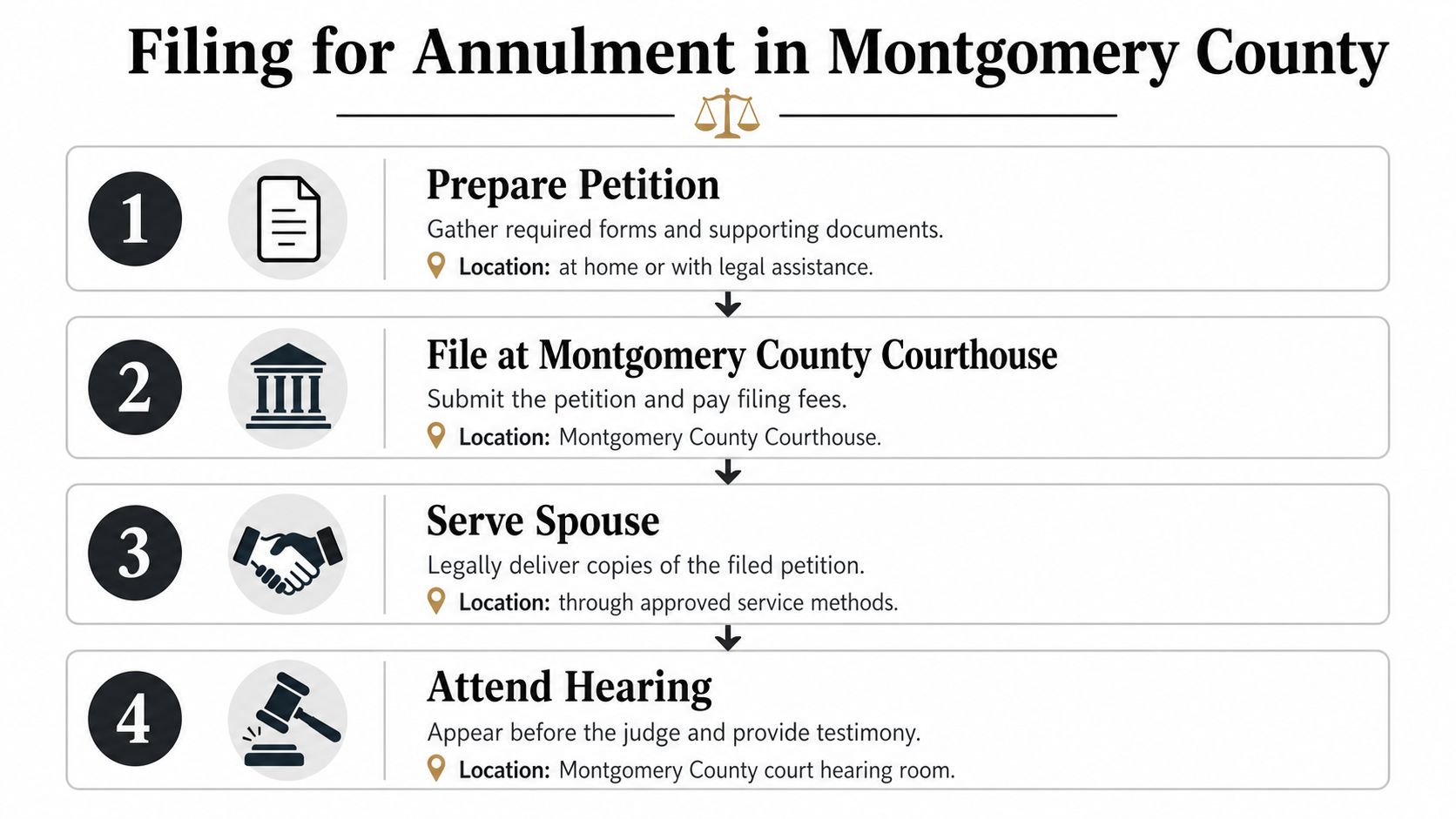
Start with the filing rules, not the emotion
Texas annulment starts with the petition. A court clerk will not sort out the facts for you. Texas Law Help says you may file if at least one spouse lives in Texas when the petition is filed, or if the marriage took place in Texas, and you may file in the county where you married, where the events leading to the marriage happened, or where your spouse lived when you married (Texas Law Help annulment article).
That matters in The Woodlands and Montgomery County because venue has to be right from the start. If you file in the wrong place, you waste time and create problems that should have been avoided on day one.
The standard filing sequence
The order of events is predictable, and every step has to be handled correctly:
- Prepare the petition. State the ground clearly and include the facts that support it.
- File in the proper court. The case has to go to the correct family court.
- Serve the other spouse. Texas procedure requires service, and the other spouse must have a chance to respond.
- Wait for the answer period. After service, the respondent gets time to answer before the court can move ahead.
- Attend the hearing. The judge reviews the legal elements and the proof before granting relief.
Texas family law is proof-driven. Saying the marriage should end does not get you anywhere. You need evidence, service, and a decree. When the facts are weak, a rushed annulment filing usually turns into a longer fight than a straight divorce would have been.
Don't ignore related order issues
If the marriage includes children or temporary orders, the fallout can spill into custody or enforcement issues later. A dispute over a decree or order can end up requiring help from an Enforcement of Court Orders in The Woodlands lawyer when a Montgomery County order has to be enforced.
What to gather before filing
- Marriage records: Get the marriage certificate and license details.
- Proof of the ground: Pull medical records, text messages, or witness names if they help prove the defect.
- Timeline notes: Write down when you learned the facts and when you stopped cohabiting, if you did.
- Service information: Know where the other spouse lives so service does not stall.
- Child-related documents: If children are involved, separate parenting issues may need their own filings.
If you are already dealing with property, custody, or a spouse who is going to fight, compare the filing path with a normal divorce first by reviewing the Woodlands divorce filing process. A weak petition or the wrong filing choice costs time either way.
Annulment Versus Divorce in The Woodlands
A client sits down wanting the cleanest exit possible. The key question is whether annulment fits the facts, or whether divorce is the safer, cheaper way out.
The short answer
Annulment works when the ground is real, the proof is solid, and the other spouse does not push back. Divorce is the better choice when the facts are unclear, the marriage was long enough to create property problems, or the other spouse plans to fight every issue. Texas courts still require proper service, a waiting period after service, and a hearing, so annulment is not automatically faster in practice.
One question comes up right away. Is annulment cheaper? Sometimes yes, but only when the case stays simple and uncontested. If you want a local cost comparison with divorce, review divorce costs in The Woodlands.
Side-by-side comparison
| Factor | Annulment | Divorce |
|---|---|---|
| Legal theory | Marriage is attacked as invalid from the start | Valid marriage is ended |
| Proof burden | Narrow, fact-specific ground must be proven | No annulment ground needed |
| Timing | Can move quickly if uncontested and documentable | Often longer, especially if contested |
| Service and hearing | Required | Required |
| Property issues | Can get complicated fast if spouses dispute assets | Built-in framework for dividing marital property |
| Children | Parenting issues still need proper court handling | Parenting issues still need proper court handling |
When annulment makes sense
Annulment makes sense when the facts fit a statutory ground and the proof is easy to present. It also makes sense when you need a legal finding that the marriage should not be treated like an ordinary breakup. That distinction matters in court, even if it does not feel that way emotionally.
When divorce is the smarter move
Divorce is the smarter move when the other spouse will contest the story, when the proof is thin, or when the marriage already created property and parenting disputes. Once every fact becomes a fight, the case can cost about the same as a low-asset divorce and take on the same kind of pressure. In that situation, the cleaner filing choice is the one the court can process without drama, not the one that sounds better on paper.
Bottom line: Do not chase annulment just because it sounds cleaner. Choose the path the evidence supports.
Choosing the Right Annulment Lawyer in The Woodlands
The Woodlands has a concentrated family-law market, and that matters more than people think. Multiple firms list offices around High Timbers Drive, Timberloch Place, Research Forest Drive, and nearby commercial corridors, so you have options, but not every lawyer who files divorces handles annulment well (The Woodlands local annulment market).
What to ask in the consultation
Ask whether the lawyer has handled Texas annulment cases before, not just divorce cases. Ask how they build proof, because the case rises or falls on evidence, not confidence. Ask how familiar they are with Montgomery County family court procedures and local hearing practice.
If a lawyer promises success, walk out. No honest family lawyer can guarantee an annulment when the judge still has to decide whether the ground is proven.
What a serious lawyer should discuss
- Ground fit: Which statutory ground matches the facts.
- Evidence plan: What documents, witnesses, or records support the case.
- Venue and service: Where to file and how the spouse gets served correctly.
- Timeline expectations: What happens if the other spouse answers and contests the case.
- Fee structure: How the retainer works and what causes the cost to climb.
If you want a general sense of how to evaluate counsel for family law disputes, use how to choose a divorce lawyer in The Woodlands as a screening framework. The standards are similar, but annulment puts even more weight on fact development.
One option when you need litigation help
The Law Office of Bryan Fagan works with The Woodlands and Montgomery County family-law matters, including contested divorce and custody disputes, so it can be a fit when an annulment case starts turning into a broader family case. That's not a promise about outcome, just a practical note about the kind of issues the firm handles.
Don't hire for charm. Hire for judgment, local court familiarity, and the ability to build a case that survives a skeptical judge.
Common Annulment Questions From Woodlands Residents
If the court grants an annulment, the marriage is treated as invalid rather than just ended, but that doesn't mean every related issue disappears. Property and debts can still become a fight, so don't assume the decree solves everything by itself. If children were born or adopted during the relationship, their legal rights still need proper handling through Texas family-court procedures.
If your spouse refuses to participate, the case can still move forward, but service and proof become even more important. Texas guidance says the other side has a chance to respond after service, so silence is not the same thing as consent (Texas attorney filing guidance, Texas Law Help annulment guide).
If you discover you don't qualify for annulment, stop forcing it. File for divorce instead, because the wrong remedy just delays your real case.
What to do next
- Write down the facts: When the marriage happened, when you learned the problem, and what evidence you have.
- Save documents now: Texts, medical records, marriage records, and witness names.
- Check the ground: Compare your facts against the Texas annulment grounds, not your feelings.
- Act quickly: Delay can hurt timing-based claims.
- Get legal advice: Use the facts, not assumptions, to decide between annulment and divorce.
The Law Office of Bryan Fagan helps people in The Woodlands and Montgomery County sort out hard family-law decisions, including whether an annulment or divorce makes sense in their situation. If you need a candid review of your facts, visit The Law Office of Bryan Fagan and schedule a consultation to talk through your options before you file.
