 Skip to content
The need for an adult guardianship lawyer in The Woodlands often signals that something has already gone wrong at home.
Maybe your mother keeps giving different answers about her medications. Maybe your father forgot to pay the electric bill twice, then insisted everything was handled. Maybe a hospital discharge planner asked who has authority to make decisions, and the room went quiet.
A common local scenario looks like this: an adult daughter in Sterling Ridge notices her widowed father has started missing appointments, falling behind on bills, and signing papers he doesn't understand. She wants to help, but she doesn't want to take away his dignity. She also doesn't know whether she needs a power of attorney, a guardianship, or something else entirely.
That uncertainty is normal. Guardianship cases often begin with a family trying to protect someone they love, not with a fight.
In Montgomery County, families are dealing with this issue more often. Montgomery County reported 1,247 new guardianship filings in 2023, a 14% increase from 2022, and adult guardianship cases in Texas are handled in County Court at Law or Probate Court jurisdictions, as noted in this Texas guardianship filing overview for Montgomery County.
This article is for educational purposes only. It is not legal advice. Every family situation in The Woodlands, Shenandoah, Spring, and nearby Montgomery County communities is different, and the right legal path depends on the person's health, capacity, documents, and family dynamics.
When a Loved One Can No Longer Decide for Themselves
The hardest part is usually the moment you realize help is needed.
A loved one may still sound like themselves. They may recognize family members, tell old stories, and insist they're fine. But daily decisions start slipping. They may wire money to strangers, ignore medical instructions, or forget whether they already took medication.
That doesn't automatically mean guardianship is necessary. It does mean the family needs to slow down and look carefully at what kind of help fits the problem.
What families in The Woodlands often notice first
In real life, concerns usually show up in small pieces:
- Money problems: unpaid bills, unusual withdrawals, or repeated confusion about routine expenses
- Medical confusion: missed appointments, refusal to follow discharge instructions, or inability to explain treatment choices
- Safety issues: getting lost on familiar roads, leaving the stove on, or letting unfamiliar people into the house
- Paperwork mistakes: signing forms without understanding them, or forgetting what was signed
Practical rule: Needing help isn't the same as lacking legal capacity. Courts look for evidence, not family frustration.
In Texas, guardianship is a legal tool that lets one person make certain decisions for another adult who can't safely make those decisions alone. That can sound harsh, so it helps to think of it as a court-built safety system. The court doesn't create it to punish a vulnerable adult. The court creates it to protect them when less restrictive options won't work.
Why local process matters
A family in The Woodlands doesn't just deal with "Texas law" in the abstract. They deal with Montgomery County courts, local filing procedures, local staff, and a judge who expects evidence in a certain form.
That local detail matters. A generic online guide may tell you what guardianship means. It often won't tell you who screens filings, where local families get delayed, or what practical steps come first in Conroe.
For many readers, the question isn't "What is guardianship?" It's "What do I do Monday morning if my parent can't manage basic decisions anymore?" That's where a local lawyer can help translate a stressful family problem into a clear process.
What Adult Guardianship Means in Texas
Adult guardianship is a court process under the Texas Estates Code that transfers certain decision-making authority from one adult to another. The person needing protection is called the ward. The person appointed to act is the guardian.
A simple way to think about it is this: the court places a legal safety rail around someone who can't fully protect themselves.

Two main types of guardianship
Texas courts commonly deal with two different roles.
- Guardian of the Person: This guardian handles personal and care-related decisions. That can include living arrangements, medical treatment coordination, and day-to-day welfare.
- Guardian of the Estate: This guardian handles money and property. That can include paying bills, protecting assets, managing accounts, and dealing with financial paperwork.
Sometimes one person serves in both roles. Sometimes the court separates them.
That distinction matters in The Woodlands because some families are dealing mostly with healthcare and daily safety, while others are dealing with complex estates, investment accounts, or a parent who can still function socially but can't manage finances safely.
Guardianship is a last resort
Under the Texas Estates Code, courts don't treat guardianship as the first tool to grab. They treat it as a serious step because it can remove or limit important rights.
A guardianship order can affect whether a person controls their money, chooses where to live, or makes medical decisions. That's why judges are supposed to look for the least restrictive option that still protects the person.
Guardianship works best when the family sees it as protection, not ownership.
Readers often misunderstand this concept. They assume guardianship means, "I'm the adult child, so I step in." That's not how it works. The court must approve it, define the scope of authority, and expect the guardian to follow ongoing legal duties.
Why the legal labels matter
If your loved one only needs help paying bills, full guardianship may be too broad. If they can express preferences about care but can't understand contracts, the court may look closely at what rights need to be limited.
That is one reason families often search for an Adult Guardianship Lawyer in The Woodlands instead of trying to piece it together alone. The key issue usually isn't just whether help is needed. It's what kind of help is legally appropriate.
Texas law in this area usually points families to the Texas Estates Code, especially the sections governing incapacity, appointment, and duties of guardians. In some family situations, readers also ask about the Texas Family Code, but adult guardianship itself is generally an Estates Code issue, not a Family Code proceeding.
Proving Incapacity in a Montgomery County Court
Many families believe their testimony should be enough. It usually isn't.
A Montgomery County judge won't appoint a guardian just because relatives say, "Mom can't handle things anymore." The court needs evidence that meets legal standards. In adult guardianship cases, that usually starts with medical proof.
The Certificate of Medical Examination
In Texas, a Certificate of Medical Examination, often called a CME, is a required part of proving incapacity in adult guardianship proceedings, as explained in the Texas Health and Human Services guardianship handbook.
The CME is not a casual doctor's note. It's a technical court document. The physician must address specific capacity-related issues, including whether the proposed ward can make decisions about matters such as voting, driving, marrying, and managing financial decisions.
That level of detail surprises many families. They expect the doctor to write, "Patient has dementia." The court expects more than a diagnosis. The court wants functional information.
What the judge is really looking for
The legal question is not whether the person has memory loss or a medical condition. The question is whether the person can make or communicate responsible decisions about personal care or property.
That is why a strong guardianship case often gathers information in layers:
- Medical findings that describe the person's condition
- Functional limits that show how the condition affects real decisions
- Practical examples such as missed medications, unsafe driving, or inability to understand bank activity
- A proposed plan showing why guardianship is necessary and why narrower options won't protect the person
For a useful local overview of filing flow and court handling, families often review the Montgomery County probate court process before they file.
The court is not asking whether your loved one is stubborn. The court is asking whether they can legally and safely decide for themselves.
If the person refuses evaluation
This is another point that causes stress. Families sometimes say, "He won't go to the doctor, so I guess we can't do anything." That isn't always true.
Under Texas Estates Code provisions described in the same HHS guidance, if the proposed ward refuses evaluation, the court may order a compulsory medical examination. That doesn't mean every refusal leads to a forced exam. It means refusal doesn't automatically end the case.
Why high-asset cases get more complicated
In some Woodlands cases, the central issue isn't obvious physical decline. It's a person with substantial assets making increasingly erratic financial decisions. Those cases can become contested because family members disagree about whether the problem is incapacity, undue influence, poor judgment, or family conflict.
When that happens, the medical evidence still matters, but so does how the facts are organized. Judges often need to see the difference between "Dad made an unwise decision" and "Dad can no longer understand the consequences of major financial decisions."
Navigating the Guardianship Process in The Woodlands
The local process usually feels less overwhelming when you break it into steps.
Families in The Woodlands generally file and move through guardianship matters in Montgomery County court, not in some distant statewide system. That means local court staff, local forms, and local procedures matter from the beginning.
To visualize the process, this timeline helps:
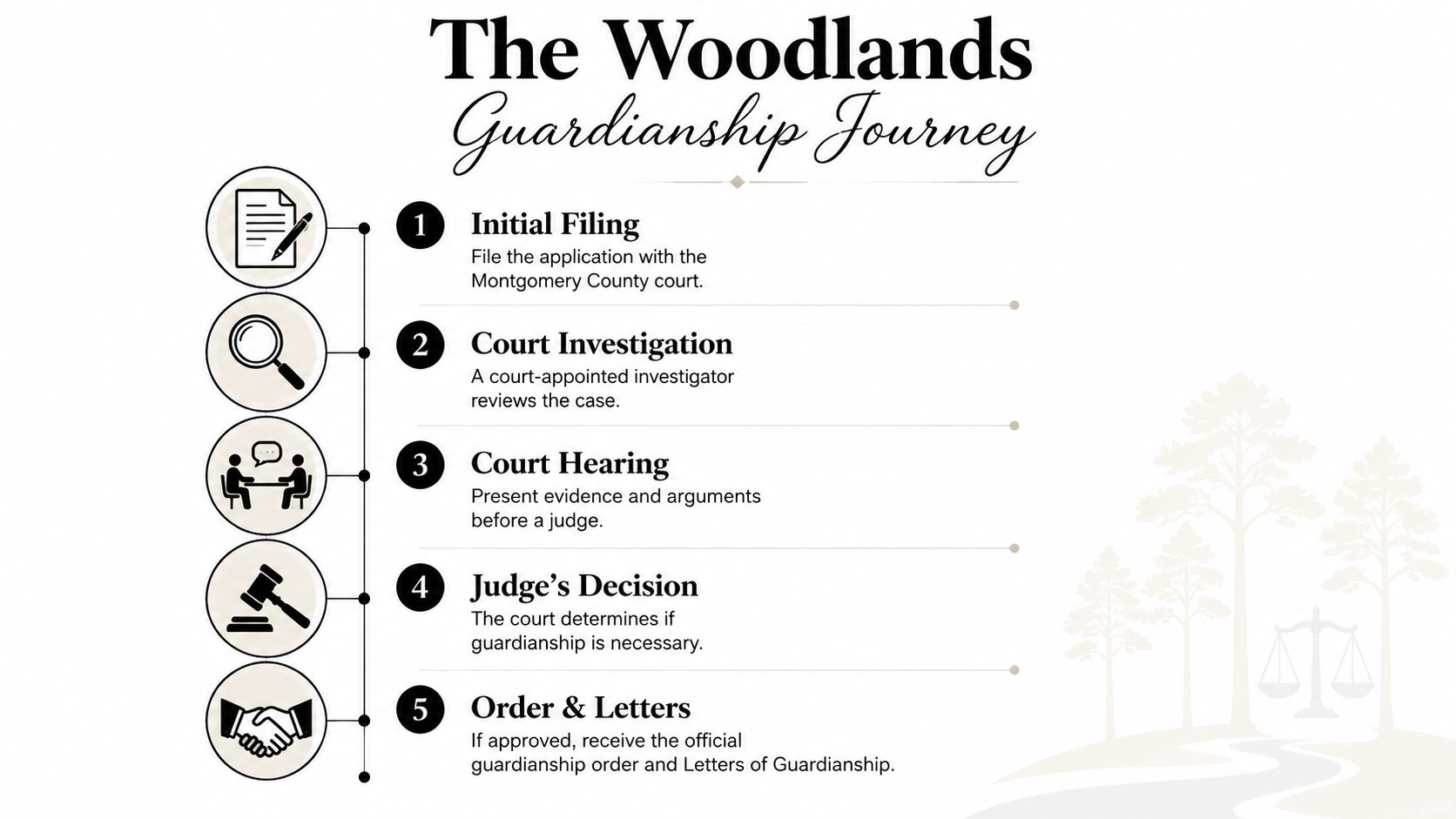
Step one through step three
The first stage is usually preparation, not argument.
Initial filing
The application is prepared and filed with the proper Montgomery County court. The filing needs to line up with the facts, the requested scope of guardianship, and the supporting records.Case intake and screening
Montgomery County uses a Guardianship Coordinator to help manage intake and verify eligibility before filing in local cases. For County Court at Law No. 2, Judge Claudia Laird, the coordinator is Amber Park, and the county's public community resources guide lists her direct line as 936-538-3570 and email as [email protected]. That local court guide identifies the coordinator as a required contact point before filing a guardianship petition in that court, as shown in the Montgomery County Community Resources Guide.Appointment of court participants
The court may appoint an attorney ad litem to represent the proposed ward's interests. Families often misunderstand this role. The attorney ad litem does not work for the applicant. That lawyer's job is to advocate for the proposed ward.
Step four and the hearing
After filing, the court process continues with investigation and review.
The court may review the medical evidence, the application, and the proposed guardian's qualifications. If the matter is contested, the hearing can become more detailed. If it is uncontested and well-prepared, the hearing may focus on whether the legal requirements have been met and whether the proposed guardian is suitable.
At the hearing, the judge decides whether guardianship is necessary, whether a less restrictive alternative would work, and what powers should be granted.
Local note: In Montgomery County, small procedural mistakes can slow a case even when the family's concerns are legitimate.
What happens if the judge approves it
If the court grants the application, the guardian receives a court order and usually Letters of Guardianship. Those letters are what banks, care facilities, and other institutions often ask to see before they will recognize the guardian's authority.
The work doesn't end there. Guardianship creates ongoing responsibilities.
Families sometimes also have parallel estate questions, especially when an aging parent's assets, beneficiary issues, or unpaid obligations are involved. In those situations, a resource like Probate Lawyer in The Woodlands, TX may help explain probate administration and estate settlement in Montgomery County.
Exploring Alternatives to Guardianship
Not every family problem needs a guardianship case.
In fact, one of the most important parts of good guardianship advice is telling a family when not to file. Texas law treats guardianship as a last resort, so less restrictive options deserve real attention.
A gap in a lot of local online content is that it skips over supported decision-making, even though this alternative is increasingly discussed in Texas elder law. As noted in this discussion of guardianship and supported decision-making in The Woodlands context, families often aren't told clearly that a senior may be able to keep autonomy while receiving structured help.
Common alternatives families use
Some alternatives are familiar. Others are not.
Durable Power of Attorney
This lets a trusted person handle financial matters if the document is valid and usable in the situation.Medical Power of Attorney
This allows a trusted person to help with healthcare decisions under the terms of the document.Supported Decision-Making agreement
This lets an adult keep decision-making rights while choosing trusted supporters to help understand options, documents, and consequences.
If you're comparing documents before pursuing court action, this guide to a power of attorney lawyer in The Woodlands can help frame the differences in plain language.
Guardianship vs alternatives at a glance
| Feature | Guardianship | Power of Attorney (POA) | Supported Decision-Making (SDM) |
|---|---|---|---|
| Court involvement | Yes | Usually no | Usually no |
| Who keeps legal rights | Rights may be limited by court order | Principal may delegate authority through the document | Adult keeps rights and receives support |
| Best fit | Person can't safely decide without formal protection | Person can still sign valid legal documents | Person can decide with help understanding choices |
| Ongoing oversight | Court oversight applies | Document-based, not court-supervised in the same way | Support-based, not full court control |
| Level of restriction | Highest | Lower | Lowest of these three |
Sometimes practical support solves the immediate problem
Families often focus on legal authority when the first need is safety at home. Better lighting, bathroom modifications, medication organization, and fall prevention can sometimes stabilize a situation while the family evaluates legal options.
A practical starting point is this guide on DME Superstore tips for home accessibility, which walks through aging-in-place home modifications in a useful, non-legal way.
The least restrictive solution is often the one that protects the person without stripping away choices they can still make.
How a Guardianship Lawyer in The Woodlands Helps You
A local guardianship lawyer does more than file forms.
In Montgomery County, a lawyer helps translate family concern into evidence, procedure, and a court-ready request. That matters because guardianship cases involve deadlines, technical documents, notice requirements, local court expectations, and ongoing responsibilities after appointment.

What a lawyer usually handles
A lawyer often helps with several jobs at once:
- Case screening: figuring out whether guardianship is the right tool or whether a POA, SDM agreement, or another approach may fit better
- Paperwork accuracy: preparing the application and related filings in a way the court can act on
- Medical coordination: identifying what records and physician input are needed to support the claim of incapacity
- Hearing preparation: organizing testimony, exhibits, and the family's explanation of why protection is necessary
- Post-appointment guidance: explaining what the guardian can do, what the guardian can't do, and what reports must be filed
For readers looking at local legal help, guardianship representation in Montgomery County is one example of a resource focused on this court process.
Ongoing duties are serious
Some families think the hard part ends once the judge signs the order. It doesn't.
A guardian has legal duties to act in the ward's best interest and follow court rules. The verified local guidance also notes a criminal-law boundary that families should understand: under Texas Penal Code Section 25.10, taking, retaining, or concealing a ward when you know it interferes with the guardian's possessory rights is a felony offense, as stated on the Montgomery County Court at Law No. 2 guardianship page.
That point isn't about turning a family disagreement into a criminal case. It's about showing how formal and enforceable a guardianship order becomes once the court enters it.
What to bring to a first meeting
Before meeting with an Adult Guardianship Lawyer in The Woodlands, gather what you can. You don't need a perfect file.
Bring items like these if available:
- Medical records: discharge papers, diagnoses, medication lists, or physician notes
- Financial records: recent bank statements, unpaid bills, account summaries, or evidence of unusual transactions
- Existing legal documents: powers of attorney, wills, trusts, advance directives, or prior court orders
- A timeline: short notes showing what changed, when it changed, and specific examples of unsafe or impaired decision-making
- Contact information: doctors, care facilities, siblings, and anyone closely involved
One factual option for families seeking probate-related and related local legal guidance is The Law Office of Bryan Fagan, which serves The Woodlands and Montgomery County.
Your Next Steps and Key Questions to Ask
When a parent or other loved one is slipping, delay usually makes things harder. Start with facts, not assumptions.
What to do next
- Write down concerns: note missed bills, unsafe driving, medication mistakes, or confused conversations with dates if possible
- Gather documents: collect medical records, legal documents, and financial paperwork
- Check for existing authority: look for a valid power of attorney, medical directive, or similar planning document
- Talk with the right court-facing professional: ask whether guardianship, a narrower option, or no court action is the better fit
- Prepare for local procedure: if filing may be needed in Montgomery County, make sure you understand the local court's intake expectations
Questions to ask in a consultation
- Do these facts suggest guardianship, or is there a less restrictive option?
- What medical evidence will the Montgomery County court expect in this case?
- Who will the court appoint, and what role will that person play?
- If guardianship is granted, what reports and duties will continue afterward?
This article is for general education only. It is not legal advice, and reading it does not create an attorney-client relationship.
If your family is trying to decide whether guardianship is necessary in The Woodlands or elsewhere in Montgomery County, a consultation can help you sort through the options calmly. The Law Office of Bryan Fagan handles probate and related family matters in Montgomery County, and scheduling a consultation can help you understand the next practical step for your specific situation.
