 Skip to content
A family crisis rarely arrives on a clean timeline. One day you're handling normal life in The Woodlands, and the next, a parent can't sign checks after a stroke, or a child is suddenly stuck in a home where no one has clear legal authority to make decisions. In those moments, people start searching for a temporary guardianship attorney Montgomery County because they need a court order that works now, not later.
That urgency is real, but the legal path isn't always obvious. Texas treats temporary guardianship as an emergency probate remedy, while family courts handle emergency custody and temporary orders in child cases. Choosing the wrong lane can slow everything down.
When a Family Crisis Requires Immediate Action
A Sterling Ridge family may be dealing with an elderly father who has dementia and has started missing bills, signing unfamiliar papers, or leaving property exposed to loss. A Panther Creek parent may be hospitalized after a car accident, with a child staying temporarily with relatives who can't sign for school or medical care. Both situations create fear, but they don't call for the same court remedy.
Temporary guardianship exists for moments like these. It gives a court-authorized adult immediate authority to protect a person or property while the court decides what comes next under the Texas Estates Code Chapter 1251.
The practical question families face
The issue is not just, “Who needs help?” It's, “Which court can legally give the right kind of help fast enough?” Probate court can step in for an incapacitated adult or a minor when guardianship is the right fit, but family court may be the better answer when the issue is a parenting emergency. That choice matters because a guardianship order is a substitute authority, not a shortcut around family-law rules.
Practical rule: If the main problem is managing an adult's health or finances, think probate. If the main problem is protecting a child from a parent-related danger, family court may be the faster path.
Families often come in wanting one fix for everything. The law doesn't work that way. Temporary guardianship is narrow, court-supervised, and designed to fill a short-term protection gap while the court reviews longer-term options.
What Temporary Guardianship Means in Texas
A family in crisis may need someone to act quickly for an aging parent who can no longer understand bills, a hospitalized adult who cannot speak for themselves, or a child whose immediate care situation has broken down. Temporary guardianship is the court order Texas uses for that kind of short-term protection. It gives a person limited authority to step in when there is probable cause to believe the proposed ward is incapacitated and needs immediate help, and the court is deciding whether a guardian should be appointed under Texas law.
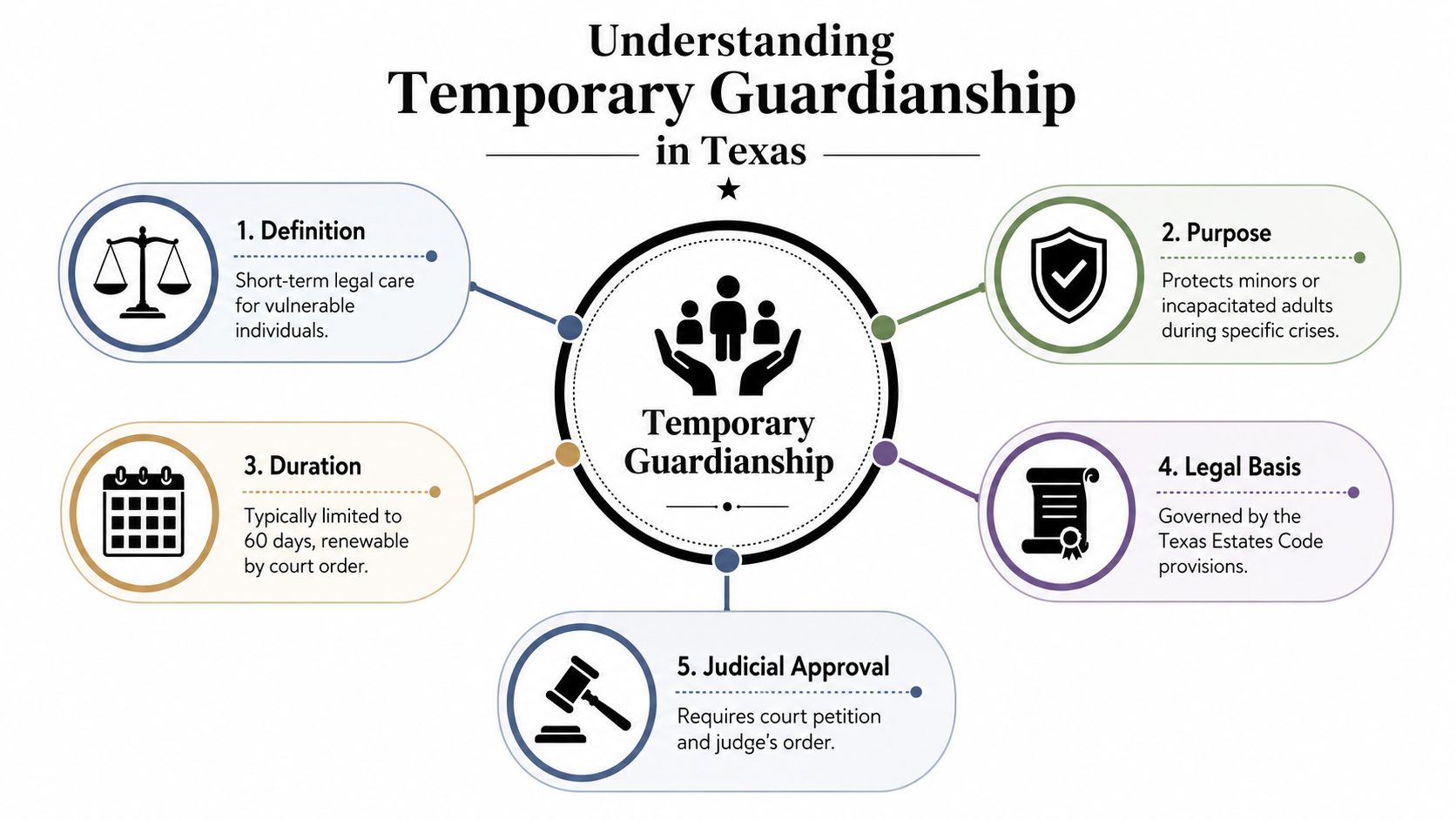
The order is narrow by design. A judge uses it to stabilize a situation while the court reviews whether a longer-term guardianship is needed. That means the focus is on immediate risk, not on general concern or family disagreement.
Person and estate are different roles
Texas guardianship can cover the person, the estate, or both. A guardian of the person makes decisions about healthcare, safety, placement, and daily personal needs. A guardian of the estate handles money, bills, and property.
That distinction matters in Montgomery County because the legal authority should match the problem in front of the court. A family may need help with medical choices, financial access, or both, but the court will look closely at whether the request is broader than the emergency. If the proposed ward can still make some decisions, or if the main danger is limited to property or finances, the court may reject a request that goes beyond what the situation calls for.
Why courts demand proof
Texas courts do not grant temporary guardianship because a family is worried. The applicant must present evidence showing the proposed ward is incapacitated and that the person's health, safety, or estate faces imminent danger. The appointment is usually limited to a short period, and that short window is part of the design.
The court expects proof up front, not after the fact. A family that wants temporary relief still has to show why the emergency cannot wait for a full hearing or another legal arrangement. In practice, that means careful preparation, medical support, and a petition that fits the facts, including the local forms used in temporary guardianship filings in Texas.
The Montgomery County Filing Process Step by Step
A temporary guardianship filing in Montgomery County starts with the county where the proposed ward lives, and the court will not act until the paperwork is in place. Families often want immediate relief and hope a judge can hear the problem the same day. In guardianship matters, that usually is not how the process works, because due process still controls the case.
The first document is the application, and it has to be supported by a recent physician's certificate. Texas guardianship practice requires a Physician's Certificate of Medical Examination dated no more than 120 days before filing, plus personal service on the proposed ward and appointment of an attorney ad litem before the court can hear the matter, as described in The Woodlands guardianship guidance. The petition should match the emergency being alleged, and if the family is using the county forms, the application should track the local filing requirements described in temporary guardianship form instructions for Texas.
What usually happens first
- Confirm venue. For residents of The Woodlands, Montgomery County is typically the proper filing county.
- Gather medical proof. The physician's certificate needs to be current and tied to the filing window.
- Prepare the petition. The petition must identify the emergency and the scope of authority requested.
- Serve notice. The proposed ward must be personally served.
- Wait for the court to appoint an attorney ad litem. The court won't hear the case until that appointment is in place.
That sequence is not just paperwork. It is how the court checks whether the emergency is real and whether a narrower option would solve the problem.
Local procedure can create practical pressure
Montgomery County probate practice also expects follow-through after appointment. Court instructions for guardianships of estate require an Inventory, Appraisement, and List of Claims within 30 days of qualification, plus a detailed Annual Account within 60 days of each qualification anniversary, according to the county's own guardianship of estate instructions. Those deadlines show why a temporary order only buys time, it does not finish the job.
If the problem involves a child, or if the real dispute is who can decide where a child lives, another court process may fit better. Some families in The Woodlands first look at Enforcement of Court Orders in The Woodlands because the issue is not guardianship at all, but a violation of an existing custody or divorce order.
Local practice point: A rushed filing that misses service, medical proof, or ad litem requirements can stall the case even when the underlying facts are strong.
I also tell clients to bring every paper trail they have, including hospital discharge summaries, bank notices, school emails, and text messages. The court cares about evidence, not assumptions.
Guardianship vs Emergency Custody a Critical Choice
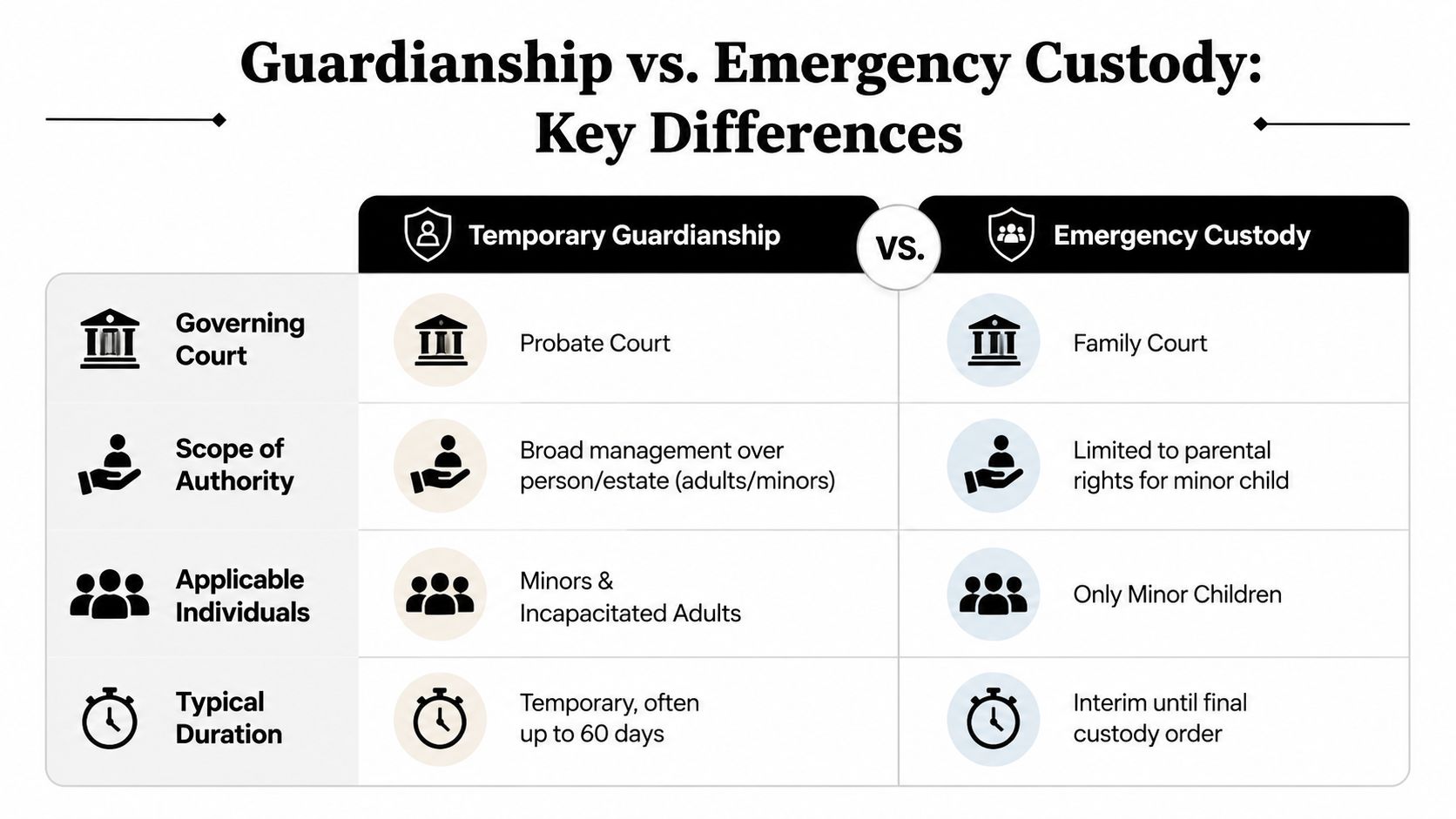
A family in crisis can lose time by filing in the wrong court. Temporary guardianship is a probate-court remedy. Emergency custody relief, temporary restraining orders, and temporary orders belong in family court under the Texas Family Code framework for child-related disputes and less restrictive alternatives. For families trying to protect a child, the starting question is whether the problem is really about guardianship, custody, or enforcement of an existing order.
Which court fits the problem
Temporary guardianship fits a minor who needs a non-parent to act, or an adult who cannot manage personal care or property because of incapacity. Emergency custody is usually the better fit when a parent needs immediate protection for a child from the other parent, especially in a fast-moving dispute over possession, safety, or visitation. If you are trying to stop a child from being taken, moved, or exposed to immediate harm, a family-court filing may give you the narrower relief you need.
That distinction matters because guardianship creates a substitute decision-maker only after the court decides less restrictive options are not enough. Family court can issue a narrower order tied to the parenting problem in front of the judge. Guardianship reaches farther, carries more formal duties, and can be harder to undo once it is entered.
If you are sorting out the child-custody side of a crisis, a guide on how to get an emergency custody order in The Woodlands can help you see how that process differs from probate guardianship. The practical question is not which remedy sounds stronger, it is which court has authority over the issue you are facing.
A simple comparison
| Question | Temporary Guardianship | Emergency Custody |
|---|---|---|
| Court | Probate Court | Family Court |
| Main subject | Minor or incapacitated adult | Minor child |
| Authority | Person, estate, or both | Parental rights and possession |
| Typical duration | Often up to 60 days | Interim until the court enters longer temporary orders |
That table is often the decision point for families. If the concern is medical decision-making for an incapacitated parent, probate court is the right place to begin. If the concern is getting a child away from immediate parental danger, family court is usually faster and more direct.
Why the wrong filing hurts
Montgomery County families sometimes ask for temporary guardianship when what they really need is custody enforcement or emergency temporary orders. That confusion is understandable in a crisis, but it can cost time. The court has to apply the right legal standard, and if the remedy does not match the facts, the request can fail even when the family's fear is real.
Practical rule: If the issue is a child and the danger comes from a parent, ask whether family court can give narrower relief before you pursue guardianship.
A temporary guardianship attorney Montgomery County families trust should be able to spot that difference quickly. The office may need to use probate tools, family-law tools, or both, depending on the facts. The Law Office of Bryan Fagan serves that kind of mixed-discipline need in Montgomery County, but the first step is still choosing the right court from day one.
How an Attorney Helps and What to Expect for Costs
A temporary guardianship case usually turns on the paper trail and the timing of the filing. Texas courts want proof of imminent danger to the proposed ward's health, safety, or estate, and the order is usually limited to 60 days. The petition, exhibits, medical proof, and hearing presentation all have to fit together before the judge will sign an emergency order. As noted in this Texas guardianship deadline overview, delay can create problems if the case is not filed promptly after incapacity is discovered.

What counsel actually does
A local attorney gathers the physician's certificate, organizes witness statements, drafts the application, prepares notice, and makes sure the file follows Montgomery County probate procedure. The lawyer also checks whether the requested authority is too broad, because judges are more likely to grant a request that fits the emergency closely.
That work matters because probate court is asking for a narrow remedy. If the facts point to a parent in immediate danger, the lawyer should also consider whether a family-court response is the better fit, or whether both courts need to be addressed in some order. Families sometimes need a guardianship attorney in The Woodlands who can sort out that distinction before the first filing goes in.
The hearing itself is not casual. The court may need a clear presentation of the medical facts, the immediate risk, and why no less restrictive option will work. If the other side objects, the attorney has to respond without losing the core emergency argument.
Costs usually come from more than one place
Families should expect several expense categories, even though the exact amount depends on the case and the provider. Those expenses can include attorney's fees, court filing fees, and the fee for the attorney ad litem appointed by the court. The cost structure is one reason people sometimes compare probate help with family-law help before filing.
Practical rule: A low upfront fee does not help if the filing is wrong, incomplete, or in the wrong court.
Timing also affects cost. The more medical records, family conflict, and asset issues involved, the more time the case usually takes. If the situation overlaps with custody, enforcement, or probate administration, a single missed step can create a second case that costs more than the first.
For families who want a single local point of contact, a temporary guardianship attorney Montgomery County residents can consult should be able to explain whether probate relief, custody relief, or both make sense. That conversation should be candid, because the right path is usually the one that matches the emergency, not the one that sounds broadest.
Your Next Steps and Local Guardianship FAQs
What to do next
- Gather current medical records and the physician's certificate if one already exists.
- Write down the immediate risk in plain language, including who is in danger and what could happen next.
- Collect financial or school papers if the problem involves bills, accounts, enrollment, or medical consent.
- Do not transfer assets or sign for someone else without legal authority.
- Schedule a consultation with a lawyer who handles both probate and family-court emergency issues in Montgomery County.
Common questions from Montgomery County families
How fast can a hearing happen in Conroe?
It depends on the court's calendar and whether the filing is complete. Even in an emergency, the court still requires notice, service, and ad litem appointment before hearing the case.
What happens after the temporary period ends?
The temporary order does not solve the entire problem. The family usually has to pursue a full guardianship, a different probate arrangement, or a family-law remedy if the issue is about a child.
Can I get temporary guardianship for a parent with dementia who refuses help?
Sometimes, yes, if the evidence supports incapacity and immediate danger. The court still requires proof, service, and a hearing, so the request needs more than a disagreement inside the family.
Is guardianship always better than emergency custody for a child?
No. If the child's problem comes from a parenting dispute, emergency custody may be narrower and faster. Guardianship is better when the law needs a non-parent substitute decision-maker.
This is not legal advice, and every case turns on its own facts and documents. If you're dealing with a crisis in The Woodlands or anywhere in Montgomery County, get local legal guidance before you file anything. A careful first step can save time, reduce conflict, and help you choose the right court.
A CTA for The Law Office of Bryan Fagan. If you need help deciding between temporary guardianship, emergency custody, or another urgent remedy, schedule a consultation so a Montgomery County attorney can review your situation and explain the next legal move.
