 Skip to content
A child can end up in legal limbo fast. A parent in The Woodlands has a sudden medical crisis. A grandparent is already doing school drop-offs, doctor visits, and bedtime, but doesn't have legal authority to sign forms or make treatment decisions. That gap is where minor guardianship usually enters the conversation.
For families in The Woodlands, Montgomery County, and nearby communities, the court process can feel heavier than expected. People often assume that if everyone agrees, the caregiver can step in. Texas law usually requires more than family agreement. Court approval is what turns day-to-day caregiving into recognized legal authority for a child.
This guide is written in plain English for people searching for a Minor Guardianship Attorney in The Woodlands and trying to understand what happens next. It focuses on practical issues that matter locally, especially the hidden role of the Attorney Ad Litem and the probate court steps that many online guides gloss over.
You'll also see where readers commonly get confused, such as the difference between guardianship and custody, what paperwork matters most, and why some cases stall even when the caregiver seems like an obvious choice.
This article is not legal advice. Minor guardianship cases are fact-specific, and Texas probate courts expect careful filings and evidence. If your family may need a guardianship, talk with a qualified Texas attorney about your exact situation.
Introduction to Minor Guardianship in The Woodlands
A child can be living with a grandparent in The Woodlands, getting to school on time, seeing the doctor when sick, and following a normal routine, yet the adult raising that child may still lack legal authority to sign the papers that matter. That gap is often what brings families into a minor guardianship case.
Texas treats minor guardianship as a formal court appointment. Daily caregiving alone does not automatically let a relative, family friend, or other adult make legal decisions for a child under 18. Schools, medical providers, insurers, and banks often want proof of court authority before they will accept major decisions from a caregiver.
In Montgomery County, that process usually runs through probate court. Many parents and relatives do not expect that. They hear "child case" and assume divorce court or a standard custody matter. Guardianship follows a different track, with different rules, different paperwork, and a different set of court concerns.
One detail many online guides skip is the Attorney Ad Litem.
The Attorney Ad Litem is appointed to represent the child's interests in the case, not the adult asking to be guardian. That can surprise families who assume an uncontested filing will stay simple from start to finish. In local probate practice, that extra layer matters because the court is not just checking whether the family agrees. The court is also testing whether the proposed arrangement protects the child.
Why early clarity matters
Guardianship cases often feel like they should be straightforward. A relative is already doing the work. The child is already settled. The family may all agree.
The court still needs evidence.
A good way to understand it is to compare guardianship to getting legal keys, not just house keys. A caregiver may already have the child in their home and may already handle meals, homework, and transportation. Court appointment is what gives that caregiver recognized authority to consent to medical care, deal with school issues, or manage protected funds if the child owns money or property.
Confusion also starts because guardianship can involve two separate roles. One person may need authority over the child's daily life. Another may need authority over the child's money or property. Sometimes the same adult fills both roles. Sometimes the court keeps those jobs separate.
Practical rule: If you are raising a child day to day but cannot legally approve treatment, enroll the child in certain programs, or handle money that belongs to the child, it is time to ask whether guardianship is needed.
Situations that commonly lead to guardianship
Families in The Woodlands and the rest of Montgomery County usually start asking about guardianship when one of these facts is present:
- A parent has died and no other parent is available to step in.
- A parent is incapacitated and cannot safely make parenting decisions.
- A child has inherited money or received property that requires court-supervised management.
- A relative or other caregiver is already providing full-time care without formal legal authority.
Judges focus on the child's best interest, but that phrase can sound vague until you see how the court applies it. In practice, the court looks for a stable plan, reliable evidence, and a legally suitable guardian. In Montgomery County, local procedure and the Attorney Ad Litem's involvement can shape how that review unfolds, even in cases that appear obvious to the family.
Understanding Minor Guardianship Key Concepts
Minor guardianship often gets confused with custody because both involve caring for a child. In Texas, though, they answer different legal questions. Custody, usually called conservatorship in family court, deals with parents' rights and parenting time. Minor guardianship asks whether a court should give a non-parent legal authority to care for a child or manage the child's property.
That difference matters early. A grandparent may already be feeding the child, taking the child to school, and keeping life stable, yet still lack authority to approve certain medical care, deal with benefits, or manage money that belongs to the child.
Texas treats guardianship as a formal court appointment. The probate court can appoint one adult to make personal decisions for the child, one adult to manage the child's property, or the same adult to do both jobs.
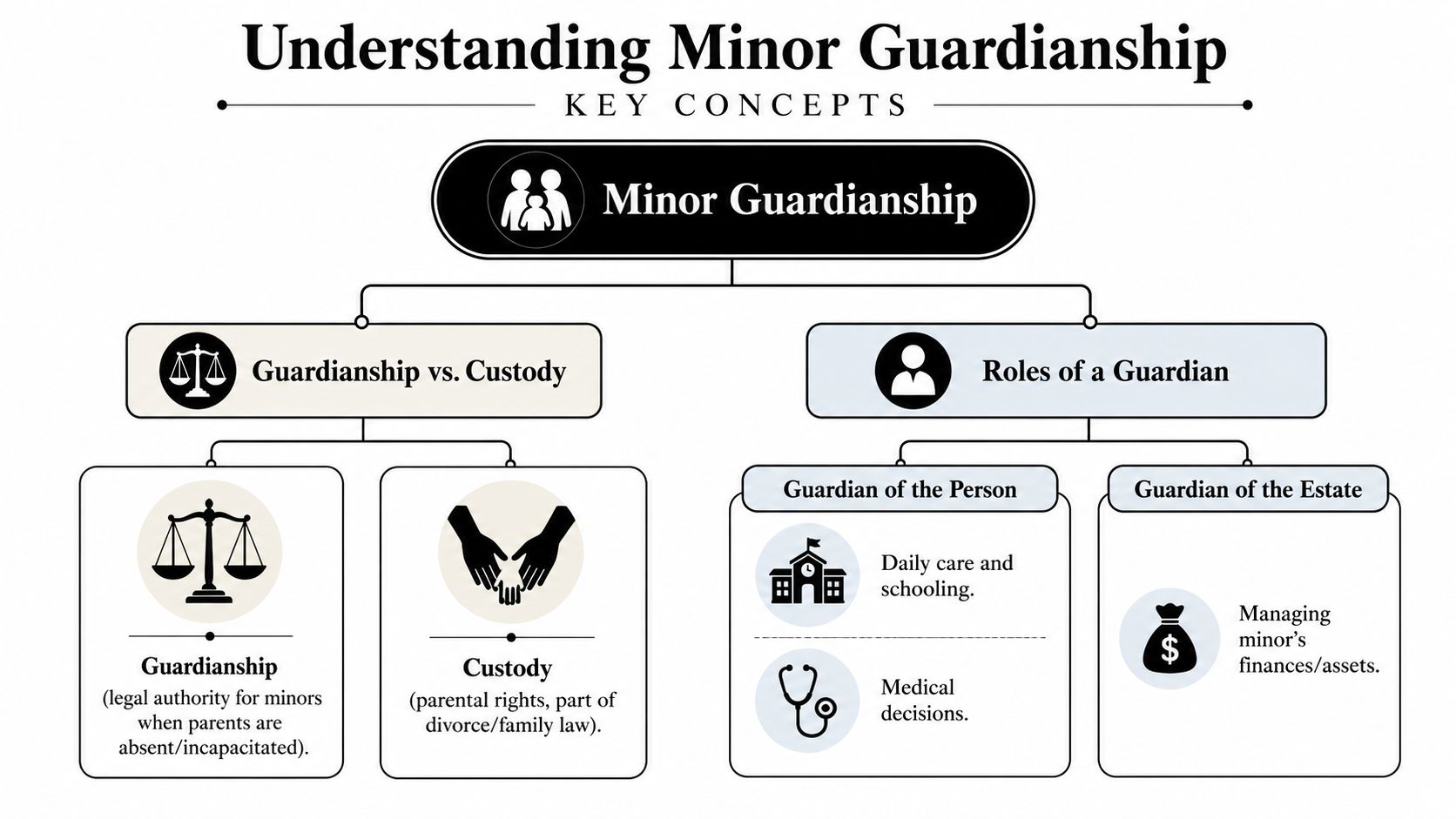
Guardianship versus custody
The easiest way to sort this out is to ask one question: is the dispute mainly between parents, or does a child need a court-appointed substitute decision-maker?
If parents are arguing over who decides school, medical care, or possession schedules, that usually stays in family court under the Texas Family Code. If a parent has died, is incapacitated, is absent, or cannot safely exercise parental authority, a probate court may be asked to appoint a guardian under the Texas Estates Code.
Guardianship is court-backed authority. It is more than a family agreement or a notarized note.
Texas courts can appoint a guardian for a minor when the legal requirements are met and the appointment serves the child's best interest. The court also looks at whether a less restrictive option would solve the problem. That point gets missed in many online guides.
The two main guardian roles
These titles sound technical, but the division is practical.
Guardian of the Person
This guardian makes decisions about the child's day-to-day life. That can include where the child lives, school matters, medical care, and general supervision.Guardian of the Estate
This guardian manages money or property that belongs to the child. Common examples include an inheritance, settlement funds, or an ownership interest in real estate.
A simple way to picture the split is this: one role handles the child's life, and the other handles the child's property.
Some families need only one role. If there are no assets to manage, the court may only need to consider a guardian of the person. If a child has funds that must be protected, the estate side becomes much more important because the court expects records, restrictions, and ongoing oversight.
Terms families hear, and what they usually mean
Families often use words like emergency, temporary, and permanent guardianship as if they were interchangeable. They are not.
An emergency request usually means the child faces an immediate risk and the court is being asked to act quickly. A temporary arrangement usually covers the period while the case is pending and the court gathers enough information to decide what should happen next. A longer-term guardianship addresses an ongoing need for legal authority.
The label matters less than the facts you can prove. Judges want to know what is happening now, why ordinary permission slips are not enough, and what order fits the child's situation.
The Attorney Ad Litem is not a side character
This is one of the most overlooked parts of a minor guardianship case in Montgomery County. The court may appoint an Attorney Ad Litem for the child. That lawyer does not represent the proposed guardian. The lawyer represents the child's interests and investigates what arrangement the court should approve.
For parents and relatives, this can feel confusing at first. You may think, "Everyone agrees the child is safe with me, so why is another lawyer involved?" The answer is that probate courts want an independent check. The Attorney Ad Litem may review records, speak with the child when appropriate, contact relatives, and test whether guardianship is actually necessary.
That local court culture matters in The Woodlands. In Montgomery County probate court, a case that seems obvious to the family can still slow down if the judge or Attorney Ad Litem sees missing evidence, unclear living arrangements, or a less restrictive option that has not been addressed. A local guide to the Montgomery County probate court process helps explain why those details matter.
Where families often get stuck
The first mistake is assuming informal authority is enough. A school may accept a caregiver for routine contact. A hospital, bank, or benefits office may require legal authority that only a court order provides.
The second mistake is assuming the court will readily approve the relative who has done the most caregiving. Past caregiving helps, but it does not end the analysis. The court still examines suitability, necessity, and the child's best interest.
The third mistake is overlooking the estate issue. Families focus on where the child will live and miss the fact that a child's money is a separate legal problem with separate duties.
For someone seeking a minor guardianship attorney in The Woodlands, that is the core idea to keep in mind. The case is not only about showing love and commitment. It is about showing the probate court why this child needs a guardian, what authority is needed, and why the proposed arrangement protects the child better than the available alternatives.
Navigating the Montgomery County Probate Process
A Montgomery County guardianship case often feels less like filing one form and more like passing through a series of gates. One gate asks whether the child requires a guardian. Another asks whether the proposed adult is suitable. A third asks whether someone else, especially the Attorney Ad Litem, sees a problem the family has missed.
The basic sequence in Montgomery County
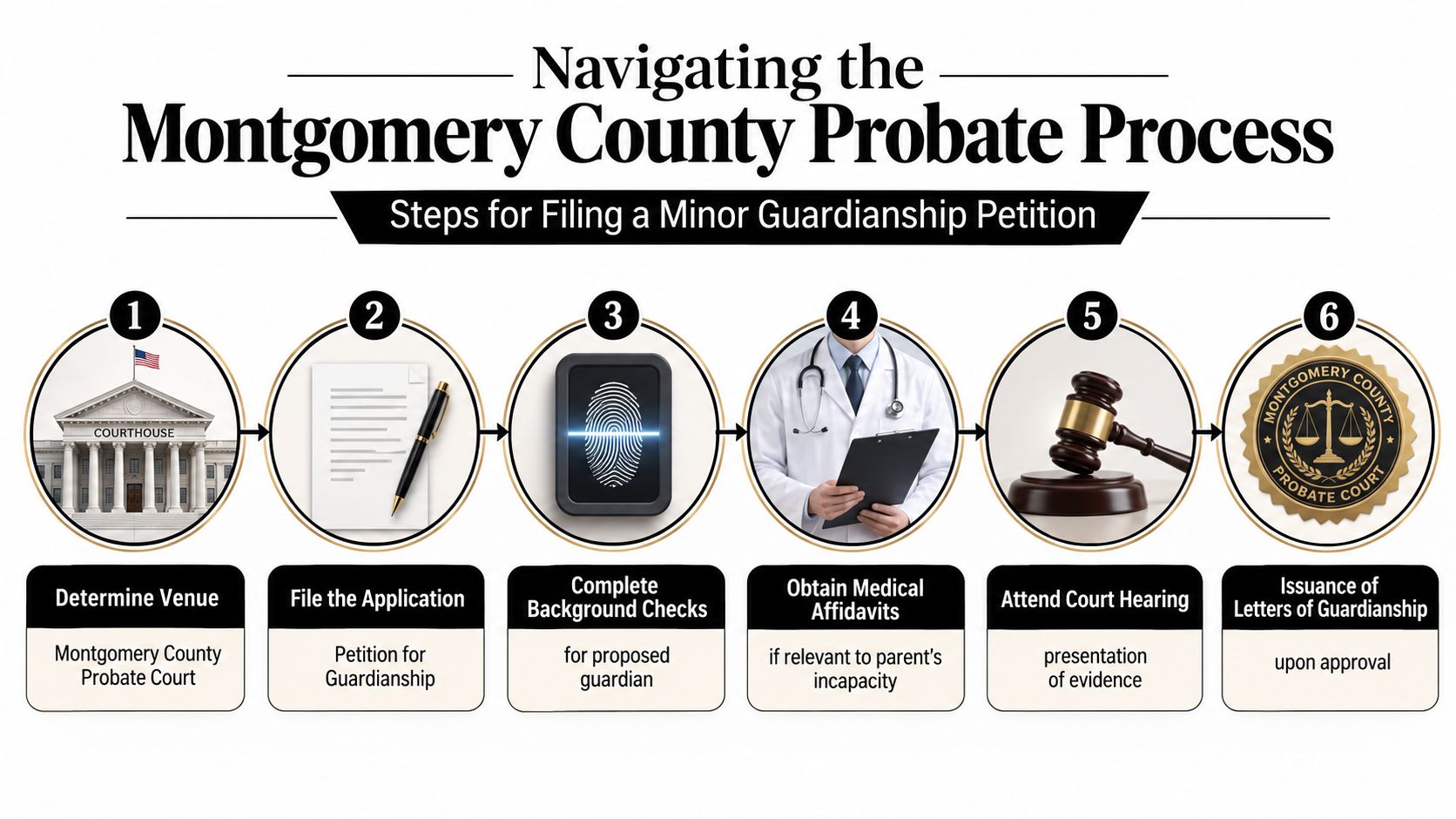
The court process usually starts in the probate court for the county where the child lives. After the application is filed, the case does not move on family agreement alone. The court reviews the paperwork, checks the proposed guardian's background, appoints an Attorney Ad Litem for the child, and sets the matter for hearing if the case is ready.
For Montgomery County families, the sequence usually looks like this:
- Choose the correct court based on the child's residence.
- File the guardianship application and supporting papers.
- Complete background checks, service, and other required filings.
- Work through the investigation stage, including contact with the Attorney Ad Litem.
- Attend the hearing and present testimony and exhibits.
- Receive Letters of Guardianship if the judge signs the order and the remaining qualification steps are completed.
Families who want a broader local overview can review the Montgomery County probate court process to see where a minor guardianship case fits within the county's probate system.
Here is a short video that gives additional context about the process families often face:
The hidden player most guides miss
The Attorney Ad Litem often shapes the direction of the case more than families expect. The ad litem does not represent the adult asking to be guardian. The ad litem represents the child's interests and tests whether the proposed plan protects the child.
That role matters in real life. A family may walk into court believing the case is simple because everyone agrees the child is already living with a grandparent or aunt. The Attorney Ad Litem may still ask questions about school stability, medical decision-making, past CPS history, financial motives, or whether a less restrictive option would solve the problem without a full guardianship.
The ad litem's questions often center on points like these:
- Is a guardianship needed right now?
- Would a narrower option meet the child's needs?
- What are the child's wishes, if the child can express them?
- Is the home stable and appropriate?
- Is the proposed guardian prepared to follow court rules after appointment?
A concern from the Attorney Ad Litem does not automatically end the case. It can, however, slow approval, lead to requests for more proof, or push the court to consider another arrangement.
Local court nuance
Montgomery County probate practice rewards preparation. Judges and court staff expect clean filings, clear affidavits, and supporting records that match the story being presented in court. If one document says the child has lived with a relative for a year, but school or medical records suggest something different, the court may want an explanation before granting authority.
Local practice also has a timing component. Some delays come from missing signatures or incomplete service. Others come from underestimating how much information the Attorney Ad Litem will want before making a recommendation.
That is why preparation starts before the hearing date. Families often benefit from organizing records the same way a careful law office would organize a file. A checklist of essential legal client intake documents can help relatives gather identification, school records, medical information, and other papers that often become important once the case is under court review.
Required Forms Evidence and Cost Breakdown
A guardianship file is less like one form and more like a stack of proof. Each document answers a different question for the Montgomery County probate court. Who is the child? Why is court authority needed? Is this proposed guardian fit to serve? Is there money or property that needs court protection?
That last question catches families off guard. A case about daily care can turn into a case with estate reporting duties if the child has insurance proceeds, an inheritance, or another asset in the child's name.
What the court usually wants to see
The starting document is the Application for Appointment of Guardian. It opens the case and states what authority the applicant wants.
From there, the court usually expects supporting records that match the family's story. Common examples include:
- The child's identifying records, such as a birth certificate or other records showing the child's legal identity
- Proof of why guardianship is needed, such as records tied to a parent's death, absence, incapacity, incarceration, or other circumstance affecting the parent's ability to care for the child
- Information about the proposed guardian, including background-check-related materials and details about the home and caregiving plan
- Medical records or evaluations, if a parent's condition is part of the legal basis for the request
- Post-appointment papers, such as the oath, bond, and inventory, especially if the child owns property or receives funds
A useful way to organize this is by question instead of by document type. Put all records that prove identity in one folder. Put all records that prove need in another. Put all records that show the proposed guardian can safely serve in a third. That makes it easier for your lawyer, the court, and the Attorney Ad Litem to follow the same timeline.
For families gathering records before an office visit, this checklist of essential legal client intake documents is a practical starting point. It is not Texas-specific, but it helps relatives build a cleaner file before the case is filed.
Why evidence quality matters in Montgomery County
Montgomery County judges and court staff often focus on whether the paperwork tells one clear story. If school records show the child has lived with an aunt for months, but the application is vague about where the child has been staying, the file may raise avoidable questions.
The Attorney Ad Litem also reviews more than labels. A death certificate, doctor record, school enrollment record, or benefit statement may each serve a different purpose. Together, they show the court whether guardianship is legally necessary and whether the proposed guardian is prepared for the responsibility.
That hidden review role matters. Many guides explain the filing step but skip the practical reality that an Attorney Ad Litem may test whether the documents line up with the day-to-day facts.
Estate cases bring extra forms and extra supervision
If the child has assets, the court adds another layer of protection. A guardian of the estate may need to file a fiduciary bond. The bond works like a financial safety net for the child's property. The amount depends on what the court believes is needed to protect the estate.
The guardian may also need to file an Inventory, Appraisement, and List of Claims after qualifying. Families sometimes focus on winning the appointment and miss what comes after. In estate cases, the appointment is only the start of the reporting duty.
If the situation is urgent and short-term relief may be needed, this guide to a temporary guardianship form in Texas gives helpful local context. If the case also involves estate administration issues, Probate Lawyer in The Woodlands, TX addresses probate administration and estate settlement in Montgomery County.
Key Guardianship Forms and Deadlines
| Form Name | Purpose | Deadline |
|---|---|---|
| Application for Appointment of Guardian | Opens the case and asks the court to appoint a guardian | Filed at the start of the proceeding |
| Medical evaluation materials, if applicable | Supports the claim that a parent is incapacitated or unable to provide care | Must be current enough for the court to rely on at filing |
| Oath of Guardian | Formal sworn acceptance of guardian duties | Filed after appointment, within the time required by the court |
| Fiduciary bond for guardian of the estate | Protects the child's assets from misuse | Must be filed as required by the court before authority is fully exercised |
| Inventory, Appraisement, and List of Claims | Lists and values the minor's estate assets | Filed after qualifying, within the court's required period |
What families usually pay for
Cost is rarely one flat number. It is more like a set of buckets.
One bucket is the court filing cost. Another is service of process. A third may be the bond premium if there is an estate. There may also be fees tied to the Attorney Ad Litem's work, since that lawyer is appointed to protect the child's interests and may need time to investigate, interview, and report to the court. If the family hires private counsel, attorney's fees are a separate category.
Contested cases usually cost more because they involve more hearings, more evidence, and more work responding to objections. Cases with missing records can also become more expensive because the lawyer has to spend time fixing proof problems that could have been addressed earlier.
A smart first question is not "What is the total?" It is "What cost categories should I expect in my type of case?" That question usually gets a clearer and more useful answer.
Common Pitfalls and How an Attorney Can Help
Some guardianship cases fail for dramatic reasons. Many more get into trouble for ordinary reasons. A missed deadline. A vague medical record. An application that explains the family crisis but doesn't clearly prove legal necessity.

Mistakes that trip families up
The first problem is often underestimating the court's supervision. A person may think, "I'm the grandparent, everyone knows I'm caring for the child, so this should be simple." But the court wants a complete legal record.
Another common issue is weak evidence of incapacity. A family may describe a parent's condition in detail, but the court usually needs proper medical support when incapacity is central to the request.
Then there's the Attorney Ad Litem problem. Families sometimes treat the ad litem interview like a formality. It isn't. If the child's living arrangement, school plan, financial handling, or family dynamics are unclear, concerns can surface quickly.
Why counsel changes the outcome
A Minor Guardianship Attorney in The Woodlands can help by tightening the case before the hearing. That usually means:
- Screening for legal fit so you don't file the wrong kind of case.
- Drafting clearer pleadings that match what the probate court needs to decide.
- Spotting missing evidence early, especially in medical or estate-related cases.
- Preparing for ad litem contact so the family responds consistently and accurately.
- Handling contested issues if a parent or relative objects.
A good guardianship presentation doesn't just tell the court that the child needs help. It shows the court exactly why this legal tool is the right one.
Lawyers also help with the unglamorous but important tasks. Calendaring deadlines. Coordinating supporting records. Explaining what not to say. Making sure the proposed guardian understands ongoing duties after appointment, not just the filing stage.
That's where legal fees can make practical sense. The cost of getting organized on the front end may be lower than the cost of a denial, delay, or later removal for noncompliance.
Real World Scenario and What to Do Next Checklist
A grandmother in Montgomery County had been helping raise her grandson for months after her daughter suffered a major medical setback. At first, the family got by informally. Then school paperwork, medical decisions, and benefit-related issues piled up. The grandmother realized that being the day-to-day caregiver wasn't the same as having legal authority.
She filed for minor guardianship in probate court, gathered medical records showing why the parent couldn't currently provide care, and prepared for the Attorney Ad Litem's investigation. The ad litem looked closely at the home, the child's routine, and whether a less restrictive option would work. After the hearing, the court issued Letters of Guardianship, allowing the grandmother to handle the child's daily legal needs.
That kind of situation is common in The Woodlands. The legal issue often starts after the caregiving has already begun.
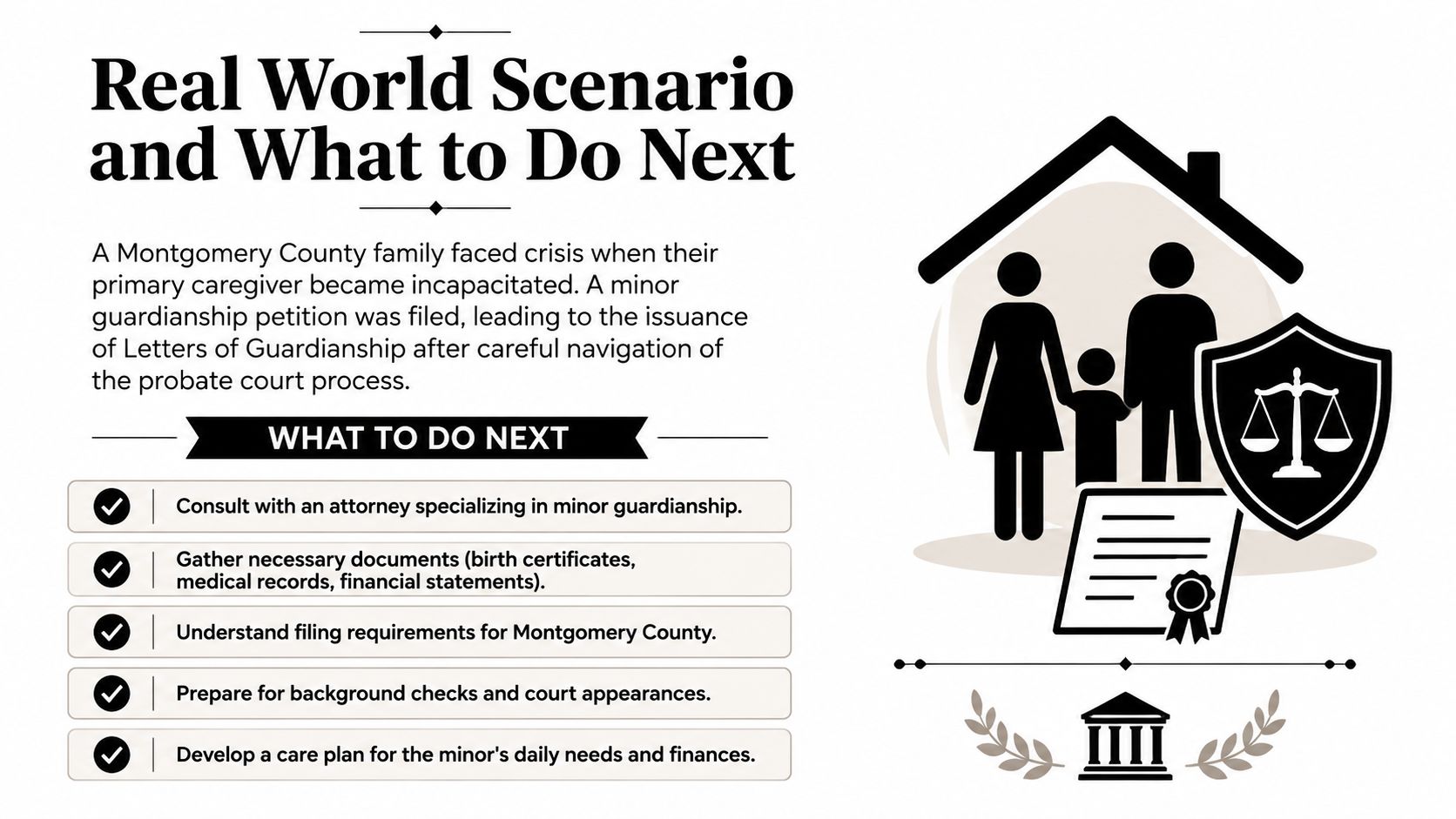
What to do next
- Collect identity documents such as the child's birth certificate and any existing court papers.
- Gather proof of the current crisis including medical records, death-related records, or other documents showing why the parent cannot provide care.
- Write down the child's daily routine so you can explain school, healthcare, transportation, and housing clearly.
- List any money or property the child owns because that may trigger estate-related requirements.
- Prepare for background review and for questions from the Attorney Ad Litem.
- Talk with a lawyer early if the case may be contested or if the child's parents may object.
If grandparents are stepping in, nearby issues sometimes overlap with broader family rights questions. This page on grandparents' rights in Montgomery County, Texas may help frame related concerns.
Local Resources FAQ and Disclaimer
A guardianship case does not end when you understand the law. Families in The Woodlands usually need practical help too. They need to know which office handles filings, who can explain court procedure, and where the process often gets more complicated in Montgomery County than people expect.
One detail many short guides skip is the Attorney Ad Litem. That court-appointed lawyer represents the child's interests, not the proposed guardian's interests. In Montgomery County probate court, that role can shape the case in a quiet but important way because the Attorney Ad Litem may ask follow-up questions, review the home situation, and raise concerns the judge wants answered before granting relief.
Local resources
Start with the offices and organizations that help families gather information and keep the case moving:
- Montgomery County Probate Clerk's Office for filing procedures, docket information, and local court administration
- The Woodlands-area law library resources for forms, statutes, and legal research materials
- Local child welfare and family support nonprofits for counseling, crisis support, and help coordinating services for the child
Court staff can explain procedure. They cannot tell you what legal strategy to choose, what evidence is enough, or how to respond if a parent objects.
FAQ
Can parents contest my guardianship petition
Yes. A parent can object to the application, present evidence, and ask the court to deny the request. The judge then looks closely at necessity, the child's welfare, and whether the proposed guardian is suitable. If the case is disputed, the Attorney Ad Litem often becomes even more important because that lawyer gives the court an independent view focused on the child.
How long do Letters of Guardianship last
Letters of Guardianship typically expire after 16 months and usually must be renewed through court filings, updated compliance steps, and any bond-related requirements that apply in the case.
Are there alternatives to guardianship
Sometimes. A family may be able to use a less restrictive option if the child only needs limited help for school, medical care, or day-to-day supervision. Guardianship is often the better fit when there is serious conflict, parental incapacity, abandonment concerns, or property that must be protected under court oversight.
Important disclaimer
This article is for general education only. It is not legal advice, does not create an attorney-client relationship, and should not replace advice from a lawyer who has reviewed your family's specific facts, records, and court posture.
If your family in The Woodlands or Montgomery County is dealing with a situation where a child needs stable legal care, The Law Office of Bryan Fagan is one option to consult for guidance on probate and family-related court procedures. A consultation can help you understand whether guardianship fits your situation and what steps to take next.
