 Skip to content

Most families assume a fatal accident creates one straightforward lawsuit with a two-year clock. Why, then, do strong cases in Montgomery County fall apart within weeks of a death, long before anyone steps into a courthouse?
Because a fatal injury in Texas doesn't open a single legal path. It sets four separate clocks and processes in motion at the same time: the family's wrongful death claim, the deceased person's survival claim, probate control over the estate, and the rapid disappearance of physical and digital evidence. Treating those pieces as unrelated tasks creates gaps that insurers and defense lawyers quickly exploit.
That coordination matters even more in a fast-growing region. According to the U.S. Census Bureau QuickFacts for Montgomery County, the county's population grew from 620,443 in the 2020 census to an estimated 749,613 residents as of July 1, 2024, an increase of 129,170 residents (roughly 20.8%) in about four years. As part of the Houston, Pasadena, and The Woodlands metropolitan area, Montgomery County now carries heavier highway traffic, expanding construction zones, busy commercial centers, and major healthcare systems.
When a sudden loss hits a household in The Woodlands, Conroe, or nearby neighborhoods like Panther Creek and Sterling Ridge, working with a wrongful death attorney in The Woodlands, TX isn't about chasing promises of guaranteed payouts. No honest lawyer can promise a result. It's about protecting evidence, clarifying who has legal authority to act, and keeping family claims and estate administration aligned from the first week forward.
Who Can File a Wrongful Death Claim in Texas
In Texas, a wrongful death claim belongs exclusively to a narrow group of close relatives, not to every person who loved or depended on the deceased. Only the surviving spouse, children, and parents have legal standing to bring a wrongful death action for their own losses.
Liability also isn't automatic just because a tragedy happened. Under Texas Civil Practice and Remedies Code Chapter 71, Section 71.002, a family can pursue actual damages only when a death results from another person's or company's wrongful act, neglect, carelessness, unskillfulness, or default. A fatal crash, workplace accident, or medical event still requires proof connecting specific conduct to the fatal injury.
The statute draws a firm line around who may recover. As set out in Texas Civil Practice and Remedies Code Section 71.004, surviving spouses, children, and parents may bring the claim for their own legally recognized losses, while siblings, grandparents, and other relatives don't automatically gain independent standing because they experienced real grief. Unmarried partners and close friends are also excluded from bringing a wrongful death lawsuit.
Verifying family relationships under the Texas Family Code matters before anyone files paperwork or talks to an insurance carrier. For instance, a formal marriage certificate proves spousal standing immediately, while an informal (common-law) marriage requires specific proof under Texas family law rather than just sharing an address. Adopted children generally qualify as legal children, whereas stepchildren who weren't legally adopted and half-siblings don't automatically hold wrongful death standing.
Confirming Statutory Standing Before Anyone Files
Before opening negotiations or signing any representation agreement, run through a quick three-step family check so no eligible relative is left out and no ineligible person assumes they hold filing authority.
- List every surviving relative. Write down the deceased person's spouse, every biological and legally adopted child (both minor and adult), and both living parents, even if a family member lives out of state or was estranged.
- Verify each legal relationship with documents. Pull marriage certificates, birth certificates, adoption decrees, or divorce decrees so counsel can confirm standing cleanly under the Texas Family Code without delays.
- Check whether the deceased left a will. Knowing whether a valid will exists tells you who may step in as executor for the estate's separate survival claim, which follows different rules than the relatives' wrongful death claims.
Even when a relative doesn't qualify as a wrongful death beneficiary, they can still have an important role in probate if they're named in a will or stand to inherit from the estate. The table below breaks down who can bring the wrongful death lawsuit itself.
| Person | Can file a wrongful death claim? | Notes |
|---|---|---|
| Surviving spouse | Yes | Statutory beneficiary who sues for their own losses |
| Children of the deceased | Yes | Statutory beneficiaries; confirm the relationship with records |
| Parents of the deceased | Yes | Statutory beneficiaries alongside spouse and children |
| Siblings, grandparents or other relatives | No, generally | Grief alone does not create standing; they may still matter in probate |
| Unmarried partner or friend | No | Not a statutory beneficiary under Texas wrongful death law |
| Executor or administrator | Brings the survival claim | Acts for the decedent's own claims |
Once your family knows who holds legal standing, the next priority is understanding the calendar, because Texas law doesn't just impose one filing deadline.
Filing Deadlines That Start the Clock After a Death
A lawsuit for an injury that causes death is generally due within two years of the date of death. Under Texas Civil Practice and Remedies Code Section 16.003(b), the wrongful death claim accrues on the exact day the injured person dies, not the day of the funeral and not the day the family finishes sorting out paperwork.
Working through a concrete date makes the math clear. If a fatal crash happens near The Woodlands on March 10, 2026, the ordinary two-year limitations deadline would generally fall on March 10, 2028, subject to case-specific rules and statutory exceptions. Filing even one day late can permanently wipe out an otherwise valid case.
That two-year limit isn't the only date families have to watch. Under Texas law, if no surviving spouse, child, or parent files a wrongful death action within three calendar months after the death, the deceased person's executor or administrator generally must bring the lawsuit unless every eligible relative asks that it not be filed. According to the Texas Civil Practice and Remedies Code limitations framework, missing either the two-year filing deadline or the three-month representative trigger can undermine a family's control over the claim even when the liability facts are strong.
Statutory Pauses and Everyday Evidence Windows
Certain legal rules can pause or alter a filing date, which is why families shouldn't rely on guesswork. For example, Texas Civil Practice and Remedies Code Section 16.062 generally suspends an applicable limitations period for 12 months after the death of a person connected to a potential claim. That suspension is not an automatic extra year for every wrongful death lawsuit, because its application depends on whose death occurred, which claim is at issue, and whether an estate representative qualifies earlier, so an attorney must review the exact timeline before anyone relies on it.
Never treat a two-year filing deadline as a two-year waiting period. Legal deadlines keep the courthouse doors open, but they do nothing to stop businesses from deleting video or witnesses from moving away.
Courts enforce statutory deadlines, while real-world evidence disappears on its own schedule. Surveillance cameras overwrite old files on routine loops, commercial vehicles get repaired or scrapped along with their electronic data, and eyewitness memories fade long before the first anniversary of a crash.
| Deadline or trigger | Rule | What it means in practice |
|---|---|---|
| Two-year limitations period | Suit generally due within two years of death (CPRC 16.003(b)) | Example: a death on March 10, 2026 generally points to March 10, 2028 |
| Three-month beneficiary window | If no eligible relative sues within three calendar months, the executor or administrator generally must file (CPRC 71.004) | Can shift control of the case to the estate representative |
| Exceptions and statutory pauses | Some rules can pause or change the standard date, including a 12-month suspension under CPRC 16.062 | Never assume the standard date applies without a lawyer's review |
| Evidence windows | No statutory date | Changes by record holder; footage and vehicle data can disappear within days or weeks |
Take five minutes today to put the date of death on a shared family calendar, highlight the three-month mark and the two-year mark, and ask a Texas lawyer to confirm whether any shorter notice rules or exceptions apply to your facts.
Evidence to Preserve in the First Weeks
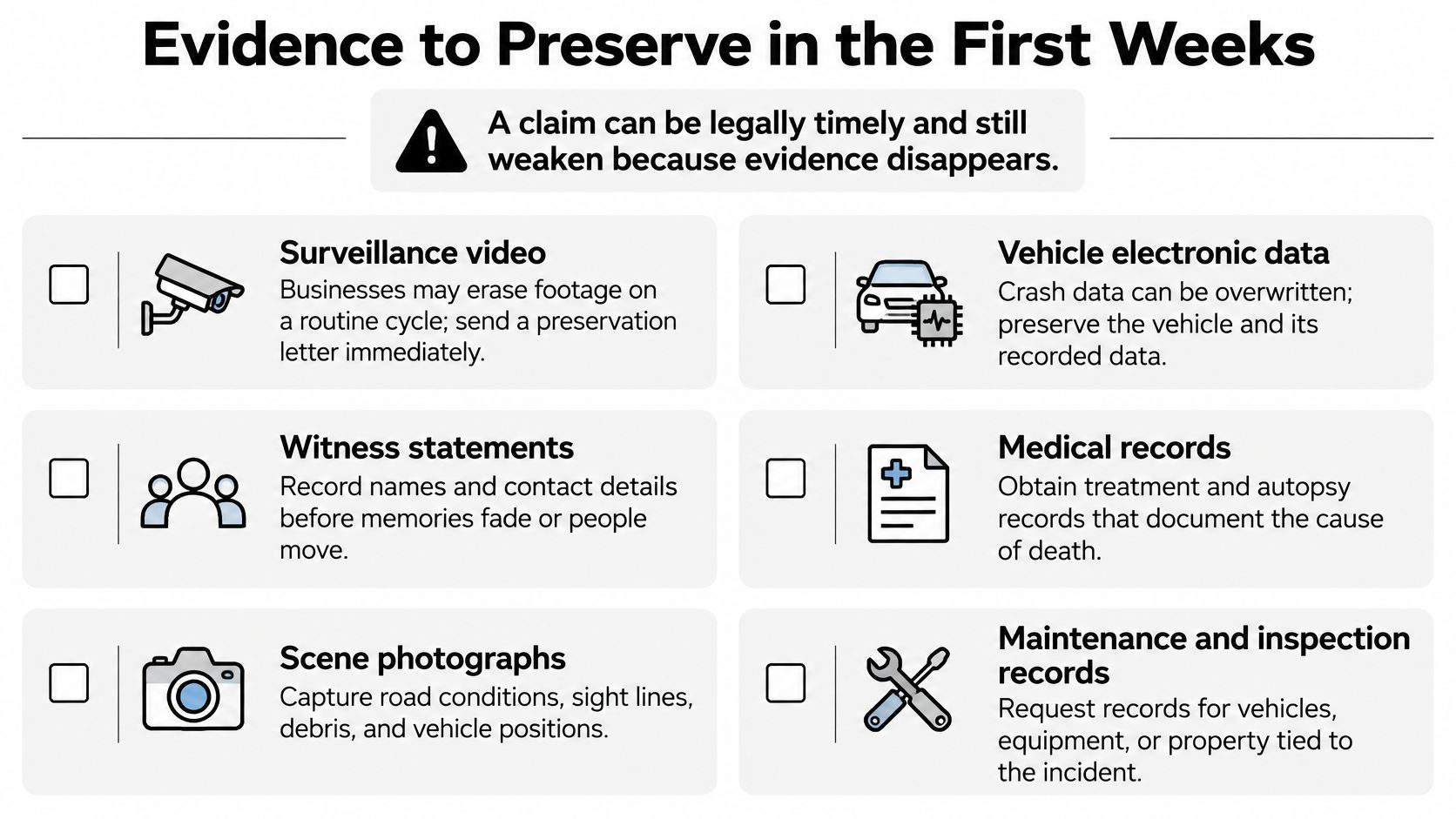
A wrongful death lawsuit can be filed well inside Texas's legal deadlines and still collapse because critical proof vanished during the first month. Businesses routinely purge security footage on automated cycles, wrecked vehicles lose their electronic crash data if released to salvage yards, and scene conditions change overnight after road repairs or rainstorms.
In The Woodlands and across Montgomery County, fatal incidents frequently involve major corridors like I-45, busy retail centers, active construction sites, hospitals, or commercial employers. That means several separate companies or agencies may hold pieces of the record. As highlighted in Texas wrongful death evidence guidance, early preservation of overwritten surveillance footage, vehicle data, workplace documentation, medical records, and financial records often determines whether a family can prove both fault and full financial loss. When a fatality involves a commercial rig or delivery fleet, working quickly with an 18-wheeler accident lawyer in The Woodlands, TX helps secure onboard black-box data, driver logs, and maintenance files before carriers cycle them out.
The checklist graphic below highlights the six most perishable categories of proof families and counsel focus on right after a fatal incident.
Seven Steps Families Can Take Right Away
You don't need to play detective while grieving, and you shouldn't put yourself in harm's way at a crash site. Focus instead on securing records that sit within your family's reach, starting with the most urgent items first.
- Send written preservation requests immediately. Ask involved businesses, property owners, employers, and insurance carriers in writing not to delete surveillance video, vehicle electronic data, inspection logs, or workplace records. This written notice, called a preservation letter, puts recipients on formal notice not to destroy evidence.
- Photograph the scene and vehicles when safe. If a family member can safely take wide and close-up photos of skid marks, signage, debris, lighting, or vehicle damage before cleanup or towing, save the original image files without editing them.
- Write down witness names and contact details. Police reports sometimes omit bystanders who left early or coworkers who saw unsafe conditions before the incident, so record phone numbers and brief notes while memories stay sharp.
- Obtain the death certificate and complete medical records. Request emergency room charts, ambulance run sheets, surgical notes, and any autopsy report, since these documents connect the incident to the cause of death.
- Keep every official incident report. Save the Texas Peace Officer's Crash Report, fire department run report, OSHA filing, or workplace incident summary so your attorney can spot missing witnesses or factual errors early.
- Preserve texts, emails, and social-media material. Don't delete messages or posts related to the incident, the deceased's final day, or conversations with employers and insurers; back them up in a dedicated folder.
- Gather financial and household contribution records. Pull recent tax returns, W-2s, pay stubs, employment contracts, and benefit statements so your legal team can document the income and services the deceased provided to the household.
Just as important as what you save is what you avoid. Decline requests from any opposing insurance adjuster to give a recorded statement, and don't sign a medical authorization or early settlement release before an attorney reviews the full record. Once hired, your lawyer can send formal preservation letters to every potentially responsible party so the burden doesn't sit on your family's shoulders.
Damages Families Can Recover in Texas
Texas law divides post-death injury compensation into two separate legal buckets, and which bucket a dollar falls into decides who receives the check. Confusing the two often surprises families during settlement talks, especially when estate debts or blended family relationships come into play.
The first bucket is the wrongful death claim, which compensates eligible relatives (the surviving spouse, children, and parents) for their own losses caused by the death. These damages can cover loss of companionship and society, mental anguish, loss of the financial support and household services the deceased would have provided, loss of expected inheritance, and medical or funeral expenses that family members paid out of pocket.
The second bucket is the survival claim, which belongs to the deceased person's estate. Under Texas Civil Practice and Remedies Code Section 71.021, a person's personal injury claim doesn't vanish when they pass away; it survives for the benefit of the heirs, legal representatives, and estate. Consider a Montgomery County worker injured in an industrial accident who survives in intensive care for several days before dying. That single tragedy supports both the estate's survival claim (covering pre-death conscious pain and suffering, medical bills incurred before death, and earnings lost between the injury and death) and the family's wrongful death claims. Because survival funds belong to the estate, probate administration and the Texas Estates Code govern who can collect and distribute that recovery.
| Damages | Claim it belongs to | Who receives it |
|---|---|---|
| Loss of companionship and mental anguish | Wrongful death | Surviving spouse, children and parents |
| Loss of support, services and inheritance | Wrongful death | Eligible relatives |
| Medical and funeral bills the family paid | Wrongful death | Relatives who paid them |
| Pain and suffering before death | Survival | The decedent's estate |
| Medical bills paid before death | Survival | The decedent's estate |
| Earnings lost between injury and death | Survival | The decedent's estate |
Why Allocation Between Both Buckets Matters Before Signing
When an insurer makes a lump-sum settlement offer, how that money gets split between wrongful death damages and survival damages changes who gets paid and whether estate creditors can reach the funds. Money allocated to the survival claim passes through the estate under the will or Texas intestacy rules, where valid estate debts may have to be addressed under the Texas Estates Code. Money allocated to wrongful death beneficiaries goes directly to the eligible relatives based on their individual losses.
Practical rule: Demand letters and settlement agreements should clearly state how every dollar is divided between eligible relatives and the estate before anyone signs a release.
To protect your family's position, save every receipt for funeral, burial, and medical bills paid out of pocket, and compile the deceased's pay stubs, tax returns, and benefit summaries early. Keep in mind that the categories above explain what Texas law allows families to pursue, not a promised payout. Every case's value turns on fault, insurance coverage, medical evidence, and documented household losses, and allocation must be agreed upon in writing before a single settlement check is accepted.
Who Controls the Claim in a Montgomery County Estate
Someone has to hold legal authority to act for the deceased person's estate, and the Texas Estates Code sets the rules for who that person is. Without clear estate authority, insurers frequently stall negotiations because they won't write a survival-claim check until they know the signer can legally bind the estate.
If your loved one left a valid will, the person named as executor ordinarily asks the probate court for formal authority (called Letters Testamentary) to act on the estate's behalf. If there is no will, a family member or other qualified person must ask the court to appoint an administrator and determine the legal heirs, a process that adds steps and time. Residents of The Woodlands must file probate at the Montgomery County Clerk's office in Conroe, at 210 W Davis St. Reviewing the Montgomery County probate court process early helps families anticipate court filings, hearings, and bond requirements before a settlement deadline arrives.
Family and Estate Conflicts That Slow Down Settlements
Coordinating probate alongside an injury claim gets complicated fast when real-world family dynamics enter the picture. As outlined in the Texas Chapter 71 statutory framework, survival actions benefit the heirs, legal representatives, and estate, which can create competing priorities alongside the surviving spouse, children, and parents' wrongful death claims.
Five situations commonly slow down Montgomery County cases:
- No valid will exists. When someone dies intestate, Texas statutory heirship rules decide who inherits estate property, and courts require formal proof of family history before appointing an administrator.
- Blended families have competing interests. A surviving spouse and adult children from a prior marriage may disagree on who should lead the case, how settlement proceeds should be divided, or whether to accept an early offer.
- Multiple heirs can't agree on an administrator. Disagreements among relatives over who should represent the estate can trigger contested probate hearings in Conroe and pause injury negotiations.
- Creditors assert claims against the estate. Medical providers, lenders, or lienholders may press for payment out of estate proceeds, making the boundary between survival money and wrongful death money highly important.
- Confusion arises over who signs releases. An executor or administrator signs settlement releases for the estate's survival claim, while each eligible surviving spouse, child, and parent signs for their own wrongful death claim (and settlements for minor children require court approval).
Remember that the three-month beneficiary window can also shift who initiates court action if eligible relatives wait too long to coordinate with the estate representative. Rather than letting an insurance offer force a family fight, handle estate control in four straightforward steps before negotiations heat up:
- Locate the original will (or confirm in writing after a thorough search that none exists).
- Identify the named executor or proposed administrator and confirm they're willing and eligible to serve in Montgomery County.
- List every eligible wrongful death relative alongside known estate creditors so counsel can spot conflicts and liens early.
- Put signing authority and allocation expectations in writing so everyone understands who signs for the estate and who signs for individual claims before an offer arrives.
What a Wrongful Death Case Timeline Looks Like
Say a Woodlands father driving home from work is killed in a two-vehicle collision on a county road near Conroe. Three days later, while the family is still making funeral arrangements, the other driver's insurance adjuster calls his widow expressing sympathy and asking for a quick recorded statement "just to get the claim moving." She almost agrees because the mortgage and medical bills are already on her mind.
Instead, she pauses, declines the recorded statement, and speaks with counsel. Within days, her attorney sends preservation letters to a nearby gas station with exterior cameras and to the tow yard holding both vehicles, obtains the crash report and hospital charts, and begins checking whether probate needs to be opened in Conroe. Because the family protected the evidence first and waited until the full financial and medical picture was documented, they enter settlement talks months later with verified proof rather than an incomplete story built around an early, unprepared phone call.
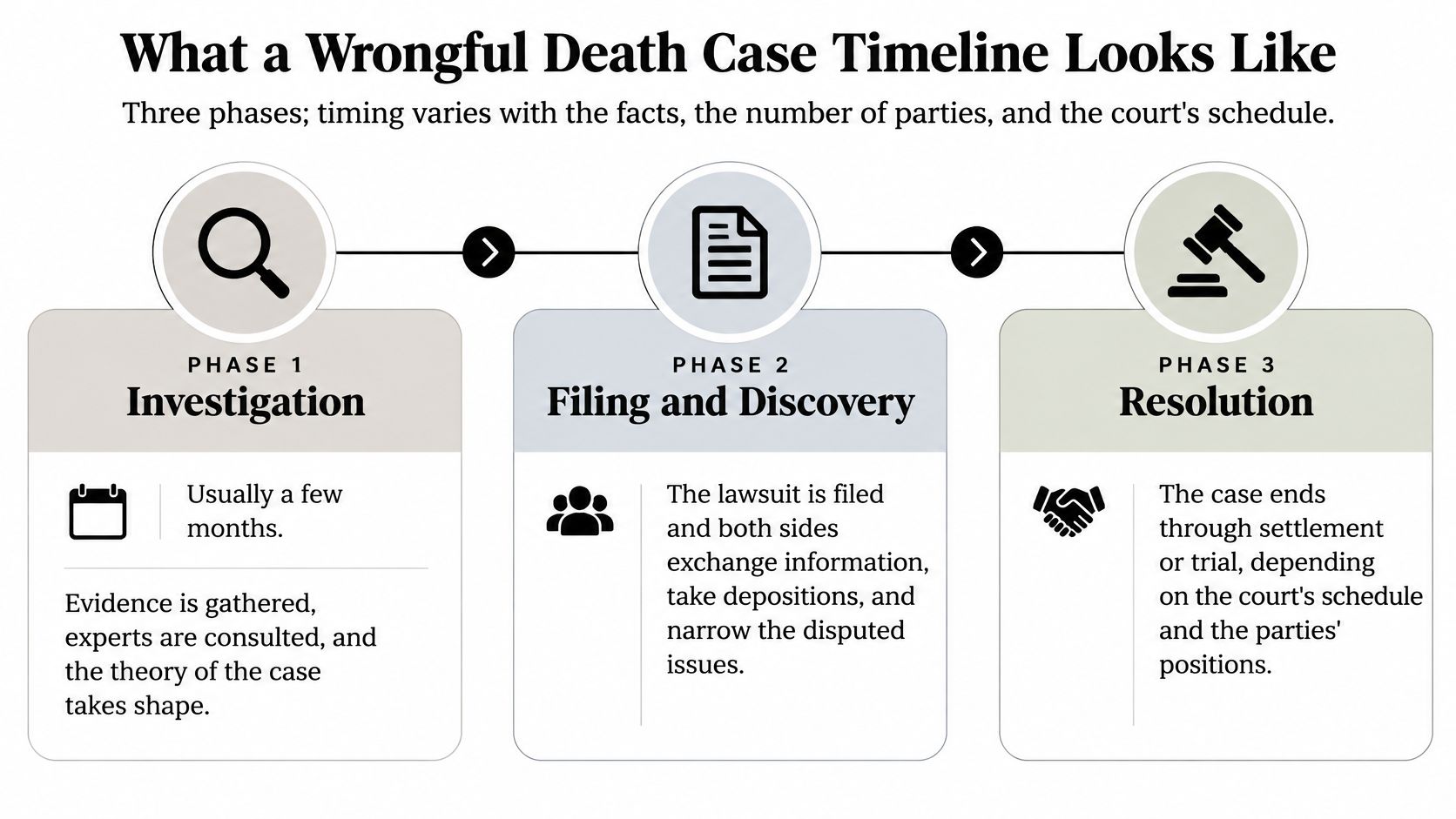
The timeline visual below outlines the three core phases most Texas wrongful death cases move through from initial review to final resolution.
How the Three Case Phases Unfold
Every case moves at its own pace depending on how clearly fault is established, how many defendants and insurers are involved, whether probate is contested, and how crowded the Montgomery County court docket is. The phases below describe typical patterns, not guaranteed schedules.
Phase 1 is investigation, which usually runs a few months. During this stage, your legal team gathers police reports, medical and autopsy records, employment files, and witness statements, checks insurance policy limits, and consults reconstruction or medical experts if fault or cause of death is disputed. Families help most here by gathering household records and keeping all insurer communications routed through counsel.
Phase 2 is settlement negotiation, which often unfolds over several months once the evidence and damages documentation are complete. Your attorney sends a formal written demand package detailing liability, wrongful death losses, and any survival claim, along with a proposed allocation between relatives and the estate. The insurer investigates on its side and responds with an offer, a counteroffer, or a denial.
Phase 3 is litigation, which begins if the insurer refuses to make a fair offer or disputes fault. Filing a lawsuit opens formal discovery, where both sides exchange documents, answer written questions under oath, take depositions of witnesses and experts, and usually attend mediation before a trial date is set. Litigation commonly stretches past a year and can take significantly longer when multiple defendants or appeals are involved.
For a quick walkthrough of how fatal injury claims progress and what families should expect when preparing a case, watch the video overview below.
Starting early doesn't guarantee a fast settlement check, because serious cases still take time to document properly. An early start gives your family clarity, so you can evaluate any offer with real facts in front of you instead of guessing under pressure.
How to Choose a Wrongful Death Attorney and What It Costs
Once immediate records are safe, families usually face two practical questions: which wrongful death attorney in The Woodlands, TX should handle the case, and how will legal fees and expenses be paid?
Most wrongful death and personal injury attorneys work on a contingency fee, meaning the lawyer receives an agreed percentage of any money recovered and collects no attorney's fee if there is no recovery. Hourly rates and flat fees are uncommon for full wrongful death lawsuits, though families do sometimes see them for limited probate filings or discrete consultations. Whatever structure a firm offers, Texas ethics rules require contingency fee agreements to be in writing, and you should know exactly how case expenses are handled before signing.
| Fee model | How it works | What to confirm in writing |
|---|---|---|
| Contingency fee | A percentage of any recovery, with no fee if nothing is recovered | The percentage at each stage, and who pays case costs if the case is lost |
| Hourly rate | Billed by time spent on the case | Estimated total, billing frequency and the retainer amount |
| Flat fee | A fixed amount for defined work | What is included and what triggers extra charges |
Questions to Bring to Every Consultation
Advertising billboards and television commercials don't tell you how an attorney prepares a case for a Montgomery County jury or handles a contested estate. Bring a written list of direct questions to each meeting when evaluating a personal injury lawyer in The Woodlands, TX so you can compare answers side by side.
- What is your Texas and Montgomery County courtroom experience? Ask how many wrongful death cases the attorney has handled across Texas and specifically in Montgomery County district courts and the probate court in Conroe.
- Who handles the file day to day? Confirm whether the lawyer sitting across from you will personally run the case, take depositions, and handle negotiations, or hand the file off to a junior associate, and ask how often your family will get status updates.
- How will you prove causation under Texas law? Under Texas Civil Practice and Remedies Code Section 71.002, counsel must connect each alleged wrongful act or omission to the fatal injury with admissible evidence such as medical records, accident reconstruction, toxicology reports, workplace documentation, or expert testimony. Ask which experts your case may require and who pays their upfront retainers.
- How are case costs advanced and deducted? Litigation expenses like filing fees, deposition transcripts, medical reviews, and expert witnesses add up. Confirm whether the firm advances those costs, whether they're deducted from the gross recovery before the attorney's fee or from the client's share after the fee, and whether you owe anything if the case doesn't recover money.
- Will you coordinate directly with probate counsel? Make sure the injury lawyer knows how to align wrongful death negotiations with estate administration so survival proceeds, creditor claims, and court approvals for minor children don't stall your settlement.
- How do you weigh early offers against filing suit? Listen for a grounded explanation of what evidence would justify settling early versus recommending litigation, rather than vague promises of quick or massive payouts.
Speak with at least two lawyers before choosing, read the entire written fee agreement before work starts, and walk away from any firm that pressures you to sign on the first phone call.
The right legal fit depends on your family's specific facts, the complexity of the estate, and your comfort with the attorney's communication style, never on who runs the loudest ad campaign.
Schedule a Consultation Before Deadlines Pass
Grieving a sudden loss while sorting out legal paperwork is exhausting, so keep your focus on a short list of concrete priorities.
What to Do Next
- Mark your calendar right away. Write down the exact date of death along with the three-month beneficiary mark and the two-year filing deadline.
- Request foundational records. Gather the death certificate, complete medical charts, and the official crash or workplace incident report.
- Confirm eligible relatives. List the surviving spouse, children, and parents and pull marriage, birth, or adoption records to verify each relationship.
- Check the estate status. Locate any will and identify who may serve as executor or administrator through the Montgomery County Clerk in Conroe.
- Preserve perishable proof in writing. Send written requests asking businesses, employers, and insurers to retain surveillance video, vehicle electronic data, and workplace files.
- Hold off on insurer statements and releases. Don't give a recorded statement or sign any settlement paperwork until a Texas attorney reviews the full picture.
Disclaimer: This guide provides general educational information about Texas wrongful death and estate law and is not legal advice. Reading this article does not create an attorney-client relationship. Every wrongful death and survival claim turns on its own facts, family relationships, evidence, and statutory deadlines, and no attorney can guarantee a specific outcome.
If your family in The Woodlands, including neighborhoods like Alden Bridge and Creekside, or anywhere else in Montgomery County is trying to sort out deadlines, evidence preservation, and estate questions after a fatal loss, sitting down for a calm conversation with an attorney can give you a clear plan. The Law Office of Bryan Fagan is located at 25211 Grogans Mills Rd, Suite 275, The Woodlands, TX 77380. You can schedule a free consultation by calling (281) 819-1726 or by filling out the firm's online contact form.
The Law Office of Bryan Fagan serves families across The Woodlands and Montgomery County with probate, estate planning, family law, and civil litigation representation focused on local courts. When a sudden death raises urgent questions about estate authority, beneficiary rights, and post-death deadlines, our team takes the time to understand your family's circumstances before recommending a path forward. Visit The Law Office of Bryan Fagan to schedule a free consultation and review your next steps with clarity.
