 Skip to content
You're lying in a hospital bed after a crash near The Woodlands, trying to remember whether you gave the officer the right mile marker. Your shoulder hurts, your phone keeps lighting up, and someone from the trucking company's insurer may already be asking for a recorded statement. The most important work in an 18-wheeler accident case often begins before the vehicles leave the roadway, because electronic data, photographs, witness details, and physical scene evidence can disappear quickly.
Texas sees these crashes often enough that local preparation matters. In 2024, Texas recorded 18,834 large-truck crashes, including 645 fatal crashes and 712 deaths, according to Federal Motor Carrier Safety Administration crash data. Nationally, 5,340 people were killed in large-truck crashes in 2024, and 70% were occupants of other vehicles, not truck occupants, according to the same federal source.
Your immediate job isn't to argue with the driver or investigate the carrier yourself. It's to protect your health, avoid damaging statements, and make sure someone preserves the evidence before the trucking company's routine systems overwrite it.
The First 60 Minutes After an 18-Wheeler Crash Near The Woodlands
A sedan is traveling north on I-45 near The Woodlands Parkway when a logging truck drifts across the lane. The truck clips the sedan, pushes it toward the feeder road, and scatters pieces of lumber and plastic across the shoulder. Traffic keeps moving. The driver feels shaken and sore, but the pain seems manageable.
That first hour can determine whether the case later has strong proof or only conflicting stories. If the car can be moved safely, get it away from live traffic. If debris, damage, or injuries make movement unsafe, stay put and wait for emergency personnel. Don't stand near the feeder-road debris to take photographs while traffic is passing.
Give dispatch useful location details
Call 911 and identify the roadway, direction of travel, nearest cross street, ramp, and mile marker if you can see one. Tell dispatch that a commercial truck is involved, especially if there are injuries, spilled cargo, blocked lanes, or a risk of another collision. That information helps responders understand the scale of the scene before they arrive.
When police and medics reach you, explain every symptom, including pain that feels minor. A high-impact truck crash can leave injuries that become more obvious after adrenaline fades. Accept medical transport when it's offered. A hospital record created shortly after the collision can connect your complaints to the event more clearly than a delayed appointment.
Practical rule: Tell the medical team what hurts now, what feels different, and what movement you can't perform comfortably. Don't minimize symptoms to appear calm.
Ask the investigating officer for the trucking company's name, the truck's identifying information, and instructions for obtaining the crash report. You don't need to interview the driver or decide fault at the roadside. You need the official record and the company identity.
Don't give the insurer your recorded story
A truck driver's insurer may send an adjuster or representative quickly, sometimes before you've left the hospital. Be polite, but don't give a recorded statement, sign a release, or speculate about speed, fault, pain, or how the collision happened. A casual answer such as “I'm probably okay” can later be used against you.
For help evaluating the vehicle damage, injury symptoms, and immediate reporting issues, review the car accident lawyer resource for The Woodlands. A commercial crash requires additional evidence work, but the first priorities remain your safety, medical care, and preserving your account before others shape the record.
What to Do Next A Practical Checklist for Truck Crash Victims
Use this list from the hospital, your home, or a family member's phone. The goal is not to create busywork. Each step protects a part of the claim that insurance companies may later challenge.
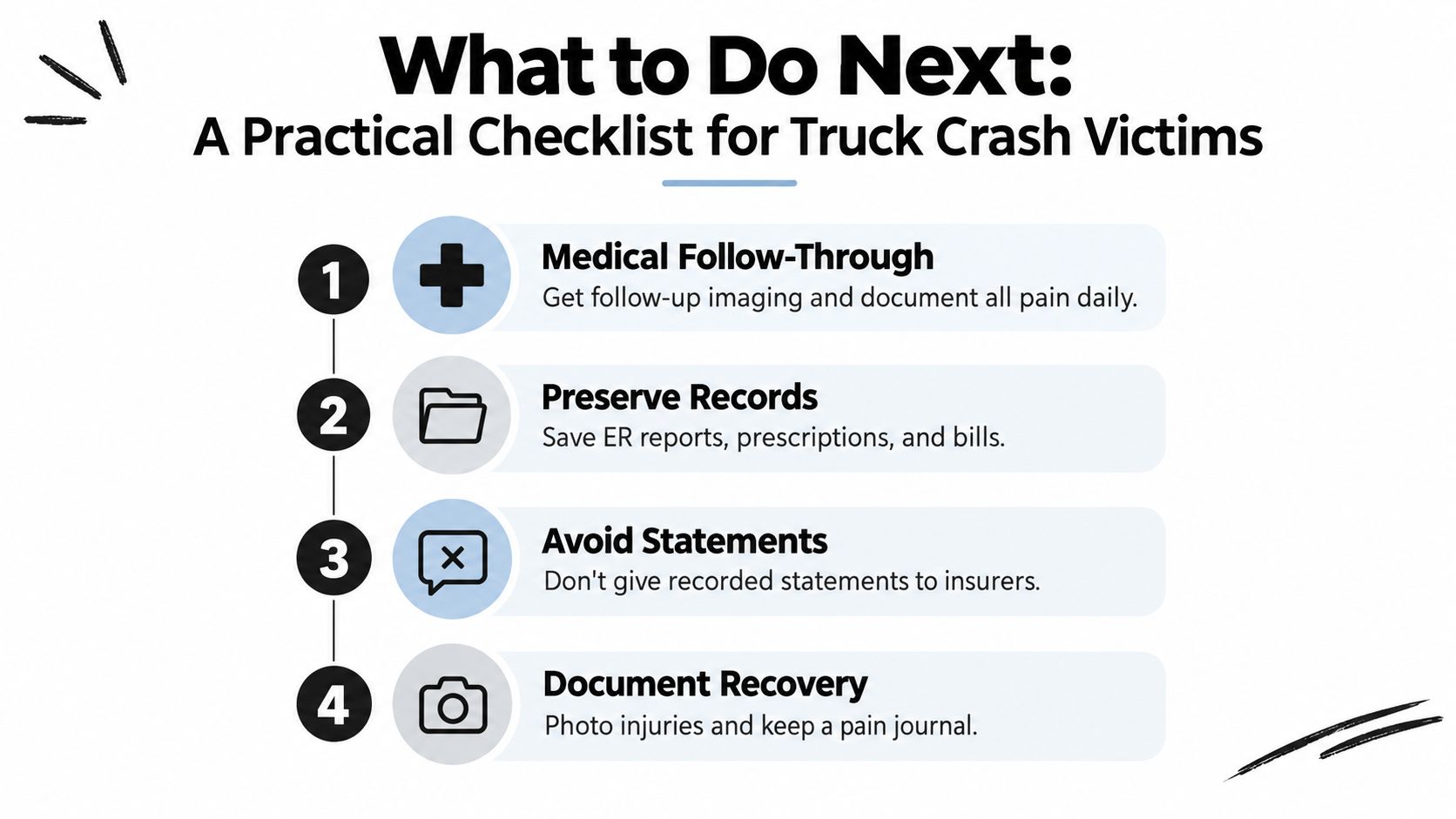
1. Follow medical instructions
Attend follow-up appointments, complete recommended imaging, and tell each provider about continuing pain, numbness, headaches, sleep problems, or restricted movement. Keep discharge papers, prescriptions, bills, work notes, therapy records, and messages sent to medical offices.
A gap in treatment gives an insurer an argument that the injury improved or wasn't related to the collision. You don't need to exaggerate symptoms, but you should document them accurately. A short daily record can include pain location, activities you couldn't perform, medication effects, and changes in sleep or work.
2. Preserve what you already have
Ask a trusted person to save photographs of the vehicle, roadside damage, debris, skid marks, asphalt gouges, truck markings, and visible DOT numbers. Preserve dashcam files, phone photographs, location data, text messages, and any video shared by witnesses. Don't edit original files, and keep copies in more than one secure location.
Your own insurer should be notified promptly as required by the policy, but stick to basic facts. Report that a collision occurred, identify the vehicles involved, and answer necessary claim questions without guessing about fault or future medical outcomes.
3. Control communications
Don't post photographs, opinions, jokes, or recovery updates on social media. Don't accept a recorded interview from the trucking company, carrier, or insurer before getting legal advice. Route substantive calls through counsel once a lawyer represents you.
The carrier's records may be governed by federal motor-carrier requirements, while the insurance company will evaluate statements under Texas claims practices. That combination makes precision important. A quick call can feel productive while creating a problem.
4. Request records and protect data
Request the crash report when it becomes available, but don't wait for the report before contacting a truck-accident lawyer. Ask whether nearby traffic-camera footage, business surveillance, or witness video exists. Preserve the original dashcam card and phone rather than relying only on a downloaded clip.
Do next: Finish medical follow-up, save every record, stop direct insurer interviews, and begin evidence preservation before the carrier's systems cycle through old data.
Who Can Be Held Liable in a Texas Truck Accident Case
The driver isn't always the only responsible party. A serious commercial collision may involve the driver, motor carrier, broker, shipper, loader, or a manufacturer, depending on what caused the wreck and what the records show.
Consider a box truck leaving The Woodlands Parkway for I-45. Lumber was loaded unevenly and secured poorly. As the trailer changes direction, the cargo shifts, the truck jackknifes, and the trailer strikes a sedan. The driver may have made a poor maneuver, but that fact doesn't answer who loaded the lumber, who accepted the shipment, who hired the driver, or who controlled the delivery schedule.
The driver and motor carrier
A driver may face liability for unsafe lane movement, distraction, fatigue, speeding, or failure to respond to a shifting load. Federal rules concerning hours of service, vehicle maintenance, driver qualification, and cargo securement can provide evidence that the conduct fell below required safety standards.
The carrier may be responsible under respondeat superior when the driver was acting within the scope of employment. A separate negligent-entrustment or negligent-hiring theory may apply if the company placed an unqualified or unsafe driver behind the wheel or ignored warning signs in its records.
Brokers, shippers, and loaders
A freight broker may become relevant when its role, contracts, selection process, or communications connect it to the unsafe transportation arrangement. The shipper or loading contractor may bear responsibility when cargo weight, distribution, or securement caused the loss of control.
Texas follows modified comparative responsibility. A claimant who is found 51% or more responsible is barred from recovering damages, while a lesser allocation of fault can reduce recovery. That rule makes early identification important. Naming every plausible responsible party can also reveal separate insurance coverage rather than forcing the claim against one carrier and one policy.
| Defendant | Legal Theory | Typical Insurance Source |
|---|---|---|
| Driver | Negligent driving, fatigue, distraction, or unsafe maneuver | Employer or driver liability coverage |
| Motor carrier | Respondeat superior, negligent hiring, entrustment, maintenance, or supervision | Commercial auto liability and excess coverage |
| Freight broker | Negligent selection, contracting, or operational involvement | Broker liability or commercial policies |
| Shipper or loader | Overloading, shifting cargo, or defective securement | Shipper, loader, or warehouse coverage |
A lawyer should investigate the carrier's federal registration, safety history, driver file, dispatch records, maintenance documents, and cargo paperwork before deciding which defendants belong in the case.
Key Evidence That Disappears Fast and How a Lawyer Locks It Down
Commercial truck cases are evidence cases. The roadway tells one part of the story, but the truck's electronic systems and the carrier's records may show what happened before the impact.
The most urgent items often include the engine control module, forward-facing and driver-facing camera footage, electronic logging device records, Qualcomm or other dispatch messages, post-crash drug and alcohol testing, weigh-station information, toll records, and pre-trip inspection documents. Each system has its own retention practices, and not every carrier preserves information automatically after a collision.
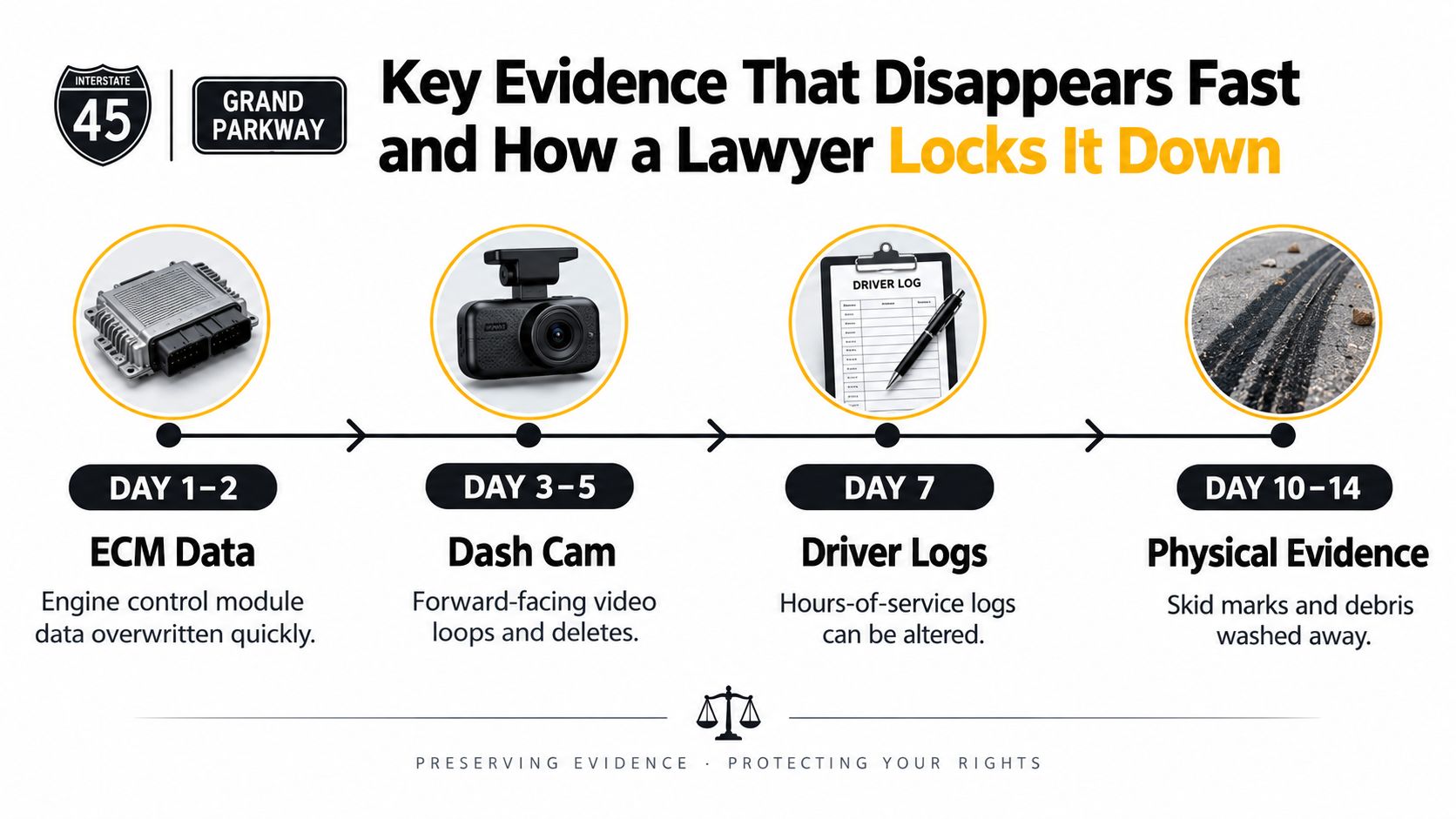
Send a preservation demand quickly
A spoliation letter tells the carrier, driver, broker, shipper, and insurers to preserve identified evidence. It should cover every relevant vehicle, trailer, camera, electronic system, log, inspection, communication, test, and cargo record. It should also identify the crash date, location, vehicles, and the types of physical evidence that must remain available.
The letter matters because routine destruction after notice can create serious litigation consequences. A carrier may not have intended to destroy evidence, but a routine overwrite can still leave the victim without the proof needed to test the company's version.
At the crash scene, investigators should document tire marks, debris fields, vehicle resting positions, road damage, sight lines, lighting, lane geometry, and nearby obstructions. Traffic-camera footage from TxDOT or nearby businesses may also matter, but those systems can roll over or become inaccessible.
Use experts before the scene changes
An accident reconstruction expert can compare vehicle damage, event data, roadway measurements, witness accounts, and photographs. A trucking-standards expert can examine whether the driver, carrier, loader, or broker followed applicable safety duties.
High driver turnover and routine fleet operations create additional pressure. Vehicles may be repaired, moved, reassigned, or inspected by people who weren't present at the crash. A Woodlands-area lawyer should move before the carrier's ordinary preservation process becomes the only record.
For another example of why early scene documentation matters in roadway claims, see this The Woodlands motorcycle accident lawyer resource. The vehicles differ, but the evidence-preservation principle is the same.
Statute of Limitations Insurance Layers and Montgomery County Filing
Texas generally gives an injured person two years from the crash date to file a personal-injury lawsuit. A wrongful-death claim also has a time limit, and waiting for treatment to end or negotiations to improve doesn't automatically stop the clock. The deadline starts with the collision, not with the day you hire a lawyer.
Exceptions can change the analysis. Claims involving a public entity may require notice within six months, and special rules can affect minors or people who lack legal capacity. Don't assume an exception applies without a lawyer reviewing the facts.
Understand the coverage structure
Commercial cases may involve more than the truck's primary liability policy. Depending on the shipment and parties involved, counsel may investigate:
| Policy Layer | Typical Limit | What It Covers |
|---|---|---|
| Primary commercial auto liability | Varies by policy and operation | Injury and property damage caused by the truck or covered driver |
| Motor-trucker cargo coverage | Varies by policy and cargo | Covered loss or damage involving transported cargo |
| Occupational accident coverage | Varies by policy | Certain covered injuries involving eligible truck workers |
| Excess or umbrella coverage | Varies by policy | Additional protection above underlying limits |
| MCS-90 endorsement | Applies in specific federally regulated situations | Public financial responsibility protection for qualifying carriers |
The dollar limits above can't be assumed in any individual case. A lawyer must obtain the policies, endorsements, contracts, and insured-party information. Cargo coverage also isn't a substitute for bodily-injury liability coverage, so the policy language matters.
Texas comparative responsibility can reduce a recovery when the injured person shares fault. That makes medical records, vehicle evidence, roadway proof, and electronic truck data important, not just the insurance declarations page.
Filing in Montgomery County
A case connected to The Woodlands may involve venue questions, jurisdiction, and local procedures in Montgomery County. The county publishes local rules for the family courts and administration of family cases, while a truck-injury lawsuit may proceed under different civil-court procedures. A lawyer should evaluate the proper court and venue rather than choosing based only on convenience.
The Montgomery County District Attorney handles criminal matters, not the civil claim for medical losses, income loss, pain, or wrongful death. Preserve the claim well before the filing deadline, especially if a public roadway or public entity may be involved.
How to Choose the Right 18 Wheeler Accident Lawyer for Your Case
Don't choose a lawyer because a billboard is familiar. Choose someone who can identify the parties, preserve electronic evidence, analyze federal trucking records, and explain how the case will be developed.
Commercial-vehicle litigation is different from an ordinary two-car claim. The lawyer should understand carrier contracts, driver qualification files, maintenance history, cargo loading, electronic logs, insurer tactics, and accident reconstruction. Local knowledge helps too, particularly when the crash involves I-45, The Woodlands Parkway, Research Forest Drive, the Grand Parkway, Conroe, or rural roads across Montgomery County.
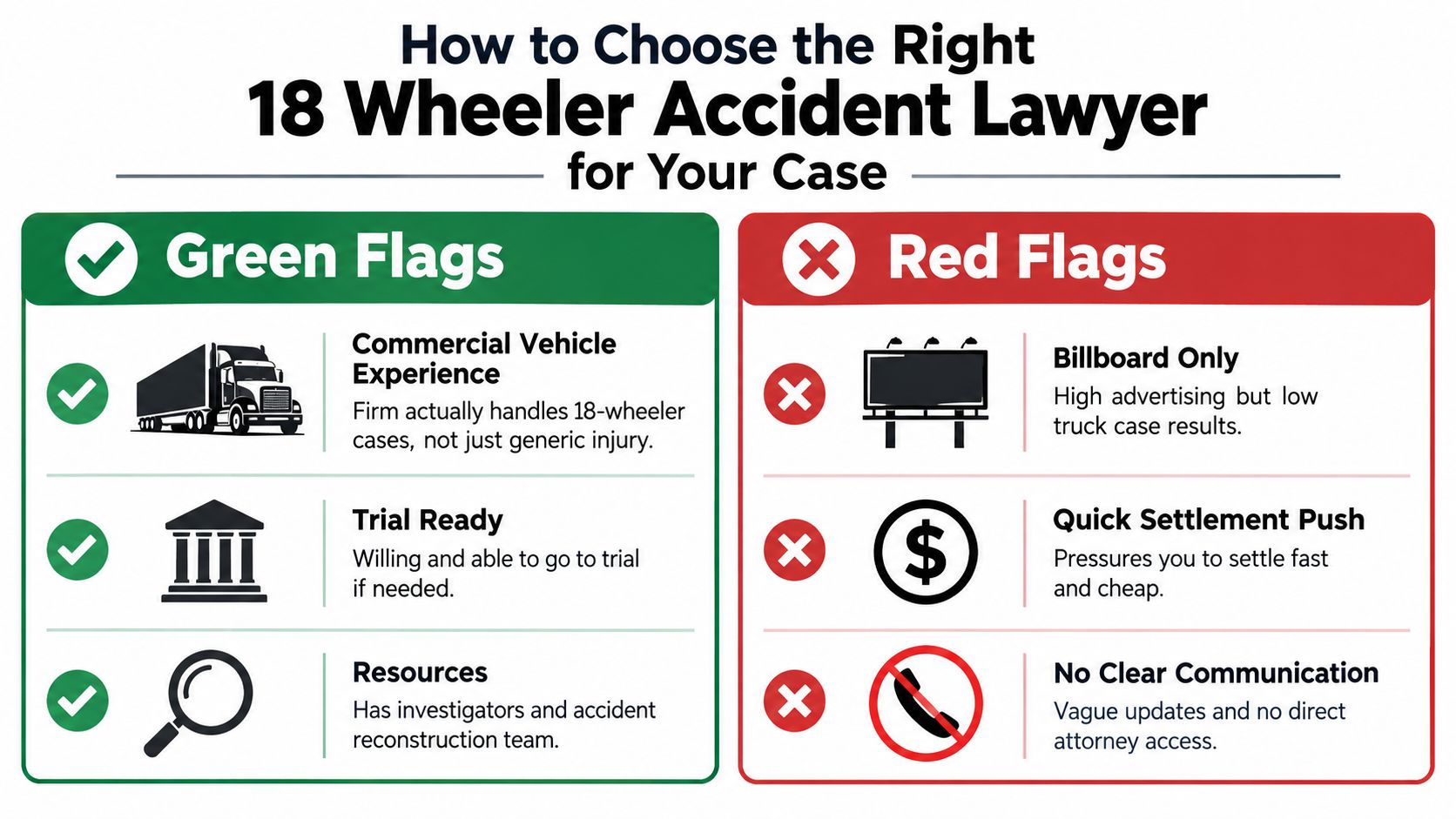
Compare qualifications, not advertising volume
| Green flags | Red flags |
|---|---|
| The firm regularly handles commercial truck cases | The firm mainly advertises generic car-wreck claims |
| The lawyer can discuss preservation letters and ECM data | The lawyer promises a dollar result before reviewing records |
| Investigators and reconstruction professionals are available | The firm has no clear plan for scene or vehicle evidence |
| The attorney has trial experience in Montgomery County or Harris County | Staff pressure you to sign before a complete intake |
| Communication expectations are explained in writing | Nobody can tell you who will actually handle the case |
Ask whether the lawyer has handled a truck case through litigation, not just whether the firm has represented injury clients. Ask who pays investigation and expert costs, how often you'll receive updates, and whether you'll speak directly with an attorney when major decisions arise.
A contingency agreement should explain the fee, expenses, case costs, and what happens if there is no recovery. A commonly quoted contingency range is 33% to 40%, but the actual agreement controls. Don't sign until you understand whether the percentage changes after filing suit and how expenses are deducted.
Before retaining anyone, interview at least two firms. You can review the State Bar of Texas attorney profile and disciplinary information, then compare the answers rather than selecting the first office that returns your call. For broader representation questions, review this personal injury lawyer resource for The Woodlands.
Working With Your Lawyer and Moving Toward Resolution
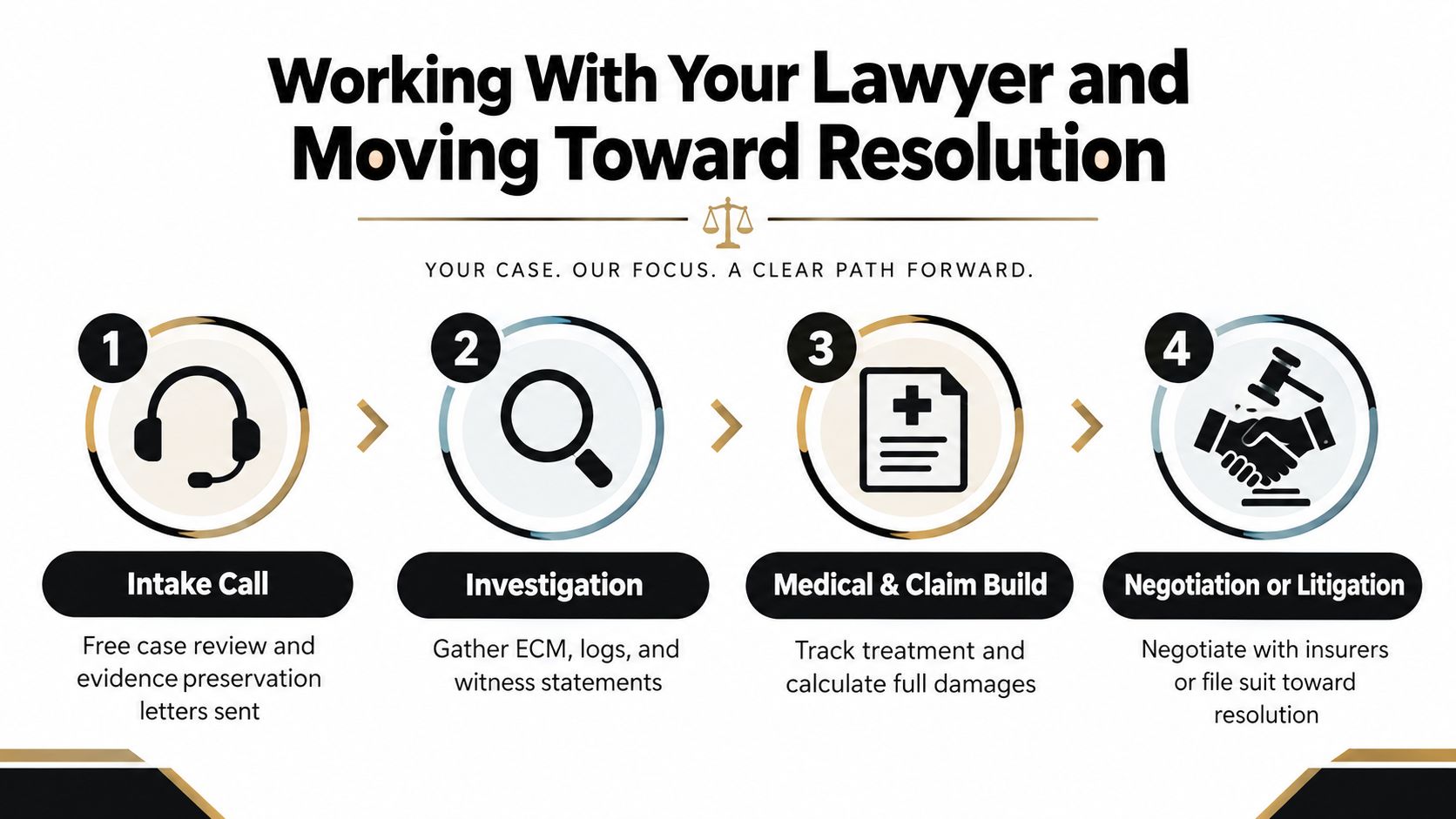
The first meeting should produce clarity, not pressure. You'll discuss the crash location, vehicles, injuries, medical care, insurance contacts, witnesses, photographs, and anything you've already signed. If the firm accepts the case, the contingency-fee agreement should explain the fee and expenses so you know what happens financially before work begins.
The investigation then moves on two tracks. Your lawyer preserves evidence and builds liability while you follow medical care. That may include sending preservation letters, obtaining the crash report, requesting records, reviewing FMCSA information, interviewing witnesses, inspecting vehicles, consulting reconstruction professionals, and analyzing medical documentation.
Your role during the claim
You don't need to become a trucking investigator. You do need to be consistent and reachable.
- Finish treatment: Follow provider instructions and report changes.
- Keep a complete file: Save bills, records, prescriptions, mileage information, work documentation, and insurer letters.
- Protect your privacy: Don't post about the crash, injuries, negotiations, or daily activities.
- Communicate changes: Tell your lawyer about new providers, missed work, insurance calls, address changes, and worsening symptoms.
If the carrier accepts responsibility early, the dispute may focus on injury extent, medical causation, and damages. If the carrier contests the driver's conduct, the road conditions, cargo loading, or your own role, the lawyer may need depositions, expert opinions, subpoenas, and formal discovery. Mediation can resolve a case without trial, but preparation still matters because the other side evaluates the strength of the proof.
Keep the final decisions informed
Your lawyer should explain settlement offers, risks, likely costs, available coverage, and the consequences of accepting or rejecting an offer. You decide whether to settle. The attorney's job is to make that decision informed by evidence instead of fear, exhaustion, or an insurer's deadline.
The short checklist is simple: finish medical care, preserve every bill and record, avoid social media, refuse recorded statements until advised, and get the trucking evidence protected promptly. This article is not legal advice. The facts of each crash, the applicable deadline, the responsible parties, and the available insurance must be reviewed individually.
The Law Office of Bryan Fagan offers consultations for people who need help understanding a serious legal problem in The Woodlands and Montgomery County, although an 18-wheeler injury claim may require a personal-injury attorney with specific commercial-trucking experience. To discuss your situation and determine the appropriate next step, visit The Law Office of Bryan Fagan.
