 Skip to content
You're driving north on I-45 near the Woodlands Parkway exit when traffic stops. The impact happens quickly. By the next morning, your neck hurts, your vehicle is damaged, medical bills are arriving, and an insurance adjuster wants your recorded statement. You're not sure whether you need a lawyer, whether the claim is a personal injury case, or whether the accident should go through workers' compensation.
Choosing a personal injury lawyer in The Woodlands, TX isn't about picking the firm with the largest directory listing. It's about identifying the correct legal pathway, protecting evidence, understanding the filing deadline, and knowing what you'll take home after fees, costs, and liens. The recommendations below are designed for residents of The Woodlands, Montgomery County, and nearby communities who want a practical way to evaluate their options.
Why Hiring the Right Injury Attorney in The Woodlands Matters
A rear-end collision can look simple from the roadside. Liability may seem obvious, but the insurance company still has questions about your symptoms, treatment, prior medical history, lost income, and whether the other driver had enough coverage. An adjuster's early call may sound friendly, but you're still discussing a claim with someone whose job is to control the insurer's payment.
A personal injury lawyer investigates the event, identifies the responsible parties, gathers medical and employment records, communicates with insurers, evaluates damages, and handles negotiations. For a Montgomery County resident, local experience can also matter when the claim turns into a lawsuit. Venue, court procedures, discovery timing, and the habits of opposing counsel affect how a case moves.
You may not need representation for every minor property-damage claim. Self-representation becomes risky when injuries require continuing treatment, fault is disputed, multiple vehicles are involved, a commercial vehicle or defective product may be involved, an employer is connected to the accident, or an insurer asks you to settle before your medical picture is clear.
Texas courts handle an enormous civil workload. The Texas Judiciary's fiscal year 2023 statistical report recorded more than 7.6 million filings, nearly 7.5 million cases disposed, and an overall 100 percent clearance rate. The same report recorded a 13 percent increase in injury-or-damage cases involving motor vehicles from the prior year. Those figures don't tell you what your individual claim is worth, but they show why timing, docket management, and case preparation matter.
The question most directories skip
The first question isn't “Which lawyer ranks highest?” It's “What kind of claim do I have?” A crash caused by another driver may be a negligence claim. An injury suffered while working may belong primarily in the workers' compensation system. A workplace accident caused by an outside contractor or equipment manufacturer may require a closer look at a third-party negligence or products-liability claim.
That classification affects deadlines, evidence, medical billing, and recoverable damages. The rest of this guide focuses on how to vet counsel, compare fee arrangements, protect your claim, and make that classification before an insurer makes it for you.
How to Search for and Vet a Personal Injury Lawyer
Start with credentials, not advertising. Search the State Bar of Texas attorney directory and confirm that the lawyer is licensed and in good standing. Review disciplinary information and make sure the lawyer's practice includes personal injury litigation, not merely occasional referrals.
Peer-review services can offer another data point. Look for the lawyer on Avvo and Martindale-Hubbell, then read the descriptions carefully. A rating alone doesn't tell you who will handle your case, whether the lawyer has tried cases, or whether the lawyer regularly appears in Montgomery County courts.
The same caution applies to client reviews. Read Google reviews and reviews on the lawyer's own website, but look for specific descriptions of communication, preparation, and case handling. A page filled with broad praise but no explanation of the client experience shouldn't decide your choice.

Use the consultation as a screening interview
Ask who will handle the claim day to day. Some firms advertise through a recognizable lawyer but assign the file to another attorney, case manager, or outside referral firm. You're entitled to a clear answer about the people responsible for investigation, medical-record collection, negotiations, and litigation.
Ask whether the lawyer regularly practices in The Woodlands and Montgomery County. Texas district courts handle most civil cases, including personal injury lawsuits, and the state has more than 400 district courts according to the discussion of Texas civil injury trends in this overview of Texas court structure and injury claims. Local familiarity doesn't guarantee an outcome, but it can help counsel handle filing decisions, scheduling, and local procedure.
Ask for the fee agreement in writing. It should explain the contingency percentage, whether the percentage changes if litigation begins, which costs are deducted, and whether expenses come out before or after the attorney's fee. Vague answers are a warning sign.
You can also compare unrelated legal needs separately. For example, Divorce Lawyer in The Woodlands, TX describes divorce representation for clients in The Woodlands and Montgomery County. That's a different practice area, so don't assume a family-law lawyer is the right choice for an injury claim. Review the firm's actual experience in the legal field your problem requires, including the family-law attorney information for The Woodlands.
Red flags worth taking seriously
- No trial background: A lawyer who never prepares cases for court may have less influence when an insurer refuses a fair offer.
- Pressure to sign immediately: You should understand the agreement before committing.
- No Montgomery County familiarity: A lawyer can be competent statewide and still be a poor fit for a local filing or scheduling problem.
- Unclear communication: You should know how updates arrive and whom to contact.
- Fee uncertainty: If the lawyer can't explain the net-recovery calculation plainly, keep interviewing.
Three non-negotiables: Confirm the lawyer's credentials, verify meaningful personal injury and local court experience, and obtain a written explanation of fees and case costs.
Consultation Questions and Contingency Fee Expectations
Use the consultation to test both the claim and the lawyer. Counsel should assess liability, damages, deadlines, insurance, and evidence. You should assess judgment, communication, relevant experience, and whether the proposed fee structure protects your net recovery.
Ask these questions directly:
- Who handles my file? Get the names and roles of the attorney, case staff, and anyone who will communicate with the insurer.
- What legal path fits the facts? Ask whether the injury points to a negligence claim, workers' compensation, a third-party claim, or an insurance dispute. A workplace injury may belong in workers' comp rather than a standard negligence case, while a claim against a separate negligent party may follow a different route.
- What evidence is missing? The lawyer should identify records, witnesses, photographs, employer documents, or vehicle evidence that could change the analysis.
- How are costs treated? Ask about filing fees, medical-record charges, expert fees, deposition expenses, investigation costs, and other case expenses.
- How will you calculate my net recovery? Request a written example showing the settlement, attorney fee, case costs, medical liens, and amount left for you.
- What changes if litigation begins? The agreement should state whether the fee increases when the case moves from pre-suit negotiation to litigation or trial.
Texas market references commonly describe contingency representation as no attorney fee if there's no recovery, but the percentage may increase as the matter advances from pre-suit settlement to litigation and trial. The Texas settlement and trial discussion identifies about 2 percent of cases reach trial as a high-level benchmark. Settlement is the usual path, yet your lawyer must be ready to prepare the case for trial if the insurer will not make a fair offer.
Compare the stages before you decide
| Case Stage | Typical Fee Range | Common Costs | Timeline Expectation |
|---|---|---|---|
| Pre-suit negotiation | The agreement may use a lower contingency percentage before litigation. Confirm the exact percentage in writing. | Medical records, investigation, lien review, correspondence, and demand preparation. | Often more direct, but treatment, records, liability review, and insurer response can still take time. |
| Litigation and trial preparation | The agreement may use a higher contingency percentage after suit is filed or as trial work begins. Confirm the trigger and calculation. | Filing fees, discovery, depositions, experts, exhibits, service, and other litigation expenses. | Usually more involved because pleadings, discovery, court scheduling, and trial preparation enter the process. |
There is no universal Texas contingency percentage. Compare the entire net-recovery calculation, not the headline percentage. A lower fee with heavy deductions can leave you with less than a higher fee paired with controlled costs and a stronger resolution.
Before authorizing litigation, require a written model based on realistic assumptions. Include attorney fees, case costs, medical balances, hospital liens, EMS liens, health-plan reimbursement claims, and other obligations. Rising litigation volume can also affect settlement timing, so ask what may delay negotiations and how the firm will keep your claim progressing.
You can review free consultation information for a Woodlands family lawyer for general consultation practices, but family-law fee structures may differ from personal injury contingency agreements.
Texas Deadlines and Montgomery County Court Realities
If you are hurt in a crash today, the first question is not how large the settlement might be. It is whether you can still file on time and whether the claim belongs in an ordinary negligence case or through workers' compensation. Under Texas Civil Practice and Remedies Code § 16.003, the standard limitations period for a Texas personal injury claim is two years from accrual, generally measured from the injury date. Missing that deadline can end the claim, even when the injuries are serious.
Have a lawyer confirm the trigger date at the start. Do not rely on memory, an insurer's estimate, or the date a bill arrived. The crash report, incident records, medical intake documents, and other records can help establish when the injury occurred. Certain situations follow different rules, which is why early review matters.
Liens can reduce the amount you receive
A settlement offer is not your net recovery. Medical treatment can create repayment obligations that remain after the insurer agrees to pay. Texas hospital liens attach only when the injured person is admitted within 72 hours of the accident. Emergency medical services liens in counties with a population of 800,000 or less also require treatment within 72 hours, according to the cited Texas lien guidance.
A bill is not automatically a lien, and a lien does not set the full value of the claim. Your lawyer should identify lien exposure early and include it in the settlement model. Subtract attorney fees, case costs, medical balances, hospital liens, EMS liens, health-plan reimbursement claims, and other obligations before deciding whether an offer is acceptable.

Court volume changes the negotiating environment
Montgomery County cases move within a busy Texas civil court system. As noted in the same Texas Judiciary report referenced above, 38 percent of more than 193,000 civil cases disposed, excluding civil cases tied to criminal matters, were dismissed by the plaintiff. The figures show that many civil disputes end before a final judgment.
That volume can affect settlement timing, scheduling, and litigation costs. Ask a personal injury lawyer in The Woodlands how the firm will prepare the venue, preserve the claim's negotiating position, handle discovery, and keep the case progressing when court dates are delayed. A properly prepared case gives the insurer a reason to take the claim seriously beyond medical bills and a demand letter.
Decide whether workers' compensation is the right route
A workplace injury may belong primarily in workers' compensation rather than an ordinary negligence claim against the employer. A separate third-party case may still exist when someone outside the employment relationship caused the injury. These routes can differ in deadlines, available damages, benefits, and medical-billing procedures.
Texas workers' compensation claim volume declined from 113,310 in 2020 to 87,713 in 2024, according to the Texas Department of Insurance workers' compensation data. The figures do not decide your case. They reinforce the practical recommendation: identify the correct claim type before evaluating settlement value or hiring counsel.
Preserving Evidence Before and After You Hire
Evidence disappears quickly after an accident. A damaged vehicle gets repaired, a business may overwrite surveillance footage, phone records become harder to obtain, and witnesses forget details. Your first job is to preserve what you can without arguing with the other driver or posting a public version of events.

Build an evidence file
- Photograph the scene: Capture vehicle positions, roadway conditions, signs, lane markings, debris, nearby businesses, and visible injuries.
- Document vehicle damage: Take close and wide photographs before repairs. Keep estimates, invoices, towing records, and storage information.
- Obtain the crash report: Request the official report and give it to the lawyer you consult.
- Save communications: Preserve texts, emails, app messages, and calls involving the other driver, witnesses, employer, or insurer.
- Record witness details: Write down names, phone numbers, and what each witness personally observed.
- Request medical records promptly: Keep appointment information, discharge paperwork, prescriptions, bills, referrals, and work restrictions together.
- Avoid social media posts: Don't post photographs, opinions, check-ins, treatment commentary, or statements about fault.
You don't need to prove the entire case from your phone. You do need to preserve the raw material that lets counsel investigate. A short written timeline can help, including what happened, when symptoms began, which providers you visited, and how the injury affected work and ordinary activities.
For practical background on organizing documents for legal use, see this guide on how to present evidence in court. The same discipline helps before a lawsuit, because organized records make it easier to identify gaps and inconsistencies.
Separate negligence evidence from workers' compensation evidence
For a roadway crash caused by another driver, prioritize the crash report, photographs, vehicle data, witness accounts, traffic-camera or business footage, insurance information, and medical records. If a vehicle defect may have caused the collision, preserve the vehicle and damaged parts before repairs or disposal.
For a workplace injury, preserve safety instructions, incident reports, schedules, training records, supervisor communications, photographs of the work area, equipment information, and the names of people who saw what happened. Don't assume your employer's report captures every relevant fact.
The strongest practical tip is simple: don't repair, discard, delete, or publicly explain important evidence before a lawyer reviews it. Save the original files, keep backup copies, and tell counsel what may disappear.
What Happens After You Hire and What to Do Next
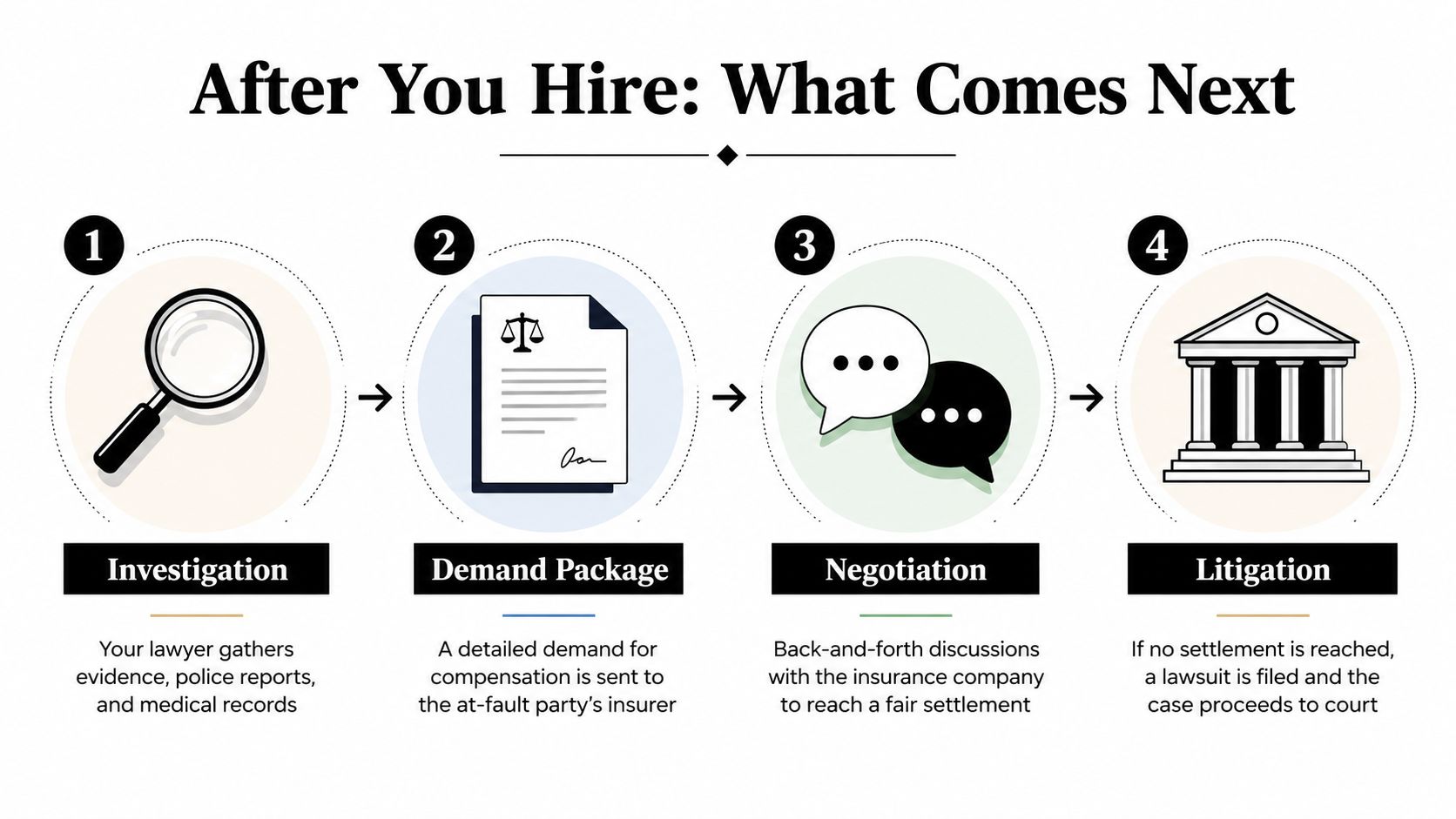
You sign the representation agreement after a rear-end crash near a busy I-45 interchange. Your lawyer should not send a demand immediately. First, counsel confirms whether the facts support a negligence claim, a workers' compensation route, a third-party claim, or an insurance dispute. That classification affects the deadline, evidence, available benefits, and who may be responsible.
The lawyer then reviews the crash report, photographs, witness information, vehicle records, medical records, employment documents, and communications with the insurer. Counsel confirms the limitations date, tracks treatment, requests missing records, checks liens and medical balances, and tells you how to handle adjuster contact. Do not give a recorded statement without understanding how it may affect the claim.
After the medical picture and evidence are developed, counsel may prepare a demand package. It usually explains liability, treatment, damages, supporting records, and the amount sought. The insurer may ask questions, make a counteroffer, or deny responsibility. Negotiations continue until the parties reach an acceptable resolution or your lawyer recommends filing suit.
A short example
The driver's records show work restrictions and a clear treatment timeline, but the insurer argues that the symptoms are unrelated to the collision. Counsel addresses that position with medical records, provider opinions, and evidence about the crash. The client then compares the offer with the projected result of litigation.
That comparison must use net recovery, not the headline settlement amount. Review the contingency fee, case costs, liens, medical balances, and any expenses that will be deducted. A larger gross settlement can produce less money in hand if fees and outstanding bills consume more of it.
A lawsuit does not guarantee a better result. It can create pressure and provide formal discovery, but it also adds expense, delay, and uncertainty. As noted earlier, only about 2 percent of cases reach trial. That trial-rate figure supports a practical recommendation: judge the offer against the evidence, projected net recovery, timing, and litigation risk rather than assuming trial is automatically stronger.
Rising litigation volume can also affect settlement timing. Insurers and courts may take longer to process files, schedule events, and respond to lawsuits. Ask counsel what delays are likely in your case and whether continued negotiation makes financial sense.
What to do next
- Get medical care: Follow provider instructions and keep every record.
- Preserve evidence: Save photographs, communications, original files, and witness details.
- Avoid recorded statements: Ask the insurer to communicate through counsel.
- Confirm the deadline: Have a lawyer verify the accrual date and filing requirements.
- Classify the claim: Decide whether it involves negligence, workers' compensation, a third-party claim, or an insurance dispute.
- Model net recovery: Review fees, costs, liens, medical balances, and the amount you would receive.
- Prepare for the consultation: Bring the crash report, photographs, medical records, insurance information, and a written timeline.
Texas statutes govern different legal systems. The Texas Estates Code addresses matters such as independent administration, while the Texas Family Code governs issues such as child-support guidelines. Those laws do not control an injury claim. The point is practical: choose counsel who works in the legal system that fits your facts.
This article provides general information, not legal advice. It does not create an attorney-client relationship and cannot determine your deadline, legal pathway, damages, or potential recovery. Those questions require review of your individual facts and documents.
The Law Office of Bryan Fagan focuses primarily on family law and probate matters for clients in The Woodlands and Montgomery County, so it may not fit every personal injury claim. Visit The Law Office of Bryan Fagan to schedule a consultation about your legal needs and discuss the appropriate next step.
