 Skip to content

A Conroe ISD boundary change doesn't change your custody or possession order. The order already in your file controls who picks up your child, when, and who decides where the child goes to school, and it keeps controlling those things until a judge modifies it or both parents agree in writing.
The most repeated advice in Woodlands parent groups is to pull up the new zone map, see where your address lands, and act on it. That's backwards. A zoning map is a district planning document, not a parenting plan, and treating it as permission is how a parent with a solid legal position ends up on the wrong side of a motion.
Scale is part of why this gets messy. Conroe ISD reported 72,352 students and 71 schools for the 2023–2024 school year, according to the Conroe Independent School District overview, so a single boundary revision can touch thousands of families at once while each family's court order stays exactly where it was.
Whether a School Boundary Changes Your Custody Order
Two systems run in parallel, and they don't talk to each other. School assignment follows the CISD attendance zone and the district's residency rules. Possession, exchanges and decision-making come from your order under Texas Family Code Chapter 153. A rezoning moves the first system. It does nothing to the second.
Why joint conservatorship doesn't mean equal say
Texas built this framework deliberately. The Legislature replaced the older "custodian" language in Title II of the Family Code with "conservator" and "possessory conservator" in 1973, adopted a policy favoring frequent and continuing contact with fit parents in 1987 while allowing joint managing conservators without equal or nearly equal possession periods, and added the 1995 rebuttable presumption favoring appointment of both parents as joint managing conservators, subject to exceptions such as family violence, as traced in the Texas courts' history of conservatorship law.
The practical consequence: being named joint managing conservators doesn't entitle either parent to half the overnights or to a veto over schooling. A judge can split educational authority and possession differently to keep a child in one campus.
| Question | Controlled by | Check first |
|---|---|---|
| Which campus my child attends | CISD attendance zone and residency rules | Attendance zone map and enrollment confirmation |
| Who picks up the child and when | Possession terms in the court order | Final or temporary order and possession schedule |
| Who makes medical and school decisions | Conservatorship terms in the order | Rights and duties section of the order |
| Whether a rezoning changes my order | Not automatically, separate systems | Order language plus CISD Board action |
| Who makes the final boundary decision | CISD Board of Trustees after the Attendance Boundary Committee | Board decision and published zoning scenario |
Say two parents in The Woodlands read a new feeder map as a green light and re-enroll their child at the newly zoned campus over the other parent's objection. The map may well be correct about the address. The exchanges still follow the old schedule, the education decision may belong to one parent alone, and the school change itself becomes the subject of a motion.
District paperwork doesn't fill the gap either. CISD's enrollment and transfer guidance explains that students generally attend the school to which they're zoned and that address changes require proof of residency, and the district approved new Grand Oaks feeder boundaries for 2026–27 after a committee process and a 7–0 trustee vote. None of that language amends a possession order.
A boundary line tells the district where to seat a child. It doesn't tell either parent what they're allowed to do.
Read the order before you withdraw, re-enroll or shift an exchange location, and check any geographic restriction in your Montgomery County custody order before a move enters the picture.
How to Prove Where Your Child Really Lives
Residency fights are won on paper, not on assertions. The workflow below keeps school eligibility separate from family-court possession rights, which is the distinction that trips up most parents.
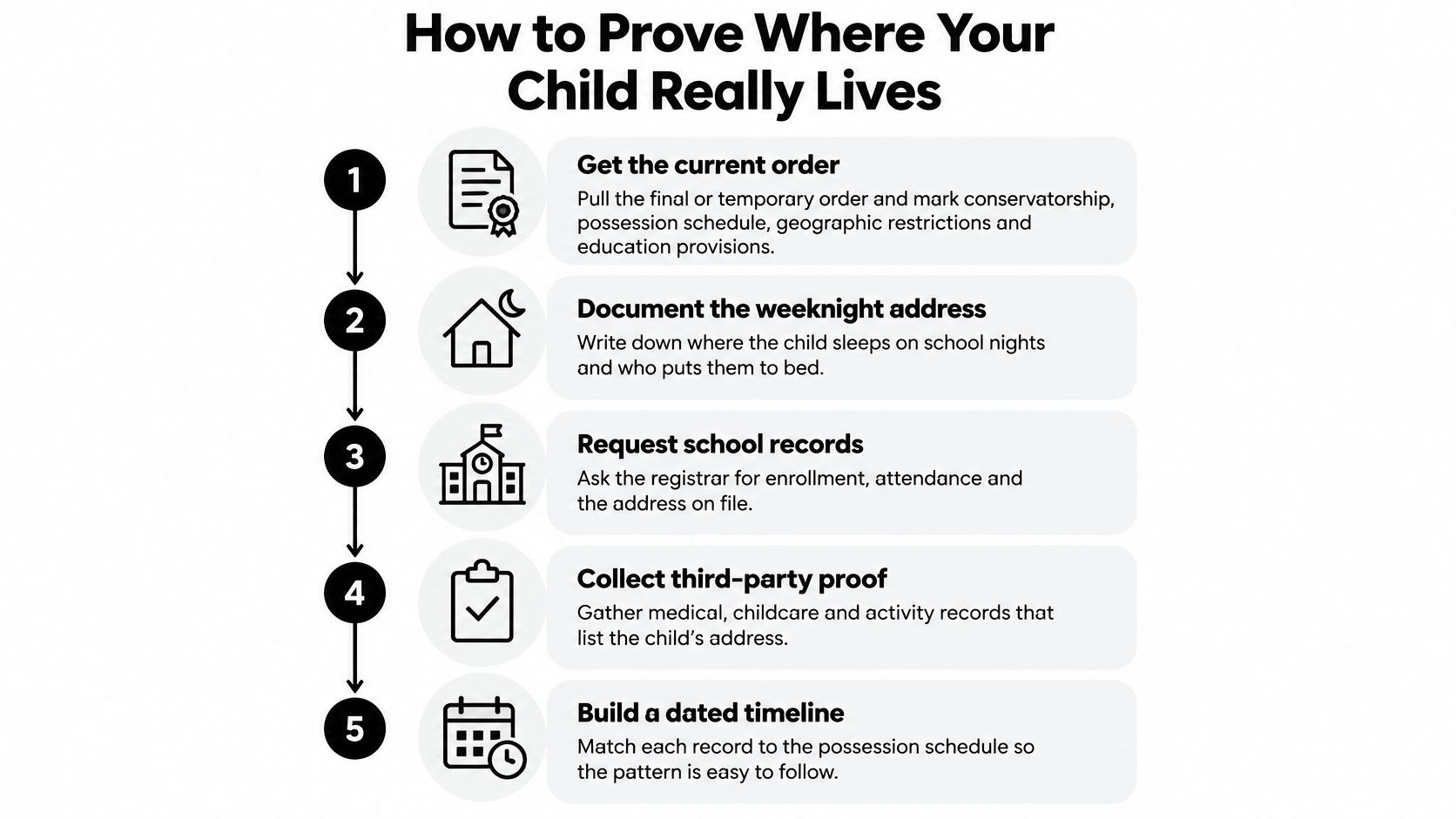
- Pull the current order. Get the operative final or temporary order and mark the conservatorship terms, possession schedule, geographic restriction and any education provisions. An unsigned draft or a superseded decree is the single most common document failure, so confirm the judge's signature and the file date before you rely on it.
- Compare the weeknight address to the zone map. Write down where the child sleeps on school nights, then check that address against the CISD attendance zone. A possession order says which parent may retain the child at a given hour; it doesn't automatically make that parent's home the qualifying school residence.
- Assemble objective residency proof. Lease or deed, utility records, driver-license address and prior enrollment records. CISD's published enrollment materials require proof of legal responsibility, court orders affecting the child, identity documentation and proof of residency, and they state that students generally enroll in the zone where they reside, per the CISD elementary handbook. A mailing address alone won't carry this.
- Give the district the order and the documents. School officials should have copies of applicable orders, and release procedures follow the parent who has possession under the order at that time. Handing over a clean, complete packet also stops the front office from guessing which parent to call.
- Ask for a written residency determination. Request the determination or an administrative review before you file anything. A written answer from the registrar is cheaper than a hearing and often resolves the dispute outright.
The overnight calendar is your best exhibit
The district's residency application asks where the student spends weeknights, when that arrangement began, and why the student lives apart from the parent or guardian. That's a request for a timeline, so build one.
Keep a dated calendar of overnights in a single spreadsheet or notebook, one row per night, with the address and the parent. Save it alongside contemporaneous records: rideshare and gas receipts, school pickup logs, childcare sign-in sheets, and the text messages arranging each exchange. Back it up monthly.
Practical rule: if a record wasn't created at the time, it's an argument. If it was, it's evidence.
Two more traps worth naming. Don't treat a temporary visitation address as a primary residence, and don't change enrollment without documenting the order that authorizes it. Strong evidence for a Texas child custody case is usually boring, dated and third-party generated.
Apply one test today: could a neutral registrar verify your child's address from the paper alone, without hearing either parent's version? If not, fix the file before you fix the schedule.
What to Do When a Rezoning Hits Your Family
A districtwide rezoning and an individual enrollment problem are different disputes with different remedies. Start with the Board's action, not the draft scenario circulating in a neighborhood group.

Work the district track in this order:
- Find the proposal and the decision. CISD's attendance boundary process describes an Attendance Boundary Committee that develops and presents zoning scenarios for community feedback, with the Board of Trustees making the final boundary decision. Save both the scenario and the Board action.
- Map your address twice. Compare the zone your address falls in under the approved map with the campus your child attends now. Screenshot each version with the date visible.
- Quantify the burden. Drive the new route at 7:15 a.m. on a school day and time it. Note sibling placement, capacity language in the district's materials, and which parent absorbs the added miles.
- Comment during the feedback window. Submit written comments while the period is open and keep dated copies. Capacity and facility utilization are planning considerations, so a family-specific hardship needs its own documented record rather than a general objection to the neighborhood's assignment.
- Keep the enrollment request separate. Any individual transfer or residency question runs through the campus registrar, not through the boundary process.
Dates to put on your calendar now
CISD's student transfer portal lists May 1 as the transfer request deadline in that process, and it notes that intradistrict transfer requests may be required to remain at a prior campus. Families planning a move within 90 days may need an intradistrict application, and families who've already moved within the district should update the Family Portal and give proof of residency to the registrar.
That's the quiet way parents lose ground. You can hold the stronger custody position and still lose the practical option because the transfer window closed while the parents argued about who was allowed to submit the form. Decide who signs, in writing, well before the date.
A Board-approved boundary is not a possession order. Challenging it as though it were one wastes the filing and the fee.
Changing Schools While a Custody Case Is Pending
Montgomery County restricts school changes while your case is open. The county's standing order generally prohibits a party from disrupting or withdrawing a child from the school or day-care facility where the child is presently enrolled unless both parents provide written agreement or the court enters an order, with an exception when a parent changes the child's residence under rights granted by an active prior court order, according to the Montgomery County standing order.
Those restrictions apply before any final judgment. The Texas Courts local rules system separately identifies local rules of practice for Montgomery County family courts, local rules for administration of family cases, and the county's Second Amended Standing Order Regarding Children, Pets, Property and Conduct of the Parties. Parents in The Woodlands, Conroe, Magnolia and Montgomery should read the current versions plus the specific language in their own case file.
| Situation | Consent or order needed? | First path |
|---|---|---|
| Withdrawing from current campus while case is pending | Yes, written agreement from both parents or a court order | Get written consent or request temporary relief |
| Parent changes residence under rights in an active prior order | Exception may apply | Keep the order and dated proof of residence, and confirm before enrolling |
| Child rezoned into a new attendance zone, order unchanged | Not automatic | Request clarification or modification |
| Safety concern or other parent unreachable | Court relief needed | Seek an emergency temporary order |
| Transfer request to remain at prior campus | District deadline applies (May 1 in the cited CISD process) | Submit the CISD transfer request before the deadline |
Getting relief when consent isn't coming
If the other parent refuses and the child's safety or stability is at risk, ask the court that issued the order for a temporary order under Texas Family Code Chapter 105. State the urgency with sworn facts: dates, addresses, missed pickups, the specific harm. Vague alarm doesn't move a docket.
Jurisdiction usually stays with the court that rendered the original order under Chapter 155, so a parent who has moved should confirm which court holds the case before filing anything new in another county. For background on how family cases proceed in the courts serving The Woodlands, see Montgomery County Family Courts: A Local Guide.
Enrolling a child at a new address doesn't resolve a dispute. It creates a second one.
Review the order, get written consent where it's required, or get relief first.
Modifying or Enforcing an Order After a Boundary Change
Pick the right remedy before you draft anything. Modification under Texas Family Code Chapter 156 asks the court to change terms because circumstances have materially and substantially changed, for example a new campus that makes the current exchange schedule unworkable. Enforcement under Chapter 157 asks the court to make the other parent obey terms that already apply. Filing the wrong one is a common and expensive mistake.
A boundary shift by itself rarely justifies changing custody. The petition has to connect the school change to the child's best interest, transportation feasibility, attendance reliability, any special educational needs, and each parent's ability to exercise court-ordered possession. Judges respond to a schedule that no longer functions. A preference for a different campus carries no weight on its own.
The Timber Mill problem, worked through
CISD reported that its Attendance Boundary Committee reviewed scenarios for the Timber Mill feeder pattern in preparation for campuses planned to open in the coming years, and that the Board of Trustees approved the final proposal on July 15, 2025, according to the district's Timber Mill feeder zoning process page. The district's process also preserves capacity for future growth rather than assigning every nearby neighborhood to the closest school.
Now apply that to a parenting plan. Consider a Panther Creek family whose decree was written around exchanges at a specific elementary campus, with the child's route running past one parent's home. After the revision, that campus is no longer on the child's route, and the exchange point sits twenty minutes off the new morning run for both households.
The fix isn't to argue about the map. It's to file for a targeted change to the exchange location and the transportation allocation, leaving conservatorship alone. That's a narrower request, it's easier to prove, and it's far more likely to be granted than a bid to flip primary residence. Our custody modification in The Woodlands work covers modifying existing custody, visitation and support orders in Montgomery County.
If instead the other parent stopped honoring Thursday possession after the rezoning, that's enforcement. The order didn't stop applying because the district redrew a line.
The evidence burden differs sharply between the two paths. A modification case needs proof that circumstances changed materially since the order was signed, so the rezoning letter, the new route times and the failed exchange attempts all matter. An enforcement case needs proof of what the order says and exactly how it was violated: dates, times, the language of the possession provision. Parents who blend the two end up proving neither.
Preserve everything as it arrives: the district maps, enrollment letters, registrar emails and the messages where the other parent refused a change. A plan that names a campus can break. A plan that assigns educational decision-making authority and a method for resolving school disputes gives you a mechanism instead of a crisis.
Negotiating School Schedules Without Going to Court
Put every school-related agreement in writing. That single habit prevents more conflict than any motion I could file. Name which parent signs transfer forms, who manages the Family Portal login, and how school notices get shared, whether that's a shared folder or an automatic forward of every campus email.
Agree on the exchange point next. Campus pickup at dismissal is usually the cleanest option because it removes a drive from one parent's day, but only if the route works. Build in real travel time to the new zone rather than the distance you remember from three years ago.
Keep a shared log of school notices, late pickups and schedule changes. A neutral record shortens arguments because neither parent has to reconstruct the month from memory.
- Name a mediator early. If the other parent stonewalls on the transfer form, propose mediation before the deadline instead of after it. A mediation outcome only becomes enforceable when it's reduced to a signed agreement, so don't leave the room with a handshake.
- Match the schedule to each home's route. A parent in Alden Bridge or Sterling Ridge may face a very different morning run than one in Panther Creek, and a schedule that ignores that will fail by October. Reviewing a Texas custody schedule example helps you see which provisions carry the transportation load.
- Don't improvise around the order. Informal swaps are fine when the order allows them. Withdrawing a child or moving the residence without written consent or a court order isn't a swap, it's a violation.
Write it down while everyone's calm. You'll need it when nobody is.
The trade-off is real: a written agreement takes an afternoon and feels unnecessary right up until the week it saves you a hearing.
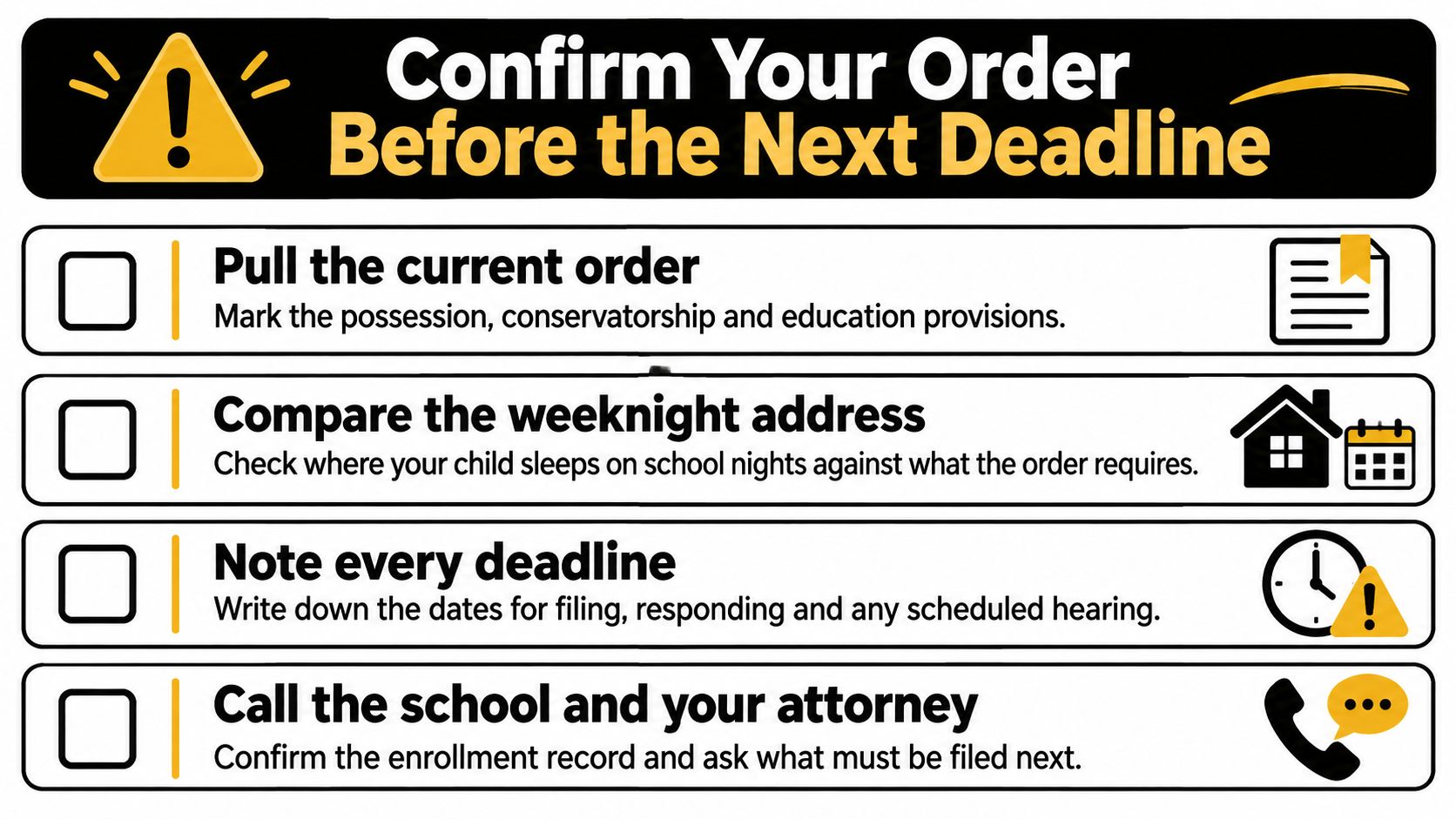
Confirm Your Order Before the Next Deadline
What to do next
- Pull the current final or temporary order and mark the possession, conservatorship and education provisions.
- Compare your child's weeknight address with the CISD attendance-zone map.
- Gather the residency documents and a dated overnight calendar.
- Check the next district deadline, including any transfer request and the Family Portal update.
- Don't withdraw or re-enroll the child until the order allows it or the other parent agrees in writing.
- Contact a family law attorney if the order is unclear, the other parent objects, or a deadline is close.
The pattern in a Conroe ISD boundary custody dispute in Montgomery County is consistent: the parent who reads the order and calendars the district dates keeps their options, and the parent who acts on the map first spends the next six months undoing it.
This article is general information, not legal advice. Every case turns on its own order, its own facts and the current county rules, and no article can substitute for review of your actual decree.
If your order is ambiguous about schooling, or a transfer window is closing while your co-parent won't respond, schedule a free consultation by calling (281) 819-1726 or filling out our online contact form. Our office is at 25211 Grogans Mills Rd, Suite 275, The Woodlands, TX 77380.
The Law Office of Bryan Fagan reviews custody and possession orders for families in The Woodlands, Panther Creek, Alden Bridge and Sterling Ridge, and handles the modification and enforcement filings that a Conroe ISD boundary change can make necessary. Bring your current order, the district's zoning notice and any transfer deadline you're facing, and we'll tell you which system controls your next step. Visit The Law Office of Bryan Fagan to request a consultation before the next deadline passes.
